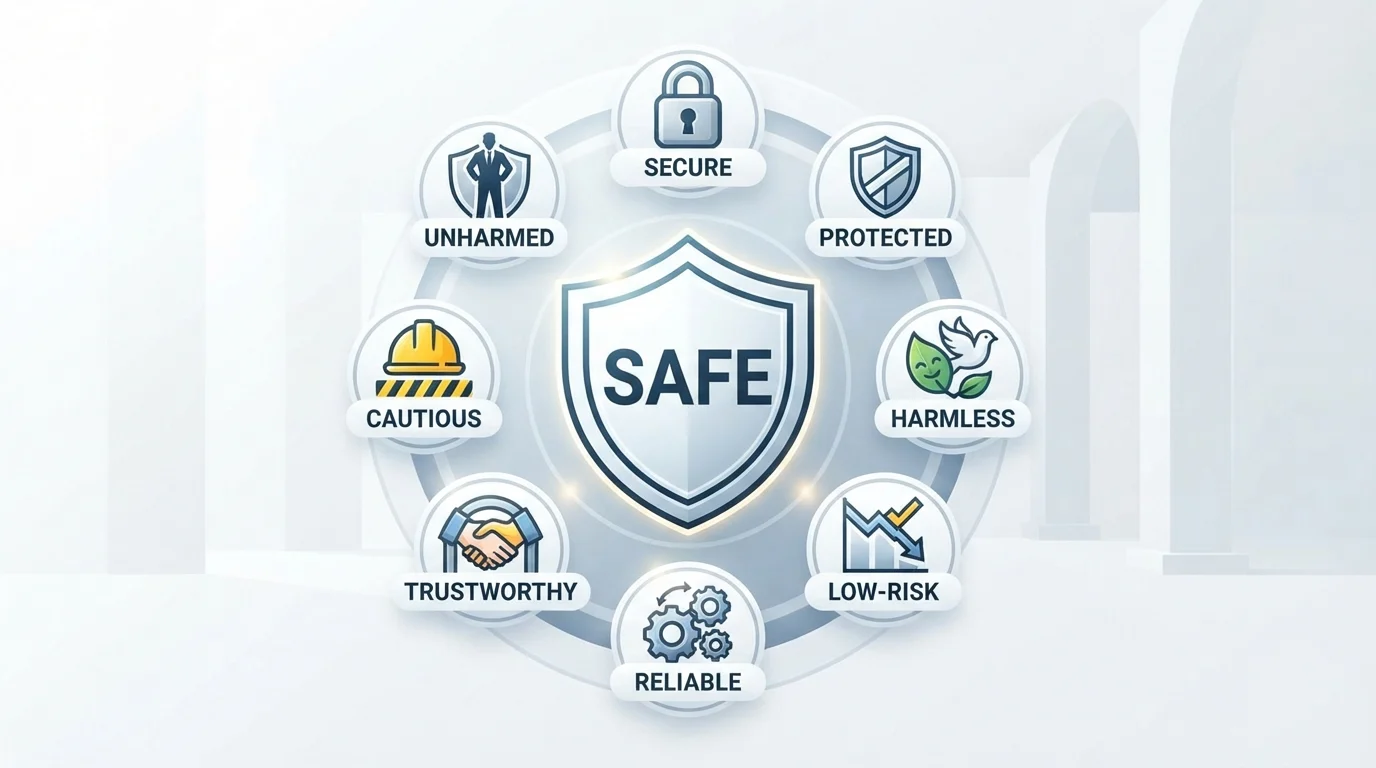
Not every situation calls for the simple word “safe.” A place can be safe because it is secure, a product can be safe because it is harmless, and a person can feel safe because they are reliable and trustworthy. Choosing the right synonyms for safe can therefore make your English clearer and more precise.
Safe generally means protected from harm, danger, injury, or loss. Depending on the context, useful alternatives include secure, protected, harmless, guarded, sheltered, risk-free, sound, reliable, and out of danger. But these words are not always interchangeable. Secure often emphasizes protection or stability, harmless means unlikely to cause harm, while reliable describes someone or something you can depend on.
Whether you need other words for safe for an essay, email, conversation, school assignment, professional writing, or everyday English, the best choice depends on what you actually mean. This guide covers useful synonyms for safe, their simple meanings, and natural examples, so you can choose the right word for the right context instead of using the same word every time.
Secure
Meaning: Secure means protected from danger, loss, or unwanted access.
Examples:
- Keep your passport in a secure place.
- The children felt secure at home.
Protected
Meaning: Protected means kept safe from harm, danger, or damage.
Examples:
- The plants are protected from the cold.
- Wear a helmet to keep your head protected.
Sheltered
Meaning: Sheltered means protected from bad weather, danger, or harm.
Examples:
- We stayed sheltered from the heavy rain.
- The birds found a sheltered spot under the roof.
Guarded
Meaning: Guarded means watched carefully to prevent danger or unwanted access.
Examples:
- The museum entrance is heavily guarded.
- A guard watched the guarded gate.
Defended
Meaning: Defended means protected from an attack, threat, or harmful action.
Examples:
- The soldiers defended the town.
- She defended her brother from the bully.
Shielded
Meaning: Shielded means protected from something harmful or dangerous.
Examples:
- The wall shielded us from the strong wind.
- Sunglasses shield your eyes from bright sunlight.
Fortified
Meaning: Fortified means strongly protected against attack or damage.
Examples:
- The old castle was heavily fortified.
- The building has fortified doors.
Impregnable
Meaning: Impregnable means so strongly protected that it is very difficult to attack or enter.
Examples:
- The fortress was almost impregnable.
- The castle stood behind impregnable walls.
Harmless
Meaning: Harmless means not likely to hurt people or cause damage.
Examples:
- The little spider is harmless.
- His comment was harmless and caused no trouble.
Innocuous
Meaning: Innocuous means harmless and unlikely to cause trouble.
Examples:
- She asked an innocuous question.
- The message looked innocuous at first.
Benign
Meaning: Benign means not harmful or dangerous.
Examples:
- The doctor said the growth was benign.
- The dog had a calm and benign nature.
Nonhazardous
Meaning: Nonhazardous means not dangerous or harmful.
Examples:
- The product uses nonhazardous materials.
- Workers must dispose of nonhazardous waste properly.
Nonthreatening
Meaning: Nonthreatening means not likely to cause fear, harm, or danger.
Examples:
- The animal looked large but nonthreatening.
- He spoke in a calm, nonthreatening way.
Risk-Free
Meaning: Risk-free means involving no expected danger, loss, or harm.
Examples:
- No investment is completely risk-free.
- The activity is designed to be as risk-free as possible.
Low-Risk
Meaning: Low-risk means having only a small chance of danger, loss, or harm.
Examples:
- Walking during the day is a low-risk activity.
- The doctor recommended a low-risk procedure.
Riskless
Meaning: Riskless means involving no risk or danger.
Examples:
- No financial decision is completely riskless.
- The plan looked simple and almost riskless.
Out of Danger
Meaning: Out of danger means no longer facing serious or immediate harm.
Examples:
- The patient is now out of danger.
- Everyone was moved to a place out of danger.
Out of Harm’s Way
Meaning: Out of harm’s way means away from a place or situation where harm may happen.
Examples:
- Move the children out of harm’s way.
- We moved the car out of harm’s way.
Free from Harm
Meaning: Free from harm means not injured, damaged, or exposed to harmful conditions.
Examples:
- Every child deserves to grow up free from harm.
- The animals were moved to a place free from harm.
Free from Danger
Meaning: Free from danger means not exposed to a harmful or dangerous situation.
Examples:
- Wait here until the area is free from danger.
- The hikers finally reached a place free from danger.
Unharmed
Meaning: Unharmed means not injured or damaged after a dangerous event.
Examples:
- Everyone escaped the fire unharmed.
- The puppy was found unharmed after the storm.
Unhurt
Meaning: Unhurt means not physically injured.
Examples:
- She walked away from the accident unhurt.
- The driver was tired but unhurt.
Uninjured
Meaning: Uninjured means not physically hurt.
Examples:
- The child was found uninjured.
- Both players left the field uninjured.
Unscathed
Meaning: Unscathed means not hurt or damaged after a difficult event.
Examples:
- He came out of the crash unscathed.
- The house survived the storm almost unscathed.
Synonyms of That: Find the Right Alternative for Each Use
Undamaged
Meaning: Undamaged means not harmed or broken.
Examples:
- The package arrived undamaged.
- Most of the furniture remained undamaged.
Intact
Meaning: Intact means still complete and not damaged.
Examples:
- The old painting remained intact.
- The box arrived with everything intact.
Unbroken
Meaning: Unbroken means not cracked, broken, or damaged.
Examples:
- The glass was still unbroken after the move.
- We were happy to find the vase unbroken.
Whole
Meaning: Whole means complete and not broken or damaged.
Examples:
- The package arrived whole and dry.
- The vase was still whole after the trip.
Safe and Sound
Meaning: Safe and sound means completely safe and without injury or damage.
Examples:
- The children came home safe and sound.
- We were glad to see everyone safe and sound.
All Right
Meaning: All right can mean safe, unharmed, or free from serious trouble.
Examples:
- Don’t worry; I’m all right.
- The driver was shaken but all right.
Okay
Meaning: Okay can mean safe, unharmed, or not in danger in informal English.
Examples:
- Are you okay after the fall?
- Everyone is okay now.
Unexposed
Meaning: Unexposed means not left open to danger, harm, or harmful conditions.
Examples:
- Keep the wires covered and unexposed.
- The plants stayed unexposed to the cold wind.
Unassailed
Meaning: Unassailed means not attacked, harmed, or challenged.
Examples:
- The village remained unassailed during the conflict.
- The old building stood unassailed for many years.
Unmolested
Meaning: Unmolested means left without being harmed, disturbed, or attacked.
Examples:
- The animals were left unmolested in the forest.
- The property remained unmolested overnight.
Reliable
Meaning: Reliable means dependable and unlikely to fail or cause problems.
Examples:
- We need a reliable car for long trips.
- She is a reliable person to call in an emergency.
Dependable
Meaning: Dependable means someone or something you can trust to work well or do what is expected.
Examples:
- My brother is very dependable.
- We need a dependable driver for the trip.
Trustworthy
Meaning: Trustworthy means deserving trust and unlikely to deceive you.
Examples:
- She is a trustworthy friend.
- Choose a trustworthy person to handle your money.
Sure
Meaning: Sure can mean reliable or certain when something is considered a safe choice.
Examples:
- This is a sure way to avoid delays.
- He wanted a sure answer before making the decision.
Sound
Meaning: Sound can mean safe, strong, healthy, or in good condition.
Examples:
- The bridge is still structurally sound.
- The plan is based on sound reasoning.
Stable
Meaning: Stable means unlikely to suddenly fail, change, or become dangerous.
Examples:
- Make sure the ladder is stable before climbing.
- The patient is now stable.
Steady
Meaning: Steady means firm, controlled, and unlikely to move or change suddenly.
Examples:
- Keep the camera steady.
- The boat stayed steady in calm water.
Cautious
Meaning: Cautious means careful because you want to avoid danger or mistakes.
Examples:
- Be cautious when crossing the busy road.
- She was cautious about sharing personal information.
Wary
Meaning: Wary means careful because you think there may be danger or trouble.
Examples:
- The dog was wary of strangers.
- Be wary of emails asking for your password.
Vigilant
Meaning: Vigilant means watching carefully for possible danger or problems.
Examples:
- The security team remained vigilant all night.
- Stay vigilant when walking near busy traffic.
Alert
Meaning: Alert means ready to notice and respond to danger.
Examples:
- Stay alert while driving.
- The guard remained alert throughout the night.
Prudent
Meaning: Prudent means making a careful choice that avoids unnecessary risk.
Examples:
- Saving some money is a prudent decision.
- It is prudent to check the weather before hiking.
Sensible
Meaning: Sensible means showing good judgment and avoiding unnecessary danger.
Examples:
- Wearing a helmet is a sensible choice.
- She made a sensible plan for the journey.
Conservative
Meaning: Conservative can mean avoiding unnecessary risk or choosing a safer option.
Examples:
- He took a conservative approach to the investment.
- The doctor suggested a conservative treatment plan.
Tried and True
Meaning: Tried and true describes something proven to work well and be dependable.
Examples:
- This is a tried-and-true recipe.
- She used a tried-and-true study method.
Foolproof
Meaning: Foolproof means designed to be very easy to use correctly and unlikely to fail because of a mistake.
Examples:
- The instructions are simple and almost foolproof.
- We need a foolproof way to organize the files.
Fail-Safe
Meaning: Fail-safe means designed to prevent serious harm if something goes wrong.
Examples:
- The machine has a fail-safe system.
- A fail-safe switch stops the equipment during an emergency.
Frequently Asked Questions
What is a good synonym for safe?
A good synonym depends on the meaning of safe. Secure and protected work well when something is protected from danger, while harmless works when something does not cause harm. Low-risk is useful when talking about limited risk.
What is another word for safe?
Other words for safe include secure, protected, guarded, harmless, sheltered, reliable, dependable, trustworthy, cautious, and unharmed. Each word has a slightly different use.
What are some simple synonyms for safe?
Simple alternatives include secure, protected, harmless, careful, okay, all right, reliable, and guarded. These are useful in everyday English, school writing, emails, and conversations.
What is a synonym for safe in writing?
In writing, useful alternatives include secure, protected, reliable, harmless, low-risk, dependable, and trustworthy. The best choice depends on whether you are describing a person, place, object, action, or decision.
What is the synonym of safe for a person?
For a person who is not in danger, protected, unharmed, unhurt, uninjured, or out of danger may work. If you mean that a person can be trusted, trustworthy or dependable may be better.
What is the synonym of safe for a decision?
For a decision or choice, low-risk, cautious, prudent, sensible, conservative, or reliable may work. These words suggest that the choice is unlikely to create serious problems.
Are all synonyms for safe interchangeable?
No. Safe has several meanings, so its alternatives are not always interchangeable. Protected focuses on being kept away from harm, harmless means something is not likely to cause harm, low-risk focuses on limited risk, and trustworthy describes someone or something that can be trusted.
Conclusion
Learning synonyms for safe gives you more precise ways to communicate. Instead of repeating safe, you can choose secure for protection, harmless for something that does not cause harm, low-risk for limited danger, or trustworthy for someone you can depend on. These words can improve your essays, blog posts, emails, conversations, and everyday English. Practice them in real sentences, and soon you will know which word fits each situation naturally.