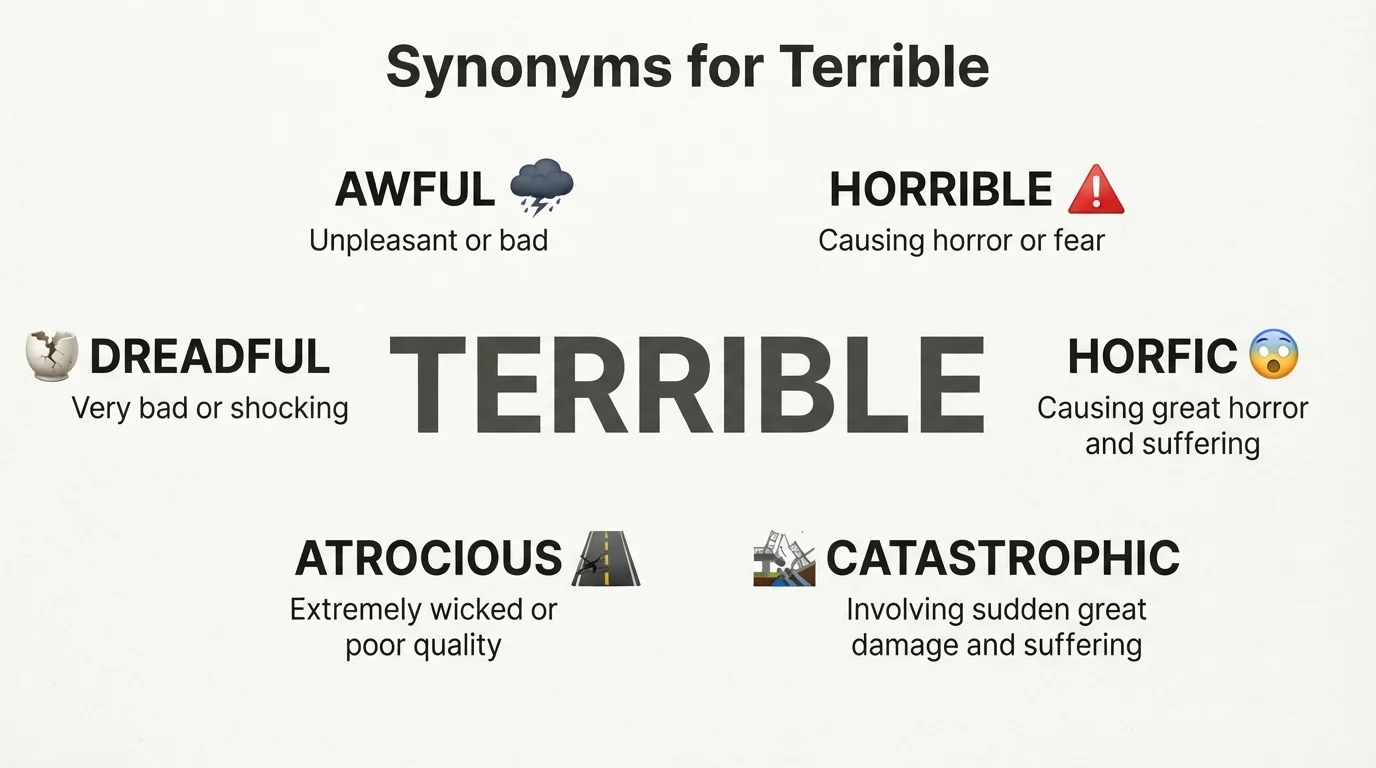
Sometimes “terrible” is too general to express exactly how bad, unpleasant, frightening, or serious something is. The right synonyms for terrible can make your English more precise and expressive, whether you are describing a mistake, experience, situation, movie, feeling, or problem.
Terrible generally means extremely bad, unpleasant, serious, or frightening, depending on the context. Useful alternatives include awful, horrible, dreadful, appalling, atrocious, unpleasant, severe, alarming, and shocking. However, these words are not always interchangeable. Unpleasant is milder, awful and horrible often describe something very bad or unpleasant, while atrocious emphasizes an exceptionally poor quality or standard. Severe is more suitable for serious conditions or problems.
For example, you might describe a terrible movie as an awful movie, a terrible experience as a horrible experience, or a terrible problem as a severe problem. Whether you need other words for terrible for an essay, story, email, school assignment, professional writing, or everyday English, this guide will help you choose the right synonym based on its meaning, intensity, and context.
Awful
Meaning: Awful means very bad or unpleasant.
Examples:
- The food tasted awful.
- We had awful weather all weekend.
Horrible
Meaning: Horrible means very bad, unpleasant, or upsetting.
Examples:
- The coffee tasted horrible.
- She had a horrible experience at the airport.
Dreadful
Meaning: Dreadful means very bad or unpleasant.
Examples:
- The weather was dreadful yesterday.
- What a dreadful mistake to make.
Vile
Meaning: Vile means extremely unpleasant, bad, or disgusting.
Examples:
- A vile smell came from the basement.
- He was in a vile mood all morning.
Horrendous
Meaning: Horrendous means extremely unpleasant, bad, or unacceptable.
Examples:
- The traffic was horrendous today.
- They faced horrendous working conditions.
Frightful
Meaning: Frightful means very frightening or unpleasant.
Examples:
- We heard a frightful noise upstairs.
- The storm created a frightful scene.
Horrid
Meaning: Horrid means very unpleasant or bad.
Examples:
- The room had a horrid smell.
- We had a horrid journey home.
Fearful
Meaning: Fearful means causing or showing fear.
Examples:
- A fearful sound came from the forest.
- The child gave me a fearful look.
Dire
Meaning: Dire means extremely serious or worrying.
Examples:
- The village was in dire need of water.
- The company faced a dire financial problem.
Grim
Meaning: Grim means very serious, sad, or unpleasant.
Examples:
- The doctor gave us a grim warning.
- The future looked grim after the announcement.
Ghastly
Meaning: Ghastly means extremely unpleasant, frightening, or shocking.
Examples:
- The accident left a ghastly scene.
- We noticed a ghastly smell in the room.
Atrocious
Meaning: Atrocious means extremely bad or unacceptable.
Examples:
- The hotel provided atrocious service.
- The road conditions were atrocious.
Horrific
Meaning: Horrific means extremely shocking, frightening, or disturbing.
Examples:
- The documentary showed a horrific accident.
- They witnessed a horrific event.
Abysmal
Meaning: Abysmal means extremely poor or very bad.
Examples:
- His exam results were abysmal.
- The restaurant had abysmal customer service.
Appalling
Meaning: Appalling means extremely bad, shocking, or upsetting.
Examples:
- The amount of waste was appalling.
- The report revealed appalling conditions.
Distressing
Meaning: Distressing means causing great worry, sadness, or pain.
Examples:
- The news was deeply distressing.
- It was distressing to see the injured animal.
Lousy
Meaning: Lousy means very bad or poor.
Examples:
- I had a lousy day at work.
- The hotel served a lousy breakfast.
Unpleasant
Meaning: Unpleasant means not nice, enjoyable, or comfortable.
Examples:
- We had an unpleasant conversation.
- The room had an unpleasant smell.
Disagreeable
Meaning: Disagreeable means unpleasant or difficult to enjoy.
Examples:
- The weather became cold and disagreeable.
- We had a disagreeable experience at the restaurant.
Displeasing
Meaning: Displeasing means causing someone to feel unhappy or dissatisfied.
Examples:
- The final result was displeasing to the client.
- The new design was displeasing to many customers.
Shocking
Meaning: Shocking means very surprising or upsetting.
Examples:
- The final result was shocking.
- We heard some shocking news this morning.
67+Synonyms for Interested: From Curious to Fascinated and Beyond
Revolting
Meaning: Revolting means extremely disgusting or unpleasant.
Examples:
- The spoiled food smelled revolting.
- The dirty kitchen looked revolting.
Hideous
Meaning: Hideous means extremely ugly or unpleasant.
Examples:
- The old building had a hideous design.
- He wore a hideous jacket to the party.
Gruesome
Meaning: Gruesome means very unpleasant because it involves injury, death, or disturbing details.
Examples:
- The movie included a gruesome scene.
- The newspaper described the gruesome accident.
Monstrous
Meaning: Monstrous means extremely cruel, shocking, or wrong.
Examples:
- The abuse was described as monstrous.
- Everyone condemned the monstrous act.
Reprehensible
Meaning: Reprehensible means very wrong and deserving strong criticism.
Examples:
- Lying to vulnerable people is reprehensible.
- His treatment of the workers was reprehensible.
Despicable
Meaning: Despicable means extremely bad or deserving strong dislike.
Examples:
- Stealing from children was despicable.
- His behavior was completely despicable.
Deplorable
Meaning: Deplorable means very bad and deserving strong disapproval.
Examples:
- The building was in deplorable condition.
- Their treatment of the animals was deplorable.
Wretched
Meaning: Wretched means extremely unpleasant, unhappy, or poor.
Examples:
- We spent a wretched night in the cold.
- The workers lived in wretched conditions.
Nasty
Meaning: Nasty means very unpleasant, harmful, or unkind.
Examples:
- She caught a nasty cold.
- He made a nasty comment online.
Rotten
Meaning: Rotten can mean very bad, unpleasant, or morally wrong.
Examples:
- We had rotten luck on our trip.
- He played a rotten trick on his brother.
Miserable
Meaning: Miserable means very unpleasant or very unhappy.
Examples:
- The rain made the picnic miserable.
- I felt miserable after losing my phone.
Unbearable
Meaning: Unbearable means so bad that you cannot tolerate it.
Examples:
- The summer heat became unbearable.
- The noise next door was unbearable.
Intolerable
Meaning: Intolerable means too bad or painful to accept.
Examples:
- The working conditions became intolerable.
- The constant delay was intolerable.
Severe
Meaning: Severe means very serious, harsh, or intense.
Examples:
- The storm caused severe damage.
- She suffered severe injuries in the accident.
Disastrous
Meaning: Disastrous means causing great damage, failure, or trouble.
Examples:
- The project was a disastrous failure.
- The business had a disastrous year.
Catastrophic
Meaning: Catastrophic means causing extremely serious damage or loss.
Examples:
- The earthquake caused catastrophic damage.
- The mistake had catastrophic results.
Calamitous
Meaning: Calamitous means causing great trouble, damage, or loss.
Examples:
- The flood had calamitous effects on the town.
- The company suffered a calamitous setback.
Tragic
Meaning: Tragic means causing great sadness or suffering.
Examples:
- The accident had a tragic ending.
- It was a tragic loss for the family.
Terrifying
Meaning: Terrifying means causing a very strong feeling of fear.
Examples:
- The dark cave looked terrifying.
- That roller coaster was terrifying.
Frightening
Meaning: Frightening means making someone feel afraid.
Examples:
- The strange noise was frightening.
- It was a frightening experience for the child.
Scary
Meaning: Scary means causing fear or worry.
Examples:
- That movie was really scary.
- Walking home alone felt scary.
Disturbing
Meaning: Disturbing means making you feel worried, upset, or uncomfortable.
Examples:
- The video contained disturbing images.
- His story was deeply disturbing.
Repulsive
Meaning: Repulsive means so unpleasant that it makes you want to move away.
Examples:
- The rotten meat had a repulsive smell.
- The creature looked repulsive.
Foul
Meaning: Foul means very unpleasant, dirty, or offensive.
Examples:
- There was a foul smell in the kitchen.
- The water had a foul taste.
Savage
Meaning: Savage means extremely violent, cruel, or severe.
Examples:
- The attack was savage.
- The team faced savage criticism after the loss.
Heinous
Meaning: Heinous means extremely evil or shocking.
Examples:
- The court heard about a heinous crime.
- Everyone condemned the heinous act.
Inexcusable
Meaning: Inexcusable means so wrong or bad that there is no good excuse for it.
Examples:
- Being rude to the staff was inexcusable.
- His behavior was completely inexcusable.
Substandard
Meaning: Substandard means below the normal level of quality.
Examples:
- The school had substandard equipment.
- Customers complained about the substandard service.
Unsatisfactory
Meaning: Unsatisfactory means not good enough or not acceptable.
Examples:
- The final result was unsatisfactory.
- The customer found the service unsatisfactory.
How Do You Say “Terrible” in a Professional Way?
For professional writing, choose a word that clearly explains why something is terrible. Unsatisfactory, substandard, inadequate, unacceptable, severe, and deplorable can work in different situations.
For example:
- Casual: “The service was terrible.”
- Professional: “The service was unsatisfactory.”
- Quality problem: “The service was substandard.”
- Serious problem: “The situation was severe.”
The best professional synonym depends on the exact problem.
What Is a Fancy Word for “Bad”?
Some more formal alternatives include atrocious, abysmal, deplorable, reprehensible, lamentable, and appalling. However, these words do not all mean exactly the same thing.
For example, abysmal is useful for extremely poor quality, while reprehensible is better for behavior that is morally wrong.
What Is the Strongest Word for “Awful” or “Horrible”?
There is no single strongest synonym for every use of awful or horrible. The strongest choice depends on what you are describing.
- Horrific emphasizes extreme shock or fear.
- Horrendous emphasizes an extreme level of unpleasantness.
- Atrocious emphasizes very poor or unacceptable quality.
- Catastrophic emphasizes extreme damage or loss.
- Heinous emphasizes extreme evil or wrongdoing.
So, instead of asking which word is always strongest, ask which word gives the exact meaning you need.
Synonyms of That: Find the Right Alternative for Each Use
What Are Synonyms for a Terrible Person, Situation, or Event?
For a terrible person, words such as despicable, vile, nasty, reprehensible, or heinous may fit, depending on the person’s behavior.
For a terrible situation, useful choices include dire, grim, severe, disastrous, calamitous, or unbearable.
For a terrible event, words such as tragic, horrific, shocking, distressing, or catastrophic may be more precise.
Are There Synonyms for “Terrible” That Start With T, S, F, or D?
Yes. For words starting with T, try terrifying and tragic. For S, useful choices include scary, shocking, severe, and substandard. For F, you can use foul, frightening, frightful, and fearful. For D, useful options include dreadful, dire, disastrous, disturbing, and deplorable.
Remember that a starting letter does not make a word a perfect synonym. The meaning still needs to fit the sentence.
What Are the Antonyms of “Terrible”?
Common terrible antonyms include good, great, excellent, wonderful, pleasant, enjoyable, fantastic, and pleasant.
The best opposite depends on the context.
For example:
- terrible quality → excellent quality
- terrible experience → wonderful experience
- terrible weather → pleasant weather
- terrible result → excellent result
Are “Terrible,” “Awful,” and “Horrible” Always Interchangeable?
No. They overlap strongly, but they can carry slightly different feelings.
Terrible is a broad word for something very bad, unpleasant, serious, or upsetting. Awful is common in everyday speech and often means very bad or unpleasant. Horrible can also mean very bad, but it can have a stronger connection with shock, fear, or something deeply unpleasant.
For example:
- “The food was terrible.”
- “The food was awful.”
- “The food was horrible.”
All three can work, but the exact feeling can change with the context.
Conclusion
Learning synonyms for terrible helps you make your writing, speaking, and communication more precise. Instead of repeating the same word, you can choose one that shows fear, sadness, disgust, poor quality, shock, or serious damage. These alternatives are useful for essays, blogs, emails, work messages, and everyday conversations. Practice a few words at a time, and pay attention to their exact meanings. The more you use them, the easier it becomes to choose the right synonym naturally.

I am Professor Emily Clarke, a language researcher and vocabulary enthusiast passionate about making English words easier to understand. I write clear, practical guides to help readers improve their vocabulary, grammar, and everyday writing.







