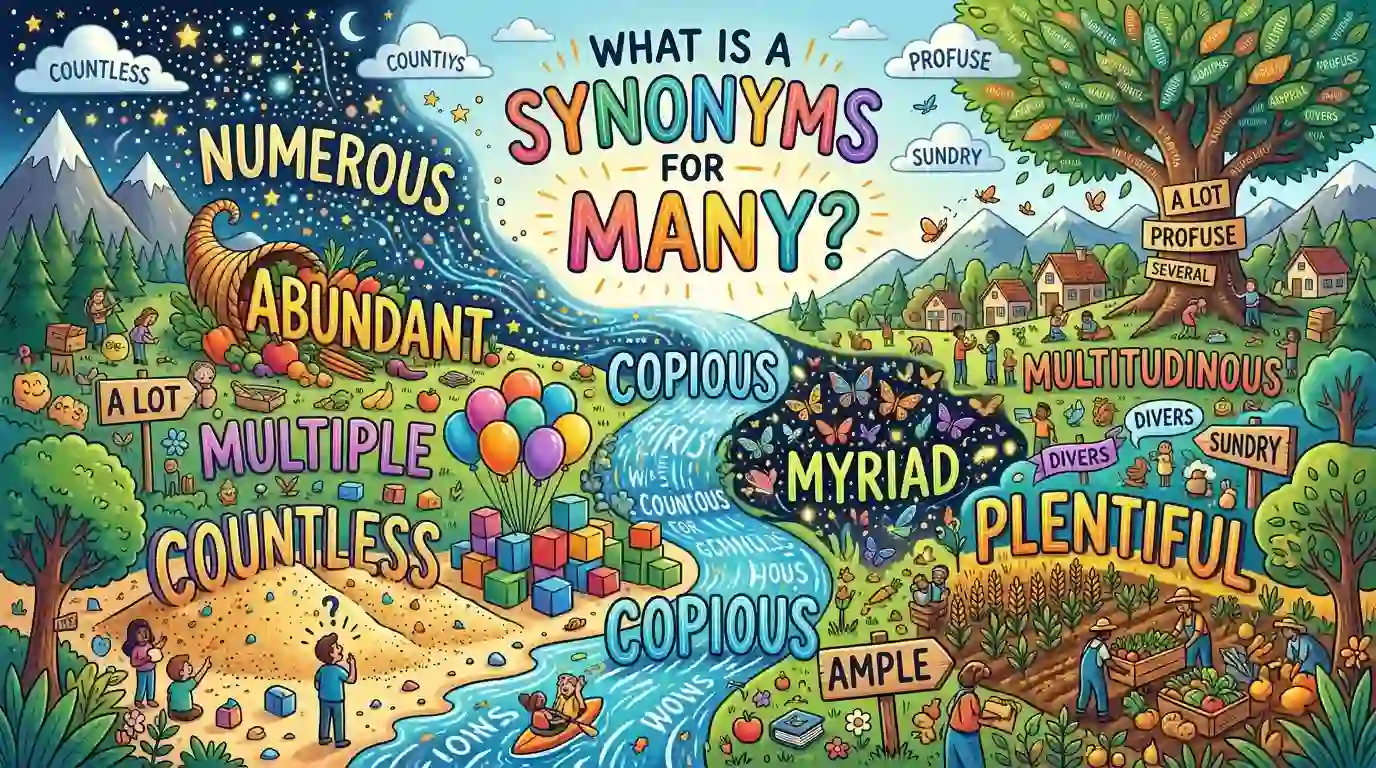
A synonym for many is numerous, which means a large number of people or things. Other alternatives include several, countless, abundant, plentiful, multiple, and myriad. The best word depends on your sentence. Use “numerous” in formal writing, “countless” for an extremely large number, and “lots of” in casual conversation.
Key Takeaways
- Numerous is a strong, formal alternative to many.
- Countless and innumerable suggest a number too large or difficult to count.
- Several means more than two, but usually suggests a smaller number than many.
- Lots of and a bunch of work well in casual conversations.
- Choose much for uncountable nouns, such as time, and many for countable nouns, such as books.
What Does Many Mean?
The word many describes a large number of people, animals, objects, or other countable things. It is one of the most common ways to express that something exists in a large quantity.
For example:
- Many students joined the school club.
- She has many ideas for her next project.
- We visited many places during our vacation.
You can also use “many” without repeating the noun when the context is clear: “Many applied, but only a few were selected.”
According to standard dictionary usage, many commonly functions as a determiner or pronoun. It often appears in questions, negative statements, and expressions such as “too many,” “so many,” and “as many.” Cambridge Dictionary
25 Synonyms for Many and Their Meanings
The following words and phrases can replace many in suitable contexts. They do not all have exactly the same meaning, so consider the tone and sentence before choosing one.
| Synonym | Meaning or best use | Example |
|---|---|---|
| Numerous | A large number; formal | Numerous applicants submitted forms. |
| Countless | Too many to count easily | Countless stars filled the sky. |
| Innumerable | Extremely numerous | Innumerable questions remained. |
| Several | More than two, usually a limited number | Several guests arrived early. |
| Multiple | More than one | Multiple reports confirmed the issue. |
| Numerous different | A large number of distinct items | Numerous different designs were available. |
| Various | Different kinds or types | We discussed various solutions. |
| Myriad | A very large number or variety | The city offers a myriad of activities. |
| Plentiful | Available in large amounts | Fresh vegetables are plentiful here. |
| Abundant | Existing in large quantities | The region has abundant natural resources. |
| A great many | A large number | A great many readers enjoyed the book. |
| A large number of | A substantial number | A large number of students attended. |
| A multitude of | A very large group or collection | A multitude of options awaited us. |
| A lot of | A large number or amount; conversational | A lot of people agreed. |
| Lots of | An informal way to express a large quantity | We have lots of time. |
| Plenty of | Enough or more than enough | There are plenty of seats available. |
| Loads of | A large amount; informal | She has loads of experience. |
| Heaps of | A large quantity; informal | Heaps of clothes filled the closet. |
| Scores of | Many, often in groups or dozens | Scores of volunteers helped. |
| Dozens of | Several groups of twelve or an approximate large number | Dozens of emails arrived. |
| Hundreds of | A quantity in the hundreds | Hundreds of people attended. |
| Thousands of | A quantity in the thousands | Thousands of visitors came. |
| Manifold | Many and varied; formal | The project has manifold benefits. |
| Multitudinous | Very numerous; uncommon and formal | Multitudinous challenges arose. |
| Umpteen | An unspecified, seemingly large number; informal | I have called you umpteen times. |
Dictionary references support many of these alternatives, including numerous, countless, innumerable, myriad, manifold, and a lot. The exact replacement depends on context. Cambridge Thesaurus and Collins Thesaurus
Common and Easy Synonyms
For everyday English, start with numerous, several, multiple, various, and a lot of.
These words are familiar to most readers and fit many ordinary situations.
- Original: Many customers visited the store.
- Alternative: Numerous customers visited the store.
- Original: We have many options.
- Alternative: We have several options.
The second replacement slightly changes the meaning. “Several” usually suggests a more limited number than “many,” so it is best when that distinction fits your message.
Formal and Academic Synonyms
In essays, reports, and professional writing, numerous, multiple, abundant, and a large number of can sound appropriate.
For example:
- Many studies examined the problem.
- Numerous studies examined the problem.
The second sentence sounds more formal without making the statement unnecessarily complicated.
Use abundant when emphasizing availability or quantity, such as abundant evidence or abundant resources. Use myriad when you want to emphasize a very large number or variety. Avoid choosing an advanced word merely to sound impressive.
Informal Synonyms
In everyday conversation, you can use lots of, loads of, heaps of, or a bunch of.
Examples:
- “I have many things to do.” → “I have lots of things to do.”
- “There were many people at the party.” → “There were loads of people at the party.”
- “She has many friends.” → “She has a bunch of friends.”
These expressions sound relaxed and natural. For formal reports or academic essays, numerous or a large number of is often a better choice.
Best Synonyms for Many in Different Situations
The right synonym depends on what you want to communicate.
| Situation | Recommended word or phrase |
|---|---|
| School essay | Numerous |
| Research paper | Multiple or numerous |
| Business report | A large number of |
| Casual conversation | Lots of |
| Extremely large number | Countless |
| Large number that is hard to count | Innumerable |
| Different types or choices | Various |
| More than enough | Plenty of |
| Large supply | Abundant or plentiful |
| Exact quantities | Hundreds of or thousands of, when accurate |
Remember that synonyms are not always interchangeable. “Many opportunities” and “numerous opportunities” communicate similar ideas, but “abundant opportunities” emphasizes that opportunities are available in plenty.
Many vs. Numerous vs. Several vs. Countless
These four words are closely related, but they carry different shades of meaning.
| Word | Main idea | Example |
|---|---|---|
| Many | A large number | Many people attended. |
| Numerous | A large number, often in a formal tone | Numerous people attended. |
| Several | More than two, usually a limited number | Several people attended. |
| Countless | So many that counting is difficult or impractical | Countless people have shared the story. |
Which is the strongest synonym for many?
Countless is often stronger when you want to emphasize an extremely large or seemingly uncountable number. However, it can be an exaggeration if you mean an ordinary, countable group. Numerous is a safer formal replacement when you simply mean a large number.
How to Replace Many in a Sentence
Follow these three steps to choose a better word.
- Identify the noun. Is it a countable item, such as books, or an uncountable substance, such as water?
- Choose the intended meaning. Do you mean a large number, different types, or more than enough?
- Match the tone. Choose a formal expression for professional writing and a conversational expression for casual speech.
Here are some useful before-and-after examples:
- Original: Many employees attended the meeting.
Revised: Numerous employees attended the meeting. - Original: The website offers many resources.
Revised: The website offers a wide range of resources. - Original: We have many supplies for the event.
Revised: We have plenty of supplies for the event. - Original: Many people have visited the museum.
Revised: Thousands of people have visited the museum.
Use this version only if the number is supported by reliable information. - Original: She has many responsibilities.
Revised: She has numerous responsibilities.
Notice that “a wide range of” emphasizes variety, while “plenty of” suggests an adequate or generous supply. The best replacement preserves the meaning of the original sentence.
Many vs. Much: What Is the Difference?
Use many with plural countable nouns and much with uncountable nouns.
| Use many | Use much |
|---|---|
| Many books | Much time |
| Many questions | Much information |
| Many friends | Much money |
| Many mistakes | Much effort |
Examples:
- Correct: How many books do you own?
- Correct: How much time do you need?
- Incorrect: How much books do you own?
- Incorrect: How many information do you need?
You can use a lot of with both countable and uncountable nouns: “a lot of books” and “a lot of information.”
Frequently Asked Questions
What is the best synonym for many?
Numerous is one of the best general synonyms for many, especially in formal writing. It means a large number of people or things. In casual conversation, lots of is a natural alternative. If you want to stress an extremely large number, consider countless.
What is a formal word for many?
Numerous is a common formal alternative. For example, “Many factors influenced the decision” can become “Numerous factors influenced the decision.” You can also use “a large number of” when you want a clear, neutral phrase in academic or professional writing.
What is another word for many in an essay?
Use numerous, multiple, or a large number of, depending on the sentence. For example, “Many studies support the argument” becomes “Numerous studies support the argument.” Make sure your replacement preserves the original meaning and does not imply evidence you do not have.
Is numerous a synonym for many?
Yes. Numerous means a large number of people or things and is often more formal than many. For example, “Numerous visitors explored the museum” has a similar meaning to “Many visitors explored the museum.”
What is a stronger word than many?
Countless and innumerable can suggest an extremely large number. Myriad can also convey a very large number or variety. Choose one that fits the facts, because these words may overstate an ordinary quantity.
Can I use plenty of instead of many?
Yes, in suitable sentences. “Many seats are available” and “Plenty of seats are available” are similar, but plenty of emphasizes that there are enough seats or more than enough. This phrase works with both countable nouns and uncountable nouns.
What is the opposite of many?
Common opposites include few, a small number of, and hardly any. For uncountable nouns, little or not much may be appropriate. For example, “Many students attended” contrasts with “Few students attended.”
Conclusion
The best answer to “what is a synonym for many” is usually numerous. Other useful choices include several, countless, abundant, plentiful, multiple, and lots of.
Choose your word based on quantity, tone, and context rather than replacing every instance of many with the same alternative. A precise word makes your writing clearer, more natural, and easier to understand.

I am Professor Emily Clarke, a language researcher and vocabulary enthusiast passionate about making English words easier to understand. I write clear, practical guides to help readers improve their vocabulary, grammar, and everyday writing.







