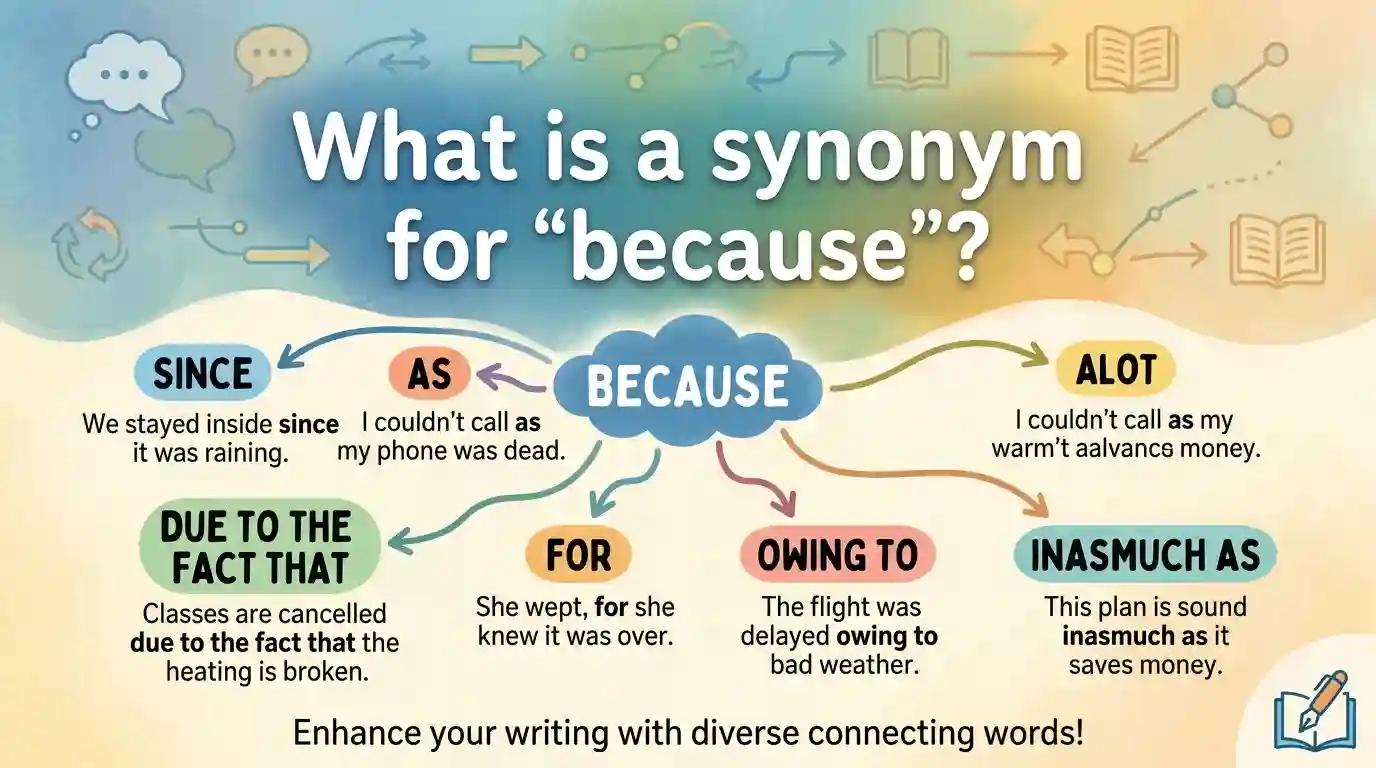
A synonym for because is since, as, for the reason that, seeing that, or given that. These words and phrases explain why something happens. For example, “I stayed home because it was raining” can become “I stayed home since it was raining.” The best alternative depends on your sentence, tone, and intended meaning.
Key Takeaways
- Since and as are common alternatives to because when giving a reason.
- Given that and considering that work well in formal or professional writing.
- Because of, due to, and owing to usually come before a noun or noun phrase.
- Therefore and consequently show a result, not a direct replacement for because.
- Choose the alternative that keeps your sentence clear and grammatically correct.
What Are the Best Synonyms for Because?
The best synonyms for because include since, as, for the reason that, seeing that, and given that. Each option explains a reason, but some sound more formal than others.
According to established dictionary and thesaurus entries, since, as, and for the reason that are recognized alternatives. However, they are not interchangeable in every sentence.
Cambridge English
+1
Common Alternatives
Use these options in everyday conversations, school assignments, and general writing.
- Since: Since I was tired, I went to bed early.
- As: As the store was closed, we returned home.
- Seeing that: Seeing that you are already here, let’s begin.
- For the reason that: The event was canceled for the reason that attendance was too low.
Formal Alternatives
For professional emails, academic assignments, and reports, consider these phrases:
- Given that: Given that the deadline is approaching, we should finish today.
- Considering that: Considering that the road was blocked, we arrived on time.
- Inasmuch as: Inasmuch as the evidence is limited, further research is needed.
The last option is particularly formal and may sound unnatural in everyday writing. In most situations, because, since, or given that is easier to understand.
10 Synonyms for Because With Examples
Here are 10 useful alternatives, along with their meanings, typical uses, and sentence examples.
| Synonym | Best use | Example |
|---|---|---|
| Since | Everyday and formal writing | Since it was late, we left. |
| As | Neutral writing | As it was raining, we stayed inside. |
| For | Literary or formal explanations | She must be tired, for she has worked all day. |
| Seeing that | Conversational explanations | Seeing that you’re busy, I’ll call later. |
| Given that | Professional writing | Given that costs increased, we revised the budget. |
| Considering that | Weighing circumstances | Considering that he was new, he did well. |
| Inasmuch as | Very formal writing | Inasmuch as the request was approved, work may begin. |
| For the reason that | Explicit explanations | The match ended early for the reason that the field was unsafe. |
| On account of | Explaining a cause, usually with a noun phrase | The game was canceled on account of rain. |
| Owing to | Formal cause-and-effect statements | The flight was delayed owing to fog. |
Important grammar note: These alternatives do not all follow the same sentence pattern. Since, as, and seeing that can introduce a clause with a subject and verb. On account of and owing to normally introduce a noun phrase.
Cambridge Grammar
+2
Which Synonym for Because Should You Use?
The right alternative depends on what you are writing and how you want the sentence to sound.
For everyday conversations
Use because, since, or as.
Example: Since you’re here, let’s get started.
For essays and school assignments
Use since, as, or given that when they fit the meaning.
Example: Given that the results were unclear, the study needs more research.
For business emails and reports
Use given that, considering that, or owing to.
Example: Owing to a scheduling conflict, the meeting has been postponed.
For a simple, direct explanation
Keep because if it communicates your meaning best.
Example: I chose this option because it saves time.
You do not need to replace every instance of because. Repeating a word is not automatically a writing mistake. Clear meaning matters more than using a different word in every sentence.
Because vs. Since vs. As
Because, since, and as can all introduce reasons. The main difference is the emphasis they place on the explanation.
| Word | Main emphasis | Example |
|---|---|---|
| Because | Directly explains the reason | I left because I felt sick. |
| Since | Often presents the reason as known or relevant background | Since you’re feeling sick, you should rest. |
| As | Often introduces background information | As it was getting dark, we headed home. |
Because is often the clearest choice when you want to answer the question “Why?” Since and as can place more emphasis on the main statement than on the reason.
Cambridge Dictionary
+1
Compare these sentences:
- Because: Maya took an umbrella because rain was expected.
- Since: Since rain was expected, Maya took an umbrella.
- As: As rain was expected, Maya took an umbrella.
All three sentences communicate a reason. However, because makes the explanation especially direct.
Because vs. Because Of
Although these expressions look similar, they follow different grammatical patterns.
Because is a conjunction that introduces a clause containing a subject and a verb. Because of is a preposition that normally comes before a noun or noun phrase.
Cambridge Grammar
+1
| Because | Because of |
|---|---|
| The game stopped because it rained. | The game stopped because of the rain. |
| She was absent because she felt ill. | She was absent because of her illness. |
| We arrived late because traffic was heavy. | We arrived late because of heavy traffic. |
Other alternatives to because of include due to, owing to, and on account of.
For example:
- Because of the storm, the school closed.
- Due to the storm, the school closed.
- Owing to the storm, the school closed.
These sentences identify the storm as the cause of the closure.
A useful rule is to check what follows the expression. If you need a full clause, use because. If you need a noun or noun phrase, because of may be appropriate.
How to Avoid Repeating Because in an Essay
If you use because several times in one paragraph, you can improve the flow without making the writing sound unnatural.
1. Replace it with a suitable alternative
Original: I chose this topic because it is interesting. I chose it because it is relevant.
Revised: I chose this topic because it is interesting and relevant.
The revised version removes unnecessary repetition while preserving the meaning.
2. Rearrange the sentence
Original: We canceled the picnic because the weather was bad.
Revised: Since the weather was bad, we canceled the picnic.
Changing the sentence structure can make your writing feel more varied.
3. Use a cause-and-effect phrase
Original: The road was flooded because of heavy rain.
Revised: Heavy rain caused the road to flood.
The second version is shorter and more direct.
4. Use result words carefully
Words such as therefore, consequently, and as a result can connect ideas when the cause has already been explained.
For example:
The roads were icy. Therefore, the school delayed opening.
These words describe the consequence of a situation. They are not direct grammatical substitutes for because.
Common Mistakes to Avoid
Even words with similar meanings may not work in the same sentence.
– Incorrect: I stayed home due to I was sick.
Correct: I stayed home because I was sick.
Alternatively: I stayed home due to my illness.
– Incorrect: The match was canceled because of it rained.
Correct: The match was canceled because it rained.
Alternatively: The match was canceled because of the rain.
– Awkward: Since I was late, because the bus broke down, I missed the meeting.
Better: I missed the meeting because the bus broke down and I was late.
– Incorrect meaning: I was tired; therefore, I stayed home because I was tired.
Better: I was tired; therefore, I stayed home.
The final example shows how a result connector can remove an unnecessary repetition. Always check that your sentence expresses the relationship you intend.
Frequently Asked Questions
1. What is another word for because?
Common alternatives include since, as, seeing that, and given that. For example, “I stayed home because I was sick” can become “I stayed home since I was sick.” The best choice depends on the sentence and the level of formality you want.
2. What is a formal synonym for because?
Given that, considering that, and inasmuch as can work in formal writing. For example, “Given that the deadline is approaching, we must finish the report today.” In most professional settings, given that is clear and natural, while inasmuch as is considerably more formal.
3. What can I use instead of because in an essay?
Try since, as, or given that when the sentence supports the substitution. You can also rearrange the sentence or combine related ideas. Do not replace every occurrence automatically. The goal is to improve clarity and sentence flow, not simply to avoid a repeated word.
4. Is due to a synonym for because?
Due to can express a similar cause, but it normally precedes a noun phrase rather than a complete clause. For example, write “The flight was delayed due to fog” or “The flight was delayed because fog reduced visibility.” Choose the construction that fits the sentence.
5. Are because and since interchangeable?
They can often introduce the same reason, but they do not always create the same emphasis. Because usually highlights the reason directly, while since often presents it as background information. In a question asking why something happened, because is generally the more natural choice.
6. Is therefore another word for because?
Not exactly. Because introduces a reason, while therefore introduces a conclusion or result. Compare “We stayed inside because it rained” with “It rained; therefore, we stayed inside.” The meaning is related, but the grammatical structure is different.
Conclusion
The best answer to “what is a synonym for because” is usually since, as, or given that. These alternatives work in many everyday, academic, and professional sentences.
For a direct explanation, because remains an excellent choice. Use because of, due to, or owing to when your sentence calls for a noun phrase, and use result words such as therefore only when you want to express a consequence.
The most effective synonym is the one that keeps your meaning clear, your grammar correct, and your writing natural.