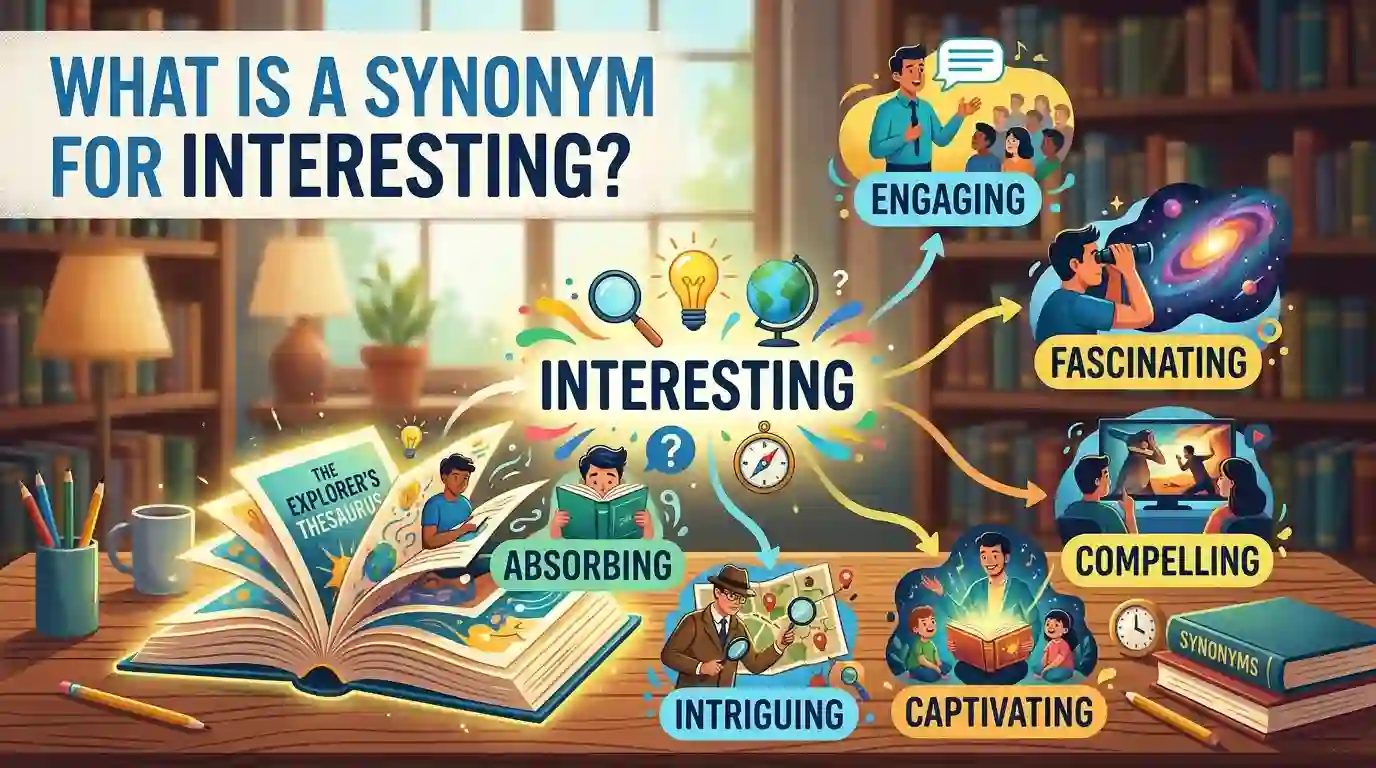
A synonym for interesting is fascinating, intriguing, engaging, compelling, or captivating. These words describe something that catches your attention or makes you want to know more. The best choice depends on the context. Use fascinating for something that strongly attracts your attention, intriguing for something mysterious, and engaging for something that keeps you involved.
Key Takeaways
- Fascinating is an excellent choice when something captures your attention strongly.
- Intriguing describes something mysterious or that makes you curious.
- Engaging works well for conversations, presentations, books, and people.
- Thought-provoking describes something that encourages deeper thinking.
- Choose a synonym based on your intended meaning, not simply because it sounds more advanced.
What Does Interesting Mean?
The word interesting is an adjective that describes something that attracts attention, creates curiosity, or holds someone’s interest. It can describe a person, story, idea, event, book, conversation, or experience.
For example:
- The documentary was interesting.
- She shared an interesting idea.
- We had an interesting conversation about history.
The word is useful in everyday English, but it can sometimes feel too general. If you want to explain exactly why something caught your attention, a more precise synonym can make your writing clearer.
25 Synonyms for Interesting and Their Meanings
Here are 25 useful alternatives to interesting, with simple meanings and examples.
| Synonym | Meaning | Example sentence |
|---|---|---|
| Fascinating | Extremely interesting | The museum had a fascinating collection of ancient objects. |
| Intriguing | Mysterious or curiosity-provoking | She asked an intriguing question. |
| Engaging | Holding attention and involvement | The teacher gave an engaging presentation. |
| Compelling | Strongly attracting attention or interest | The journalist wrote a compelling story. |
| Captivating | Holding someone’s attention completely | The singer delivered a captivating performance. |
| Absorbing | Keeping someone deeply involved | The novel was so absorbing that I forgot the time. |
| Thought-provoking | Encouraging careful thought | The film raised thought-provoking questions. |
| Riveting | Extremely exciting or attention-holding | The courtroom drama was riveting. |
| Gripping | Creating strong interest or suspense | The mystery had a gripping ending. |
| Stimulating | Encouraging mental activity or new ideas | We had a stimulating discussion about science. |
| Entertaining | Providing enjoyment or amusement | The comedian told an entertaining story. |
| Amusing | Funny or pleasantly entertaining | His amusing comment made everyone laugh. |
| Informative | Providing useful knowledge | The article was informative and easy to understand. |
| Appealing | Attractive or inviting | The book’s subject sounded appealing. |
| Remarkable | Unusual or worthy of attention | She made remarkable progress in a month. |
| Noteworthy | Worth noticing or mentioning | The report includes several noteworthy findings. |
| Unusual | Different from what is common | We discovered an unusual rock formation. |
| Curious | Strange or interesting enough to attract attention | There was a curious pattern on the wall. |
| Exciting | Creating enthusiasm or anticipation | The team announced an exciting new project. |
| Stimulating | Inspiring activity or thought | The workshop provided a stimulating learning experience. |
| Enchanting | Delightfully charming | They visited an enchanting little village. |
| Enthralling | Holding attention very strongly | The storyteller gave an enthralling performance. |
| Eye-opening | Revealing something surprising or new | The report offered an eye-opening view of the problem. |
| Revealing | Showing information that was not obvious before | Her answer was revealing. |
| Worthwhile | Valuable enough to justify the time or effort | The lecture was worthwhile and practical. |
Note: Some words overlap in meaning but are not interchangeable in every sentence. For example, informative emphasizes knowledge, while entertaining emphasizes enjoyment. Also, stimulating appears twice in the table’s conceptual categories above because it can describe mental activity as well as lively discussion. In a final edit, keep it only once if you want a strictly unique list.
Which Synonym for Interesting Should You Use?
The right word depends on what makes the subject interesting. Major dictionaries also distinguish between words that hold attention, create curiosity, and provide enjoyment. See the Cambridge English Thesaurus and Collins American English Thesaurus for related vocabulary and usage examples.
| If you mean… | Choose… | Example |
|---|---|---|
| Something attracts your attention strongly | Fascinating | The history of the city is fascinating. |
| Something makes you curious | Intriguing | That is an intriguing possibility. |
| Something keeps people involved | Engaging | The speaker was engaging. |
| Something presents a convincing case | Compelling | She made a compelling argument. |
| Something encourages deeper thinking | Thought-provoking | It was a thought-provoking question. |
| Something provides useful facts | Informative | The guide was informative. |
| Something is enjoyable or funny | Entertaining | The show was entertaining. |
| Something is unusual or surprising | Remarkable | The discovery was remarkable. |
Fascinating vs. Intriguing
Fascinating suggests a strong attraction to a subject. Intriguing suggests curiosity, often because something is unusual, mysterious, or not fully understood.
- Fascinating: The scientist explained the fascinating behavior of the stars.
- Intriguing: The scientist noticed an intriguing pattern in the data.
Engaging vs. Compelling
Engaging describes something that keeps a person interested and involved. Compelling often suggests that something is powerful, persuasive, or difficult to ignore.
- Engaging: The instructor used engaging examples.
- Compelling: The lawyer presented a compelling argument.
Best Synonyms for Interesting in Essays and Professional Writing
If you are writing an essay, report, email, or work presentation, choose a word that communicates your point clearly.
For essays: Use thought-provoking, compelling, noteworthy, or fascinating when the context supports them.
Example: Instead of writing, “The book presents an interesting argument,” write, “The book presents a compelling argument.”
For research and reports: Use significant, noteworthy, informative, or revealing when you mean that a finding matters, provides knowledge, or shows something important.
Example: “The survey revealed a noteworthy difference between the two groups.”
Be careful with significant. It can mean important or meaningful in everyday writing, but in statistics it can have a specific technical meaning.
For professional presentations: Use engaging, informative, or thought-provoking.
Example: “The presenter delivered an engaging explanation of the new process.”
For casual conversations: Use cool, fascinating, amazing, or intriguing, depending on your tone.
Example: “That’s fascinating! How did you discover it?”
A useful rule is to identify the quality you want to describe first. Then select the word that expresses that quality most accurately.
Examples of Interesting Used in Sentences
Here are a few simple before-and-after examples.
- Original: I read an interesting book about space.
Improved: I read a fascinating book about space. - Original: She gave an interesting speech.
Improved: She gave an engaging speech. - Original: He presented an interesting theory.
Improved: He presented an intriguing theory. - Original: We had an interesting discussion.
Improved: We had a thought-provoking discussion. - Original: The article contains interesting information.
Improved: The article contains informative details. - Original: The lawyer made an interesting argument.
Improved: The lawyer made a compelling argument. - Original: We saw an interesting discovery in the report.
Improved: We found a noteworthy discovery in the report.
These replacements work because they give readers a better idea of what made the original subject interesting.
Common Mistakes When Replacing Interesting
1. Choosing a stronger word without checking its meaning.
Not every interesting subject is fascinating or exciting. A quiet historical fact may be intriguing without being exciting.
2. Using complicated vocabulary unnecessarily.
A simple word is often the best choice. Clear writing matters more than using impressive vocabulary.
3. Treating every synonym as identical.
An informative article provides knowledge, while an entertaining article provides enjoyment. Choose according to the message.
4. Repeating the same replacement.
Replacing every instance of interesting with fascinating can create another form of repetition. Vary your wording when the meaning genuinely changes.
5. Forgetting the tone.
A word suitable for an academic essay may sound unnatural in a casual text message. Match the word to the audience and situation.
Frequently Asked Questions
1. What is the best synonym for interesting?
Fascinating is an excellent general alternative when something strongly attracts attention. However, intriguing is better for something mysterious, and engaging is often better for a presentation or conversation. The best synonym depends on the subject and the exact meaning you want to express.
2. What is another word for very interesting?
Try fascinating, captivating, enthralling, riveting, or compelling. For example, “The documentary was very interesting” could become “The documentary was captivating.” Use riveting or gripping when a story creates strong suspense or holds your attention closely.
3. What is a professional word for interesting?
Professional alternatives include compelling, noteworthy, informative, engaging, and thought-provoking. For example, “The meeting raised an interesting point” could become “The meeting raised a noteworthy point.” Choose a word that accurately reflects the importance or value of the point.
4. What is a good synonym for interesting in an essay?
Thought-provoking, compelling, noteworthy, and fascinating can work well in essays. Use thought-provoking for an idea that encourages reflection, compelling for a strong argument, and noteworthy for something deserving attention. Avoid changing a word simply to make the sentence sound more advanced.
5. What is the opposite of interesting?
Common antonyms include boring, dull, tedious, monotonous, and uninteresting. For example, “The lecture was interesting” becomes “The lecture was engaging,” while “The lecture was dull” expresses the opposite idea. Choose the antonym that best describes the problem.
6. How can I avoid using interesting too often?
Identify why the subject caught your attention. If it teaches you something, use informative and If it creates curiosity, use intriguing. If it holds your attention, use engaging and If it encourages reflection, use thought-provoking. You can also explain the specific detail that made the subject worth discussing.
Conclusion
If you are asking, “What is a synonym for interesting?” the best starting choices are fascinating, intriguing, engaging, and compelling. Each word expresses a slightly different quality, so the right replacement depends on your sentence.
For stronger writing, focus on the reason something deserves attention. Choosing a precise word makes your message clearer, improves your vocabulary, and helps you communicate naturally in school, work, and everyday conversations.

I am Joseph Clark, a vocabulary and language content writer at SynonymLibrary.com. I create clear, practical synonym guides that help readers improve their writing, word choice, and communication skills. My goal is to make language learning simple, accurate, and useful for students, writers, professionals, and everyday learners.







