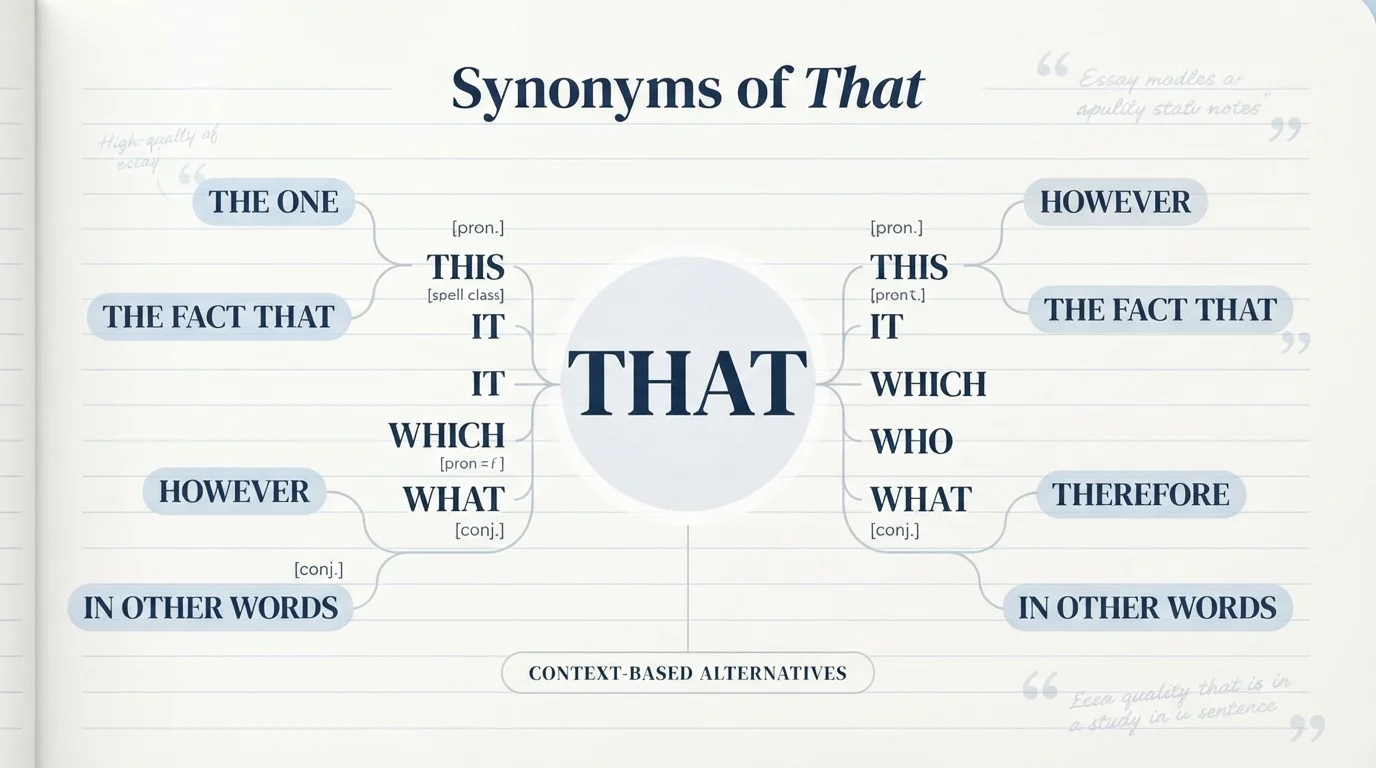
Using “that” repeatedly can make your writing feel repetitive, but finding a replacement is not as simple as swapping it for another word. The best synonyms of that depend on how “that” is being used in the sentence because it can serve several different grammatical roles.
For example, “that” can point to a specific thing, introduce a relative clause, connect two parts of a sentence, or describe a noun. Depending on its function, possible alternatives may include which, this, such, those, who, or a different sentence structure. In some cases, “that” can simply be removed. For instance, “I know that she is right” can become “I know she is right” without replacing that with another word.
That is why other words for that are not one-size-fits-all. Whether you are writing an essay, email, article, school assignment, or everyday English, choosing the right alternative requires looking at the meaning and grammar of the sentence. This guide explains the different uses of “that,” with clear alternatives, simple explanations, and natural examples to help you avoid repetition without creating a grammatical mistake.
What Can I Use Instead of “That”?
There is no single synonym that works in every sentence. Depending on the meaning and grammar, alternatives include this, it, which, who, what, the one, the thing, such, and the fact that. In some sentences, you can simply remove that.
It is important to choose an alternative based on the sentence rather than replacing that just to avoid repetition.
This
Meaning: “This” points to a person, thing, idea, or situation that is usually close to the speaker or currently being discussed.
Examples:
- This is the book I wanted.
- I did not expect this to happen.
Best use: Use this when you want to point to something near you or something you have just introduced.
It
Meaning: “It” can refer to a thing, idea, or situation that is already known.
Examples:
- I like the plan, and I think it will work.
- The movie was long, but it was enjoyable.
Best use: Use it when a specific noun or idea is already clear from the context.
Which
Meaning: “Which” can introduce a relative clause about a thing or animal in many sentences.
Examples:
- This is the phone which I bought yesterday.
- She chose the dress which looked more comfortable.
Best use: In defining relative clauses, which can often replace that when talking about things.
Who
Meaning: “Who” can introduce a relative clause when you are talking about a person.
Examples:
- She is the teacher who helped me.
- I met the man who designed the website.
Best use: Use who for people when a relative clause needs a subject or object referring to a person.
Whom
Meaning: “Whom” can refer to a person who is the object of a verb or preposition, especially in formal English.
Examples:
- She is the person whom I contacted.
- The manager whom we invited arrived early.
Best use: Whom is more formal and is less common in everyday conversation.
What
Meaning: “What” can mean “the thing that” when it introduces a noun-like idea.
Examples:
- I understand what you mean.
- Take what you need.
Best use: Use what when you mean “the thing that,” not as a simple replacement for that before a noun.
The One
Meaning: “The one” refers to a specific person or thing that is already clear.
Examples:
- I want the one you showed me.
- Is this the one you ordered?
Best use: Use the one when the noun does not need to be repeated.
The Thing
Meaning: “The thing” refers to a specific object, idea, or matter.
Examples:
- The thing I need most is time.
- I remember the thing you told me.
Best use: It can replace a longer reference when the meaning is clear.
Such
Meaning: “Such” refers to something of the type or kind already mentioned.
Examples:
- I have never seen such a beautiful view.
- Such behavior can cause problems.
Best use: Use such when you want to refer to a kind or type of thing.
The Fact That
Meaning: “The fact that” introduces information that is presented as a fact.
Examples:
- The fact that she came early surprised me.
- I appreciate the fact that you helped.
Best use: This is useful in essays and formal writing, but it should not replace every use of that.
The Idea That
Meaning: “The idea that” introduces a thought, belief, or possibility.
Examples:
- I like the idea that everyone can learn.
- The idea that money solves every problem is unrealistic.
Best use: Use it when that introduces an idea rather than simply pointing to something.
The Belief That
Meaning: “The belief that” introduces something someone believes to be true.
Examples:
- She supports the belief that practice builds skill.
- The belief that mistakes are useful can help students.
Best use: This works well in essays and discussions about opinions or beliefs.
The Claim That
Meaning: “The claim that” introduces something someone says is true.
Examples:
- I questioned the claim that the product was safe.
- The claim that sales increased needs proof.
Best use: It is useful when discussing a statement or argument that may need evidence.
The View That
Meaning: “The view that” introduces an opinion or way of thinking.
Examples:
- I understand the view that change takes time.
- He supports the view that education should be affordable.
Best use: This is especially useful in essays and formal discussions.
The Suggestion That
Meaning: “The suggestion that” introduces an idea offered for consideration.
Examples:
- I liked the suggestion that we start early.
- Her suggestion that we meet online saved time.
Best use: Use it when that introduces a proposed idea.
The Fact
Meaning: “The fact” can refer to information that is already known or stated.
Examples:
- The fact surprised everyone.
- We cannot ignore the fact.
Best use: It can make a reference more specific when the meaning is already clear.
This Idea
Meaning: “This idea” points to an idea that has just been discussed.
Examples:
- This idea could help new writers.
- I think this idea is worth trying.
Best use: It is a clear alternative when that refers to a nearby idea.
This Point
Meaning: “This point” refers to an idea or fact being discussed.
Examples:
- This point is important for students.
- Let us explain this point clearly.
Best use: It works especially well in essays, reports, and explanations.
This Fact
Meaning: “This fact” points to information that has just been mentioned.
Examples:
- This fact changed my opinion.
- We should remember this fact.
Best use: Use it when you want to make the reference clear.
This Situation
Meaning: “This situation” refers to a situation that is currently being discussed.
Examples:
- This situation needs quick action.
- I have never faced this situation before.
Best use: It is useful when that refers to an event or condition.
This Reason
Meaning: “This reason” refers to a reason that has just been explained.
Examples:
- This reason explains my choice.
- I stayed home for this reason.
Best use: Use it when referring back to a reason without repeating the full explanation.
In That Way
Meaning: “In that way” explains how something can happen or be done.
Examples:
- You can save time in that way.
- We solved the problem in that way.
Best use: This is a context-based alternative for that way, not a direct synonym for the single word that.
Like That
Meaning: “Like that” means in the way just shown, described, or understood.
Examples:
- Don’t hold the cup like that.
- I never said it like that.
Best use: It is natural in casual conversation.
In This Manner
Meaning: “In this manner” means in this way or by using this method.
Examples:
- Complete the form in this manner.
- The problem can be solved in this manner.
Best use: This is more formal than like that.
By Doing So
Meaning: “By doing so” means by doing the action just mentioned.
Examples:
- Save your work before closing the file. By doing so, you can avoid losing it.
- She followed the instructions and, by doing so, finished early.
Best use: Use it when referring to an action rather than a physical object.
58 Synonyms for Using: Find the Right Word for Every Meaning
Because
Meaning: “Because” gives the reason why something happens.
Examples:
- I stayed home because it was raining.
- She smiled because she got good news.
Best use: Because can sometimes express the reason behind an idea containing that, but it is not a direct synonym for that.
Since
Meaning: “Since” can introduce a reason in some sentences.
Examples:
- Since you are here, let us begin.
- I stayed home since I felt tired.
Best use: Use it when the reason is clear from the situation.
As
Meaning: “As” can introduce a reason for something.
Examples:
- As it was late, we went home.
- I stayed quiet as everyone was working.
Best use: It is useful in formal and everyday writing when the reason is already clear.
So
Meaning: “So” can show the result of an earlier fact or action.
Examples:
- It was cold, so I wore a coat.
- She was tired, so she went to bed.
Best use: Use so when you want to connect a cause with its result.
Therefore
Meaning: “Therefore” means “for that reason” and is common in formal writing.
Examples:
- The road was closed; therefore, we turned back.
- He missed the bus; therefore, he was late.
Best use: Use it to show a clear result or conclusion.
Thus
Meaning: “Thus” means “in this way” or “for this reason” and is often formal.
Examples:
- The test was difficult; thus, many students struggled.
- She saved money and thus reached her goal.
Best use: It works well in academic and formal writing.
Hence
Meaning: “Hence” can mean “for this reason” or “as a result.”
Examples:
- The store was closed, hence the delay.
- He was tired, hence his early departure.
Best use: It is mainly useful in formal writing.
Consequently
Meaning: “Consequently” shows that something happened as a result of something else.
Examples:
- The rain continued; consequently, the match was canceled.
- She missed the deadline and consequently lost the chance.
Best use: Use it when you want to show a direct result.
As a Result
Meaning: “As a result” introduces the outcome of an earlier event.
Examples:
- He studied hard. As a result, he passed.
- The price increased, and as a result, fewer people bought it.
Best use: This phrase is clear and useful in essays and explanations.
For This Reason
Meaning: “For this reason” explains why something happens.
Examples:
- The road was unsafe. For this reason, we stayed home.
- She needed help, and for this reason, I called her.
Best use: It is a clear formal alternative when explaining a cause.
In Other Words
Meaning: “In other words” restates an idea in a simpler or clearer way.
Examples:
- In other words, we need more time.
- He was exhausted; in other words, he needed a break.
Best use: It is useful when explaining or simplifying an earlier statement.
That Is
Meaning: “That is” introduces a clarification or more exact explanation.
Examples:
- He is self-employed, that is, he works for himself.
- We need one simple plan, that is, one everyone can follow.
Best use: This phrase is useful when explaining exactly what you mean.
That Is to Say
Meaning: “That is to say” formally introduces a clearer explanation.
Examples:
- He is self-employed, that is to say, he works for himself.
- The plan is flexible, that is to say, we can change it later.
Best use: It is more formal than in other words.
Namely
Meaning: “Namely” introduces the exact person, thing, or details being discussed.
Examples:
- We need one thing, namely, more time.
- She invited two people, namely, Ali and Sara.
Best use: Use it when you want to name something exactly.
Specifically
Meaning: “Specifically” gives exact information about something.
Examples:
- I need help, specifically with grammar.
- What specifically do you want to change?
Best use: It is useful when moving from a general idea to an exact detail.
In Particular
Meaning: “In particular” points to one specific person or thing.
Examples:
- I liked the blue dress in particular.
- This rule matters for students in particular.
Best use: Use it when you want to highlight one specific part.
Such As
Meaning: “Such as” introduces examples of a larger group.
Examples:
- I enjoy fruits such as mangoes and apples.
- Use simple tools such as dictionaries and notebooks.
Best use: It introduces examples rather than replacing that directly.
For Example
Meaning: “For example” introduces a specific example.
Examples:
- Some fruits are sweet; for example, mangoes are very sweet.
- You can practice daily, for example, by writing short notes.
Best use: Use it when explaining an idea through a real example.
For Instance
Meaning: “For instance” means “for example.”
Examples:
- Some jobs allow remote work, for instance, writing.
- You can start small, for instance, with five minutes a day.
Best use: It is a natural alternative to for example.
In That Case
Meaning: “In that case” refers to a situation that was just mentioned.
Examples:
- If you are tired, in that case, take a break.
- You missed the train? In that case, call me.
Best use: It is useful when responding to a condition or situation.
If So
Meaning: “If so” means “if that is true” or “if that is the case.”
Examples:
- Are you busy? If so, we can talk later.
- Did she agree? If so, we can begin.
Best use: It avoids repeating an entire previous statement.
Even So
Meaning: “Even so” means “despite that.”
Examples:
- The task was hard. Even so, I finished it.
- It was raining. Even so, they went outside.
Best use: Use it to show that something remains true despite an earlier fact.
Still
Meaning: “Still” can show that something remains true despite another fact.
Examples:
- It was expensive, but I still bought it.
- She was nervous but still gave the speech.
Best use: It is common in everyday English.
However
Meaning: “However” introduces a contrast with an earlier idea.
Examples:
- The task was difficult. However, I completed it.
- I wanted to go. However, I was too tired.
Best use: It is common in formal and general writing.
Nevertheless
Meaning: “Nevertheless” means “despite that” and introduces a contrasting point.
Examples:
- The weather was poor. Nevertheless, the event continued.
- The plan had problems. Nevertheless, we tried it.
Best use: It is more formal than still or even so.
Having Said That
Meaning: “Having said that” introduces a different or balancing point after an earlier statement.
Examples:
- The job is difficult. Having said that, it is rewarding.
- The plan has risks. Having said that, it may still work.
Best use: It is useful when you want to acknowledge one point before giving another.
That Being Said
Meaning: “That being said” introduces another point after an earlier statement.
Examples:
- The room is small. That being said, it feels comfortable.
- The test was hard. That being said, I enjoyed it.
Best use: This phrase is common in essays, blogs, and thoughtful conversations.
On the Other Hand
Meaning: “On the other hand” introduces another side of an idea.
Examples:
- The phone is expensive. On the other hand, it lasts for years.
- The course is long. On the other hand, it covers many topics.
Best use: Use it to compare two different sides of an issue.
The Mentioned
Meaning: “The mentioned” refers to something already discussed, but it is mainly formal and can sound unnatural in everyday English.
Examples:
- Please check the mentioned file before the meeting.
- The mentioned details were added to the report.
Best use: Prefer a specific noun or the above in many situations because it often sounds clearer.
The Above
Meaning: “The above” refers to information written earlier in a document.
Examples:
- Please review the above information.
- The above points explain the problem.
Best use: It is common in formal documents, reports, and instructions.
The Said
Meaning: “The said” refers formally to something already mentioned.
Examples:
- The said document must be signed.
- The said person was asked to leave.
Best use: This is mainly formal or legal-style language, not everyday English.
The Former
Meaning: “The former” refers to the first of two people or things already mentioned.
Examples:
- Tea and coffee were offered, but I chose the former.
- Sara and Mia applied, but the former arrived first.
Best use: Use it only when exactly two previously mentioned choices are clear.
The Latter
Meaning: “The latter” refers to the second of two people or things already mentioned.
Examples:
- Cats and dogs were discussed, and the latter need more space.
- We compared email and phone calls, with the latter being faster.
Best use: Like the former, it is mainly useful in formal writing.
Should You Replace Every “That”?
No. This is one of the most important rules to remember.
That is often the clearest and most natural word. You should not replace it simply because you want to use a synonym.
For example:
- I know that she is busy.
- I know she is busy.
The second sentence removes that naturally. But replacing it with a random word could make the sentence incorrect.
Good writing is not about avoiding one word at all costs. It is about choosing the clearest structure.
67+Synonyms for Interested: From Curious to Fascinated and Beyond
Synonyms of That in English
The best alternatives depend on the grammatical job of that.
When that points to something, alternatives may include this, it, the one, or the thing.
When that introduces a relative clause, who or which may work in suitable sentences.
When that introduces a clause after a verb, adjective, or noun, it can sometimes be removed or rewritten with phrases such as the fact that or the idea that.
This is why there is no single replacement for that in English.
That Synonym Formal
For formal writing, useful context-based alternatives include which, whom, namely, specifically, therefore, thus, hence, consequently, that is to say, and the fact that.
However, these words do different jobs. A formal alternative should be chosen for meaning and grammar, not just because it sounds more advanced.
For example:
- The road was closed; therefore, we returned.
- The person whom I contacted replied later.
These are formal choices, but they are not interchangeable.
Synonyms of That Slang
There is no universal slang synonym for that.
In casual speech, people may use expressions such as this, it, that thing, that stuff, like that, or something like that, depending on the situation.
For example:
- I don’t want that stuff.
- Don’t say it like that.
- I meant something like that.
These expressions are conversational and should not automatically be used in essays or professional writing.
Another Word for That in an Essay
In an essay, you may be able to use which, this, the fact that, the idea that, the claim that, the view that, namely, or a more specific noun.
Sometimes, however, the best solution is to remove that.
For example:
With that:
- I believe that daily practice improves writing.
Without that:
- I believe daily practice improves writing.
The second version is shorter and still clear.
That Synonym Conjunction
When that introduces a clause after a verb, adjective, or noun, it can work as a conjunction.
For example:
- I know that she is ready.
- I believe that he is honest.
- She said that she was tired.
There is not always a direct synonym for this use. Often, the most natural alternative is simply to leave that out:
- I know she is ready.
- I believe he is honest.
- She said she was tired.
This is one of the most useful ways to avoid unnecessary repetition.
Synonyms of That Way
Common alternatives for that way include:
- in that way
- like that
- in that manner
- by doing so
The correct choice depends on what that way refers to.
For example:
- Don’t do it that way.
- Don’t do it like that.
Both can sound natural in conversation.
Synonyms of That Is Why
Useful alternatives for that is why include:
- therefore
- for this reason
- because of that
- as a result
- consequently
- hence
For example:
- It was raining. That is why we stayed home.
- It was raining. Therefore, we stayed home.
The second version is more formal.
Synonyms of That Means
Possible alternatives for that means include:
- this means
- in other words
- this shows
- this indicates
- so
For example:
- The shop is closed. That means we must wait.
- The shop is closed. In other words, we must wait.
Choose the alternative based on whether you are explaining, restating, or showing a result.
Synonyms of That Said
Common alternatives for that said include:
- however
- nevertheless
- even so
- still
- having said that
- that being said
For example:
- The plan is expensive. That said, it may save time.
- The plan is expensive. However, it may save time.
These expressions usually introduce a contrast or balancing point.
Synonyms of That Are
There is no single synonym for that are because this phrase usually appears inside a relative clause.
For example:
- The books that are on the desk are mine.
You can often shorten it:
- The books on the desk are mine.
The best alternative is sometimes not another word but a shorter sentence structure.
Synonyms of That Being Said
Common alternatives include:
- having said that
- however
- nevertheless
- even so
- still
- on the other hand
For example:
- The apartment is small. That being said, it is comfortable.
- The apartment is small. However, it is comfortable.
These expressions help you introduce a second point without simply repeating the first one.
Synonyms of That Is to Say
Useful alternatives include:
- in other words
- namely
- specifically
- meaning
- to put it another way
For example:
- He is self-employed, that is to say, he works for himself.
- He is self-employed, in other words, he works for himself.
These expressions are especially useful when you want to clarify an idea.
Is “That” Always Replaceable?
No. Sometimes that is the most natural choice.
Consider:
- The movie that we watched was funny.
You could use:
- The movie which we watched was funny.
Or, because that is the object of the relative clause:
- The movie we watched was funny.
But you cannot simply replace that with any word from a synonym list.
The meaning, grammar, and sentence structure must all work together.
What Is the Antonym for “That”?
There is no single antonym for that in every use.
When that points to something farther away, this can provide a contrast because this usually points to something closer.
For example:
- That book is yours.
- This book is mine.
But this is not an opposite of that in every grammatical situation.
What Is a Synonym for “It”?
Possible alternatives for it include this, that, the thing, the object, or a specific noun, depending on the context.
For example:
- I bought it.
- I bought the book.
Using the specific noun can make writing clearer when the reader may not know what it means.
Is There Any Other Name for “That”?
Yes. The word that has several grammatical roles. It can work as a determiner, demonstrative pronoun, relative pronoun, or conjunction, depending on the sentence.
That is why its alternatives change from one sentence to another.
The important lesson is simple: do not search for one replacement that works everywhere. First identify what that is doing in the sentence.
FAQs About Synonyms of That
What is the best synonym for “that”?
There is no single best synonym. Depending on the sentence, this, it, which, who, what, the one, or no replacement at all may be correct.
What words can I use instead of “that”?
You can use this, it, which, who, what, the one, the thing, or phrases such as the fact that and the idea that, depending on the meaning.
Can I use “which” instead of “that”?
Sometimes. Which can often replace that in defining relative clauses about things, but it is not a replacement for every use of that.
What is a formal synonym for “that”?
There is no universal formal synonym. Depending on the sentence, formal alternatives may include which, whom, namely, specifically, or that is to say.
What can I use instead of “that” in an essay?
You can sometimes use which, this, the fact that, the idea that, namely, or a specific noun. You can also remove that when the sentence remains grammatically correct.
Are “that said” and “that being said” the same?
They are very similar. Both can introduce a contrasting or balancing point after an earlier statement. That said is shorter, while that being said is a longer version.
Conclusion
Learning the synonyms of that can help you write with more variety, clarity, and confidence. Students can use these alternatives in essays, bloggers can avoid unnecessary repetition, and content writers can create smoother sentences. They can also help daily English users speak and write more naturally.
But remember: good English is not about replacing that every time you see it. Choose an alternative only when it keeps the meaning and grammar clear. Practice these options in emails, essays, blog posts, and daily conversations, and choosing the right expression will become easier.

I am Meer Hadi, a passionate language and content writer at SynonymLibrary.com. I focus on creating helpful word guides that make it easier for readers to choose the right words, understand meanings, and express their ideas more clearly. Through my work, I aim to support students, writers, and professionals in building stronger communication skills.







