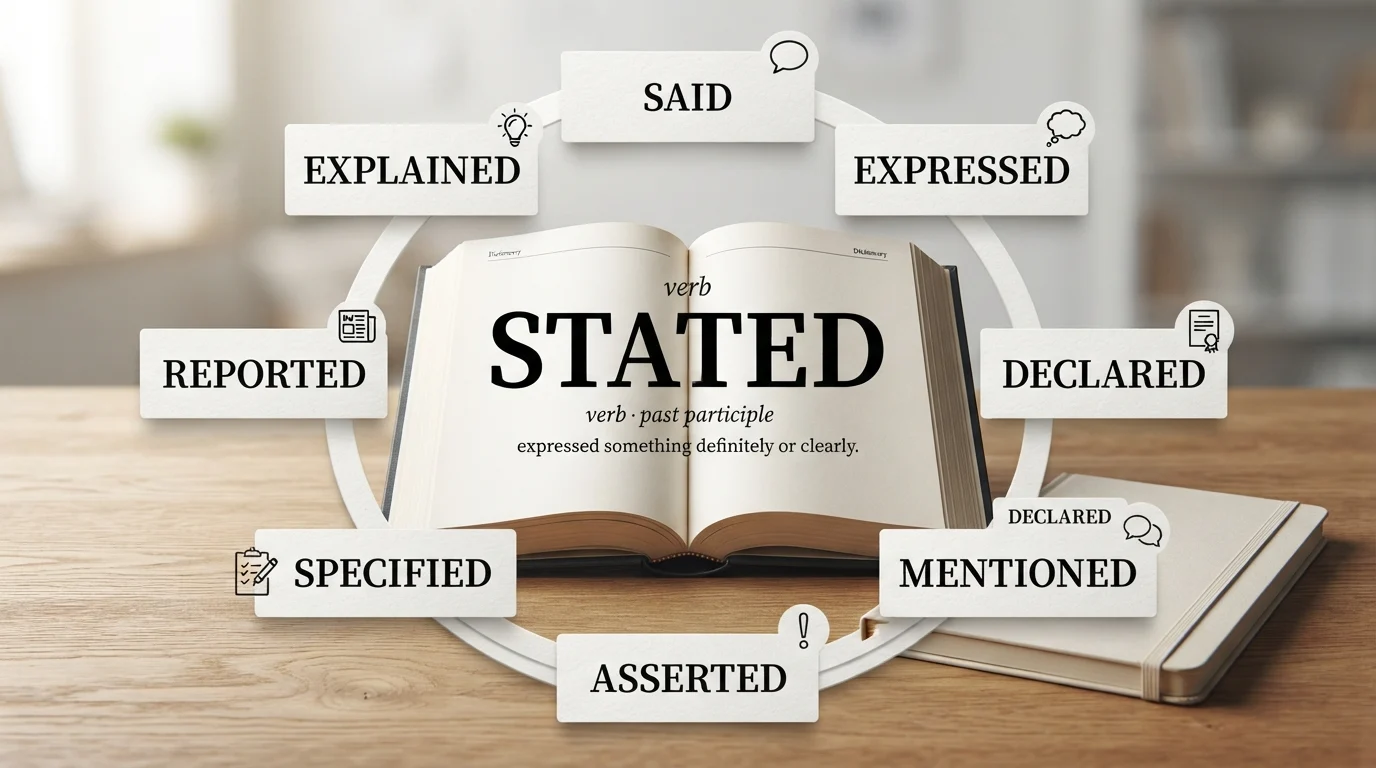
Need another word for stated but want to keep the exact meaning and tone of your sentence? Synonyms for stated include said, expressed, declared, mentioned, explained, specified, asserted, noted, and reported, but these alternatives are not interchangeable in every context.
Stated is the past tense and past participle of state and generally means that someone communicated a fact, opinion, idea, or position clearly. Said is more general and conversational, while expressed often focuses on an idea or feeling. Declared sounds stronger or more formal, mentioned suggests a brief reference, and explained adds the idea of making something clear.
In formal or academic writing, noted or reported may fit when presenting information, while asserted can emphasize a firm claim. Specified is more precise when exact details or requirements are given. If you’re searching for synonyms for stated for essays, schoolwork, professional writing, articles, or everyday English, this guide explains their meanings, differences, tone, and best uses.
Said
Meaning:
Said means that someone spoke or wrote something in words.
Examples:
- She said that the meeting would start soon.
- Tom said he needed more time.
Best use: This is the most common everyday alternative to stated. It is usually less formal.
Expressed
Meaning:
Expressed means that someone clearly shared a thought, feeling, opinion, or idea.
Examples:
- Mia expressed her concern about the change.
- He expressed his opinion during the meeting.
Best use: Use it for thoughts, feelings, opinions, concerns, and ideas.
Declared
Meaning:
Declared means that someone made a clear and often formal or public statement.
Examples:
- The mayor declared the event officially open.
- She declared her support for the new plan.
Best use: Use it when a statement is public, official, firm, or important.
Mentioned
Meaning:
Mentioned means that someone referred to something briefly.
Examples:
- Jake mentioned your name yesterday.
- She mentioned the new schedule in her email.
Best use: Use it when something is brought up briefly rather than explained fully.
Announced
Meaning:
Announced means that someone gave information publicly or officially.
Examples:
- The school announced the new holiday dates.
- They announced the winner after the show.
Best use: Use it for news, decisions, events, results, or information shared with a group.
Asserted
Meaning:
Asserted means that someone stated something strongly and confidently.
Examples:
- He asserted that the report was accurate.
- She asserted her right to speak.
Best use: Use it when the speaker strongly presents something as true.
Reported
Meaning:
Reported means that someone gave information about something they saw, heard, found, or learned.
Examples:
- The team reported a problem with the system.
- Several people reported hearing a loud noise.
Best use: Use it for news, findings, events, problems, results, or information passed to others.
Indicated
Meaning:
Indicated means that something showed or pointed to a fact, idea, or result.
Examples:
- The results indicated a rise in sales.
- His answer indicated that he understood the question.
Best use: Use it when evidence, results, signs, or information point toward something.
Specified
Meaning:
Specified means that someone gave exact details about something.
Examples:
- The form specified the required file size.
- The contract specified a delivery date.
Best use: Use it for exact dates, numbers, limits, rules, conditions, or requirements.
Explained
Meaning:
Explained means that someone made an idea clear by giving details or reasons.
Examples:
- The teacher explained the new rule.
- She explained why the plan had changed.
Best use: Use it when the purpose is to make something easier to understand.
Described
Meaning:
Described means that someone gave details about what a person, place, thing, or event was like.
Examples:
- He described the house as small but comfortable.
- She described what happened at the station.
Best use: Use it when someone gives details or characteristics rather than simply making a statement.
Noted
Meaning:
Noted means that someone pointed out or recorded a fact or detail.
Examples:
- The report noted several safety concerns.
- The teacher noted that the class was quiet.
Best use: Use it often in reports, essays, summaries, and formal observations.
Remarked
Meaning:
Remarked means that someone made a comment about something.
Examples:
- “That was a long day,” she remarked.
- He remarked that the room looked different.
Best use: Use it for a comment or observation, especially in narrative or written English.
Informed
Meaning:
Informed means that someone gave another person information about something.
Examples:
- The manager informed us about the change.
- Please inform me when the package arrives.
Best use: Use it when one person gives information directly to another person.
Notified
Meaning:
Notified means that someone officially told another person about something.
Examples:
- The company notified customers about the delay.
- We were notified of the meeting by email.
Best use: Use it for official notices, alerts, changes, appointments, and decisions.
Advised
Meaning:
Advised means that someone gave guidance or recommended an action.
Examples:
- The doctor advised him to rest.
- My teacher advised me to check my answers.
Best use: Use it when the original statement contains advice rather than simple information.
Told
Meaning:
Told means that someone gave information directly to another person.
Examples:
- She told me about her new job.
- I told him where to find the keys.
Best use: Use it for direct communication with another person. It is common and informal.
Communicated
Meaning:
Communicated means that someone shared information, thoughts, or feelings with others.
Examples:
- The manager communicated the new plan clearly.
- We communicated our concerns to the team.
Best use: Use it when the focus is on sharing information successfully.
Conveyed
Meaning:
Conveyed means that someone communicated an idea, feeling, or message to another person.
Examples:
- Her letter conveyed a sense of hope.
- His voice conveyed his disappointment.
Best use: Use it when the message or feeling is being passed from one person to another.
Voiced
Meaning:
Voiced means that someone openly expressed a thought, feeling, concern, or opinion.
Examples:
- Several workers voiced their concerns.
- She voiced her support for the project.
Best use: Use it when someone speaks openly about an opinion, concern, or feeling.
Uttered
Meaning:
Uttered means that someone spoke a word, sound, or short phrase aloud.
Examples:
- He uttered a quiet apology.
- She barely uttered a word.
Best use: Use it mainly for short spoken words or phrases, not as a general replacement for every use of stated.
Synonyms of With: 60+ Alternatives From Together to Using
Affirmed
Meaning:
Affirmed means that someone clearly confirmed that something was true, correct, or important.
Examples:
- The witness affirmed that the statement was accurate.
- She affirmed her commitment to the project.
Best use: Use it when someone confirms or strongly supports something.
Confirmed
Meaning:
Confirmed means that someone said or showed that information was true or correct.
Examples:
- The hotel confirmed our booking.
- He confirmed that the event was still planned.
Best use: Use it when information is being checked and verified.
Proclaimed
Meaning:
Proclaimed means that someone announced something publicly and strongly.
Examples:
- The leader proclaimed a new holiday.
- She proudly proclaimed her love for the city.
Best use: Use it for strong, public, or formal declarations.
Pronounced
Meaning:
Pronounced means that someone formally said or announced something aloud.
Examples:
- The judge pronounced the final decision.
- The speaker pronounced the words carefully.
Best use: Use it mainly for formal spoken statements, judgments, decisions, or clearly spoken words.
Disclosed
Meaning:
Disclosed means that someone made private, hidden, or previously unknown information known.
Examples:
- The company disclosed its yearly results.
- He disclosed the reason for his absence.
Best use: Use it when information was previously private, secret, or unknown.
Revealed
Meaning:
Revealed means that someone made something previously unknown known.
Examples:
- She revealed the answer at the end.
- The report revealed a serious problem.
Best use: Use it when new information becomes known.
Cited
Meaning:
Cited means that someone referred to a fact, source, example, or reason as support.
Examples:
- The writer cited a study in the essay.
- She cited several reasons for her decision.
Best use: Use it when information is given as evidence or support, especially in academic or formal writing.
Recounted
Meaning:
Recounted means that someone told the details of something that happened.
Examples:
- Grandpa recounted his childhood stories.
- She recounted what happened during the trip.
Best use: Use it for stories, experiences, events, and past experiences.
Related
Meaning:
Related means that someone told or described a story, event, or experience.
Examples:
- He related the story to his friends.
- She related what she had seen that morning.
Best use: Use it mainly when telling a story or describing an experience, not as a general replacement for stated.
Recorded
Meaning:
Recorded means that someone wrote down, stored, or saved information for future use.
Examples:
- The nurse recorded the patient’s temperature.
- He recorded the details in his notebook.
Best use: Use it when information is saved in writing, audio, video, or another form.
Documented
Meaning:
Documented means that someone recorded information as evidence or for future reference.
Examples:
- The researcher documented each result.
- The team documented the changes carefully.
Best use: Use it when information is formally recorded or supported by records.
Stipulated
Meaning:
Stipulated means that someone clearly required or agreed to a specific condition.
Examples:
- The contract stipulated a payment date.
- The agreement stipulated that both sides must sign.
Best use: Use it for formal agreements, contracts, rules, and conditions. It is not a general synonym for everyday speech.
Prescribed
Meaning:
Prescribed means that someone officially ordered, required, or set something to be followed.
Examples:
- The doctor prescribed a new treatment.
- The rules prescribed a specific safety procedure.
Best use: Use it when an authority formally sets an action, treatment, rule, or requirement.
Defined
Meaning:
Defined means that someone clearly explained what a word, idea, or thing means.
Examples:
- The teacher defined the new term.
- The guide defined each key concept.
Best use: Use it when the statement gives a definition rather than general information.
Presented
Meaning:
Presented means that someone formally gave information, an idea, argument, or proposal to others.
Examples:
- She presented her findings to the class.
- The team presented a new plan.
Best use: Use it when information is formally shown or given to an audience.
Proposed
Meaning:
Proposed means that someone suggested an idea or plan for consideration.
Examples:
- She proposed a new solution.
- The group proposed several changes.
Best use: Use it when the original statement is actually a suggestion or plan, not just a neutral fact.
Asserted
Meaning:
Asserted means that someone stated a belief or claim firmly.
Examples:
- The writer asserted that the method was effective.
- He asserted that he had followed the rules.
Best use: Use it when the speaker is firm or confident. Because asserted is already included above, use it as a repeated contextual reminder rather than as a new synonym.
Synonyms for Horrible: 42+ Words From Unpleasant to Horrific
Claimed
Meaning:
Claimed means that someone said something was true, especially when the truth may need proof.
Examples:
- He claimed that he had seen the accident.
- The seller claimed that the phone was brand new.
Best use: Use it when the statement is presented as a claim rather than an established fact.
Alleged
Meaning:
Alleged means that something is said to be true but has not been proven.
Examples:
- The report discussed the alleged mistake.
- The article described the alleged incident.
Best use: Use it carefully because it adds doubt or uncertainty to the statement.
Contended
Meaning:
Contended means that someone argued strongly that something was true.
Examples:
- The writer contended that the plan needed changes.
- The lawyer contended that the evidence was weak.
Best use: Use it mainly in formal arguments, essays, legal writing, and debates.
Posited
Meaning:
Posited means that someone suggested an idea as a possible explanation or theory.
Examples:
- The scientist posited a new explanation.
- The writer posited that the trend could continue.
Best use: Use it for theories, explanations, or ideas being offered for consideration.
Put Forth
Meaning:
Put forth means that someone presented an idea, opinion, argument, or proposal.
Examples:
- She put forth a new idea at the meeting.
- The group put forth several possible solutions.
Best use: Use it when someone formally or openly presents an idea or proposal.
Laid Out
Meaning:
Laid out means that someone presented information, plans, or ideas in a clear order.
Examples:
- The report laid out the main facts.
- He laid out his plan for the project.
Best use: Use it when information is organized and presented clearly.
Spelled Out
Meaning:
Spelled out means that someone explained something very clearly and completely.
Examples:
- The teacher spelled out the instructions.
- The email spelled out what we needed to do.
Best use: Use it when the writer or speaker makes every important detail clear.
Pointed Out
Meaning:
Pointed out means that someone drew attention to a particular fact or detail.
Examples:
- She pointed out a mistake in the report.
- He pointed out that the door was open.
Best use: Use it when the purpose is to draw attention to something specific.
Observed
Meaning:
Observed means that someone made a comment after noticing something.
Examples:
- The teacher observed that the class was unusually quiet.
- He observed that the weather had changed.
Best use: Use it for comments based on something someone noticed or saw.
Emphasized
Meaning:
Emphasized means that someone gave extra importance to a particular point.
Examples:
- The coach emphasized the need for teamwork.
- She emphasized that everyone should arrive early.
Best use: Use it when the speaker wants the reader or listener to pay special attention to a point.
Stressed
Meaning:
Stressed means that someone strongly highlighted something important.
Examples:
- The doctor stressed the value of regular exercise.
- Our teacher stressed the importance of careful reading.
Best use: Use it when importance or urgency is being strongly highlighted.
Highlighted
Meaning:
Highlighted means that someone gave special attention to an important fact, issue, or idea.
Examples:
- The report highlighted several safety concerns.
- She highlighted the main points during the meeting.
Best use: Use it when an important part needs special attention.
Maintained
Meaning:
Maintained means that someone continued to say that something was true.
Examples:
- He maintained that he had followed the rules.
- The company maintained that the product was safe.
Best use: Use it when someone continues to defend or support the same position, especially during disagreement.
Reiterated
Meaning:
Reiterated means that someone stated the same point again to make it clear or important.
Examples:
- The manager reiterated the safety rules.
- She reiterated her request before leaving.
Best use: Use it when a person repeats a previous statement for emphasis or clarity.
Testified
Meaning:
Testified means that someone formally gave information or evidence, especially in a legal setting.
Examples:
- The witness testified in court.
- She testified that she had seen the event.
Best use: Use it for formal evidence or statements given under an official process.
Referred To
Meaning:
Referred to means that someone mentioned or pointed to a person, thing, fact, or idea.
Examples:
- The teacher referred to the earlier lesson.
- He referred to the report during the meeting.
Best use: Use it when someone points back to existing information rather than making a completely new statement.
How to Choose the Right Synonym for Stated
Not every synonym for stated works in every sentence. The best word depends on what you want the sentence to mean.
| What you mean | Useful choice |
|---|---|
| Simple everyday speech | Said |
| A thought, feeling, or opinion | Expressed |
| A formal or public statement | Declared |
| A brief reference | Mentioned |
| News or official information | Announced |
| A strong or confident claim | Asserted |
| Exact details or conditions | Specified |
| Information from an event or result | Reported |
| Making an idea clear | Explained |
| Giving descriptive details | Described |
| A formal observation | Noted |
| Official information given to someone | Informed |
| An official notice | Notified |
| Advice or guidance | Advised |
| A private fact made known | Disclosed |
| New information made known | Revealed |
| Evidence or supporting information | Cited |
| A story or past event | Recounted |
| A formal condition | Stipulated |
| A formal requirement | Prescribed |
| A definition | Defined |
| A suggested plan | Proposed |
| A strong argument | Contended |
| A possible theory or explanation | Posited |
| A repeated position | Maintained |
| A repeated statement | Reiterated |
| Formal evidence in court | Testified |
Stated vs. Said
Stated and said are very close, but they do not always have the same tone.
Said is the normal choice for everyday speech.
Stated sounds more deliberate and formal. It is common in reports, essays, professional writing, official documents, and formal statements.
Example:
- She said that she was ready.
- She stated that she was ready.
Both are correct, but the second sounds more formal.
Stated vs. Mentioned
Stated usually suggests that information was clearly given.
Mentioned usually means that something was brought up briefly.
Example:
- He stated the reason for the delay.
- He mentioned the delay during the conversation.
The first focuses on clear information. The second focuses on briefly bringing up the subject.
Stated vs. Declared
Stated means that something was expressed clearly.
Declared usually adds a sense of formality, authority, publicity, or firmness.
Example:
- The leader stated the goal.
- The leader declared the goal publicly.
Use declared when the statement has a stronger public or official quality.
Stated vs. Explained
Stated gives information clearly.
Explained gives information in a way that helps someone understand it.
Example:
- The teacher stated the rule.
- The teacher explained the rule with an example.
If the sentence focuses on understanding, explained is usually more precise.
Stated vs. Asserted
Stated is relatively neutral.
Asserted is stronger and suggests confidence or firmness.
Example:
- She stated that the method worked.
- She asserted that the method worked.
The second sentence shows a stronger commitment to the claim.
Stated vs. Specified
Stated can give general information.
Specified gives exact details.
Example:
- The email stated the deadline.
- The email specified Friday as the deadline.
Use specified when exact details such as dates, numbers, limits, or conditions matter.
Stated vs. Claimed
Stated is neutral.
Claimed can suggest that the information is an assertion that may need proof.
Example:
- He stated that he was at home.
- He claimed that he was at home.
The second sentence can make the reader more cautious about whether the statement is true.
Stated vs. Alleged
Stated does not automatically suggest doubt.
Alleged specifically indicates that something has been said or reported but is not established as proven.
Example:
- The report stated that a problem occurred.
- The report discussed the alleged problem.
Do not use alleged simply because you want another word for stated. It changes the meaning.
Common Mistakes When Using Synonyms for Stated
Using every synonym as if it means exactly the same thing
Words such as said, mentioned, declared, specified, asserted, and explained overlap, but each has its own use.
Choose the word that matches the actual meaning of the sentence.
Using “prescribed” for ordinary speech
Prescribed usually means officially ordered or set as a requirement.
It is not a natural replacement for:
She stated her opinion.
Use expressed instead if the meaning is about an opinion.
Using “alleged” when there is no uncertainty
Alleged adds the idea that something has not been proven.
If you simply mean that someone gave information, use said, stated, reported, or another accurate alternative.
Using “asserted” for a neutral statement
Asserted sounds stronger than stated.
If the speaker is simply giving information, stated or said may be more accurate.
Using “mentioned” when the information was detailed
Mentioned usually suggests a brief reference.
If someone gave a full explanation, explained or described may be better.
Using “specified” when exact details are not involved
Specified works best for exact information such as dates, numbers, rules, conditions, or requirements.
For a general statement, stated may be more natural.
Frequently Asked Questions
What is the simplest synonym for stated?
The simplest synonym for stated is said. It is natural, common, and suitable for many everyday sentences.
What is a formal synonym for stated?
Useful formal alternatives include declared, asserted, specified, noted, reported, affirmed, and pronounced, depending on the meaning.
Is said the same as stated?
They are very close, but said is more common and conversational, while stated often sounds more formal and deliberate.
What is another word for stated in an essay?
Depending on the sentence, you can use argued, explained, noted, indicated, expressed, asserted, or reported. The best choice depends on what the writer is actually doing.
What is another word for stated clearly?
Good choices include specified, explained, clarified, spelled out, and set out. Choose the word that matches whether the sentence gives exact details or simply makes an idea easier to understand.
Is mentioned a synonym for stated?
Sometimes, but not always. Mentioned usually means that something was brought up briefly, while stated usually suggests that information was clearly given.
Which synonym for stated should I use in formal writing?
Choose according to meaning. Noted works well for observations, specified for exact details, asserted for strong claims, reported for findings, and declared for formal or public statements.
Conclusion
Learning synonyms for stated gives you more control over your writing. You can use said for everyday speech, expressed for feelings and opinions, declared for formal announcements, specified for exact details, and asserted for strong claims. These choices can improve essays, blogs, emails, reports, and daily conversations. The key is not to replace stated with a random synonym. Choose the word that gives your sentence the exact meaning and tone you want. Practice these words in emails, essays, and daily conversations, and your English will become clearer and more precise.