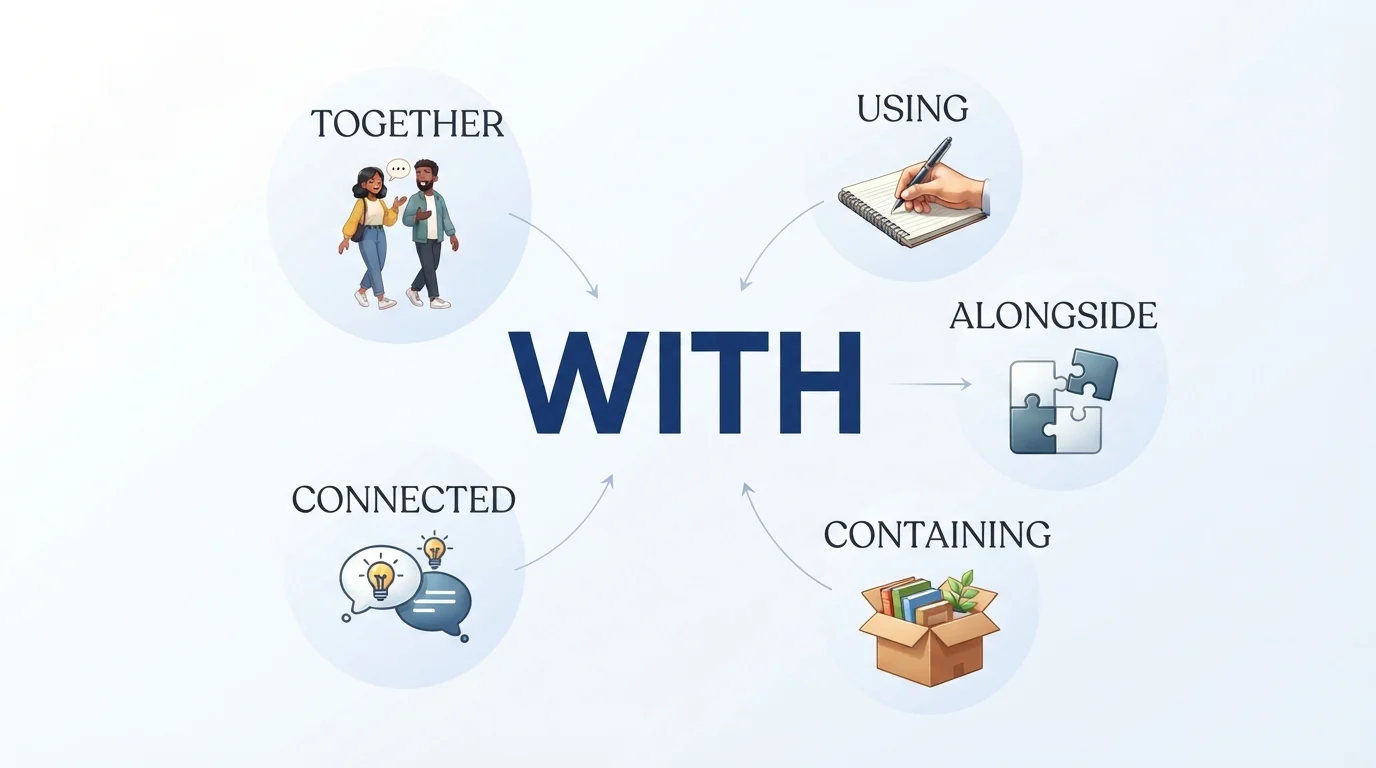
Need another word for with but want to keep your sentence grammatically correct? Synonyms of with are highly context-dependent because with can express company, possession, tools, methods, association, or addition.
Possible replacements include alongside, together with, using, through, accompanied by, and that has, but these are not interchangeable in every sentence. For example, “She went with her friend” may become “She went alongside her friend,” while “He cut the paper with a knife” can become “He cut the paper using a knife.” In “a house with a garden,” however, that has may be a more natural replacement than a single synonym.
Likewise, “I agree with you” does not always have a natural one-word substitute. Because with performs several grammatical functions, choosing the right alternative depends on the exact meaning and structure of your sentence. If you’re searching for synonyms of with for essays, schoolwork, professional writing, or everyday English, this guide explains their meanings, differences, and best uses.
Together
Meaning:
Together means being in the same place or doing something as a group.
Examples:
- We studied together after school.
- They traveled together last year.
Alongside
Meaning:
Alongside means next to or together with someone or something.
Examples:
- She walked alongside her brother.
- A small café stands alongside the library.
Beside
Meaning:
Beside means next to someone or something.
Examples:
- I sat beside my cousin.
- The bag is beside the chair.
By
Meaning:
By can mean next to someone or something in certain sentences.
Examples:
- She sat by her mother.
- He waited by the door.
Accompanied by
Meaning:
Accompanied by means going or being somewhere together with another person or thing.
Examples:
- The singer arrived accompanied by her manager.
- The child was accompanied by his father.
Escorted by
Meaning:
Escorted by means going somewhere with someone who guides or protects you.
Examples:
- The guest was escorted by a security officer.
- The children were escorted by their teacher.
Together
Meaning:
Together can show that people or things are joined or used at the same time.
Examples:
- Mix the two ingredients together.
- The sisters worked together on the project.
Jointly
Meaning:
Jointly means done by two or more people or groups together.
Examples:
- They jointly organized the event.
- The two teams jointly created the plan.
Collectively
Meaning:
Collectively means as a group rather than separately.
Examples:
- The students collectively chose a topic.
- The team collectively made the decision.
In tandem
Meaning:
In tandem means working together at the same time.
Examples:
- The two departments worked in tandem.
- Good planning and practice work in tandem.
Using
Meaning:
Using means doing something by means of a tool, object, or method.
Examples:
- She opened the box using a key.
- He fixed the shelf using simple tools.
Via
Meaning:
Via means by way of a particular route, method, or communication channel.
Examples:
- Please send the file via email.
- We traveled via Istanbul.
Through
Meaning:
Through can show the method or means used to achieve something.
Examples:
- She learned English through practice.
- We found the answer through careful research.
By means of
Meaning:
By means of means using a particular method or tool.
Examples:
- The door was opened by means of a special key.
- They solved the problem by means of careful planning.
By way of
Meaning:
By way of means using a particular route or method.
Examples:
- We reached the village by way of the mountain road.
- She introduced the topic by way of a short story.
Employing
Meaning:
Employing means using a particular method, tool, or skill.
Examples:
- The artist created the effect employing simple brushes.
- The team solved the issue employing a new method.
Utilizing
Meaning:
Utilizing means using something for a useful purpose.
Examples:
- The school is utilizing digital tools.
- She is utilizing her free time to study.
With the use of
Meaning:
With the use of means by using a particular tool or method.
Examples:
- The image was enlarged with the use of special software.
- He measured the table with the use of a tape measure.
Through the use of
Meaning:
Through the use of means by using a particular tool or method.
Examples:
- The message was shared through the use of social media.
- The students learned through the use of videos.
By using
Meaning:
By using means through the action of using something.
Examples:
- You can save time by using a checklist.
- She opened the package by using scissors.
By applying
Meaning:
By applying means through the use of a rule, method, or idea.
Examples:
- You can improve your writing by applying these tips.
- He solved the problem by applying a simple rule.
Containing
Meaning:
Containing means having something inside.
Examples:
- I found a box containing old letters.
- She bought a drink containing fresh fruit.
Including
Meaning:
Including means having someone or something as part of a group or amount.
Examples:
- Everyone joined the trip, including Mia.
- The price covers everything, including breakfast.
Featuring
Meaning:
Featuring means having someone or something as an important or noticeable part.
Examples:
- The magazine published an article featuring young writers.
- The menu has a special dish featuring fresh seafood.
Synonyms for Energy: 56+ Words Across Different Meanings
Having
Meaning:
Having can replace with when it describes a person, place, or thing that possesses or includes something.
Examples:
- We rented a house having three bedrooms.
- They chose a car having better safety features.
Possessing
Meaning:
Possessing means having or owning something, especially a quality or valuable item.
Examples:
- She is known for possessing great patience.
- The museum displays a painting possessing unusual detail.
Carrying
Meaning:
Carrying means having something with you while moving.
Examples:
- He entered the room carrying a backpack.
- She walked home carrying a basket.
Bearing
Meaning:
Bearing means carrying or showing something.
Examples:
- The letter arrived bearing his name.
- The package was bearing a fragile label.
Equipped
Meaning:
Equipped means supplied with the tools or features needed for a purpose.
Examples:
- The kitchen is equipped with modern appliances.
- The car comes equipped with safety features.
Adorned by
Meaning:
Adorned by means made more attractive by having something added.
Examples:
- The hall was adorned by colorful flowers.
- The dress was adorned by small silver details.
Surrounded by
Meaning:
Surrounded by means having people or things all around something.
Examples:
- The house is surrounded by tall trees.
- She stood surrounded by her friends.
Covered by
Meaning:
Covered by means having something spread over or placed on top of it.
Examples:
- The ground was covered by fresh snow.
- The table was covered by a clean cloth.
Filled by
Meaning:
Filled by means made full because something occupies the space.
Examples:
- The hall was filled by excited students.
- The room was filled by the sound of music.
Marked by
Meaning:
Marked by means showing a clear feature or quality.
Examples:
- Her speech was marked by confidence.
- The year was marked by major changes.
Characterized by
Meaning:
Characterized by means having a particular quality that clearly describes something.
Examples:
- The area is characterized by quiet streets.
- His writing is characterized by simple language.
Defined by
Meaning:
Defined by means strongly described or shaped by a particular feature.
Examples:
- Her style is defined by clean lines.
- The town is defined by its old buildings.
Known for
Meaning:
Known for means recognized because of a particular quality or feature.
Examples:
- The city is known for its beautiful parks.
- She is known for her honest advice.
Noted for
Meaning:
Noted for means known or respected because of a particular quality.
Examples:
- The restaurant is noted for fresh food.
- The writer is noted for simple storytelling.
Characteristic of
Meaning:
Characteristic of means typical of a person, place, or thing.
Examples:
- Bright colors are characteristic of her artwork.
- Quiet streets are characteristic of the village.
Associated with
Meaning:
Associated with means connected in people’s thoughts or experience.
Examples:
- Spring is often associated with new beginnings.
- Blue is commonly associated with calmness.
Connected to
Meaning:
Connected to means joined or related to someone or something.
Examples:
- The printer is connected to my laptop.
- The problem is connected to poor planning.
Linked to
Meaning:
Linked to means having a connection with something.
Examples:
- The delay was linked to bad weather.
- The account is linked to her phone.
Synonyms for Development: 49+ Words for Growth, Change & Creation
Related to
Meaning:
Related to means connected with a subject, person, or idea.
Examples:
- This lesson is related to grammar.
- Her research is related to education.
Concerning
Meaning:
Concerning means about or connected to a particular subject.
Examples:
- I have a question concerning the meeting.
- She sent a message concerning the new rule.
Regarding
Meaning:
Regarding means about a particular topic or matter.
Examples:
- I emailed you regarding the schedule.
- She asked a question regarding the assignment.
About
Meaning:
About means concerning or relating to a subject.
Examples:
- We talked about the new project.
- I have a question about your idea.
In relation to
Meaning:
In relation to means connected with or concerning something.
Examples:
- The rule was changed in relation to safety.
- She asked for help in relation to her project.
In connection with
Meaning:
In connection with means relating to or linked to something.
Examples:
- He called me in connection with the job.
- The notice was sent in connection with the event.
Compared with
Meaning:
Compared with means considered alongside another thing to see similarities or differences.
Examples:
- This phone is small compared with my old one.
- Today’s test was easy compared with yesterday’s.
Versus
Meaning:
Versus means against or compared with another person or thing.
Examples:
- The debate was about quality versus price.
- The article compares online learning versus classroom learning.
And
Meaning:
And can replace with when two things or people are simply joined in a sentence.
Examples:
- She bought bread and milk.
- Tom and Sara joined the meeting.
Plus
Meaning:
Plus means added to something else.
Examples:
- The package includes a notebook plus a pen.
- We need two chairs plus a small table.
In addition to
Meaning:
In addition to means added to something that already exists.
Examples:
- In addition to English, she studies French.
- He bought fruit in addition to bread.
Alongside of
Meaning:
Alongside of means next to or together with someone or something.
Examples:
- The new building stands alongside of the old school.
- She worked alongside of experienced teachers.
FAQ
What are the best synonyms of with?
There is no single synonym that works in every sentence. Depending on the meaning, useful alternatives include together, alongside, beside, accompanied by, using, via, through, containing, including, regarding, about, and connected to.
Why does with have so many synonyms?
With is used for several different relationships. It can show company, a tool or method, possession, inclusion, description, connection, or comparison. Because the meaning changes, the best alternative changes too.
What can I use instead of with for people?
When with means being together with someone, you can often use alongside, beside, accompanied by, together, or escorted by. The best choice depends on the sentence.
What can I use instead of with for tools?
When with names the tool used to do something, alternatives include using, via, through, by means of, employing, and by using.
For example:
She opened it with a key.
can become:
She opened it using a key.
What can I use instead of with in formal writing?
Depending on the meaning, formal choices can include regarding, concerning, in relation to, in connection with, by means of, and characterized by. Choose the phrase that keeps the original meaning.
Is every synonym of with interchangeable?
No. This is one of the most important points to remember. A word such as using can replace with when it shows a tool, but it cannot replace with when with means company.
For example:
She went with her sister.
does not become:
She went using her sister.
How can I choose the right synonym for with?
First, ask what with means in your sentence. Does it show a person, tool, possession, addition, connection, or comparison? Once you know the meaning, choose an alternative that expresses the same idea.
Conclusion
Learning the synonyms of with is not about memorizing a long word list. It is about understanding what with means in each sentence and choosing the right alternative. This can make your writing clearer, your blog posts less repetitive, and your everyday English more natural. Practice these words in emails, essays, articles, and daily conversations. Start with simple choices such as alongside, using, via, about, together, and regarding. With regular practice, choosing the right word becomes much easier.

I am Professor Emily Clarke, a language researcher and vocabulary enthusiast passionate about making English words easier to understand. I write clear, practical guides to help readers improve their vocabulary, grammar, and everyday writing.







