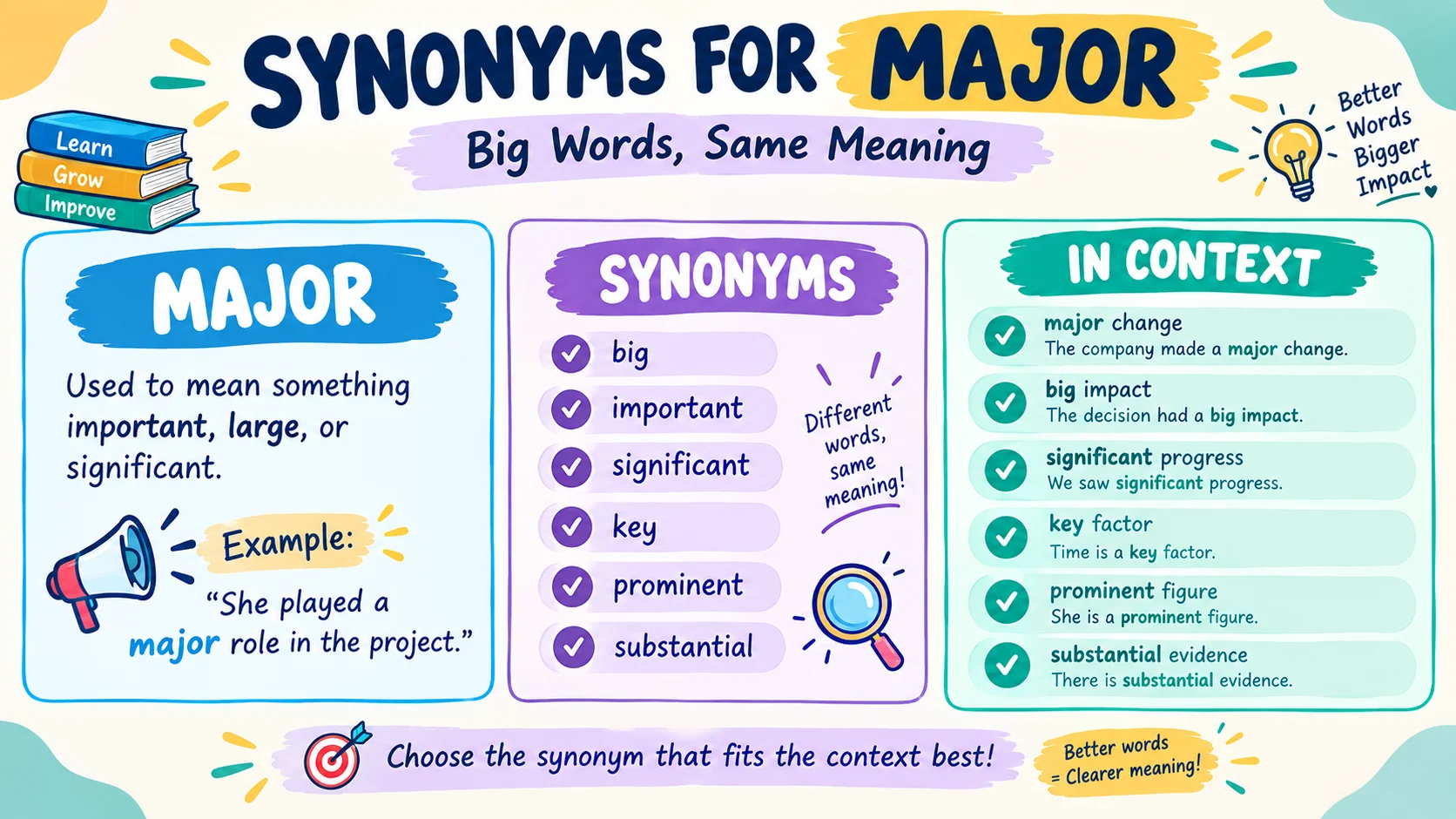
Looking for another word for “major” without changing the meaning of your sentence? The best synonyms for major depend on what you are describing. Major can mean important, large in scale, serious, or the main part of something, so one replacement will not fit every situation.
Useful alternatives include important, significant, substantial, considerable, serious, primary, principal, central, prominent, leading, and substantial. However, these words have different shades of meaning. Important and significant emphasize importance, substantial and considerable can describe a large amount or degree, serious often fits problems or situations, while primary and principal emphasize what is most important. Prominent and leading can describe people, organizations, or things with an important position.
For example, a major problem can be a serious problem, a major change can be a significant change, and a major investment can be a substantial investment. This guide explains which alternatives fit different contexts, including essays, professional writing, and everyday English.
Important
Meaning: Important means having a lot of value or needing attention.
Examples:
- Your health is important to your family.
- This is an important part of the plan.
Significant
Meaning: Significant means important enough to have a clear effect.
Examples:
- The new rule caused a significant change.
- She made significant progress this year.
Main
Meaning: Main means the most important part or reason.
Examples:
- The main reason was the high cost.
- What is the main problem?
Primary
Meaning: Primary means first or most important.
Examples:
- Safety is our primary concern.
- Her primary goal is to finish college.
Principal
Meaning: Principal means the main or most important part of something.
Examples:
- The principal cause was poor planning.
- Trust is a principal part of their agreement.
Chief
Meaning: Chief means the most important among several things.
Examples:
- Money was the chief reason for his decision.
- Her chief concern was her child’s safety.
Key
Meaning: Key means very important to a result or situation.
Examples:
- Good communication is key to teamwork.
- Timing played a key role in the decision.
Central
Meaning: Central means very important to the main idea or purpose.
Examples:
- Family is central to his life.
- Trust is central to a strong friendship.
Crucial
Meaning: Crucial means extremely important to success or failure.
Examples:
- Good planning is crucial for the event.
- Her support was crucial to our success.
Critical
Meaning: Critical means extremely important and often needing quick attention.
Examples:
- Clean water is critical for every community.
- We reached a critical point in the project.
Essential
Meaning: Essential means absolutely needed or very important.
Examples:
- Sleep is essential for good health.
- Clear instructions are essential for new workers.
Vital
Meaning: Vital means extremely important or necessary.
Examples:
- Fresh air is vital for life.
- Her advice was vital to our plan.
Fundamental
Meaning: Fundamental means basic and very important.
Examples:
- Respect is a fundamental part of friendship.
- Reading is a fundamental skill for students.
Notable
Meaning: Notable means important or unusual enough to be noticed.
Examples:
- The team made a notable improvement.
- Her work had a notable effect on the community.
Consequential
Meaning: Consequential means likely to have an important effect.
Examples:
- It was a consequential decision for the company.
- The vote could have consequential results.
Considerable
Meaning: Considerable means fairly large or important in amount or degree.
Examples:
- The repair caused considerable expense.
- He has considerable experience in teaching.
Substantial
Meaning: Substantial means large or important in amount, size, or effect.
Examples:
- The project needs substantial funding.
- She made a substantial contribution to the team.
Sizeable
Meaning: Sizeable means fairly large in size or amount.
Examples:
- They received a sizeable payment.
- The store has a sizeable customer base.
Large
Meaning: Large means big in size, amount, number, or scale.
Examples:
- The school has a large student population.
- They faced a large increase in costs.
Big
Meaning: Big is an informal word for something large or important.
Examples:
- This is a big decision for our family.
- The company announced a big change.
Great
Meaning: Great can mean very large, strong, or important.
Examples:
- The decision had a great effect on the team.
- She showed great courage during the crisis.
Huge
Meaning: Huge means very large in size, amount, or degree.
Examples:
- The news had a huge impact on the market.
- We saw a huge change in the neighborhood.
Enormous
Meaning: Enormous means extremely large.
Examples:
- The project required an enormous amount of work.
- The storm caused enormous damage.
Massive
Meaning: Massive means extremely large, heavy, or extensive.
Examples:
- The company faced a massive loss.
- A massive crowd gathered outside.
Immense
Meaning: Immense means extremely large or great.
Examples:
- She felt immense joy after winning.
- The project required immense effort.
Extensive
Meaning: Extensive means large in size, range, or amount.
Examples:
- The company has extensive experience overseas.
- We did extensive research before starting.
Broad
Meaning: Broad means covering a large range or area.
Examples:
- The course gives a broad view of history.
- We need a broad plan for the future.
Sweeping
Meaning: Sweeping means affecting a large area, group, or range.
Examples:
- The government introduced sweeping reforms.
- The new policy brought sweeping changes.
Profound
Meaning: Profound means very deep or having a strong effect.
Examples:
- The experience had a profound effect on her.
- Education can bring profound changes to a community.
Serious
Meaning: Serious means important, harmful, or needing careful attention.
Examples:
- The doctor found a serious problem.
- We need to have a serious discussion.
Severe
Meaning: Severe means very serious, strong, or harmful.
Examples:
- The storm caused severe damage.
- The company faced severe financial problems.
Pressing
Meaning: Pressing means very important and needing attention soon.
Examples:
- Housing is a pressing issue in the city.
- We need to solve this pressing problem.
Acute
Meaning: Acute means very serious or severe, often for a short period.
Examples:
- The region faced an acute water shortage.
- The hospital was dealing with an acute shortage of beds.
68+ Synonyms for Communication: From Talk to Transmission
Pivotal
Meaning: Pivotal means extremely important to what happens next.
Examples:
- Her decision was pivotal to the team’s success.
- This meeting could be pivotal for the company.
Decisive
Meaning: Decisive means having a strong effect on the final result.
Examples:
- His goal was decisive in the final match.
- The evidence played a decisive role in the case.
Influential
Meaning: Influential means having the power to affect people, ideas, or events.
Examples:
- She became an influential writer.
- His work was influential in modern design.
Prominent
Meaning: Prominent means important, well known, or easy to notice.
Examples:
- He is a prominent figure in the industry.
- The building has a prominent place in the city.
Leading
Meaning: Leading means being one of the most important or successful.
Examples:
- She is a leading expert in her field.
- The company is a leading name in technology.
Dominant
Meaning: Dominant means more powerful, noticeable, or important than others.
Examples:
- The company has a dominant position in the market.
- Blue is the dominant color in the painting.
Foremost
Meaning: Foremost means first in importance.
Examples:
- Her foremost priority is her children.
- Safety is the foremost concern.
Paramount
Meaning: Paramount means more important than anything else.
Examples:
- Customer safety is paramount.
- Accuracy is paramount in this kind of work.
Preeminent
Meaning: Preeminent means more important, successful, or respected than others.
Examples:
- He is a preeminent scholar in his field.
- The university is a preeminent center for research.
Momentous
Meaning: Momentous describes something very important with lasting effects.
Examples:
- It was a momentous day for the country.
- She made a momentous choice about her future.
Weighty
Meaning: Weighty means important or serious, especially in formal writing.
Examples:
- The judge had to make a weighty decision.
- They discussed several weighty matters.
Material
Meaning: Material means important enough to affect a decision or result.
Examples:
- The report revealed a material change in costs.
- The mistake had a material effect on the results.
Meaningful
Meaning: Meaningful means important because it has value or a strong effect.
Examples:
- Her words had a meaningful impact on me.
- The meeting led to meaningful progress.
Predominant
Meaning: Predominant means greater or more noticeable than others.
Examples:
- Farming is the predominant industry in the area.
- Blue was the predominant color in the room.
Prime
Meaning: Prime means most important, useful, or suitable.
Examples:
- This is a prime example of good design.
- Location is a prime concern for buyers.
Core
Meaning: Core means central and very important to something.
Examples:
- Honesty is a core value of the company.
- Writing is a core skill for bloggers.
Drastic
Meaning: Drastic means very strong or extreme and likely to cause a major change.
Examples:
- The company made drastic changes to its budget.
- We need drastic action to solve the problem.
Context-Based Synonyms for Major
Not every synonym above works in every sentence. Major has several meanings, so the best alternative depends on context.
Synonyms for Major Impact
When major impact means a strong or important effect, you can use:
- significant impact
- substantial impact
- considerable impact
- profound impact
- powerful impact
- far-reaching impact
- meaningful impact
For example:
The new technology had a significant impact on education.
Synonyms for Major and Minor
Major and minor are often opposites.
Major can mean important, serious, or large. Minor usually means less important, less serious, or smaller.
| Context | Major | Minor |
|---|---|---|
| Problem | serious problem | small problem |
| Change | significant change | slight change |
| Role | key role | small role |
| Injury | serious injury | slight injury |
| Mistake | serious mistake | small mistake |
Synonyms for Major Key
The phrase major key can have different meanings.
If you mean an important factor, natural alternatives include:
- key factor
- crucial factor
- primary factor
- main factor
- important factor
If you mean major key in music, it is a specific musical term and should not be replaced simply because you are looking for a synonym for the word “major.”
Synonyms for Major Change
Useful alternatives for major change include:
- significant change
- substantial change
- drastic change
- sweeping change
- profound change
- considerable change
The choice depends on the type of change. Drastic suggests a strong or extreme change, while sweeping suggests that the change affects many areas.
Synonyms for Major Issue
For major issue, natural alternatives include:
- serious issue
- significant issue
- critical issue
- pressing issue
- important concern
- central issue
Use pressing when the issue needs attention soon. Use critical when the issue is extremely important or serious.
Synonyms for Major Problem
For major problem, you can use:
- serious problem
- significant problem
- critical problem
- severe problem
- pressing problem
- substantial problem
For example:
Poor communication became a serious problem for the team.
Synonyms for Major Role
If someone has a major role, they have an important part in an event, project, or result.
Useful alternatives include:
- important role
- key role
- central role
- crucial role
- pivotal role
- primary role
- leading role
For example:
Teachers play a key role in helping students learn.
Another Word for Major Cause
If major cause means the main reason something happened, use:
- main cause
- primary cause
- principal cause
- chief cause
- leading cause
- significant cause
For example:
Lack of sleep was the main cause of his poor performance.
Synonyms for Majorly
Majorly is common in casual speech, but it can sound awkward in formal English.
Depending on the sentence, better choices include:
- greatly
- significantly
- considerably
- substantially
- seriously
- largely
For example:
Casual: Prices increased majorly.
Formal: Prices increased significantly.
Major Synonym Formal
For formal writing, useful alternatives to major include:
- significant
- substantial
- considerable
- primary
- principal
- crucial
- consequential
- paramount
Choose the word based on meaning rather than replacing major automatically.
Another Word for Major in College
In college, major has a special meaning. It refers to the main subject or field a student chooses to study.
For example:
My major is English.
In this context, related terms include field of study, academic discipline, subject, and specialization. These words can describe the idea, but they are not always exact replacements for major.
Synonyms for Major in English
The best synonym depends on the meaning.
If major means important, use:
important, significant, crucial, key, vital, or notable.
If it means large, use:
large, huge, substantial, sizeable, massive, or extensive.
If it means serious, use:
serious, severe, critical, acute, or pressing.
If it means the main part, use:
main, primary, principal, chief, or central.
Major Antonyms
Common antonyms of major include:
- minor
- small
- insignificant
- unimportant
- secondary
- slight
- limited
The correct antonym depends on the meaning.
For example:
major problem → minor problem
But:
major change → slight change
And:
major role → minor role
Major Synonym and Antonym
A synonym has a similar meaning, while an antonym has an opposite meaning.
Common synonyms for major include important, significant, primary, substantial, key, crucial, and main.
Common antonyms include minor, insignificant, small, secondary, and unimportant.
Always check the sentence before choosing a replacement because major can describe importance, size, seriousness, influence, or a college field.
48+ Synonyms for Consistent: Words for Steady, Reliable & More
Frequently Asked Questions
What are the 7 major synonyms?
There is no single official list of seven synonyms. Seven common alternatives are important, significant, main, primary, crucial, substantial, and key. Each fits different contexts.
Is “main” a synonym of “major”?
Yes, when major means the most important or central. For example, “the major reason” and “the main reason” can have the same meaning. However, main does not cover every meaning of major.
What is a synonym for “large” or “major”?
When major means large, useful alternatives include large, big, huge, enormous, massive, immense, sizeable, substantial, and considerable.
What is another word for “major” or “important”?
Useful alternatives include significant, important, key, crucial, vital, essential, primary, notable, and consequential. The best choice depends on the sentence.
What is a formal synonym for major?
Formal alternatives include significant, substantial, considerable, consequential, primary, principal, crucial, and paramount. Use the one that matches the exact meaning.
What is another word for a major problem?
You can say serious problem, significant problem, critical problem, severe problem, pressing problem, or substantial problem.
What is the opposite of major?
The most common opposite is minor. Other opposites can include small, insignificant, secondary, slight, and unimportant, depending on the meaning.
Conclusion
Learning synonyms for major gives you more control over your writing and speaking. Instead of repeating “major,” you can choose significant for importance, substantial for size or amount, crucial for strong importance, or serious for difficult situations. Students can use these words in essays, while bloggers and content writers can make their articles more natural. Practice them in emails, schoolwork, blog posts, and daily conversations. The goal is not to use the fanciest word—it is to choose the right word for the meaning.

I am Joseph Clark, a vocabulary and language content writer at SynonymLibrary.com. I create clear, practical synonym guides that help readers improve their writing, word choice, and communication skills. My goal is to make language learning simple, accurate, and useful for students, writers, professionals, and everyday learners.







