There isn’t one perfect synonym for “this”—and that’s exactly why replacing it can be tricky. Depending on the sentence, “this” can identify a specific person, thing, idea, situation, or point that is close to the speaker or currently being discussed.
You may be able to replace it with that, the, these, such, the aforementioned, or a more specific noun or phrase, but the right choice depends on grammar and context. For example, “This book is useful” might become “The book is useful” when the book is already clear from context, while “This is my favorite” could become “That is my favorite” when referring to something more removed from the immediate context.
If you’re searching for synonyms of this, you may want to avoid repetition or find a clearer alternative for an essay, academic paper, article, report, professional writing, or everyday sentence. This guide covers 50+ alternatives, related words, and sentence-rewriting options, organized by grammatical use and context, with clear explanations and natural examples to help you choose the right replacement.
What Are the Best Synonyms of “This”?
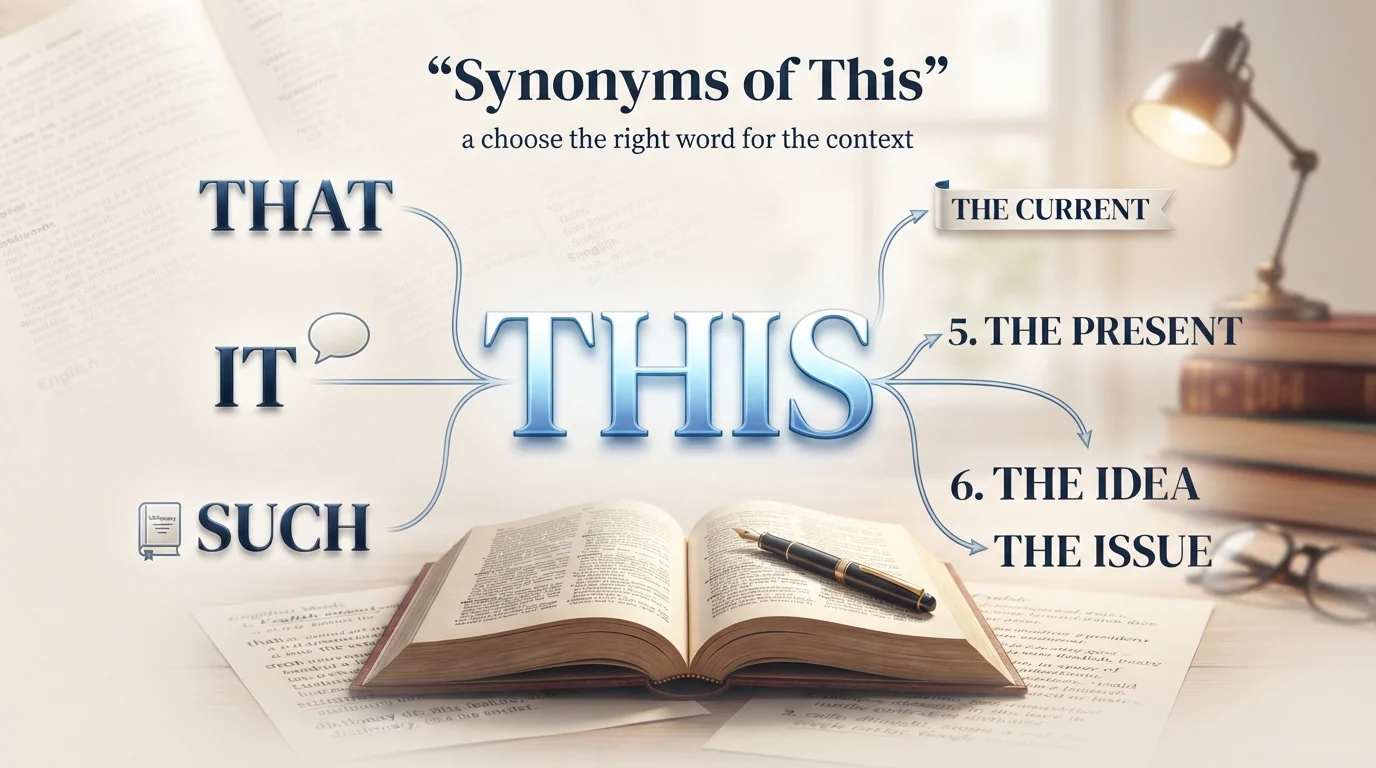
Common alternatives and context-based replacements for “this” include that, it, such, the current, the present, the same, the mentioned, the above, the idea, the point, the issue, the situation, and the matter. However, the correct replacement depends on the sentence. “This” can work as a determiner, pronoun, or part of a phrase, so no single replacement works everywhere.
How to Choose the Right Alternative to “This”
Before choosing a replacement, ask what “this” means in your sentence.
- Use that when pointing to something farther away or already discussed.
- Use it when the noun is already clear.
- Use such when referring to something of the same kind.
- Use the current for something happening now.
- Use the present for the current time or condition.
- Use the same for something identical.
- Use the mentioned when referring back to something named earlier.
- Use a specific noun such as the idea, the issue, or the situation when you want clearer writing.
- Use formal choices such as aforementioned only when the writing truly needs a formal tone.
That
Meaning: “That” points to a person, thing, or idea that is farther away or already mentioned.
Examples:
- That book belongs to my brother.
- I remember that day very well.
It
Meaning: “It” refers to a thing, idea, animal, or situation that is already clear.
Examples:
- I bought a new laptop, and I love it.
- The cake looked great, so we ate it.
Such
Meaning: “Such” refers to something of the kind just described or mentioned.
Examples:
- She gave me such useful advice.
- We had such a fun evening.
The Same
Meaning: “The same” refers to something identical to something already known.
Examples:
- I ordered the same meal.
- We chose the same hotel.
The Current
Meaning: “The current” refers to something that exists or happens now.
Examples:
- The current plan needs more work.
- We should review the current system.
The Present
Meaning: “The present” refers to the current time, condition, or situation.
Examples:
- We must focus on the present.
- The present problem needs attention.
The Existing
Meaning: “The existing” refers to something that is already in place.
Examples:
- We improved the existing design.
- The existing rules still apply.
The Mentioned
Meaning: “The mentioned” refers to something named or discussed earlier.
Examples:
- Please check the mentioned details.
- The mentioned book is on my desk.
The Previously Mentioned
Meaning: “The previously mentioned” refers to something discussed earlier in the text.
Examples:
- The previously mentioned rule still applies.
- We used the previously mentioned method.
The Above
Meaning: “The above” refers to information written earlier in a document.
Examples:
- Please review the above information.
- The above example shows the difference.
The Aforementioned
Meaning: “The aforementioned” refers to something already mentioned and is very formal.
Examples:
- The aforementioned rule applies to all users.
- Please follow the aforementioned instructions.
The Aforesaid
Meaning: “The aforesaid” refers to something already stated and is mainly used in very formal writing.
Examples:
- The aforesaid terms remain unchanged.
- The aforesaid conditions must be followed.
The Earlier One
Meaning: “The earlier one” refers to something mentioned before another similar thing.
Examples:
- I compared two designs and preferred the earlier one.
- We discussed two plans, and the earlier one was simpler.
The Former
Meaning: “The former” refers to the first of two things already mentioned.
Examples:
- We can choose tea or coffee; I prefer the former.
- Jack and Tom applied, but the former arrived first.
The Latter
Meaning: “The latter” refers to the second of two things already mentioned.
Examples:
- We discussed cars and bikes, and I chose the latter.
- She offered tea and juice, but I wanted the latter.
The Item
Meaning: “The item” names a particular object that is already clear from the context.
Examples:
- Please check the item before buying it.
- The item arrived this morning.
The Object
Meaning: “The object” refers to a particular physical thing being discussed.
Examples:
- The object is made of wood.
- Please move the object carefully.
The Thing
Meaning: “The thing” is an informal way to refer to an object or matter already understood.
Examples:
- I need to fix the thing on my desk.
- What is the thing beside the lamp?
The One
Meaning: “The one” points to a particular person or thing from a known group.
Examples:
- I want the one near the window.
- She chose the one with the blue cover.
The Current One
Meaning: “The current one” refers to the person or thing being used or discussed now.
Examples:
- The current one works well.
- I want to replace the current one.
The Present One
Meaning: “The present one” refers to the one that exists now.
Examples:
- The present one is much better.
- We can keep the present one for now.
Synonyms for Helped: 65+ Words That Say More Than “Helped”
The Same One
Meaning: “The same one” points to the identical person or thing.
Examples:
- I want the same one you bought.
- She picked the same one again.
This Particular One
Meaning: “This particular one” identifies one specific item or person, but it still contains “this.”
Examples:
- I like this particular one best.
- This particular one is easier to use.
This Specific One
Meaning: “This specific one” highlights one exact person or thing, but it still contains “this.”
Examples:
- I need this specific one.
- This specific one fits the box.
The Idea
Meaning: “The idea” can replace “this idea” when the idea is already clear.
Examples:
- The idea could save us time.
- I really like the idea.
The Point
Meaning: “The point” refers to a specific thought or fact already being discussed.
Examples:
- The point is easy to understand.
- I agree with the point.
The Issue
Meaning: “The issue” refers to a problem or topic already under discussion.
Examples:
- The issue affects many workers.
- We need to solve the issue soon.
The Matter
Meaning: “The matter” refers to a topic, problem, or situation already known.
Examples:
- We need to discuss the matter today.
- Please keep the matter private.
The Situation
Meaning: “The situation” refers to the circumstances being discussed.
Examples:
- The situation is getting better.
- We need to understand the situation first.
The Problem
Meaning: “The problem” clearly names the difficulty that “this problem” refers to.
Examples:
- The problem is easy to fix.
- We should discuss the problem calmly.
The Result
Meaning: “The result” refers to an outcome that has already been identified.
Examples:
- The result surprised everyone.
- We need to explain the result.
The Finding
Meaning: “The finding” refers to a fact or result discovered through study or research.
Examples:
- The finding supports our idea.
- The finding was published yesterday.
The Study
Meaning: “The study” refers to a specific research project already identified.
Examples:
- The study explains the main cause.
- The study included many students.
The Research
Meaning: “The research” refers to research already known from the context.
Examples:
- The research shows a clear trend.
- The research needs more time.
The Method
Meaning: “The method” refers to a way of doing something that has already been explained.
Examples:
- The method is simple to follow.
- We tested the method yesterday.
The Approach
Meaning: “The approach” refers to a way of dealing with a task or problem.
Examples:
- The approach worked well.
- I like the approach you suggested.
The Example
Meaning: “The example” refers to a specific example already mentioned.
Examples:
- The example makes the idea clear.
- Please study the example carefully.
Synonyms for Slow: 62+ Words When “Slow” Doesn’t Say Enough
The Case
Meaning: “The case” refers to a particular situation or example being discussed.
Examples:
- The case is unusual.
- We need more facts about the case.
The Situation at Hand
Meaning: “The situation at hand” means the situation being dealt with right now.
Examples:
- We should focus on the situation at hand.
- The situation at hand needs a quick answer.
The Matter at Hand
Meaning: “The matter at hand” means the issue currently being discussed or handled.
Examples:
- Let’s return to the matter at hand.
- The matter at hand needs careful thought.
The Point in Question
Meaning: “The point in question” refers to the exact point being discussed.
Examples:
- The point in question is easy to check.
- We disagree about the point in question.
The Issue in Question
Meaning: “The issue in question” refers to the specific issue under discussion.
Examples:
- The issue in question affects both teams.
- We need facts about the issue in question.
The Subject
Meaning: “The subject” refers to the topic already being discussed.
Examples:
- The subject is important for students.
- We changed the subject after lunch.
The Topic
Meaning: “The topic” refers to the subject that people are discussing.
Examples:
- The topic is easy to understand.
- We discussed the topic in class.
The Reference
Meaning: “The reference” refers to something previously mentioned or used for information.
Examples:
- Please check the reference below.
- The reference supports the claim.
The Statement
Meaning: “The statement” refers to something that was said or written earlier.
Examples:
- The statement needs more detail.
- We checked the statement carefully.
The Claim
Meaning: “The claim” refers to an idea or statement that has already been made.
Examples:
- The claim needs strong evidence.
- We tested the claim carefully.
The Argument
Meaning: “The argument” refers to a reason or set of reasons already presented.
Examples:
- The argument sounds convincing.
- I understand the argument now.
The Explanation
Meaning: “The explanation” refers to information that explains something already discussed.
Examples:
- The explanation was very clear.
- I finally understood the explanation.
The Detail
Meaning: “The detail” refers to a specific piece of information already identified.
Examples:
- The detail is easy to miss.
- Please check the detail again.
The Information
Meaning: “The information” refers to facts or details already known from the context.
Examples:
- The information is useful.
- Please verify the information first.
The Point Mentioned Earlier
Meaning: “The point mentioned earlier” clearly refers back to an idea stated before.
Examples:
- The point mentioned earlier is important.
- We should return to the point mentioned earlier.
The Idea Mentioned Earlier
Meaning: “The idea mentioned earlier” refers to a thought that appeared earlier in the discussion.
Examples:
- The idea mentioned earlier could work.
- I still like the idea mentioned earlier.
The Situation Described Above
Meaning: “The situation described above” points to a situation already explained in the text.
Examples:
- The situation described above needs attention.
- We can learn from the situation described above.
The Example Given Above
Meaning: “The example given above” refers to an example already provided in a text.
Examples:
- The example given above shows the difference.
- Review the example given above before continuing.
Alternatives That Still Contain “This”
Some expressions cannot remove the word “this” because “this” is an important part of their meaning. They are useful expressions, but they should not be called direct synonyms.
Examples include:
- this one
- this particular idea
- this specific issue
- in this case
- in this situation
- for this reason
- with this method
The key point is that a good synonym guide should not pretend that every related phrase has exactly the same meaning as “this.”
“This” vs. “That”
This and that are closely related, but they are not always interchangeable.
Use this when something feels near, current, or closely connected to the speaker or writer.
This book is in my hand.
Use that when something feels farther away or when referring back to something already discussed.
I read a book yesterday. That book was excellent.
Changing this to that can change the meaning, so choose carefully.
“This” vs. “It”
This can introduce or point to something, while it usually refers to something already identified.
Compare:
This book is interesting.
I bought a book. It is interesting.
The second sentence uses “it” because the reader already knows which book is being discussed.
“This” vs. “Such”
This points to a particular person, thing, idea, or situation. Such usually refers to something of a certain kind or type.
Compare:
This problem is difficult.
Such problems are difficult.
The first sentence points to one specific problem. The second talks about problems of that type.
“This” vs. “The”
“The” is not a true synonym for “this.” However, a specific noun phrase can sometimes replace a phrase beginning with “this.”
For example:
This idea is useful.
can become:
The idea is useful.
when the reader already knows which idea you mean.
The article should therefore treat “the + noun” as a context-based replacement, not a direct synonym.
How to Avoid Repeating “This” in Writing
The easiest way to avoid repetition is to name exactly what “this” refers to.
Instead of:
This is important. This can help students. This can improve writing.
Try:
The idea is important. It can help students. The method can improve writing.
This makes the writing clearer and gives readers more information.
Frequently Asked Questions About Synonyms of This
What are the best synonyms of “this”?
There is no single synonym that works in every sentence. Common alternatives include that, it, such, the same, the current, the present, and specific noun phrases such as the idea, the issue, and the situation.
What can I say instead of “this”?
You can use that, it, such, the same, the current, the present, or a specific noun. The best choice depends on what “this” refers to in your sentence.
Is “that” a synonym of “this”?
That is a close demonstrative counterpart, but it does not always mean exactly the same thing. “This” often points to something near or current, while “that” often points to something farther away or already mentioned.
Can “it” replace “this”?
Sometimes. “It” works well when the noun or idea is already clear. However, it cannot replace “this” in every sentence because the two words have different grammatical functions.
What is a formal alternative to “this”?
Formal alternatives depend on the sentence. The aforementioned, the aforesaid, the previously mentioned, the present, and the current can work in suitable formal contexts. However, some of these sound too formal for everyday English.
How can I avoid using “this” too much?
Replace repeated uses of “this” with a specific noun when possible. For example, use the idea, the problem, the result, the study, the method, or the situation. This often makes your writing clearer rather than simply replacing one pronoun with another.
Are all 50 words and phrases true synonyms of “this”?
No. English does not have 50 exact one-word synonyms for “this.” The list includes direct alternatives, grammatical substitutes, reference expressions, and context-based replacements. This distinction is important because the correct replacement depends on the sentence.
Conclusion
Learning alternatives to “this” can make your writing clearer, smoother, and less repetitive. The key is not to replace the word blindly. First, understand what “this” refers to, then choose a word or phrase that gives the same idea in that context. Students can practice these alternatives in essays, bloggers can use them in articles, and daily English users can use them in emails and conversations. With regular practice, your writing and speaking will become more natural and precise

I am Meer Hadi, a passionate language and content writer at SynonymLibrary.com. I focus on creating helpful word guides that make it easier for readers to choose the right words, understand meanings, and express their ideas more clearly. Through my work, I aim to support students, writers, and professionals in building stronger communication skills.