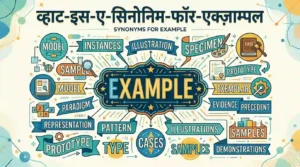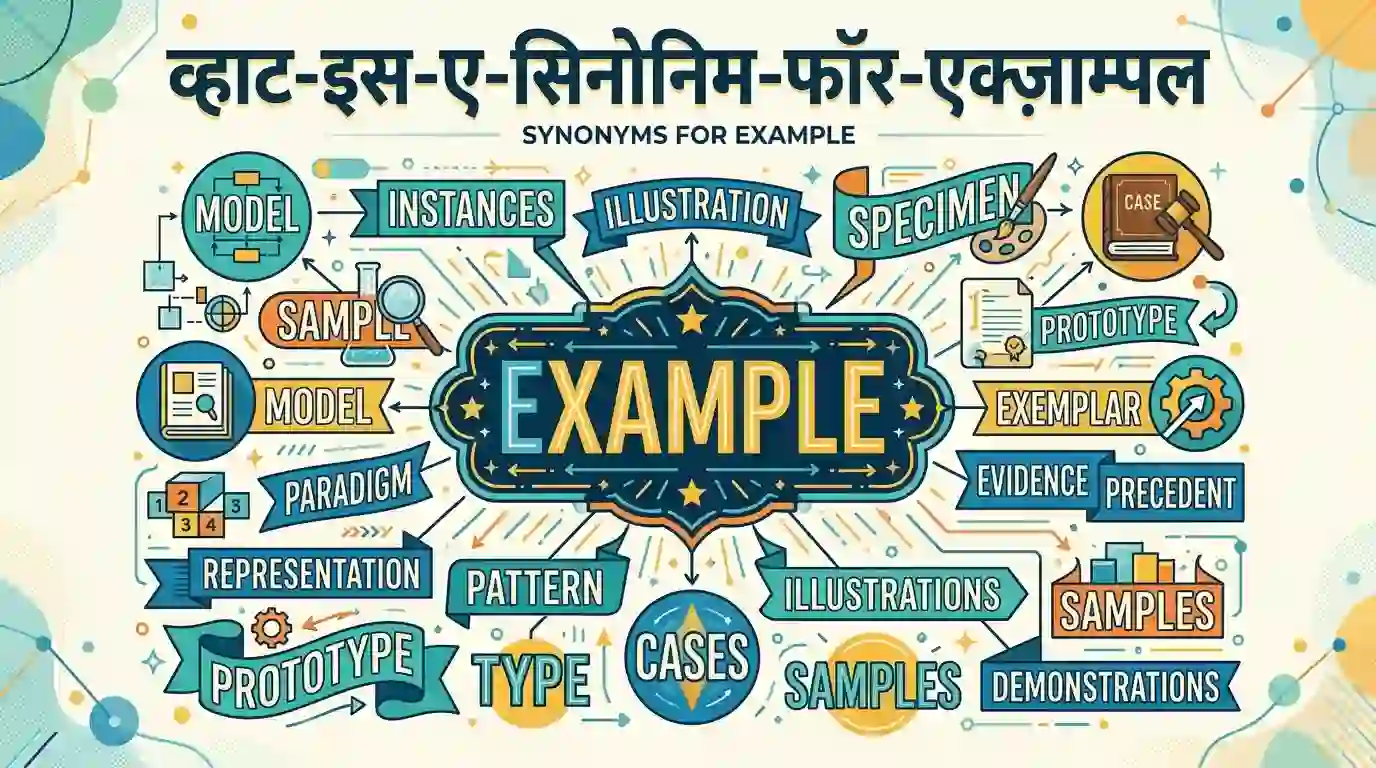
A synonym for example is instance, illustration, sample, specimen, or case in point. These words describe something that helps explain an idea, represents a group, or shows how something works. The best choice depends on your sentence. For academic writing, use illustration or instance. For a representative portion, use sample. For a specific situation, use case in point.
Key Takeaways
- Instance is a close synonym when you mean one occurrence or case.
- Illustration works well when something helps explain an idea.
- Sample refers to a representative part of a larger group or whole.
- Case in point highlights a specific example that supports an argument.
- For the phrase “for example,” alternatives include for instance, such as, and to illustrate.
20 Synonyms for Example and Their Meanings
The word example has several meanings. It can refer to a specific case, an item that represents a larger group, or a person or action worth following. Dictionary and thesaurus references list alternatives according to these different meanings.
Thesaurus
+2
Here are 20 useful synonyms, with explanations and original sentence examples.
| Synonym | Meaning | Example sentence |
|---|---|---|
| 1. Instance | One occurrence of something | This is an instance of excellent customer service. |
| 2. Illustration | Something that explains an idea | The diagram provides an illustration of the process. |
| 3. Sample | A representative part of a whole | The teacher shared a sample of a strong essay. |
| 4. Specimen | An individual item examined or studied | The scientist examined a specimen under a microscope. |
| 5. Case in point | A specific case that supports an argument | Mia improved her grades through practice, a case in point for consistent effort. |
| 6. Model | Something used as a pattern to follow | Her presentation serves as a model for future projects. |
| 7. Demonstration | A practical showing of how something works | The instructor gave a demonstration of the software. |
| 8. Representation | Something that depicts or stands for something else | The chart offers a representation of the survey results. |
| 9. Exemplar | An outstanding example of a quality | The novel is an exemplar of clear storytelling. |
| 10. Prototype | An early version used to test a design | The engineers tested a prototype of the new device. |
| 11. Paradigm | A model or pattern of something | The discovery created a new paradigm for research. |
| 12. Ideal | A standard of perfection or excellence | The school describes her work as an ideal of careful writing. |
| 13. Standard | A level used for comparison | This report sets a standard for accuracy. |
| 14. Pattern | A repeated or recognizable form | The case revealed a pattern of late payments. |
| 15. Precedent | An earlier case that guides later decisions | The court considered a precedent from an earlier ruling. |
| 16. Archetype | A typical or original model | The character is an archetype of the brave hero. |
| 17. Paragon | A person or thing regarded as an outstanding model | She became a paragon of honesty in the community. |
| 18. Case | A particular situation or occurrence | This case shows why clear instructions matter. |
| 19. Exposition | An explanation or detailed presentation | The opening section provides an exposition of the main argument. |
| 20. Exemplification | The act of showing something through examples | The writer uses exemplification to clarify the theory. |
Quick tip: You do not need the most sophisticated word. Choose the word that preserves your intended meaning. For instance, prototype is appropriate for an early product design, but it usually cannot replace example in a sentence about a student’s behavior.
Which Synonym for Example Should You Choose?
Your purpose matters more than the number of synonyms you know. The right word should make your meaning clearer and help your reader understand your point.
For essays and academic writing
Use instance, illustration, case in point, or exemplification when the context supports them.
- Instance: One instance of poor planning can delay an entire project.
- Illustration: The experiment provides an illustration of the theory.
- Case in point: The company’s recent success is a case in point.
- Exemplification: The author uses exemplification to explain the central argument.
For most school essays, example and instance remain clear, natural choices. More formal vocabulary is useful only when it fits the sentence.
For professional and business writing
Choose words that communicate the purpose of the information.
- Model: Use this report as a model for future submissions.
- Case: This case demonstrates the importance of customer feedback.
- Demonstration: The team scheduled a demonstration of the new platform.
- Illustration: The chart provides an illustration of quarterly performance.
In business emails, direct wording usually works best. Instead of writing “I am providing an exemplification of the process,” write “Here is an example of the process.”
For everyday conversations
Use simple, familiar alternatives.
- Instance: This is an instance where patience helps.
- Case in point: You arrived early again, a case in point of your punctuality.
- Sample: Can you show me a sample of your work?
- For instance: You could try a different approach, for instance, by asking a colleague for feedback.
These expressions help you avoid repetition without making your speech sound unnatural.
What Can You Say Instead of “For Example”?
Sometimes, you are not looking for a synonym for the noun example. You want a different way to introduce supporting information.
The following expressions can help.
| Alternative | Best use | Example |
|---|---|---|
| For instance | Introducing a specific case | For instance, you can save your work every few minutes. |
| Such as | Introducing items in a list | Bring supplies such as paper, pens, and folders. |
| To illustrate | Explaining an idea with a case | To illustrate, consider how plants respond to sunlight. |
| As an example | Introducing a particular case | As an example, our team reduced unnecessary steps. |
| Namely | Identifying something more precisely | Two subjects interest me, namely, science and history. |
| Including | Naming items that belong to a group | The store sells several fruits, including apples and oranges. |
| Like | Giving familiar examples in informal English | I enjoy outdoor activities like hiking and cycling. |
| In particular | Highlighting one specific item | Several skills matter, communication in particular. |
These phrases are related, but they do not always work in the same grammatical position.
For example, such as usually introduces examples within a sentence:
- Correct: “I enjoy sports such as tennis and basketball.”
- Less natural: “Such as, I enjoy tennis and basketball.”
Likewise, namely introduces a more precise identification, while for instance generally introduces an illustrative case. Choose the expression that fits your sentence structure and meaning.
Example vs. Instance vs. Sample vs. Illustration
These four words are among the most useful alternatives, but each has a slightly different emphasis. Cambridge Dictionary and Thesaurus.com also distinguish sample, instance, and illustration by their typical uses.
Thesaurus
+1
| Word | Main emphasis | Example |
|---|---|---|
| Example | A general case that explains or represents something | This painting is an example of modern art. |
| Instance | One particular occurrence | This is an instance of effective teamwork. |
| Sample | A part that represents a larger whole | The researcher collected a sample of the population. |
| Illustration | Something that makes an idea easier to understand | The teacher used a drawing as an illustration. |
Consider a writing lesson. A teacher might show an example of a strong paragraph, discuss an instance of effective word choice, provide a sample essay, and use an illustration to explain paragraph structure.
The words are related, but they emphasize different things. Replacing one with another without considering context can make a sentence less accurate.
How to Use Synonyms for Example in Sentences
The easiest way to choose a synonym is to identify what you want the sentence to communicate.
1. Replace repetition with a more precise word
Original: “This is a good example of teamwork. Another example is the group’s planning process.”
Improved: “This is a good example of teamwork. The group’s planning process is another instance of cooperation.”
The change makes the second sentence more specific.
2. Choose a word that fits the subject
Original: “The engineer built an example of the new machine.”
Improved: “The engineer built a prototype of the new machine.”
Prototype is more precise because it describes an early version of a product or design.
3. Use an alternative to introduce evidence
Original: “For example, regular reading can improve vocabulary.”
Alternative: “For instance, regular reading can improve vocabulary.”
Both versions communicate the same general point.
4. Use the correct word for a representative portion
Original: “The researcher selected an example of the soil for testing.”
Improved: “The researcher collected a sample of the soil for testing.”
Sample is more appropriate when referring to a portion collected for examination.
Common Mistakes to Avoid
1. Treating every synonym as interchangeable.
A prototype is an early version of a design, while a paragon is an outstanding model of a quality. Neither fits every sentence that contains example.
2. Using formal words just to sound intelligent.
Words such as exemplar and exemplification are useful in the right context, but simpler alternatives often improve readability.
3. Confusing a noun with a linking phrase.
Instance and sample are nouns. For instance and such as are expressions that introduce supporting information. They require different sentence structures.
4. Using “like” in every formal example sentence.
In everyday American English, like often introduces examples naturally. In formal writing, such as may communicate the relationship more precisely.
5. Replacing words without checking the meaning.
A thesaurus provides possible alternatives, not automatic replacements. Check the definition and read the complete sentence after making a change.
Frequently Asked Questions
What is the best synonym for example?
Instance is one of the closest alternatives when you mean a particular occurrence or case. However, illustration works better when explaining an idea, and sample works better when referring to a representative part of a whole. The best synonym depends on your sentence.
What is another word for example in an essay?
Useful choices include instance, illustration, case in point, and demonstration. Use instance for a specific occurrence and illustration when explaining an idea. To introduce supporting information, you can also use for instance or to illustrate.
What is a formal word for example?
Exemplar, paradigm, and exemplification are relatively formal alternatives, although they have different meanings. An exemplar is an outstanding example, a paradigm is a model or pattern, and exemplification means showing or explaining something through examples.
Is “such as” a synonym for “for example”?
They serve similar purposes, but their grammar differs. For example can introduce a complete illustrative statement, while such as usually introduces items within a sentence. For example, “I enjoy sports such as tennis and soccer.”
What is the difference between an example and a case in point?
An example can be any case that explains an idea. A case in point specifically highlights a case that supports or demonstrates a claim. For example, “The new policy reduced delays; the first week of results is a case in point.”
Can I use “e.g.” instead of “for example”?
Yes. E.g. is an abbreviation of the Latin phrase exempli gratia, meaning “for example.” It commonly appears in academic, professional, and technical writing. Follow your style guide’s punctuation rules, and use for example when you want a more conversational tone.
Conclusion
The best answer to “what is a synonym for example” depends on what you want to express. Instance, illustration, sample, specimen, and case in point are useful alternatives, but each serves a different purpose.
For everyday writing, choose instance or for instance. And for explaining an idea, use illustration. For a representative portion, choose sample. When supporting an argument with a specific case, use case in point.
The goal is not to replace example every time you use it. Choose the word that communicates your meaning clearly and naturally.

I am Joseph Clark, a vocabulary and language content writer at SynonymLibrary.com. I create clear, practical synonym guides that help readers improve their writing, word choice, and communication skills. My goal is to make language learning simple, accurate, and useful for students, writers, professionals, and everyday learners.