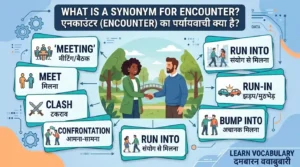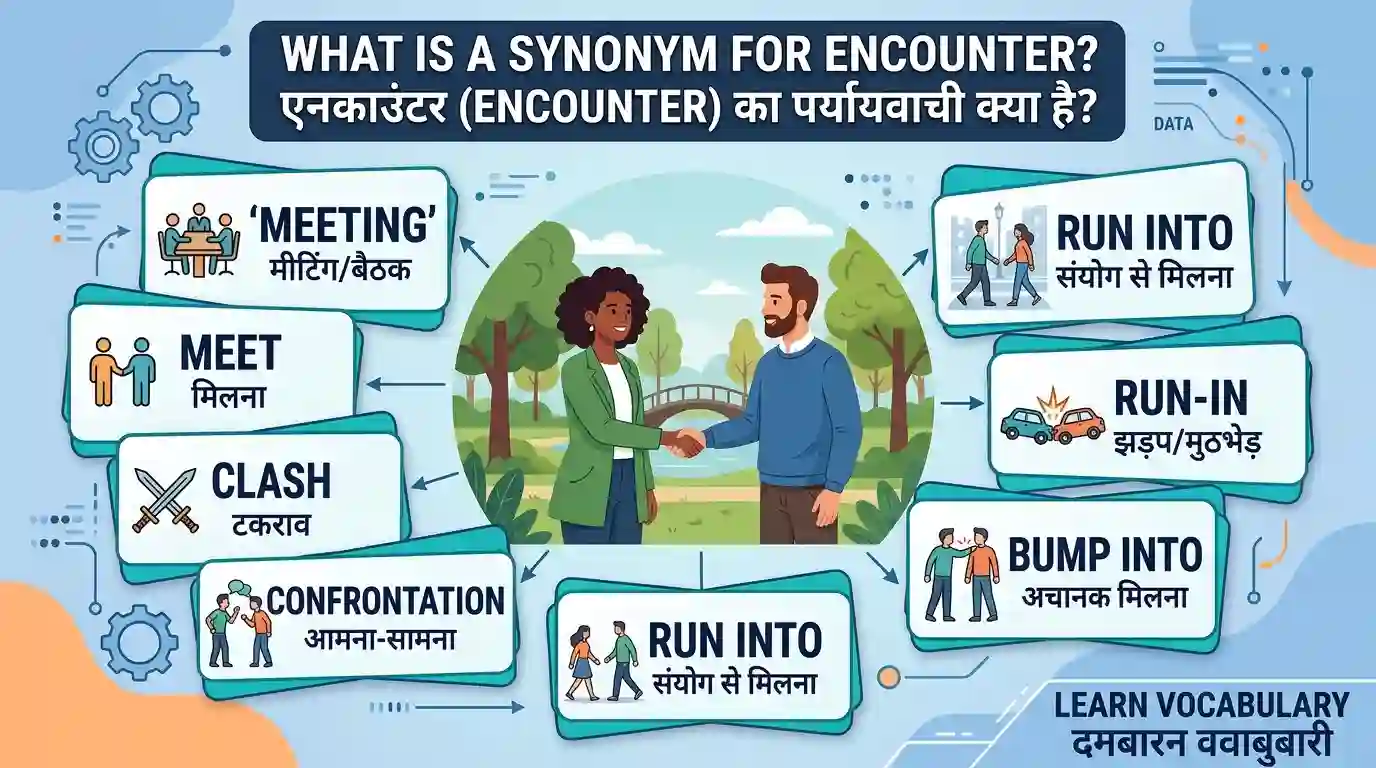
A synonym for encounter is meet, come across, run into, experience, or face. The best alternative depends on the context. Use “run into” for an unexpected meeting, “experience” for an event or situation, and “face” when dealing with a problem or challenge. For a noun, “meeting,” “chance meeting,” and “confrontation” may fit.
Key Takeaways
- Meet and run into work well when talking about people.
- Experience and undergo describe events, situations, or difficulties.
- Face and confront are useful when dealing with challenges or opposition.
- Meeting and chance meeting are suitable noun synonyms.
- No single synonym fits every use of “encounter,” so consider the meaning of your sentence.
What Does Encounter Mean?
The word encounter means to meet someone or something, often unexpectedly, or to experience a situation. It can also describe a meeting between opposing people or groups. The word works as both a verb and a noun.
definition in the Cambridge English Dictionary
+1
Encounter as a Verb
As a verb, “encounter” describes meeting someone, discovering something, or facing a situation.
Examples:
- I encountered an old friend at the grocery store.
- The team encountered several problems during the project.
- Hikers encountered a bear near the trail.
In these sentences, you could replace “encountered” with “ran into,” “faced,” or “came across,” depending on the meaning.
Encounter as a Noun
As a noun, “encounter” refers to a meeting, experience, or confrontation.
Examples:
- Our encounter at the library was unexpected.
- She described her first encounter with a wild animal.
- The two teams had a difficult encounter during the championship.
Possible alternatives include “meeting,” “experience,” and “clash.” Each word emphasizes a different aspect of the event.
15 Synonyms for Encounter and Their Meanings
The following words offer useful alternatives for different situations.
| Synonym | Best use | Example |
|---|---|---|
| Meet | Seeing or getting together with someone | I met my former teacher downtown. |
| Run into | Meeting someone unexpectedly | I ran into my neighbor at the store. |
| Come across | Finding someone or something by chance | I came across an old photograph. |
| Chance upon | Discovering something unexpectedly | We chanced upon a quiet beach. |
| Experience | Going through an event or situation | She experienced a sudden delay. |
| Face | Dealing with a challenge | We faced several obstacles. |
| Confront | Dealing directly with a person or issue | He confronted the problem calmly. |
| Come upon | Finding something unexpectedly | They came upon an abandoned house. |
| Discover | Finding something previously unknown | Researchers discovered a new pattern. |
| Undergo | Going through a process or change | She underwent extensive training. |
| Meet with | Experiencing a response or outcome | The proposal met with resistance. |
| Confrontation | A direct or hostile meeting | The confrontation ended quickly. |
| Meeting | An occasion when people come together | Their meeting lasted an hour. |
| Clash | A conflict or disagreement | The debate turned into a clash. |
| Brush | A brief or limited experience, often unpleasant | He had a brief brush with danger. |
These words are not interchangeable in every sentence. For example, “undergo” commonly describes a process, while “run into” is natural for an unexpected meeting. Dictionary sources also distinguish between encounter’s meeting, experience, and conflict-related meanings.
Cambridge English
+2
Best Synonyms for Encounter in Different Situations
Choosing the right word makes your writing clearer and more natural. Start by identifying what “encounter” means in your sentence.
When You Meet Someone Unexpectedly
Use run into, come across, meet, or chance upon when describing an unplanned meeting or discovery.
Examples:
- Original: I encountered my cousin at the mall.
- Natural alternative: I ran into my cousin at the mall.
- Original: She encountered an interesting book in the library.
- Natural alternative: She came across an interesting book in the library.
“Run into” is conversational and common in American English. “Chance upon” sounds more literary, while “meet” is a simple, general alternative.
When You Face a Problem
Use face, experience, undergo, or meet with when describing difficulties, setbacks, or challenging situations.
Examples:
- Original: We encountered technical problems.
- Better alternative: We faced technical problems.
- Original: The proposal encountered strong resistance.
- Better alternative: The proposal met with strong resistance.
- Original: He encountered several difficulties during training.
- Better alternative: He experienced several difficulties during training.
Choose “undergo” when the sentence describes a process, such as training, treatment, or a major change. It usually does not work as a direct replacement for encountering an unexpected person.
When You Describe a Conflict
Use confrontation, clash, conflict, or face when the encounter involves disagreement, opposition, or fighting.
Examples:
- Original: The encounter between the rivals became tense.
- Alternative: The confrontation between the rivals became tense.
- Original: The two teams encountered each other in the final.
- Alternative: The two teams faced each other in the final.
- Original: Their encounter led to an argument.
- Alternative: Their clash led to an argument.
A “clash” usually emphasizes disagreement or opposition. A “confrontation” suggests a direct meeting that may be tense or hostile. Use “battle” or “combat” only when the context supports a stronger sense of fighting.
Encounter vs. Meet vs. Experience
These three words are related, but their meanings are not identical.
| Word | Main meaning | Typical context |
|---|---|---|
| Encounter | Meet unexpectedly or come up against something | An unexpected meeting or difficulty |
| Meet | Come together with a person | An ordinary or planned meeting |
| Experience | Go through an event or situation | An event, feeling, or difficulty |
Consider these examples:
- Encounter: I encountered my former coach at the airport.
- Meet: I met my coach for lunch.
- Experience: I experienced a long delay at the airport.
The first sentence suggests an unexpected meeting. The second describes a meeting without necessarily suggesting surprise. The third describes going through an event rather than meeting someone.
When editing your writing, choose the word that preserves the original meaning instead of selecting an alternative simply because it sounds different.
Example Sentences Using Encounter Synonyms
Here are additional examples showing how to use these alternatives in everyday writing, school assignments, and professional communication.
Everyday conversation
- “I ran into an old friend while shopping.”
- “We came across a small café on our walk.”
- “She met her new neighbors yesterday.”
Academic and professional writing
- “The researchers faced several challenges during the study.”
- “The company experienced a temporary system failure.”
- “The team met with resistance when proposing the changes.”
Storytelling and descriptive writing
- “The hikers came upon a hidden waterfall.”
- “He had an unusual encounter with a stranger.”
- “The rivals clashed during the final round.”
Formal writing
- “The organization confronted a serious ethical issue.”
- “The patient underwent further testing.”
- “The negotiations ended after a tense confrontation.”
Notice how the alternatives change the tone. “Ran into” sounds informal, while “confronted” and “underwent” suit more formal situations.
Common Mistakes When Choosing an Encounter Synonym
Even words with similar meanings can create awkward sentences when used in the wrong context.
1. Using “meet” for every situation
Incorrect: “We met several technical difficulties.”
Better: “We encountered several technical difficulties.”
You could also write, “We faced several technical difficulties.” Although “meet” can appear in expressions such as “meet a challenge” or “meet with resistance,” it does not fit every use of encounter.
2. Confusing “experience” with “meet”
Incorrect: “I experienced my neighbor at the grocery store.”
Better: “I ran into my neighbor at the grocery store.”
“Experience” describes going through an event or situation. “Run into” describes an unexpected meeting.
3. Using “confront” when there is no conflict
Incorrect: “I confronted an old friend at the coffee shop,” if you simply mean you met them unexpectedly.
Better: “I ran into an old friend at the coffee shop.”
“Confront” can suggest a direct challenge or disagreement. Use it when that meaning is intended.
4. Ignoring the noun form
Incorrect: “Our meeting was an unexpected meet.”
Better: “Our meeting was unexpected.”
When replacing the noun “encounter,” use a noun such as “meeting,” “experience,” or “confrontation,” rather than a verb such as “meet” or “experience.”
Frequently Asked Questions
1. What is the best synonym for encounter?
“Meet” is a useful general alternative when talking about people. “Run into” is better for unexpected meetings, “experience” fits events and situations, and “face” works well for problems. The best choice depends on what the sentence means.
2. What is another word for an unexpected encounter?
You can use “chance meeting,” “unexpected meeting,” or “chance encounter.” In casual conversation, “running into someone” is also natural. For example, “I had a chance meeting with my former teacher at the airport.”
3. What is a synonym for encountering a problem?
“Facing,” “experiencing,” and “running into” can replace “encountering,” depending on the sentence. For example, “We encountered a problem with the software” can become “We ran into a problem with the software” or “We faced a problem with the software.”
4. Is “meet” a synonym for “encounter”?
Yes. “Meet” can replace “encounter” when the sentence describes coming into contact with someone. However, “encounter” often suggests an unexpected meeting, while “meet” can describe either a planned or unplanned meeting.
5. What is the difference between an encounter and an experience?
An encounter often involves meeting someone or coming across something, sometimes unexpectedly. An experience is a broader term for something you live through or take part in. An encounter can be an experience, but not every experience is an encounter.
6. What is the opposite of encounter?
There is no single opposite that works in every context. “Avoid” or “evade” can be opposites of encountering someone or something, while “miss” can describe failing to meet someone. In a conflict setting, “withdraw” may express the opposite action.
Cambridge English
+1
Conclusion
If you are asking what is a synonym for encounter, start with meet, run into, come across, experience, or face. Use “run into” for unexpected meetings, “experience” for events, and “face” for challenges. For the noun form, consider “meeting,” “chance meeting,” or “confrontation.”
The most effective synonym is the one that fits your sentence, tone, and intended meaning. A carefully chosen word improves clarity without changing what you want to say.