“Slow” can mean much more than simply moving at a low speed. Depending on the context, it can describe something that takes a long time, develops gradually, happens later than expected, or moves at a relaxed pace. Alternatives such as sluggish, gradual, unhurried, leisurely, delayed, and lethargic can work in specific situations, but they are not interchangeable in every sentence.
For example, “slow progress” can become “gradual progress” when emphasizing steady development, while “a sluggish response” highlights a lack of speed or responsiveness. Likewise, “a leisurely afternoon” suggests a relaxed pace rather than a problem with speed.
If you’re searching for synonyms for slow, you likely want the right word for movement, people, learning, progress, processes, technology, communication, writing, or everyday conversation. In this guide, you’ll find 50+ synonyms, related words, and context-specific alternatives, organized by meaning and tone, with clear definitions and natural examples to help you choose the word that fits your sentence best.
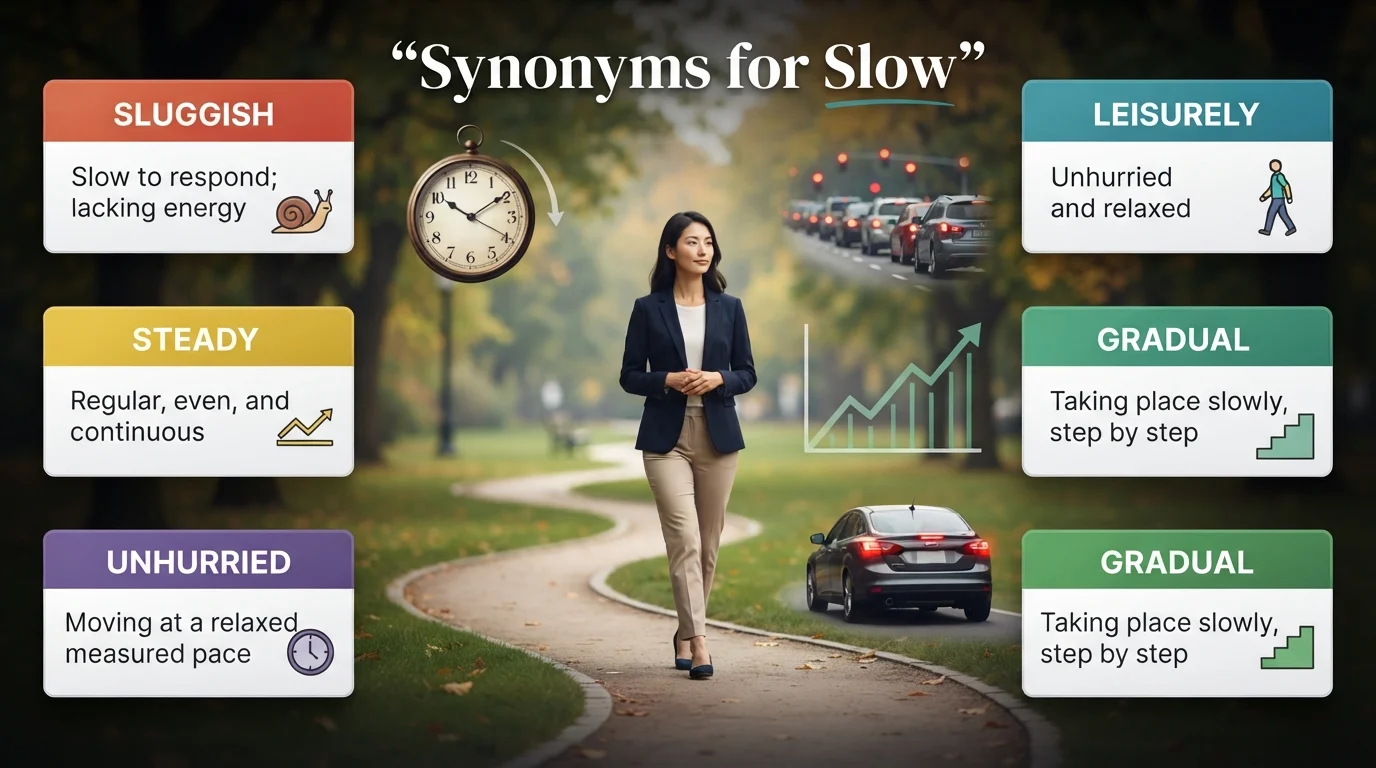
Sluggish
Meaning:
Sluggish means moving or working more slowly than normal.
Examples:
- My computer feels sluggish this morning.
- I felt sluggish after eating a heavy meal.
Leisurely
Meaning:
Leisurely means done slowly and comfortably without rushing.
Examples:
- We took a leisurely walk around the lake.
- She enjoyed a leisurely breakfast on Sunday.
Unhurried
Meaning:
Unhurried means done calmly without being in a hurry.
Examples:
- He took an unhurried walk through the park.
- Her unhurried style made everyone feel relaxed.
Gradual
Meaning:
Gradual means happening slowly over a period of time.
Examples:
- The company made a gradual change to its schedule.
- Her gradual improvement was easy to notice.
Tardy
Meaning:
Tardy means late or arriving later than expected.
Examples:
- Tom was tardy for his morning class.
- Her tardy reply worried the team.
Delayed
Meaning:
Delayed means happening later than planned or expected.
Examples:
- Our flight was delayed by heavy rain.
- The delivery was delayed until Monday.
Lagging
Meaning:
Lagging means falling behind or moving more slowly than others.
Examples:
- Our internet connection is lagging again.
- The team is lagging behind its competitors.
Crawling
Meaning:
Crawling means moving extremely slowly.
Examples:
- Traffic was crawling during rush hour.
- The queue was crawling toward the entrance.
Creeping
Meaning:
Creeping means moving very slowly and quietly.
Examples:
- The cat was creeping toward the sleeping bird.
- The fog was creeping across the field.
Plodding
Meaning:
Plodding means moving slowly with heavy or steady steps.
Examples:
- The tired horse kept plodding along the road.
- He came plodding home after a long day.
Ambling
Meaning:
Ambling means walking slowly in a relaxed way.
Examples:
- We spent the afternoon ambling through the village.
- He was ambling along the beach alone.
Strolling
Meaning:
Strolling means walking slowly for pleasure or relaxation.
Examples:
- They were strolling through the market.
- I like strolling around the neighborhood after dinner.
Sauntering
Meaning:
Sauntering means walking in a slow and relaxed way.
Examples:
- She came sauntering into the café.
- He was sauntering down the street without a care.
Dawdling
Meaning:
Dawdling means wasting time by moving or acting too slowly.
Examples:
- Stop dawdling and put your shoes on.
- He was dawdling instead of finishing his homework.
Loitering
Meaning:
Loitering means staying somewhere without a clear reason.
Examples:
- The guard asked them to stop loitering outside.
- Several teenagers were loitering near the entrance.
Linger
Meaning:
Linger means to stay or continue longer than expected.
Examples:
- We lingered over coffee after lunch.
- The smell of smoke lingered in the room.
Lingering
Meaning:
Lingering means lasting or staying for a longer time than expected.
Examples:
- She had a lingering feeling of sadness.
- A lingering smell filled the kitchen.
Drawn-Out
Meaning:
Drawn-out means lasting much longer than necessary.
Examples:
- The meeting turned into a drawn-out discussion.
- Their drawn-out argument annoyed everyone.
Prolonged
Meaning:
Prolonged means continuing for a long time.
Examples:
- The city faced a prolonged period of rain.
- Prolonged delays caused many problems.
Protracted
Meaning:
Protracted means lasting for a long time, often longer than expected.
Examples:
- The dispute became a protracted legal battle.
- They faced a protracted period of negotiation.
Lengthy
Meaning:
Lengthy means taking a long time to finish.
Examples:
- The doctor gave us a lengthy explanation.
- We had a lengthy meeting this morning.
Synonyms for Pride: 59+Words for Honor, Ego & More
Time-Consuming
Meaning:
Time-consuming means needing a lot of time to complete.
Examples:
- Sorting these files is time-consuming.
- Cooking for a large group can be time-consuming.
Tedious
Meaning:
Tedious means boring because something takes a long time or repeats.
Examples:
- Entering all the data was tedious.
- The long paperwork became tedious.
Laborious
Meaning:
Laborious means needing a lot of time and effort.
Examples:
- Building the model was a laborious task.
- Cleaning the old warehouse was laborious.
Measured
Meaning:
Measured means careful and controlled rather than quick.
Examples:
- She gave a measured response to the question.
- He took a measured approach to the problem.
Deliberate
Meaning:
Deliberate means done carefully and with thought rather than quickly.
Examples:
- He made a deliberate decision to wait.
- She took a deliberate step toward the door.
Steady
Meaning:
Steady means moving or happening at a regular pace.
Examples:
- The car moved at a steady speed.
- We made steady progress all week.
Moderate
Meaning:
Moderate means not very fast or very slow.
Examples:
- Keep the fan at a moderate speed.
- He walked at a moderate pace.
Relaxed
Meaning:
Relaxed means calm and free from hurry.
Examples:
- We had a relaxed afternoon at home.
- She used a relaxed pace during the walk.
Calm
Meaning:
Calm means quiet and without sudden action or hurry.
Examples:
- He stayed calm during the long wait.
- She spoke in a calm, steady voice.
Gentle
Meaning:
Gentle means soft, careful, and not sudden.
Examples:
- The boat moved with a gentle motion.
- Give the plant a gentle shake.
Sedate
Meaning:
Sedate means calm, quiet, and not very active or fast.
Examples:
- The town has a sedate pace of life.
- We spent a sedate evening at home.
Torpid
Meaning:
Torpid means very slow and lacking energy.
Examples:
- The hot weather left him feeling torpid.
- The animal became torpid during the cold spell.
Lethargic
Meaning:
Lethargic means having little energy and moving slowly.
Examples:
- I felt lethargic after staying awake all night.
- The dog seemed lethargic in the afternoon heat.
Inert
Meaning:
Inert means not moving or not active.
Examples:
- The machine remained inert after the power cut.
- The object lay inert on the ground.
Idle
Meaning:
Idle means not working or being used.
Examples:
- The factory machines stood idle overnight.
- Several workers were idle during the break.
Stationary
Meaning:
Stationary means staying in one place without moving.
Examples:
- The bus remained stationary at the stop.
- The car was stationary at the red light.
Motionless
Meaning:
Motionless means completely still and not moving.
Examples:
- The deer stood motionless in the forest.
- She remained motionless for the photograph.
Inactive
Meaning:
Inactive means not moving, working, or doing anything.
Examples:
- The old account has been inactive for years.
- The machine is inactive at night.
Synonyms for Various: 58+ Words Beyond “Various”
Dormant
Meaning:
Dormant means not active now but able to become active later.
Examples:
- The volcano has been dormant for centuries.
- The project remained dormant until funding arrived.
Decelerating
Meaning:
Decelerating means becoming slower.
Examples:
- The train was decelerating near the station.
- The driver started decelerating before the corner.
Slowing
Meaning:
Slowing means becoming less fast.
Examples:
- The car is slowing near the school.
- Sales are slowing this month.
Decreasing
Meaning:
Decreasing means becoming lower or smaller.
Examples:
- The wind speed is decreasing now.
- The number of visitors is decreasing each week.
Diminishing
Meaning:
Diminishing means becoming weaker, smaller, or less.
Examples:
- His energy was diminishing after the long hike.
- The sound was slowly diminishing in the distance.
Fading
Meaning:
Fading means becoming weaker or less strong.
Examples:
- The music was fading as the car drove away.
- Her excitement was fading after the long delay.
Receding
Meaning:
Receding means moving or becoming farther away.
Examples:
- The floodwater is slowly receding.
- The sound of the train was receding into the distance.
Behindhand
Meaning:
Behindhand means late with work or not finished on time.
Examples:
- I am behindhand with my schoolwork.
- The office is behindhand on several reports.
Unhurriedly
Meaning:
Unhurriedly means doing something slowly and without rushing.
Examples:
- She walked unhurriedly toward the station.
- He unhurriedly packed his books into the bag.
Slowly
Meaning:
Slowly means at a low speed or over a longer period.
Examples:
- Please speak slowly so I can understand.
- The turtle moved slowly across the path.
Gradually
Meaning:
Gradually means little by little over time.
Examples:
- The sky gradually became darker.
- She gradually became more confident.
Leisurely-paced
Meaning:
Leisurely-paced means moving or happening at a relaxed speed.
Examples:
- We enjoyed a leisurely-paced tour of the city.
- The story has a leisurely-paced beginning.
Unhurried-paced
Meaning:
Unhurried-paced means happening at a calm speed without pressure.
Examples:
- The lesson had an unhurried-paced style.
- They enjoyed an unhurried-paced morning together.
FAQ About Synonyms for Slow
What are the best synonyms for slow?
Some of the most useful synonyms for slow are sluggish, leisurely, unhurried, gradual, delayed, steady, crawling, lingering, sluggish, and decelerating. The right word depends on the context.
What is a simple synonym for slow?
Slowly is the simplest alternative when you need an adverb. Gradual works well when something happens little by little, while unhurried works well for relaxed actions.
What is a synonym for slow movement?
Words such as crawling, creeping, ambling, strolling, sauntering, and plodding can describe slow movement. Each word gives a slightly different feeling or picture.
What is a synonym for slow progress?
Useful choices include gradual, steady, lagging, delayed, and plodding. For example, you can say, “The project is making gradual progress.”
What is a synonym for slow in writing?
Good choices include gradual, measured, leisurely, unhurried, lengthy, prolonged, and deliberate. Choose the word that matches the exact idea in your sentence.
What is the opposite of slow?
Common opposites include fast, quick, rapid, swift, speedy, and brisk. The best opposite depends on whether you are talking about movement, work, speech, or change.
Why should I learn synonyms for slow?
Learning synonyms helps you avoid repeated words and express ideas more precisely. It can improve your essays, blog posts, emails, conversations, and everyday English.
Conclusion
Learning synonyms for slow gives you more control over your English. Instead of using the same word again and again, you can choose sluggish for low energy, leisurely for relaxed movement, gradual for slow change, or delayed for something late. This makes your writing clearer and your speaking more natural. Practice these words in emails, essays, blog posts, and daily conversations. With regular use, your vocabulary will become richer, sharper, and more confident.

I am Joseph Clark, a vocabulary and language content writer at SynonymLibrary.com. I create clear, practical synonym guides that help readers improve their writing, word choice, and communication skills. My goal is to make language learning simple, accurate, and useful for students, writers, professionals, and everyday learners.