Have you ever met someone who always says something negative? No matter what you do, they find a way to put it down. They do not cheer for you. They do not support you. They just criticize and complain. Most people call that person a “hater.”
Here is a simple example. You write a story and share it online. One person leaves a mean comment just to bring you down. That person is a hater. But if you write that word every single time, your content starts to feel the same.
The word hater means someone who dislikes or criticizes others in a negative and unfair way. They often feel jealous or angry about someone else’s success.
Knowing synonyms for hater helps students write stronger opinion pieces. It helps bloggers describe negative behavior more clearly. It helps content writers keep their language fresh and varied. And it helps everyday English users express their thoughts with more power.
Meaning and Origin of Hater
Meaning:
A hater is someone who shows strong dislike or jealousy toward another person. They often leave negative comments, spread criticism, or try to make others feel bad. The word is used a lot in modern culture, especially on social media and in music.
Origin:
The word “hater” comes from the word “hate,” which has roots in Old English “hatian,” meaning to have a very strong dislike for something or someone. The word “hater” as we use it today became popular in the 1990s through hip-hop music and street culture. By the 2000s, it had spread into everyday speech around the world and became a common term in pop culture and social media.
Let us look at 50 strong synonyms for hater you can use right now.
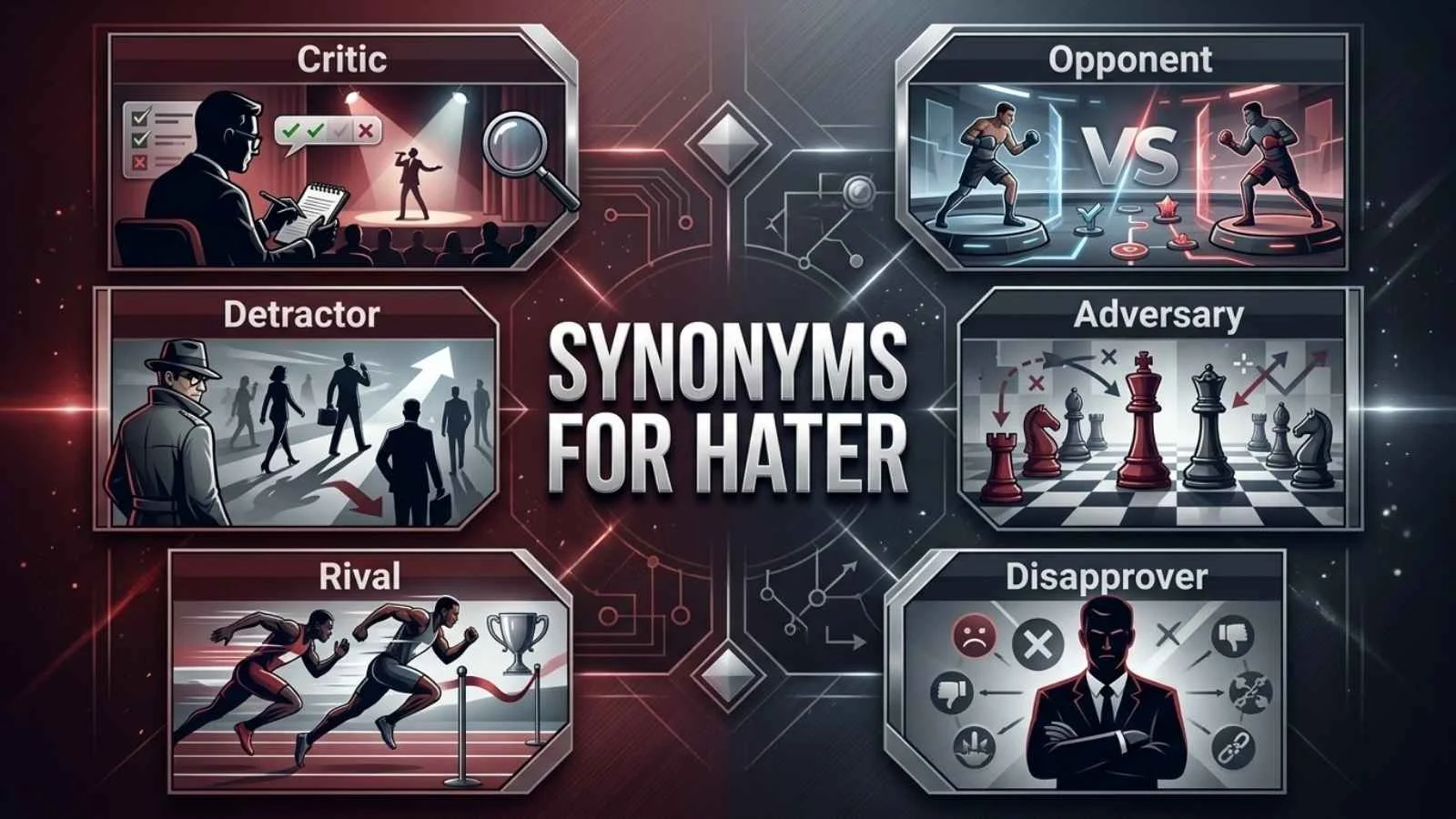
1. Critic
Meaning:
A person who finds faults and shares their negative opinions about others.
Usage:
Used in formal and everyday writing when someone regularly judges or evaluates others in a harsh way.
Examples:
- Every artist faces a harsh critic at some point in their career.
- She ignored the critic in the comments and kept sharing her work online.
2. Detractor
Meaning:
Someone who tries to make another person or thing seem less valuable or important.
Usage:
Used in formal writing and speeches when describing people who undermine others.
Examples:
- Despite the detractors, she kept pushing forward with her business idea.
- Every great leader has a few detractors who doubt them along the way.
3. Cynic
Meaning:
A person who always expects the worst and doubts that anything good will happen.
Usage:
Used when describing someone who is negative about people’s motives and actions.
Examples:
- He was such a cynic that he never celebrated anyone else’s good news.
- The cynic in the room always had a reason why the plan would fail.
4. Naysayer
Meaning:
A person who always says no or predicts that things will go wrong.
Usage:
Used when someone constantly disagrees or refuses to believe in positive outcomes.
Examples:
- She proved every naysayer wrong when her small shop became a huge success.
- Do not let a naysayer talk you out of chasing your biggest dreams.
5. Antagonist
Meaning:
Someone who actively works against another person or opposes their goals.
Usage:
Used in storytelling, formal writing, and everyday speech for someone who creates conflict.
Examples:
- The antagonist in the story tried to destroy everything the hero had built.
- He became the antagonist in the office by blocking every new idea the team proposed.
6. Rival
Meaning:
A person who competes with another and often wishes them to fail.
Usage:
Used in sports, business, and personal life to describe a competitive opponent.
Examples:
- Her rival spread false rumors before the school talent show.
- The two rivals had been competing against each other since middle school.
7. Adversary
Meaning:
A strong opponent who actively works against you.
Usage:
Used in formal and literary writing for a serious or powerful enemy or opponent.
Examples:
- She faced a tough adversary in the debate who challenged every point she made.
- He turned his greatest adversary into an ally by treating them with respect.
8. Oppressor
Meaning:
Someone who uses power or cruelty to keep others down.
Usage:
Used in serious writing about injustice, power, or control over others.
Examples:
- The community stood up against the oppressor who had silenced them for years.
- History is full of stories of people who rose up against their oppressor.
9. Bully
Meaning:
A person who uses fear, force, or mean words to hurt or control others.
Usage:
Used in schools, workplaces, and online to describe someone who targets others with cruelty.
Examples:
- The bully made fun of his shoes every day until a teacher stepped in.
- She stood up to the online bully and reported every hateful message.
10. Scoffer
Meaning:
Someone who mocks and laughs at others in a mean and disrespectful way.
Usage:
Used when a person makes fun of others’ ideas, beliefs, or achievements.
Examples:
- The scoffer in the back row laughed at every answer the nervous student gave.
- She ignored the scoffer and delivered her presentation with full confidence.
11. Mocker
Meaning:
A person who imitates or teases others to make them feel foolish.
Usage:
Used when someone ridicules others through mimicry or cruel humor.
Examples:
- The mocker repeated everything she said in a silly voice to get a laugh.
- He refused to let the mocker ruin what had been a great day for him.
12. Disparager
Meaning:
Someone who speaks about others in a way that makes them seem worthless or unimportant.
Usage:
Used in formal writing when describing a person who constantly belittles others.
Examples:
- The disparager in the group always dismissed other people’s contributions.
- She learned to tune out the disparager and focus on her own growth instead.
13. Pessimist
Meaning:
A person who always sees the bad side of things and expects the worst outcome.
Usage:
Used when someone consistently holds a negative view of people or situations.
Examples:
- The pessimist on the team drained everyone’s energy before the project even started.
- He was a natural pessimist who found it hard to celebrate anyone’s success.
14. Jealous Person
Meaning:
Someone who dislikes you because they want what you have.
Usage:
Used in everyday speech when someone’s negativity comes from envy of another’s success.
Examples:
- The jealous person left a rude comment the moment her photo went viral.
- She realized the jealous person in her life was someone she had trusted for years.
15. Envious Rival
Meaning:
A competitor who resents your success and wants to see you fail.
Usage:
Used when someone’s jealousy pushes them to work actively against you.
Examples:
- Her envious rival copied her ideas and pretended they were original.
- He did not let his envious rival distract him from his own path forward.
16. Underminer
Meaning:
Someone who quietly works to weaken your confidence or destroy your progress.
Usage:
Used when a person slowly chips away at another person’s success or self-belief.
Examples:
- The underminer in the office always took credit for other people’s ideas.
- She spotted the underminer early and kept her plans private from that point on.
17. Backstabber
Meaning:
A person who acts friendly to your face but hurts you behind your back.
Usage:
Used in casual and informal writing for someone who betrays trust in a sneaky way.
Examples:
- She found out the backstabber had been sharing her private messages with others.
- A backstabber is harder to deal with than an open enemy because you cannot see it coming.
18. Troll
Meaning:
Someone who posts mean or upsetting messages online just to cause trouble.
Usage:
Used widely in digital and social media writing for people who spread hate online.
Examples:
- The troll left dozens of nasty comments under her motivational post.
- He reported the troll to the platform and blocked the account right away.
19. Malcontent
Meaning:
A person who is always unhappy and complains about everything around them.
Usage:
Used in formal writing for someone who is never satisfied and spreads their discontent.
Examples:
- The malcontent in the group made every team meeting feel heavy and slow.
- She stayed positive and refused to become a malcontent like those around her.
20. Faultfinder
Meaning:
A person who constantly looks for and points out mistakes in others.
Usage:
Used when someone focuses only on flaws and never on strengths or good work.
Examples:
- The faultfinder picked apart every slide in the presentation without giving any praise.
- Being around a faultfinder all day made it hard to feel confident in her own work.
21. Grump
Meaning:
A person who is always in a bad mood and reacts to everything with irritation.
Usage:
Used in casual writing and speech for someone whose negativity comes out in everyday life.
Examples:
- The grump at the end of the street complained about everything from the weather to the birds.
- She tried not to let the grump in the office affect her mood every morning.
22. Killjoy
Meaning:
A person who spoils other people’s fun or happiness with their negative attitude.
Usage:
Used in casual writing for someone who deliberately brings down the mood of others.
Examples:
- The killjoy reminded everyone of the bad weather just as the party was starting.
- Do not be a killjoy when your friends are trying to enjoy a special moment.
23. Envier
Meaning:
Someone who feels strong jealousy toward another person’s success or possessions.
Usage:
Used when someone’s dislike of you is clearly rooted in envy of what you have.
Examples:
- The envier made snide comments every time she received good news.
- He recognized the envier in his circle and kept his achievements quiet after that.
24. Spoilsport
Meaning:
A person who ruins fun or excitement for others by being negative or difficult.
Usage:
Used in casual everyday writing for someone who deliberately dampens good moments.
Examples:
- The spoilsport told everyone the ending of the film before they had seen it.
- She was not going to let one spoilsport ruin the best day of her life.
25. Vilifier
Meaning:
Someone who says very harmful and untrue things about another person in public.
Usage:
Used in formal writing when someone deliberately damages another person’s reputation.
Examples:
- The vilifier spread false stories about the new manager before she even started.
- He took legal action against the vilifier who had damaged his good name online.
26. Slanderer
Meaning:
A person who spreads false spoken statements to hurt someone’s reputation.
Usage:
Used in legal and formal writing for someone who lies verbally to harm others.
Examples:
- The slanderer told lies about her to everyone in the neighborhood.
- She proved the slanderer wrong by showing the truth to everyone who would listen.
27. Defamer
Meaning:
Someone who publicly damages another person’s good name through false claims.
Usage:
Used in formal and legal writing for deliberate acts of reputation damage.
Examples:
- The defamer used social media to spread harmful lies about the local business owner.
- She hired a lawyer to deal with the defamer who had been attacking her online for months.
28. Scorner
Meaning:
A person who looks down on others and treats them with open disrespect.
Usage:
Used when someone expresses strong contempt or dismissiveness toward others.
Examples:
- The scorner laughed at the younger students who struggled with the assignment.
- She refused to shrink in front of the scorner and kept her head held high.
29. Denigrator
Meaning:
Someone who tries to make another person seem small or unworthy.
Usage:
Used in formal writing for a person who consistently puts others down with words.
Examples:
- The denigrator in the team always pointed out who was the weakest link.
- She chose not to respond to the denigrator and let her results speak for her.
30. Persecutor
Meaning:
A person who treats someone cruelly and keeps targeting them over time.
Usage:
Used in serious writing about ongoing cruelty, bullying, or unfair treatment.
Examples:
- The persecutor followed her from school to social media with mean comments.
- He finally spoke out about the persecutor who had made his school life miserable.
31. Traitor
Meaning:
Someone who pretends to be on your side but secretly works against you.
Usage:
Used when someone betrays trust after building a relationship with the person they harm.
Examples:
- The traitor shared private team plans with the competing group without warning.
- She felt hurt to discover the traitor had been someone she called a close friend.
32. Saboteur
Meaning:
A person who deliberately ruins or blocks someone else’s plans or progress.
Usage:
Used in formal and everyday writing when someone actively works to destroy another’s success.
Examples:
- The saboteur deleted important files just before the big product launch.
- She identified the saboteur in the group and removed them from the project entirely.
33. Complainer
Meaning:
A person who constantly finds things to moan about and never seems satisfied.
Usage:
Used in casual writing for someone whose main habit is criticizing and expressing discontent.
Examples:
- The complainer had something negative to say about every single idea on the table.
- Being around a constant complainer can make even a good day feel draining.
34. Gossip
Meaning:
A person who spreads personal or private information about others in a harmful way.
Usage:
Used in everyday writing for someone who shares stories to damage other people.
Examples:
- The gossip told everyone about her job loss before she had even told her family.
- She stayed away from the office gossip and kept her personal life private.
35. Agitator
Meaning:
Someone who stirs up anger or conflict among others to cause trouble.
Usage:
Used in political and everyday writing for a person who creates unrest on purpose.
Examples:
- The agitator kept interrupting the meeting to derail every productive discussion.
- He recognized the agitator in the group and called out the behavior directly.
36. Discourager
Meaning:
A person who makes others feel like giving up by saying their goals are not worth pursuing.
Usage:
Used when someone’s negativity is aimed at breaking down another person’s confidence.
Examples:
- The discourager told her that writing a book was a waste of her time and energy.
- She tuned out every discourager and finished her novel in eleven months.
37. Obstructor
Meaning:
Someone who deliberately gets in the way of another person’s path or progress.
Usage:
Used in formal writing for a person who blocks others from moving forward.
Examples:
- The obstructor delayed every approval process and slowed the whole team down.
- She worked around the obstructor and found a faster way to reach her goal.
38. Troublemaker
Meaning:
A person who causes problems and conflict wherever they go.
Usage:
Used in schools, workplaces, and communities for someone who starts arguments or spreads chaos.
Examples:
- The troublemaker started a rumor that split the whole friend group apart.
- Teachers kept a close eye on the troublemaker at the back of the classroom.
39. Provocateur
Meaning:
Someone who deliberately says or does things to make others angry or upset.
Usage:
Used in political and social writing for a person who provokes reactions for their own gain.
Examples:
- The online provocateur posted extreme opinions just to watch people fight in the comments.
- She refused to take the bait from the provocateur and ignored the post completely.
40. Nitpicker
Meaning:
A person who focuses on very small and unimportant flaws instead of seeing the bigger picture.
Usage:
Used in casual writing for someone who picks apart every minor detail in an unhelpful way.
Examples:
- The nitpicker complained about the font size on a report that otherwise got great results.
- She learned to filter feedback from the nitpicker and focus on what actually mattered.
41. Begrudger
Meaning:
Someone who resents other people’s success and cannot be happy for them.
Usage:
Used in everyday and informal writing for a person who grudgingly watches others do well.
Examples:
- The begrudger never clapped at the award ceremony when her colleague won.
- He spotted the begrudger in the room right away by the look on his face.
42. Denouncer
Meaning:
A person who publicly accuses or speaks out against someone in a harsh and damaging way.
Usage:
Used in formal and political writing for someone who makes public attacks on others.
Examples:
- The denouncer called out the artist publicly without knowing the full story.
- She responded calmly to the denouncer and let her work defend itself.
43. Enemy
Meaning:
A person who actively dislikes you and may work to harm you in some way.
Usage:
Used in everyday and formal writing as a direct and clear word for someone who opposes you.
Examples:
- She never made an enemy on purpose but always knew who had a problem with her.
- He kept his plans secret because he knew an enemy was watching his every move.
44. Fault-Seeker
Meaning:
A person who spends all their time looking for what is wrong instead of what is right.
Usage:
Used when someone deliberately hunts for mistakes to criticize others.
Examples:
- The fault-seeker read her article just to find something to complain about online.
- Working with a fault-seeker made every project feel like a test instead of a team effort.
45. Doomsayer
Meaning:
Someone who always predicts that terrible things are going to happen.
Usage:
Used in casual and formal writing for a person with an extremely dark and negative outlook.
Examples:
- The doomsayer told everyone the new plan would fail before it even launched.
- She stopped sharing her ideas with the doomsayer after getting burned one too many times.
46. Resenter
Meaning:
A person who holds deep bitterness toward others because of their success or happiness.
Usage:
Used when someone’s negativity is driven by long-held anger or bitterness toward others.
Examples:
- The resenter in the group had never forgiven her for getting the promotion two years ago.
- He could see the resenter watching him from across the room with cold eyes.
47. Mud-Slinger
Meaning:
Someone who throws harmful accusations or insults at others to damage their image.
Usage:
Used in political and social writing for a person who attacks others with dirty tactics.
Examples:
- The mud-slinger released false stories about the candidate just before the vote.
- She refused to become a mud-slinger even when the attacks against her got personal.
48. Belittler
Meaning:
A person who makes others feel small and unimportant through words or actions.
Usage:
Used when someone constantly talks down to others or dismisses their value.
Examples:
- The belittler called her ideas silly in front of the whole group without any reason.
- She stopped attending meetings where the belittler was allowed to speak freely.
49. Heckler
Meaning:
A person who interrupts or shouts rude comments at someone who is speaking or performing.
Usage:
Used for live events, speeches, or performances where someone tries to disrupt the speaker.
Examples:
- A heckler shouted from the crowd during her very first stand-up comedy performance.
- The host handled the heckler with humor and the crowd loved every second of it.
50. Ill-Wisher
Meaning:
Someone who quietly hopes that bad things will happen to you.
Usage:
Used in formal and literary writing for a person whose dislike shows through wishing you harm.
Examples:
- She had more ill-wishers than she realized once her business started taking off.
- An ill-wisher rarely speaks out loud but you can feel their negative energy in the room.
FAQs
What is another word for hater?
Great options include critic, detractor, cynic, naysayer, and antagonist.
Can I use “troll” instead of “hater”?
Yes, especially when talking about online behavior. A troll specifically targets people through harmful or provocative messages on the internet.
What is the difference between a hater and a critic?
A critic gives feedback that may be harsh but is usually based on real observations. A hater dislikes you without a fair reason and often acts out of jealousy.
Why should I learn synonyms for hater in my writing?
Using the same word over and over makes your writing feel flat. Synonyms help you describe negative behavior more precisely and keep your content interesting.
Which synonym for hater works best in formal writing?
Words like detractor, antagonist, adversary, defamer, and denouncer work well in formal essays and professional writing.
Conclusion
Learning synonyms for hater gives your writing more depth and precision. Whether you are writing a blog post, a speech, or a school essay, choosing the right word always makes your message stronger. Each word in this list describes negativity in a slightly different way. Pick five from this list and try them in your next piece of writing. Your content will feel more powerful, more professional, and much more interesting to read.

I am Meer Hadi, a passionate language and content writer at SynonymLibrary.com. I focus on creating helpful word guides that make it easier for readers to choose the right words, understand meanings, and express their ideas more clearly. Through my work, I aim to support students, writers, and professionals in building stronger communication skills.