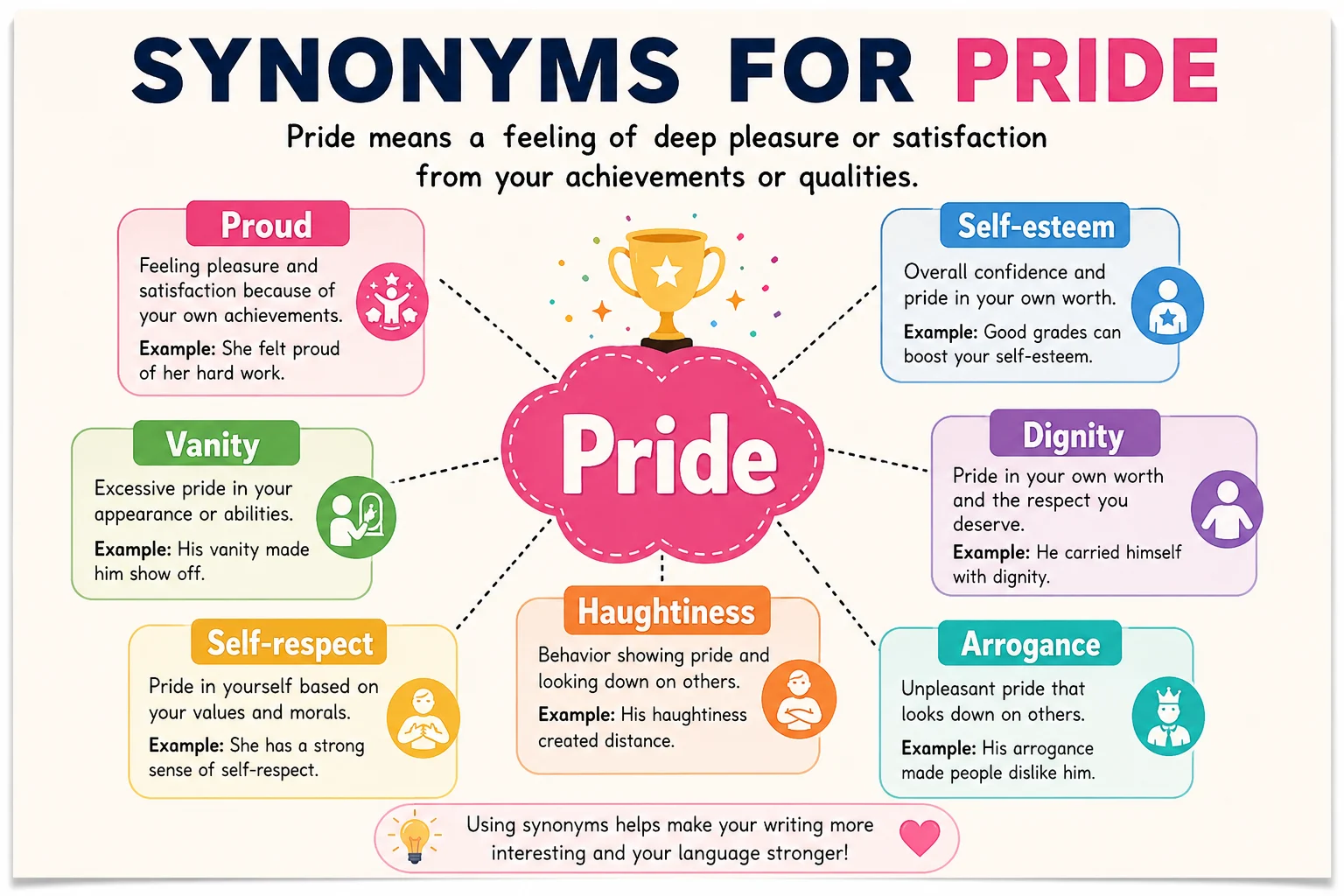
Looking for a better word than “pride” without changing the meaning or emotional tone of your sentence? The best synonym depends on what kind of pride you mean. You might use self-respect, dignity, or self-esteem when referring to a healthy sense of personal worth; satisfaction, fulfillment, or accomplishment when feeling proud of an achievement; or arrogance, conceit, or self-importance when pride becomes excessive.
If you’re searching for synonyms for pride, you may want to avoid repetition, improve an essay, story, speech, article, professional piece of writing, or everyday sentence, or find a more precise emotional expression. The tricky part? “Pride” can express healthy self-worth, satisfaction, joy, or excessive self-importance, so the wrong alternative can completely change your sentence’s tone.
For example, “She felt pride in her achievement” may call for satisfaction, while “His pride stopped him from apologizing” may suggest arrogance or stubbornness. This guide covers useful synonyms, near-synonyms, and context-specific alternatives for pride, with clear examples and tone differences to help you choose the right word.
Understanding the Different Meanings of Pride
Before choosing a synonym, it helps to know what pride means in context.
Positive pride is a good feeling about yourself, someone you care about, or something you have done.
- “She felt pride after passing her exam.”
- “He takes pride in his work.”
Pride as self-respect means feeling that you deserve respect and should value yourself.
- “She refused to give up her dignity.”
Excessive pride means having too high an opinion of yourself.
- “His pride would not let him admit his mistake.”
This difference matters because confidence is not the same as arrogance, and satisfaction is not the same as vanity.
Choosing the Right Synonym for Pride
| If you mean… | A useful word |
|---|---|
| Feeling good about an achievement | Satisfaction |
| Believing in your abilities | Confidence |
| Respecting yourself | Self-respect |
| Feeling worthy | Dignity |
| Feeling happy about success | Pleasure |
| Respect for another person | Admiration |
| Being pleased with your work | Fulfillment |
| Thinking you are better than others | Arrogance |
| Too much pride in yourself | Conceit |
| Pride in your appearance | Vanity |
| Extreme and dangerous pride | Hubris |
| Praise for your own achievements | Self-praise |
Language Tip: Pride is not always negative. In phrases such as “take pride in your work,” it usually expresses a healthy feeling of satisfaction. In phrases such as “his pride made him look down on others,” it can suggest arrogance.
Self-Respect
Meaning: Self-respect means valuing yourself and believing you deserve respect.
Examples:
- She kept her self-respect during the argument.
- He would not trade his self-respect for money.
Dignity
Meaning: Dignity means having a calm sense that you are worthy of respect.
Examples:
- She handled the criticism with dignity.
- He walked away with his dignity intact.
Confidence
Meaning: Confidence means believing that you can do something well.
Examples:
- She spoke with confidence during the meeting.
- Practice gave him more confidence.
Self-Confidence
Meaning: Self-confidence means trusting your own abilities and decisions.
Examples:
- The speech helped build her self-confidence.
- His self-confidence grew after he passed the test.
Self-Assurance
Meaning: Self-assurance means feeling calm and sure about your abilities.
Examples:
- She answered the questions with self-assurance.
- His self-assurance impressed the interview panel.
Self-Esteem
Meaning: Self-esteem means the value and respect you feel for yourself.
Examples:
- Kind support can improve a child’s self-esteem.
- Her success gave her self-esteem a healthy boost.
Esteem
Meaning: Esteem means strong respect or admiration for someone.
Examples:
- She is held in high esteem by her students.
- His honesty earned the esteem of his team.
Satisfaction
Meaning: Satisfaction is the good feeling you get when something goes well.
Examples:
- He felt deep satisfaction after finishing the project.
- Cooking the meal herself gave her great satisfaction.
Pleasure
Meaning: Pleasure is a happy feeling that comes from something you enjoy or achieve.
Examples:
- She took pleasure in helping her younger brother.
- His success gave his parents great pleasure.
Joy
Meaning: Joy is a strong feeling of happiness.
Examples:
- Her graduation filled her with joy.
- He felt pure joy when his team won.
Happiness
Meaning: Happiness is the feeling of being glad and content.
Examples:
- Her child’s success brought her great happiness.
- He smiled with happiness after hearing the news.
Fulfillment
Meaning: Fulfillment is a deep feeling that comes from doing something meaningful or worthwhile.
Examples:
- Teaching children gave her a sense of fulfillment.
- He found fulfillment in helping his community.
Contentment
Meaning: Contentment is a peaceful feeling that comes from being satisfied with what you have.
Examples:
- She felt contentment after a quiet evening at home.
- His simple life gave him a sense of contentment.
Gratification
Meaning: Gratification is a feeling of pleasure after getting what you wanted or achieving something.
Examples:
- Finishing the difficult task gave him instant gratification.
- She felt gratification when her hard work paid off.
Honor
Meaning: Honor can describe the respect or sense of pride connected with a person, role, or achievement.
Examples:
- It was an honor to represent my school.
- He felt honored to receive the award.
Admiration
Meaning: Admiration means strong respect and approval for someone.
Examples:
- I have great admiration for her courage.
- His dedication earned the admiration of his friends.
Appreciation
Meaning: Appreciation means recognizing the value or good qualities of someone or something.
Examples:
- She showed appreciation for her team’s effort.
- His note expressed sincere appreciation.
Respect
Meaning: Respect means having a high opinion of someone because of their qualities or actions.
Examples:
- Her hard work earned everyone’s respect.
- We have deep respect for our coach.
Recognition
Meaning: Recognition means public or personal acknowledgment of someone’s good work or achievement.
Examples:
- She received recognition for her research.
- The award gave him a proud sense of recognition.
Acclaim
Meaning: Acclaim means strong public praise for an achievement.
Examples:
- The author received acclaim for her first novel.
- His performance won widespread acclaim.
Praise
Meaning: Praise means saying that someone has done something well.
Examples:
- The teacher gave Maya praise for her effort.
- His hard work earned praise from the manager.
Approval
Meaning: Approval means a positive response that shows you think something is good or acceptable.
Examples:
- Her parents gave their approval to the plan.
- He smiled when he received his teacher’s approval.
Synonyms for Various: 58+ Words Beyond “Various”
Delight
Meaning: Delight means great happiness or pleasure.
Examples:
- She felt delight when she saw her final grade.
- His parents watched the ceremony with delight.
Exultation
Meaning: Exultation means a very strong feeling of happiness after a victory or success.
Examples:
- The players shouted in exultation after the final goal.
- She felt exultation when her team won the title.
Triumph
Meaning: Triumph means a great victory or the strong happiness that comes from winning.
Examples:
- The team celebrated its triumph together.
- Passing the difficult exam felt like a personal triumph.
Glory
Meaning: Glory means great honor, praise, or fame gained through success.
Examples:
- The athlete dreamed of Olympic glory.
- The victory brought glory to the small town.
Self-Satisfaction
Meaning: Self-satisfaction means feeling very pleased with yourself or your actions.
Examples:
- He smiled with self-satisfaction after solving the puzzle.
- Her self-satisfaction was clear after the successful presentation.
Self-Approval
Meaning: Self-approval means accepting and feeling positive about yourself.
Examples:
- She learned to seek self-approval instead of constant praise.
- Self-approval helped him feel more secure.
Self-Worth
Meaning: Self-worth means knowing that you have value as a person.
Examples:
- Your salary does not decide your self-worth.
- She discovered her self-worth after leaving the toxic job.
Synonyms for Give: 55+ Alternatives When “Give” Isn’t Enough
Self-Praise
Meaning: Self-praise means speaking positively about your own abilities or achievements.
Examples:
- His post sounded like self-praise.
- Too much self-praise can make a person seem boastful.
Self-Admiration
Meaning: Self-admiration means having a strong liking or admiration for yourself.
Examples:
- His constant self-admiration annoyed his friends.
- Too much self-admiration can hurt relationships.
Self-Congratulation
Meaning: Self-congratulation means giving yourself praise for your own success.
Examples:
- She avoided self-congratulation after winning the prize.
- His speech sounded like self-congratulation.
Self-Glorification
Meaning: Self-glorification means presenting yourself as especially great or successful.
Examples:
- The speech felt more like self-glorification than thanks.
- His online posts often turned into self-glorification.
Bragging
Meaning: Bragging means talking too proudly about your abilities or achievements.
Examples:
- He kept bragging about his high score.
- Her constant bragging annoyed the group.
Boasting
Meaning: Boasting means speaking proudly about yourself in a way that can seem annoying.
Examples:
- She was boasting about her new job.
- His boasting made the conversation uncomfortable.
Conceit
Meaning: Conceit means too much pride in your own abilities or qualities.
Examples:
- His conceit made teamwork difficult.
- Her conceit was clear from the way she spoke.
Vanity
Meaning: Vanity means excessive pride in your appearance, qualities, or achievements.
Examples:
- His vanity made him check the mirror constantly.
- She did not want vanity to control her choices.
Arrogance
Meaning: Arrogance means acting as if you are better or more important than others.
Examples:
- His arrogance upset the rest of the team.
- She answered with confidence, not arrogance.
Haughtiness
Meaning: Haughtiness means behaving as if you are better than other people.
Examples:
- Her haughtiness made the new workers uncomfortable.
- He spoke with haughtiness during the meeting.
Hubris
Meaning: Hubris means extreme pride that makes someone ignore limits, advice, or consequences.
Examples:
- His hubris made him ignore the warning.
- The leader’s hubris caused a serious mistake.
Superiority
Meaning: Superiority means believing that you are better than other people.
Examples:
- His attitude showed a sense of superiority.
- She never treated her classmates with superiority.
Self-Importance
Meaning: Self-importance means thinking that you are more important than you really are.
Examples:
- His sense of self-importance was obvious.
- Her self-importance made small tasks seem beneath her.
Ego
Meaning: Ego is a person’s sense of their own importance or ability.
Examples:
- His ego would not let him admit the mistake.
- She put her ego aside and apologized.
Pridefulness
Meaning: Pridefulness means having a strong sense of pride, especially in a way that may seem excessive.
Examples:
- His pridefulness made it hard to accept advice.
- Her pridefulness sometimes caused problems at work.
Vainglory
Meaning: Vainglory means excessive pride in your achievements, appearance, or reputation.
Examples:
- He chased fame and vainglory instead of meaningful work.
- Her actions were driven by vainglory.
Smugness
Meaning: Smugness means being too pleased with yourself and showing it.
Examples:
- His smugness was clear after he won the debate.
- She disliked his look of smugness.
Self-Regard
Meaning: Self-regard means the opinion and value you have of yourself.
Examples:
- Healthy self-regard can support confidence.
- His strong self-regard helped him handle criticism.
Frequently Asked Questions About Synonyms for Pride
What is another word for pride?
Another word for pride depends on the context. Self-respect, dignity, confidence, satisfaction, pleasure, honor, and self-esteem can describe positive forms of pride, while arrogance, conceit, vanity, and hubris describe excessive pride.
What is a positive synonym for pride?
Common positive synonyms include self-respect, dignity, confidence, satisfaction, self-esteem, pleasure, fulfillment, honor, and admiration. The best choice depends on the exact situation.
What is a negative synonym for pride?
Common negative synonyms include arrogance, conceit, vanity, haughtiness, hubris, smugness, self-importance, boasting, and vainglory.
What is a synonym for being proud of an achievement?
Satisfaction, pleasure, fulfillment, delight, triumph, and gratification can describe the positive feeling that comes from achieving something.
What is a synonym for pride in your work?
Useful choices include satisfaction, self-respect, fulfillment, confidence, and pleasure. For example, “I take pride in my work” can often be expressed as “I feel satisfaction in my work.”
Is pride the same as arrogance?
No. Pride can be healthy and can mean feeling good about your work or qualities. Arrogance is negative because it involves acting as if you are better or more important than others.
What is the difference between pride and self-esteem?
Self-esteem is how you value yourself. Pride is often a feeling of pleasure or satisfaction about yourself, someone you care about, or something you have done. They can overlap, but they are not always interchangeable.
Conclusion
Learning synonyms for pride helps you choose the right word for the right situation. Confidence can express belief in your abilities, satisfaction can describe pleasure in an achievement, and self-respect can show healthy personal value. Words such as arrogance, vanity, and hubris help describe excessive pride. Practice these words in your emails, essays, blog posts, and daily conversations. The more precise your vocabulary becomes, the clearer and more confident your communication will sound.

I am Joseph Clark, a vocabulary and language content writer at SynonymLibrary.com. I create clear, practical synonym guides that help readers improve their writing, word choice, and communication skills. My goal is to make language learning simple, accurate, and useful for students, writers, professionals, and everyday learners.