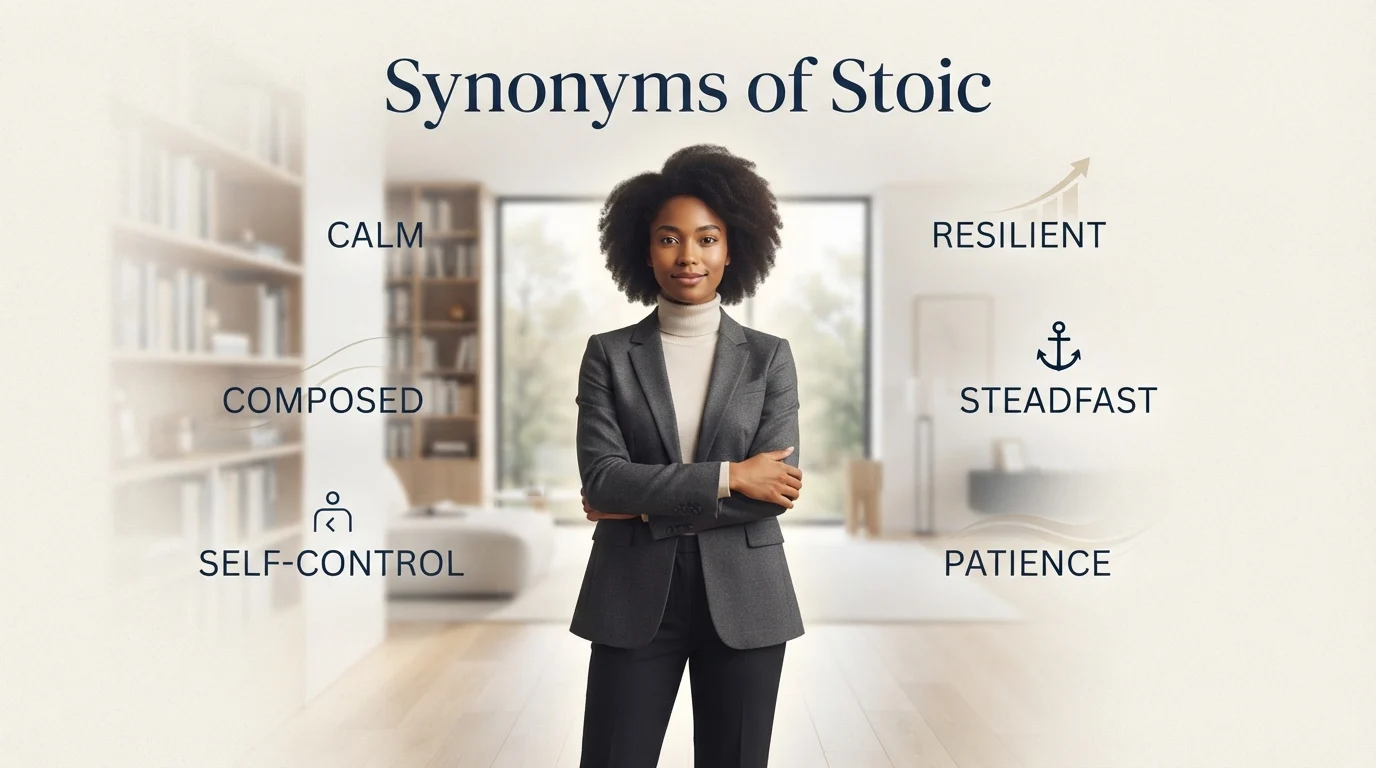
Someone can receive bad news, face criticism, or experience pain without showing much outward emotion. That is where the word stoic fits—but finding the right synonyms of stoic can help you describe this quality more precisely.
Stoic generally describes someone who remains calm, controlled, and uncomplaining during difficulty, even though they may still feel strong emotions internally. Depending on the context, useful alternatives include composed, impassive, unflappable, restrained, self-controlled, steadfast, unemotional, tough, and resolute. However, these words are not exact substitutes. Composed emphasizes calm behavior, impassive suggests little visible emotion, unflappable highlights resistance to being upset, while resolute focuses on determination.
For example, a stoic person might feel nervous after receiving bad news but calmly handle the situation without showing panic. This guide explores synonyms for stoic, another word for stoic, and related alternatives so you can choose the most accurate word for essays, character descriptions, professional writing, and everyday English.
Stoical
Meaning: Stoical means staying calm and showing little emotion during pain or trouble.
Examples:
- She remained stoical after hearing the disappointing news.
- His stoical response showed how well he handled the pressure.
Composed
Meaning: A composed person stays calm and in control of their emotions.
Examples:
- She stayed composed during the difficult interview.
- He looked composed even when the meeting became tense.
Impassive
Meaning: An impassive person shows very little emotion on their face or in their behavior.
Examples:
- He remained impassive while everyone waited for his answer.
- Her impassive expression gave nothing away.
Unflappable
Meaning: An unflappable person stays calm even when something stressful happens.
Examples:
- Our teacher is unflappable during busy exam days.
- She stayed unflappable when the computer suddenly stopped working.
Unperturbed
Meaning: An unperturbed person does not seem worried or bothered by a problem.
Examples:
- He seemed unperturbed by the sudden change in plans.
- She was unperturbed when the flight was delayed.
Unruffled
Meaning: An unruffled person remains calm and is not easily upset.
Examples:
- She stayed unruffled during the heated conversation.
- He appeared completely unruffled by the criticism.
Self-Possessed
Meaning: A self-possessed person stays confident and calm in difficult situations.
Examples:
- She sounded self-possessed during her first public speech.
- He remained self-possessed when the audience asked hard questions.
Self-Controlled
Meaning: A self-controlled person can manage their feelings and actions.
Examples:
- She was self-controlled when the customer became rude.
- He stayed self-controlled instead of shouting back.
Restrained
Meaning: A restrained person keeps strong feelings or reactions under control.
Examples:
- He gave a restrained response to the unfair comment.
- Her restrained reaction surprised everyone in the room.
Controlled
Meaning: A controlled person keeps their emotions and reactions from becoming too strong.
Examples:
- She gave a controlled answer during the argument.
- His voice remained controlled throughout the discussion.
Calm
Meaning: A calm person stays peaceful and does not become upset easily.
Examples:
- Try to stay calm when the plan changes.
- She remained calm while helping the frightened child.
Collected
Meaning: A collected person stays calm and thinks clearly under pressure.
Examples:
- He looked collected before the important presentation.
- She stayed collected after discovering the mistake.
Level-Headed
Meaning: A level-headed person thinks clearly and makes sensible choices during problems.
Examples:
- My sister is very level-headed in a crisis.
- We needed a level-headed person to solve the disagreement.
Even-Tempered
Meaning: An even-tempered person does not become angry or excited easily.
Examples:
- Our coach is patient and even-tempered.
- His even-tempered nature makes him easy to work with.
Steady
Meaning: A steady person remains calm, strong, and reliable during difficult moments.
Examples:
- She kept a steady voice during the emergency.
- His steady manner helped everyone feel less worried.
Serene
Meaning: A serene person has a peaceful and calm manner.
Examples:
- She had a serene smile during the quiet morning.
- His serene nature made the room feel peaceful.
Tranquil
Meaning: Tranquil means peaceful, quiet, and free from stress.
Examples:
- He kept a tranquil attitude during the long wait.
- Her tranquil voice helped calm the nervous group.
Placid
Meaning: A placid person has a quiet and peaceful nature.
Examples:
- The placid teacher rarely became upset with students.
- She remained placid while everyone discussed the problem.
Equable
Meaning: An equable person stays calm and steady even when situations change.
Examples:
- His equable manner helped during the stressful meeting.
- She remained equable when the schedule changed again.
Patient
Meaning: A patient person can deal with delays or problems without becoming angry.
Examples:
- She was patient with the confused customer.
- He stayed patient while waiting for the repair.
Cool-Headed
Meaning: A cool-headed person thinks clearly instead of panicking.
Examples:
- We need someone cool-headed during an emergency.
- She stayed cool-headed when the team lost its plan.
Cool
Meaning: In casual English, cool can describe someone who stays relaxed under pressure.
Examples:
- He kept cool when everyone started arguing.
- She stayed cool after hearing the unexpected news.
Imperturbable
Meaning: An imperturbable person is not easily worried, upset, or disturbed.
Examples:
- The doctor remained imperturbable during the busy shift.
- Nothing seemed to disturb his imperturbable manner.
Resilient
Meaning: A resilient person can recover from problems and keep going.
Examples:
- She was resilient after losing an important opportunity.
- His resilient attitude helped him start again.
Steadfast
Meaning: A steadfast person remains strong, loyal, and firm during difficult times.
Examples:
- She remained steadfast when the project faced problems.
- His steadfast support helped his friend through a hard week.
Resolute
Meaning: A resolute person is firm and does not easily change their decision.
Examples:
- She was resolute about finishing the difficult task.
- He remained resolute despite the pressure from others.
Determined
Meaning: A determined person keeps trying because they strongly want to reach a goal.
Examples:
- She was determined to improve her English.
- He stayed determined after failing his first test.
Firm
Meaning: A firm person stays strong in their decision or position.
Examples:
- She was firm about her decision to leave.
- He gave a firm answer without becoming angry.
Unwavering
Meaning: An unwavering person remains firm and does not lose confidence or focus.
Examples:
- She showed unwavering support for her family.
- His unwavering focus helped him complete the project.
Unshaken
Meaning: An unshaken person stays strong after something difficult or frightening happens.
Examples:
- She remained unshaken by the negative comments.
- He looked unshaken after the unexpected setback.
Strong
Meaning: A strong person can handle difficult situations without giving up.
Examples:
- She stayed strong after receiving the disappointing result.
- He remained strong when his plans suddenly changed.
Tough
Meaning: A tough person can deal with pain, pressure, or trouble well.
Examples:
- She is tough enough to handle difficult days.
- He stayed tough during the demanding training.
Hardy
Meaning: A hardy person can handle difficult conditions and keep going.
Examples:
- The hardy worker continued despite the cold weather.
- She is hardy enough to manage long outdoor trips.
Enduring
Meaning: Enduring describes someone or something that continues through difficulty or pain.
Examples:
- Her enduring strength helped her through the long recovery.
- His enduring patience impressed everyone around him.
Courageous
Meaning: A courageous person faces fear, danger, or difficulty with bravery.
Examples:
- She made a courageous choice during the crisis.
- His courageous response inspired his teammates.
Brave
Meaning: A brave person faces fear or difficulty instead of running away.
Examples:
- She was brave enough to speak in front of the crowd.
- He stayed brave when the situation became frightening.
Fearless
Meaning: A fearless person shows little or no fear when facing a difficult situation.
Examples:
- The fearless climber continued toward the summit.
- She looked fearless before giving her difficult speech.
Reserved
Meaning: A reserved person does not openly share many thoughts or feelings.
Examples:
- He is reserved when meeting new people.
- She remained reserved during the family discussion.
Reticent
Meaning: A reticent person is not willing to talk openly about their thoughts or feelings.
Examples:
- He was reticent about his personal problems.
- She remained reticent when asked about the disagreement.
Taciturn
Meaning: A taciturn person usually speaks very little.
Examples:
- The taciturn man rarely joined long conversations.
- Her taciturn nature made her difficult to read.
Unemotional
Meaning: An unemotional person does not openly show strong feelings.
Examples:
- He sounded unemotional when he explained the decision.
- Her unemotional response surprised her friends.
Detached
Meaning: A detached person keeps emotional distance from a situation.
Examples:
- He sounded detached while discussing the problem.
- She stayed detached during the heated debate.
Aloof
Meaning: An aloof person seems distant and does not easily connect with others.
Examples:
- He seemed aloof at the crowded party.
- She can appear aloof when she meets strangers.
Note: Aloof is not a direct synonym for stoic. It suggests emotional or social distance.
59+ Synonyms for Consequences: From Results to Repercussions
Indifferent
Meaning: An indifferent person shows little care or concern about something.
Examples:
- He seemed indifferent to the negative comments.
- She was indifferent to the final result.
Note: Indifferent is not the same as stoic. A stoic person may care deeply but control how they react.
Apathetic
Meaning: An apathetic person seems to have little interest, care, or concern.
Examples:
- He appeared apathetic about the team’s poor result.
- Her apathetic response worried her friends.
Note: Apathetic is usually more negative than stoic. Stoicism involves emotional control, while apathy suggests a lack of interest or concern.
Philosophical
Meaning: A philosophical person can accept an unwanted situation without becoming overly upset.
Examples:
- She was philosophical about missing the train.
- He took a philosophical view of the failed plan.
Note: Philosophical can overlap with stoic in some situations, but it is not an exact synonym.
Disciplined
Meaning: A disciplined person controls their actions and follows a plan.
Examples:
- She is disciplined about her study routine.
- He stayed disciplined during months of training.
Note: Disciplined is related to self-control, but it does not directly mean stoic.
Forbearing
Meaning: A forbearing person stays patient and avoids reacting angrily to someone’s behavior.
Examples:
- She was forbearing when her coworker made the same mistake again.
- His forbearing attitude kept the discussion peaceful.
Nonchalant
Meaning: A nonchalant person acts relaxed and unconcerned about something.
Examples:
- He gave a nonchalant reply to the surprising question.
- She looked nonchalant even though the situation was tense.
Note: Nonchalant can resemble stoic when someone appears unconcerned, but it does not necessarily imply inner strength.
Phlegmatic
Meaning: A phlegmatic person has a calm and unemotional temperament.
Examples:
- His phlegmatic nature helped him handle stressful work.
- She remained phlegmatic during the long disagreement.
What Is a Stoic Person?
A stoic person is someone who stays calm and controlled when facing pain, stress, disappointment, or difficulty.
For example, imagine someone receives bad news at work. Instead of shouting or blaming someone, they take a moment, think clearly, and deal with the problem. You could describe that person as stoic.
The word does not mean that the person has no feelings. A stoic person may feel sadness, anger, fear, or disappointment but may choose not to show those emotions openly.
There is also a difference between stoic and Stoic. In everyday English, stoic usually describes a person’s calm and controlled behavior. Stoic can also refer to a person connected with Stoicism, the philosophical tradition.
Is Stoic a Positive Word?
Stoic can be positive, neutral, or negative depending on the context.
It is often positive when it describes someone who remains calm, strong, patient, or controlled during a difficult time.
For example:
She remained stoic during the difficult experience.
Here, stoic can suggest emotional strength.
However, the word can sound less positive when it suggests that someone hides feelings too much or seems emotionally distant.
For example:
He was so stoic that nobody knew how he felt.
Here, the speaker may be pointing out a communication problem.
So, stoic is not automatically good or bad. The surrounding sentence determines the feeling.
What Is a Positive Synonym for Stoic?
If you want a positive synonym for stoic, the best choice depends on the quality you want to highlight.
Use composed when you mean calm and controlled.
Use resilient when you mean able to recover from hardship.
Use level-headed when you mean calm and sensible.
Use self-controlled when you mean able to manage emotions.
Use steadfast when you mean strong and loyal during difficulty.
Use unflappable when you mean calm even under pressure.
Use courageous when you want to emphasize bravery rather than emotional control.
This is why synonyms should not be treated as interchangeable. Each word adds a slightly different idea.
Is Stoic Good or Bad?
The answer depends on the context.
Being stoic can be helpful when it means staying calm, thinking clearly, and handling hardship without losing control.
But being extremely stoic can sometimes be viewed negatively if a person never communicates their feelings or seems emotionally distant.
Compare these sentences:
She stayed stoic during the crisis.
This usually highlights strength and control.
He was stoic and never told anyone how he felt.
This may suggest emotional distance.
So, stoic itself is not simply a positive or negative word.
67+ Synonyms for Establish: Powerful Alternatives for Every Use
Stoic Antonym and Synonym
A synonym is a word with a similar meaning. An antonym is a word with an opposite meaning.
Some close or contextual synonyms for stoic include:
- stoical
- composed
- impassive
- unflappable
- self-controlled
- restrained
- unperturbed
- unruffled
- level-headed
- self-possessed
Possible stoic antonyms include:
- emotional
- expressive
- reactive
- excitable
- impulsive
The exact antonym depends on which part of stoic you want to contrast. If you mean “showing little emotion,” expressive or emotional may work best.
Stoic Antonyms
Here are some useful stoic antonyms and what they suggest.
Emotional means showing strong feelings.
Expressive means openly showing thoughts and emotions.
Reactive means responding quickly or strongly to events.
Excitable means becoming excited or upset easily.
Impulsive means acting quickly without thinking carefully first.
These are not perfect opposites in every sentence. For example, someone can be both brave and emotional, or calm in one situation and expressive in another.
Synonyms of Stoic Slang
If you want synonyms of stoic slang, everyday English gives you a few casual choices.
Cool can describe someone who stays relaxed.
Unfazed can describe someone who does not seem affected by something.
Unbothered can suggest that someone does not seem worried or upset.
Chill can describe a relaxed person in very informal English.
These are not exact replacements for stoic.
For example:
He stayed cool when everyone started arguing.
This sounds casual.
He remained stoic during the crisis.
This sounds more formal and strongly suggests emotional control during difficulty.
So, choose the word based on the situation and tone.
Calm or Stoic Synonyms
If you are looking for calm or stoic synonyms, first decide what you want to emphasize.
For simple calmness, use calm, serene, tranquil, or placid.
For emotional control, use composed, self-controlled, restrained, or impassive.
For staying calm under pressure, use unflappable, unperturbed, or imperturbable.
For strength during hardship, use resilient, steadfast, or unshaken.
This distinction helps you choose a word that fits your sentence instead of using every synonym as if it had exactly the same meaning.
Stoic Synonym Negative
Some words may describe a stoic person in a negative way, but they should not be treated as exact synonyms.
Aloof suggests emotional or social distance.
Indifferent suggests a lack of concern.
Apathetic suggests little interest or motivation.
Detached suggests emotional distance from a situation.
Unemotional simply suggests that strong feelings are not being shown.
For example:
She was stoic during the difficult conversation.
This can sound respectful.
But:
She was apathetic during the difficult conversation.
This suggests that she did not care.
That difference is important.
Stoicism Meaning
Stoicism is the name of an ancient philosophy associated with ideas about reason, self-control, virtue, and dealing with things outside your control.
In everyday English, however, people often use stoicism to mean emotional strength and the ability to remain calm during hardship.
For example:
His stoicism helped him stay focused during a difficult period.
Remember that stoicism does not simply mean having no emotions. The everyday idea is closer to managing your response to difficult emotions and situations.
Calm or Stoic Synonyms: 7 Letters
If you need a seven-letter word related closely to stoic, stoical is a useful choice because it has seven letters and directly describes someone who shows stoic qualities.
Other words may fit the general idea of calmness but have different lengths or meanings.
For example:
- stoical — seven letters; showing stoic qualities
- placid — six letters; peaceful and calm
- serene — six letters; peaceful and calm
- reserved — eight letters; not openly expressive
- phlegmatic — ten letters; calm and unemotional
If you are solving a crossword or word puzzle, stoical may be especially useful when the clue asks for a seven-letter word related to stoic.
Why Stoic Synonyms Are Not Always Interchangeable
This is one of the most important things to remember.
Consider these words:
| Word | Main idea |
|---|---|
| Stoic | Calm while facing pain or difficulty |
| Composed | Calm and in control |
| Resilient | Able to recover after hardship |
| Brave | Willing to face fear |
| Reserved | Does not openly show much |
| Aloof | Emotionally or socially distant |
| Apathetic | Shows little care or interest |
| Indifferent | Shows little concern |
| Serene | Peaceful and calm |
| Determined | Keeps trying toward a goal |
These words overlap, but they are not identical.
A stoic person may be brave, but bravery is not required for someone to be stoic.
A person may be reserved without being stoic.
A person may be calm without dealing with pain or hardship.
And an apathetic person may not care at all, which is very different from someone who cares but controls their reaction.
That is why choosing the right synonym matters.
How to Choose the Right Synonym for Stoic
Use composed when the person is calm during pressure.
Use impassive when the person shows almost no emotion.
Use unflappable when the person stays calm despite stressful events.
Use resilient when the person recovers after hardship.
Use level-headed when the person thinks clearly during a problem.
Use reserved when the person does not share feelings openly.
Use brave when the main idea is courage.
Use steadfast when the person remains firm or loyal.
Use aloof when the person seems distant.
Use apathetic when the person seems not to care.
This approach makes your English more precise and natural.
Frequently Asked Questions About Synonyms of Stoic
What is the closest synonym for stoic?
Some of the closest alternatives are stoical, composed, impassive, self-controlled, unflappable, and restrained. The best choice depends on whether you want to emphasize calmness, emotional control, or endurance.
What is a positive synonym for stoic?
Positive alternatives include composed, resilient, self-controlled, level-headed, steadfast, unflappable, and strong. Each word highlights a different positive quality.
Is stoic a positive or negative word?
Stoic can be positive, neutral, or negative. It can praise calmness and strength, but it can also suggest that someone hides emotions or seems distant.
What is the opposite of stoic?
Possible opposites include emotional, expressive, reactive, excitable, and impulsive. The best choice depends on the exact meaning of stoic in the sentence.
What is a synonym for a stoic person?
A stoic person may be described as composed, calm, self-controlled, impassive, unflappable, resilient, or steadfast, depending on the quality you want to highlight.
What is the difference between stoic and calm?
Calm mainly means relaxed and not upset. Stoic usually adds the idea of staying controlled while facing pain, hardship, pressure, or disappointment.
Conclusion
Learning the synonyms of stoic gives you more precise ways to describe calmness, emotional control, strength, patience, courage, and restraint. It can make your writing clearer and more natural.
Students can use these words in essays. Bloggers and content writers can avoid repeating the same word. Daily English users can choose better words in emails, messages, and conversations.
The key is to choose a synonym based on its exact meaning. Practice words such as composed, resilient, level-headed, steadfast, and unflappable in your own sentences, and your vocabulary will become stronger over time.

I am Meer Hadi, a passionate language and content writer at SynonymLibrary.com. I focus on creating helpful word guides that make it easier for readers to choose the right words, understand meanings, and express their ideas more clearly. Through my work, I aim to support students, writers, and professionals in building stronger communication skills.







