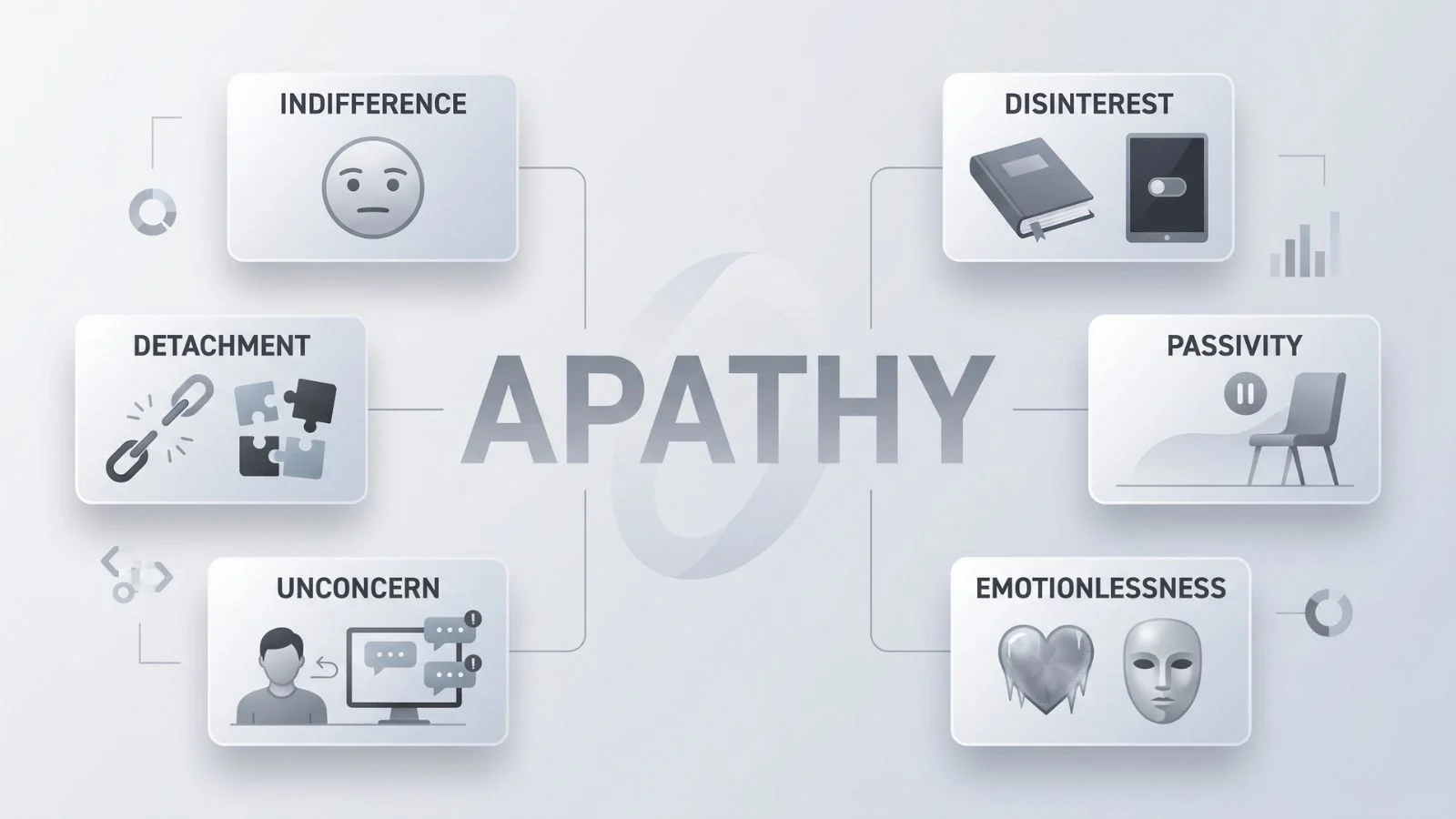
Apathy can mean more than simply “not caring,” and choosing the wrong alternative can change the meaning of your sentence. If you need synonyms for apathy, the right choice depends on whether you mean a lack of interest, concern, emotion, or motivation. Indifference is a close general alternative, while unconcern emphasizes a lack of worry. Disinterest can refer to a lack of interest, detachment suggests emotional distance, and passivity focuses on a lack of action rather than a lack of feeling.
These words overlap, but they are not interchangeable in every context. Someone may show indifference toward an issue, remain unconcerned about a problem, or respond with emotional detachment. Apathy can be broader, describing a reduced interest, enthusiasm, concern, or motivation toward something.
This guide covers useful synonyms for apathy, including formal, everyday, emotional, and context-based alternatives, with simple meanings and examples to help you choose the word that best matches your intended meaning.
Indifference
Meaning:
- A feeling of not caring about something or someone at all.
Examples:
- His indifference to the school play hurt the feelings of his classmates.
- She showed total indifference when the prize winners were announced.
Disinterest
Meaning:
- Having no interest or curiosity in what is happening around you.
Examples:
- Her disinterest in the lesson made the teacher stop and check on her.
- His disinterest in the new club was clear from the look on his face.
Unconcern
Meaning:
- Not feeling worried or bothered about something that matters.
Examples:
- His unconcern about the upcoming test shocked everyone in his group.
- She showed complete unconcern when the alarm went off during lunch.
Detachment
Meaning:
- Feeling far away from things around you and not connected to them.
Examples:
- Her emotional detachment from the group made others feel worried.
- He walked through the busy fair with a strange sense of detachment.
Listlessness
Meaning:
- Feeling tired, weak, and having no energy or desire to do anything.
Examples:
- A wave of listlessness hit her after three long days of being unwell.
- His listlessness during the afternoon made his mom take him home early.
Passivity
Meaning:
- Not doing anything and letting things happen without reacting at all.
Examples:
- Her passivity during the group game frustrated every single teammate.
- His passivity in the face of problems made things harder for the team.
Lethargy
Meaning:
- A very heavy and slow feeling where you have no energy to do anything.
Examples:
- A deep lethargy kept him lying on the sofa for most of the rainy day.
- Her lethargy after the long trip made even small tasks feel very hard.
Torpor
Meaning:
- A state of being so slow and dull that you can barely move or think.
Examples:
- The class fell into a torpor after the long and very boring lecture.
- Winter seemed to push him into a deep torpor every single year.
Sluggishness
Meaning:
- Moving or thinking very slowly with very little energy or effort.
Examples:
- The heat of the afternoon caused a sluggishness across the whole class.
- His sluggishness on the field worried the coach before the big match.
Inertia
Meaning:
- The feeling of being stuck and unable to start or do anything at all.
Examples:
- A strong sense of inertia kept her from opening her textbook all evening.
- His inertia on school mornings made getting out of bed a daily battle.
Languor
Meaning:
- A soft and dreamy tiredness where you feel too relaxed to do anything.
Examples:
- A pleasant languor washed over the class on the last day before holidays.
- She stretched out on the grass and gave in to a gentle summer languor.
Numbness
Meaning:
- A feeling where you cannot feel anything at all, not sad or happy.
Examples:
- A strange numbness settled over her after the long and hard week.
- He felt a deep numbness after hearing the disappointing final results.
Coldness
Meaning:
- Showing no warmth or feeling toward other people or events.
Examples:
- Her coldness toward the new student made the classroom feel unfriendly.
- His coldness at the family dinner made everyone feel very uncomfortable.
Unresponsiveness
Meaning:
- Not reacting to things that happen or to people who are talking to you.
Examples:
- Her unresponsiveness during the lesson worried her classroom teacher.
- His unresponsiveness to every joke told at the party puzzled his friends.
Unenthusiasm
Meaning:
- Having no excitement or energy about something happening around you.
Examples:
- His unenthusiasm about the field trip surprised the whole planning group.
- Her unenthusiasm for the new project showed in every slow step she took.
Boredom
Meaning:
- Feeling that nothing around you is interesting or worth paying attention to.
Examples:
- A deep boredom settled over him during the very long rainy afternoon.
- She hid her boredom well but kept checking the clock every few minutes.
Weariness
Meaning:
- Feeling very tired and fed up after doing or seeing something too many times.
Examples:
- A heavy weariness came over her after the third long meeting of the day.
- His weariness with the same daily routine made him want a big change.
Tedium
Meaning:
- A long and boring feeling that comes when things feel dull and repetitive.
Examples:
- The tedium of copying the same notes every day made her lose focus fast.
- He fought the tedium of the long wait by making up stories in his head.
Dispassion
Meaning:
- Not having strong feelings one way or the other about something.
Examples:
- She spoke about the sad event with a strange and calm dispassion.
- His dispassion during the exciting announcement confused all his friends.
Emotionlessness
Meaning:
- Showing or feeling no emotions at all in any situation.
Examples:
- Her emotionlessness after the big win worried everyone who knew her.
- His emotionlessness during the sad film made his sister stare at him.
Blankness
Meaning:
- A state of having no thoughts, feelings, or reactions at all.
Examples:
- A strange blankness came over his face when the teacher called on him.
- She stared at the wall with a blankness that lasted a full ten minutes.
Vacancy
Meaning:
- An empty feeling inside where no thoughts or emotions seem to live.
Examples:
- A look of vacancy crossed her face as she sat through the long speech.
- His vacancy during the fun activity made his friend gently nudge him.
Withdrawal
Meaning:
- Pulling back from people and things because you do not feel connected.
Examples:
- His withdrawal from the group over several weeks worried the teacher.
- She showed signs of withdrawal by eating lunch alone every single day.
Disengagement
Meaning:
- Stepping away from things and no longer taking part or caring about them.
Examples:
- Her disengagement from class discussions lowered her participation grade.
- His disengagement from the sport he loved most worried his whole family.
Resignation
Meaning:
- Giving up caring or trying because you feel nothing will ever change.
Examples:
- A quiet resignation settled over him after failing the test a second time.
- She accepted the bad news with a dull resignation and walked away slowly.
Defeatism
Meaning:
- Believing things will go wrong before they even start, so why even try.
Examples:
- His defeatism before the competition stopped him from practicing hard.
- She had to fight her defeatism every morning before picking up her pen.
Hopelessness
Meaning:
- Feeling like nothing good will ever happen and things cannot get better.
Examples:
- A deep hopelessness kept her from trying out for the school team again.
- His hopelessness after the bad review faded once a kind friend helped him.
Despondency
Meaning:
- Feeling so low and sad that you stop trying or caring about anything.
Examples:
- A cloud of despondency followed him for days after the team loss.
- Her despondency at the end of term lifted once the holidays finally began.
Gloominess
Meaning:
- Feeling dark, sad, and low with no excitement or brightness in sight.
Examples:
- A heavy gloominess settled over the house on the long rainy weekend.
- His gloominess before the test was hard to cheer up with any kind words.
Melancholy
Meaning:
- A gentle but deep sadness that stays with you for a long time.
Examples:
- A quiet melancholy filled the room as the last day of school came to an end.
- She felt a soft melancholy every autumn when the leaves began to fall.
Joylessness
Meaning:
- A complete absence of happiness or pleasure in things around you.
Examples:
- A joylessness crept into her days after her best friend moved far away.
- His joylessness during the class party made his teacher sit beside him.
Passionlessness
Meaning:
- Having no drive, fire, or strong feeling about anything you do or see.
Examples:
- Her passionlessness in the art room was new and very unlike her at all.
- His passionlessness for football shocked the coach who had known him for years.
Coolness
Meaning:
- Keeping an emotional distance and showing very little warmth or care.
Examples:
- Her coolness toward the celebration made everyone wonder if she was okay.
- His coolness in the face of great news surprised his cheerful little sister.
Aloofness
Meaning:
- Staying away from people and things and keeping a strong emotional distance.
Examples:
- Her aloofness at the welcome party left a poor first impression on others.
- His aloofness from the group made new students think he was unfriendly.
Insensitivity
Meaning:
- Not noticing or caring about the feelings or needs of other people.
Examples:
- His insensitivity to her sadness made the situation much harder for her.
- Her insensitivity to the class mood made the teacher pull her aside.
Callousness
Meaning:
- Being so cold and unfeeling that you show no care for anyone at all.
Examples:
- His callousness toward the crying child shocked every adult in the room.
- She was not naturally callous, she was just very tired and overwhelmed.
Hardheartedness
Meaning:
- Being tough and cold with no room for gentle feelings toward others.
Examples:
- His hardheartedness during the sad film made him seem like a robot.
- Her hardheartedness softened a little when the puppy looked up at her.
Stolidity
Meaning:
- Being calm and showing very little reaction to anything around you.
Examples:
- Her stolidity during the scary ride impressed everyone waiting in line.
- His stolidity when the results were read out confused his nervous friends.
Impassivity
Meaning:
- Showing no feelings on your face or in your actions no matter what happens.
Examples:
- Her impassivity during the award ceremony was unusual for such a big win.
- His impassivity in the debate made it hard to know if he cared at all.
Stoniness
Meaning:
- Being hard, cold, and completely unfeeling like a stone wall.
Examples:
- A stoniness in his eyes made it clear he had completely shut everyone out.
- Her stoniness during the argument stopped any real progress being made.
Frigidity
Meaning:
- Being very cold and distant in a way that pushes everyone away.
Examples:
- Her frigidity toward the new group made the first week very awkward.
- His emotional frigidity made it hard for anyone to get close to him.
Unfeelingness
Meaning:
- Having no emotion or concern for what is going on around you.
Examples:
- His unfeelingness when others were upset made people stop confiding in him.
- Her unfeelingness during the sad assembly seemed out of character for her.
Phlegm
Meaning:
- A calm and slow nature where nothing excites or bothers you much at all.
Examples:
- He faced every challenge with a quiet phlegm that others could not match.
- Her phlegm in the face of chaos was both useful and a little surprising.
Spiritlessness
Meaning:
- Having no energy, spark, or desire to do anything or go anywhere.
Examples:
- A deep spiritlessness took hold of the team after three losses in a row.
- Her spiritlessness during the holidays worried her parents very much.
Dullness
Meaning:
- A flat, lifeless feeling with no spark, brightness, or excitement at all.
Examples:
- A dullness crept into his writing when he stopped reading for fun.
- The dullness in her eyes that week told her friends something was wrong.
Flatness
Meaning:
- Having no highs or lows, just a dull and steady lack of feeling.
Examples:
- A flatness in her voice told the teacher she was not doing very well.
- His flatness during the celebration made the whole room feel a bit quieter.
Tedium
Meaning:
- The dull and heavy feeling that comes when nothing holds your interest.
Examples:
- The tedium of waiting for an hour with nothing to do left them all restless.
- She wrote in her diary about the tedium of the long and quiet rainy week.
Numbness
Meaning:
- A total absence of feeling, as if your emotions have been switched off.
Examples:
- A protective numbness kept her calm through the very difficult afternoon.
- His numbness after the big disappointment lasted for most of the week.
Stagnation
Meaning:
- Staying still and not growing, moving, or feeling anything new at all.
Examples:
- A mental stagnation set in after weeks of doing the exact same routine.
- She worried about her own stagnation and decided to try a new hobby.
Lassitude
Meaning:
- A deep and heavy physical and mental tiredness that drains all your energy.
Examples:
- A great lassitude came over her after the final long week of the school term.
- His lassitude on the last day of the competition showed just how hard he had worked.
Conclusion
Learning synonyms for apathy gives your writing real power and depth. These simple words help you describe feelings in a much more vivid and interesting way. They make your essays richer, your blog posts more relatable, and your everyday conversations more expressive.
Start today. Pick three or four words from this list. Use one in your next story. Try one in your next email. Say one when you are describing how someone looks or feels.
Every new word you learn and use builds a stronger and more confident voice. You now have 50 great synonyms for apathy. Go use them all!

I am Joseph Clark, a vocabulary and language content writer at SynonymLibrary.com. I create clear, practical synonym guides that help readers improve their writing, word choice, and communication skills. My goal is to make language learning simple, accurate, and useful for students, writers, professionals, and everyday learners.