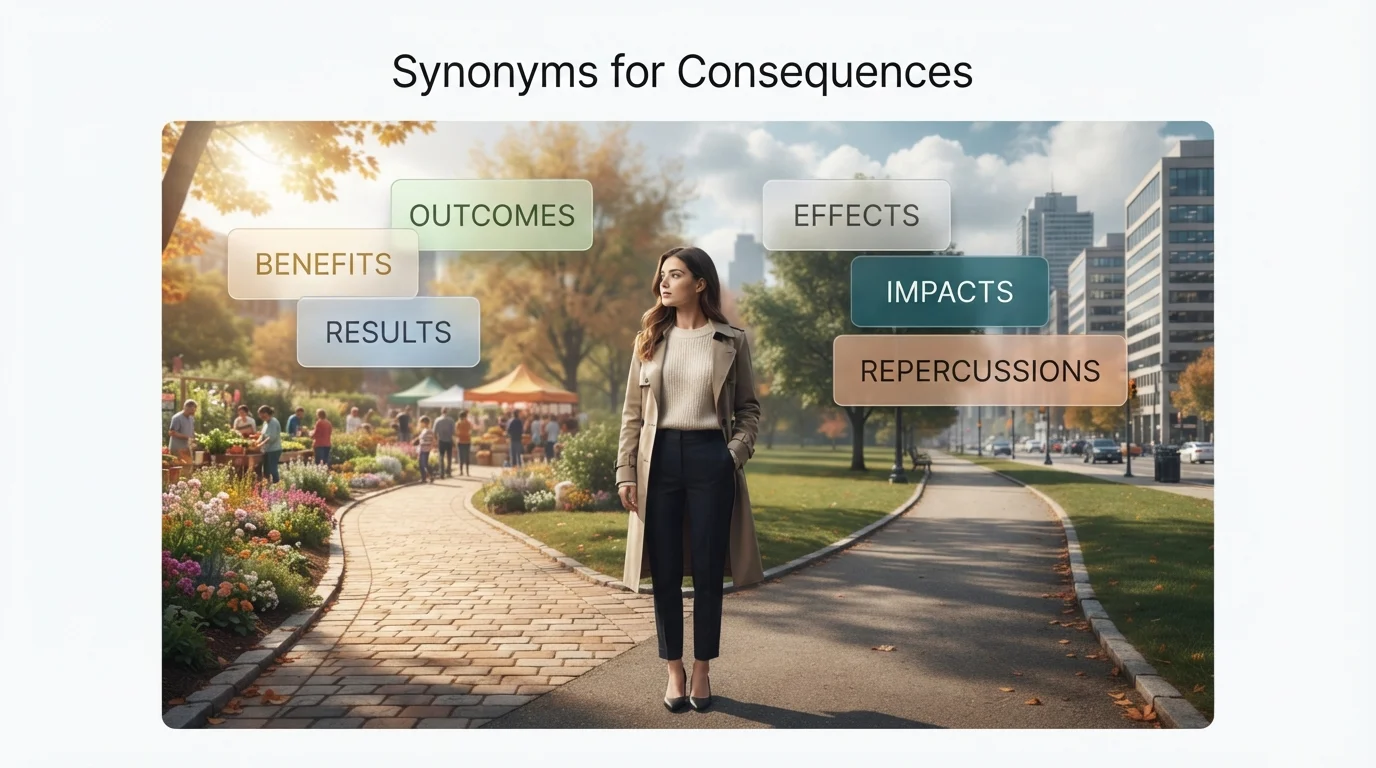
Writing “consequences” several times in an essay or report can make your sentences feel repetitive, but replacing it with any related word can also change the meaning. Consequences are the results or effects that follow an action, choice, or event. The word can be neutral, but it often carries a negative or serious tone in everyday English.
Useful synonyms for consequences include results, effects, outcomes, repercussions, ramifications, implications, impact, aftermath, and fallout. However, these alternatives are not exact substitutes in every situation. Results and outcomes can be positive or negative, repercussions usually suggest harmful effects, and ramifications often describe complex or far-reaching consequences. Aftermath is more suitable for what follows a major event, while fallout usually suggests damaging effects.
This guide breaks down these alternatives by meaning, tone, and context, with simple examples to help you choose the right word for essays, reports, professional writing, and everyday English.
Results
Meaning: Results are the things that happen because of an action, choice, or event.
Examples:
- The results of her hard work were easy to see.
- Every choice can bring different results.
“Results” is one of the safest alternatives to “consequences” because it sounds neutral and works in both everyday and formal writing.
Effects
Meaning: Effects are changes caused by a person, action, event, or situation.
Examples:
- The new rule had positive effects on students.
- We talked about the effects of too much screen time.
“Effects” is especially useful when you want to focus on how something changes another person, group, or situation.
Outcomes
Meaning: Outcomes are the final results of an action, process, or situation.
Examples:
- We were pleased with the outcome of the meeting.
- The outcome of the game surprised everyone.
“Outcomes” is a strong choice for essays, reports, and formal writing when you are discussing the final result.
Impacts
Meaning: Impacts are noticeable effects that something has on another person, place, or situation.
Examples:
- The storm had a huge impact on the town.
- The decision could impact many workers.
“Impact” often sounds stronger than “effect,” especially when the result is important or noticeable.
Repercussions
Meaning: Repercussions are usually negative effects that happen after an action or decision.
Examples:
- He did not think about the repercussions of his words.
- The mistake could have serious repercussions.
“Repercussions” is a useful choice when you mean negative consequences, especially consequences that may appear later.
Ramifications
Meaning: Ramifications are the wider effects that can develop from an action or decision.
Examples:
- The company considered the ramifications of the new policy.
- We need to understand the possible ramifications before acting.
“Ramifications” works well when one decision may create several connected effects.
Implications
Meaning: Implications are possible effects or meanings that follow from something.
Examples:
- The decision has important implications for students.
- We discussed the implications of the new rule.
“Implications” is common in essays and academic writing, especially when talking about what a fact or decision may mean in the future.
Aftereffects
Meaning: Aftereffects are effects that continue after an event has ended.
Examples:
- The town was still dealing with the aftereffects of the flood.
- He felt the aftereffects of the long journey for days.
Use “aftereffects” when the result remains after the original event is over.
Aftermath
Meaning: The aftermath is the situation that exists after a serious or difficult event.
Examples:
- Volunteers helped families in the aftermath of the storm.
- The city faced many problems in the aftermath of the accident.
“Aftermath” is usually connected with major or difficult events, so it is not a replacement for “consequences” in every sentence.
Fallout
Meaning: Fallout is the harmful result that follows a serious event, action, or problem.
Examples:
- The company faced public fallout after the mistake.
- The argument caused lasting fallout between the two teams.
“Fallout” usually has a negative tone and often suggests that the effects spread beyond the original event.
Side Effects
Meaning: Side effects are additional effects that happen because of an action, treatment, or situation.
Examples:
- The medicine caused some mild side effects.
- The new plan may have unexpected side effects.
“Side effects” is especially common in health-related contexts, but it can also be used more broadly.
Reactions
Meaning: Reactions are responses that happen because of something someone says or does.
Examples:
- Her announcement received mixed reactions.
- We were surprised by his reaction to the news.
“Reactions” is related to consequences but is not always interchangeable with it. Use it when you mean how people respond.
Responses
Meaning: Responses are actions, words, or feelings that happen after something occurs.
Examples:
- The new policy received strong responses from workers.
- Her answer was a direct response to his question.
“Responses” focuses on what people do or say afterward rather than the result itself.
Changes
Meaning: Changes are differences that happen because of something.
Examples:
- The new system brought major changes to the school.
- Small changes can improve your daily routine.
“Changes” is useful when the consequence is a difference in a condition, behavior, or situation.
Developments
Meaning: Developments are new events or changes that happen as a situation continues.
Examples:
- We are waiting for further developments.
- The latest development changed our plans.
“Developments” works best when consequences unfold over time.
Ramification
Meaning: A ramification is one wider or additional effect caused by a decision or action.
Examples:
- The rule could have an unexpected ramification.
- She explained one possible ramification of the decision.
Use the singular form when discussing one particular wider effect.
Repercussion
Meaning: A repercussion is a usually negative effect that follows an action.
Examples:
- Missing the deadline had a serious repercussion.
- He did not expect such a strong repercussion.
“Repercussion” is especially useful when the consequence is unwanted.
Resulting Effect
Meaning: A resulting effect is a change that happens because of something else.
Examples:
- The resulting effect was easy to notice.
- We studied the resulting effect of the new rule.
This phrase can help when you want to make the cause-and-effect relationship very clear.
End Result
Meaning: The end result is what finally happens after a process or series of events.
Examples:
- The end result was better than we expected.
- Hard work changed the end result.
“End result” is useful when you want to stress the final outcome rather than every effect along the way.
Final Result
Meaning: The final result is the outcome reached at the end of something.
Examples:
- The final result showed a clear improvement.
- Nobody knew the final result until the meeting ended.
It is useful in essays and explanations when you are focusing on the final stage.
End Consequence
Meaning: An end consequence is a result that appears after a series of actions or events.
Examples:
- The end consequence was difficult for the team.
- Poor planning became the end consequence of several earlier mistakes.
This phrase is less common than “end result,” so “end result” is usually more natural in everyday English.
Positive Effects
Meaning: Positive effects are good changes caused by something.
Examples:
- Exercise can have positive effects on your mood.
- The program created positive effects in the community.
This is a clear choice when you need a positive word for consequences.
Benefits
Meaning: Benefits are good results or advantages that come from something.
Examples:
- Reading every day has many benefits.
- The new plan offers several benefits for students.
“Benefits” is one of the best choices when the consequences are clearly positive.
Advantages
Meaning: Advantages are helpful features or positive results that give someone a benefit.
Examples:
- One advantage of online learning is flexibility.
- Saving early has many advantages.
“Advantages” works when you are describing the good side of an action, choice, or situation.
Rewards
Meaning: Rewards are good things received because of effort, behavior, or achievement.
Examples:
- Her hard work brought many rewards.
- Patience can bring rewards over time.
“Rewards” focuses on something valuable received because of an action rather than a consequence in general.
Gains
Meaning: Gains are improvements or advantages received from something.
Examples:
- The company made major gains in sales.
- Learning new skills can bring long-term gains.
“Gains” is useful when the positive consequence involves progress, improvement, money, knowledge, or another advantage.
57 Synonyms for Terrible: Words for Every Level of Intensity
Payoffs
Meaning: Payoffs are good results that come after effort, patience, or investment.
Examples:
- Her years of practice finally had a payoff.
- Careful planning can bring big payoffs.
“Payoff” has a positive tone and often suggests that effort was worth it.
Improvements
Meaning: Improvements are positive changes that make something better.
Examples:
- The new plan led to clear improvements.
- Better sleep brought improvements in his mood.
Use “improvements” when the consequence is a better condition or situation.
Progress
Meaning: Progress is forward movement or improvement that happens over time.
Examples:
- Daily practice led to steady progress.
- The new plan helped the team make progress.
“Progress” is a positive result, but it does not replace “consequences” in every sentence.
Successes
Meaning: Successes are good results achieved through effort or action.
Examples:
- Her small successes gave her confidence.
- The project had several important successes.
Use “successes” when the result is specifically an achievement.
Positive Outcomes
Meaning: Positive outcomes are final results that are helpful or desirable.
Examples:
- The discussion produced several positive outcomes.
- Good planning can lead to positive outcomes.
This is a strong formal alternative when writing about good consequences.
Favorable Results
Meaning: Favorable results are results that are helpful, useful, or wanted.
Examples:
- The treatment produced favorable results.
- The changes brought favorable results for the team.
“Favorable results” is useful in formal writing when you want to avoid the negative tone of “consequences.”
Adverse Effects
Meaning: Adverse effects are harmful or unwanted changes caused by something.
Examples:
- The medicine may have adverse effects.
- Poor sleep can have adverse effects on learning.
This is a precise formal choice for negative consequences, especially in academic or professional writing.
Negative Effects
Meaning: Negative effects are harmful changes caused by something.
Examples:
- Too much stress can have negative effects.
- The decision had negative effects on small businesses.
This phrase is simple, clear, and useful when you want a neutral way to explain harmful results.
Harmful Effects
Meaning: Harmful effects are results that cause damage or problems.
Examples:
- Smoking can have harmful effects on health.
- The chemicals may have harmful effects on plants.
“Harmful effects” is direct and easy to understand.
Drawbacks
Meaning: Drawbacks are disadvantages or unwanted parts of something.
Examples:
- Every plan has some drawbacks.
- One drawback of the job is the long commute.
“Drawbacks” is related to negative consequences, but it usually means disadvantages rather than results that happen afterward.
Disadvantages
Meaning: Disadvantages are conditions or features that make something less helpful or less successful.
Examples:
- The plan has a few disadvantages.
- We discussed the disadvantages of working alone.
Use “disadvantages” when you mean the negative side of something, not necessarily its direct consequence.
Costs
Meaning: Costs are things that must be given, lost, or paid because of an action or choice.
Examples:
- The decision came with high costs.
- We should consider the costs of delaying the project.
“Costs” can describe negative consequences when there is a sacrifice, loss, or price involved.
Losses
Meaning: Losses are things that someone no longer has or fails to gain because of something.
Examples:
- The company reported heavy losses.
- The mistake led to financial losses.
“Losses” is useful when the consequence involves money, property, opportunity, people, or something valuable.
Damage
Meaning: Damage is harm caused to a person, place, thing, or situation.
Examples:
- The storm caused serious damage.
- His mistake did lasting damage to the team’s trust.
“Damage” is a strong negative alternative when the consequence involves harm.
Harm
Meaning: Harm is injury, damage, or trouble caused by something.
Examples:
- The decision could cause serious harm.
- We should consider the harm caused by the mistake.
“Harm” is direct and powerful, but it should be used when the result is genuinely damaging.
Trouble
Meaning: Trouble is a problem or difficult situation caused by something.
Examples:
- His actions got him into trouble.
- Poor planning can cause trouble later.
“Trouble” is informal and natural in everyday English.
Problems
Meaning: Problems are difficulties or unwanted situations caused by something.
Examples:
- The delay created several problems.
- Ignoring the warning could cause more problems.
“Problems” is a simple alternative when the consequences create difficulties.
Difficulties
Meaning: Difficulties are problems or hard situations that result from something.
Examples:
- The change caused difficulties for workers.
- They faced difficulties after the company closed.
“Difficulties” sounds more formal and polite than “problems.”
Challenges
Meaning: Challenges are difficult situations that require effort to handle.
Examples:
- The change created new challenges for teachers.
- Moving to a new city brought several challenges.
“Challenges” is not always a negative synonym. It is useful when a consequence creates something difficult that must be managed.
Burdens
Meaning: Burdens are problems, responsibilities, or pressures that are hard to carry.
Examples:
- The debt became a heavy burden for the family.
- Extra work can place a burden on employees.
“Burdens” works when the consequence creates ongoing pressure or responsibility.
Strain
Meaning: Strain is pressure or difficulty caused by a situation.
Examples:
- The long hours put strain on the team.
- Financial problems placed strain on their relationship.
“Strain” is useful when the consequence creates pressure on people, relationships, systems, or resources.
Ripple Effects
Meaning: Ripple effects are consequences that spread from one event to other people or areas.
Examples:
- The price increase had ripple effects across the market.
- Her decision created ripple effects throughout the family.
This is a strong choice when one consequence creates several additional effects.
Synonyms of That: Find the Right Alternative for Each Use
Knock-On Effects
Meaning: Knock-on effects are additional results caused by an earlier event.
Examples:
- The flight delay had knock-on effects on our plans.
- The shortage created knock-on effects for local stores.
“Knock-on effects” is especially useful when one problem causes another problem.
Chain Effects
Meaning: Chain effects happen when one event causes another and then another.
Examples:
- One missed class can create chain effects later.
- The first mistake caused chain effects throughout the project.
This phrase highlights a sequence of connected consequences.
Long-Term Effects
Meaning: Long-term effects are results that continue or appear over a long period.
Examples:
- Poor sleep can have long-term effects.
- The decision may have long-term effects on the company.
Use this phrase when the consequence does not end quickly.
Short-Term Effects
Meaning: Short-term effects are results that last for a short period.
Examples:
- The change had short-term effects on sales.
- We studied the short-term effects of the new schedule.
This is useful when you want to contrast immediate results with long-term results.
Lasting Effects
Meaning: Lasting effects are results that continue for a long time.
Examples:
- The experience had lasting effects on her career.
- Kind words can have lasting effects on someone.
“Lasting effects” is a natural choice when the consequence remains important over time.
Immediate Effects
Meaning: Immediate effects are results that happen very soon after something occurs.
Examples:
- The announcement had immediate effects on the market.
- We noticed the immediate effects of the change.
This phrase is useful when timing matters.
Unintended Effects
Meaning: Unintended effects are results that were not planned or expected.
Examples:
- The new rule had several unintended effects.
- His joke caused an unintended effect on the group.
This is useful when an action produces a result that nobody expected.
Unintended Consequences
Meaning: Unintended consequences are results that happen without being planned or expected.
Examples:
- The new system created unintended consequences.
- Good ideas can sometimes have unintended consequences.
This phrase is often more precise than a general synonym because it directly emphasizes unexpected results.
What Are Synonyms for Consequences?
The most common synonyms for consequences include results, effects, outcomes, impacts, repercussions, ramifications, implications, aftereffects, aftermath, and fallout.
However, these words are not interchangeable in every sentence.
For example:
- Results = general and neutral
- Effects = changes caused by something
- Outcomes = final results
- Impacts = noticeable or important effects
- Repercussions = usually negative effects
- Ramifications = wider or connected effects
- Aftereffects = effects that continue afterward
- Aftermath = the situation following a serious event
- Benefits = positive results
- Drawbacks = disadvantages
So, the best synonym depends on the exact meaning you want.
Another Word for Consequences in an Essay
If you need another word for consequences in an essay, choose a word that matches your argument.
Results is a simple neutral choice.
Effects works well when explaining how something changes another situation.
Outcomes is useful when discussing the final result.
Impacts works when the effect is important or noticeable.
Repercussions is suitable for negative results.
Ramifications works when a decision creates several wider effects.
Implications is useful when discussing what something may mean or lead to.
For example:
Instead of:
The consequences of social media can be serious.
You could write:
The effects of social media can be serious.
Or:
The impacts of social media can be significant.
Or:
The long-term outcomes of social media use can vary.
The best choice depends on the point your essay is making.
Consequences Synonym and Antonym
When looking for a consequences synonym and antonym, it helps to separate similar meaning from opposite ideas.
Common synonyms include:
- Results
- Effects
- Outcomes
- Impacts
- Repercussions
- Ramifications
- Implications
- Aftereffects
There is no single perfect antonym for “consequences” in every context. However, causes are often treated as the conceptual opposite because a cause comes before an effect, while a consequence comes after it.
For example:
Lack of sleep was the cause.
Poor concentration was the consequence.
This cause-and-effect difference is especially useful in essays and academic writing.
Consequences Antonyms
The clearest conceptual contrast to consequences is often causes.
Other words that can describe the beginning of a chain of events include:
- Causes
- Reasons
- Sources
- Origins
- Triggers
These are not perfect dictionary antonyms in every situation. They describe what leads to an event rather than what follows from it.
For example:
Stress was the cause of the problem.
Poor health was one consequence of long-term stress.
Understanding this difference helps you explain cause and effect more clearly.
Consequences Positive Synonym
If you need a consequences positive synonym, use a word that clearly shows a helpful result.
Good choices include:
- Benefits
- Advantages
- Rewards
- Gains
- Payoffs
- Improvements
- Progress
- Positive effects
- Positive outcomes
- Favorable results
For example:
Exercise has many benefits.
This sounds more natural than:
Exercise has many positive consequences.
Both can be correct, but “benefits” immediately tells the reader that the results are good.
Consequences Synonym Neutral
A consequences synonym neutral should not automatically suggest that the result is good or bad.
The best choices are:
- Results
- Effects
- Outcomes
- Impacts
- Changes
- Developments
- Implications
For example:
The decision had several effects.
This sentence does not tell us whether the effects were positive or negative.
That makes “effects” and “results” especially useful for neutral writing.
Consequences Synonym Starting With A
If you need a consequences synonym starting with A, there is no common exact synonym beginning with the letter A.
However, two related choices can work in specific contexts:
Aftereffects refers to effects that remain after an event.
Advantages refers to positive results or benefits.
For example:
The accident had lasting aftereffects.
Online learning has several advantages.
These words should not be treated as exact replacements for “consequences” in every sentence.
Repercussion Meaning
Repercussion means a usually negative effect that happens because of an action or decision.
For example:
His rude behavior had serious repercussions.
The word often suggests that an action creates problems later. That is why repercussion is a strong choice when you mean negative consequences.
The plural form repercussions is very common:
The decision could have serious repercussions.
It is more negative than the neutral word “results.”
Positive Word for Consequences
If you want a positive word for consequences, the best choice depends on the situation.
Use benefits when the result is helpful.
Use rewards when the result comes from effort or good behavior.
Use advantages when you are describing the positive side of a choice.
Use gains when the result involves improvement or progress.
Use payoffs when effort eventually produces a valuable result.
Use positive outcomes when writing formally.
For example:
The benefits of regular exercise are clear.
This is more natural than using “consequences” when the result is clearly good.
What Can I Use Instead of Consequences?
You can use results, effects, outcomes, impacts, repercussions, ramifications, implications, aftereffects, aftermath, fallout, benefits, drawbacks, or ripple effects, depending on the sentence.
The safest neutral alternatives are:
results, effects, and outcomes.
For negative consequences, use:
repercussions, fallout, adverse effects, or harmful effects.
For positive consequences, use:
benefits, advantages, rewards, gains, or positive outcomes.
For consequences that spread, use:
ripple effects, knock-on effects, or chain effects.
What Is Another Word for “In Consequence”?
A natural modern alternative to “in consequence” is “as a result.”
Other options include:
- Therefore
- Consequently
- Because of this
- For this reason
- As a result of this
For everyday English, “as a result” is usually the clearest choice.
For example:
He missed the deadline. As a result, the project was delayed.
In formal writing, “consequently” can also work:
He missed the deadline; consequently, the project was delayed.
What’s a Word for Negative Consequences?
Several words can describe negative consequences, but each has a slightly different use.
Repercussions suggests unwanted effects that follow an action.
Fallout suggests harmful effects that spread after a serious event.
Adverse effects is a formal choice for harmful results.
Drawbacks means disadvantages.
Damage focuses on harm caused by something.
Losses works when something valuable is lost.
For example:
The decision had serious repercussions.
This is more precise than simply saying:
The decision had consequences.
What Is Another Word for “Consequences of Actions”?
If you are writing about the consequences of actions, you can use:
- Results of actions
- Effects of actions
- Outcomes of actions
- Impacts of actions
- Repercussions of actions
- Ramifications of actions
- Effects of our choices
- Results of our decisions
For example:
People should think about the effects of their actions.
Or:
We should consider the repercussions of our actions.
The second sentence sounds more serious because “repercussions” usually suggests negative results.
How Do I Choose the Right Synonym?
Start by asking what kind of consequence you mean.
If it is neutral, use results, effects, or outcomes.
If it is positive, use benefits, advantages, rewards, or gains.
If it is negative, use repercussions, fallout, adverse effects, or harmful effects.
If it is long-lasting, use aftereffects or lasting effects.
If it is wide or complex, use ramifications or ripple effects.
If it is the final result, use outcome or end result.
Choosing based on meaning is much better than replacing “consequences” with a random synonym.
FAQs
What are the most common synonyms for consequences?
The most common alternatives are results, effects, outcomes, impacts, repercussions, ramifications, implications, and aftereffects. The right word depends on the context and tone.
What is the easiest synonym for consequences?
Results is one of the easiest and most flexible alternatives. It works in everyday English, essays, articles, and conversations.
What is a good synonym for consequences in an essay?
Effects, results, outcomes, impacts, implications, and repercussions can all work well. Choose based on whether the result is neutral, positive, negative, final, or possible.
What is a positive synonym for consequences?
Benefits is one of the clearest positive alternatives. Other choices include advantages, rewards, gains, payoffs, improvements, and positive outcomes.
What is a negative synonym for consequences?
Repercussions is a strong choice for negative consequences. Other options include fallout, adverse effects, harmful effects, damage, losses, and drawbacks, depending on the meaning.
Are consequences and results the same?
They can have a similar meaning, but they are not identical in every situation. “Results” is usually more neutral, while “consequences” can often suggest that an action has an important or serious result.
What is the difference between consequences and repercussions?
“Consequences” can be positive, negative, or neutral. “Repercussions” usually refers to negative effects that follow an action or decision.
Conclusion
Learning synonyms for consequences helps you write with more variety and precision. Instead of repeating one word, you can choose results for a neutral meaning, benefits for a positive result, or repercussions for a negative one. This makes essays, blog posts, emails, and everyday conversations clearer and more natural. Practice these words in your own sentences, especially when writing about choices, actions, results, and change. The more you use them, the easier it becomes to choose the right word naturally.

I am Joseph Clark, a vocabulary and language content writer at SynonymLibrary.com. I create clear, practical synonym guides that help readers improve their writing, word choice, and communication skills. My goal is to make language learning simple, accurate, and useful for students, writers, professionals, and everyday learners.







