Have you ever read a sentence and seen the word “however” three times in a row? It starts to feel like the same song playing again and again. Good writing needs variety.
Here is a simple example. You write: “I wanted to go. However, it rained. However, I stayed home. However, it was fun.” That sounds dull. Replacing some of those words makes it much better.
The word however means “but” or “in spite of that.” It connects two ideas that go in different directions.
Knowing synonyms for however helps students write cleaner essays. It helps bloggers keep readers interested. It helps content writers sound polished. And it helps everyday English users say things in a fresh way.
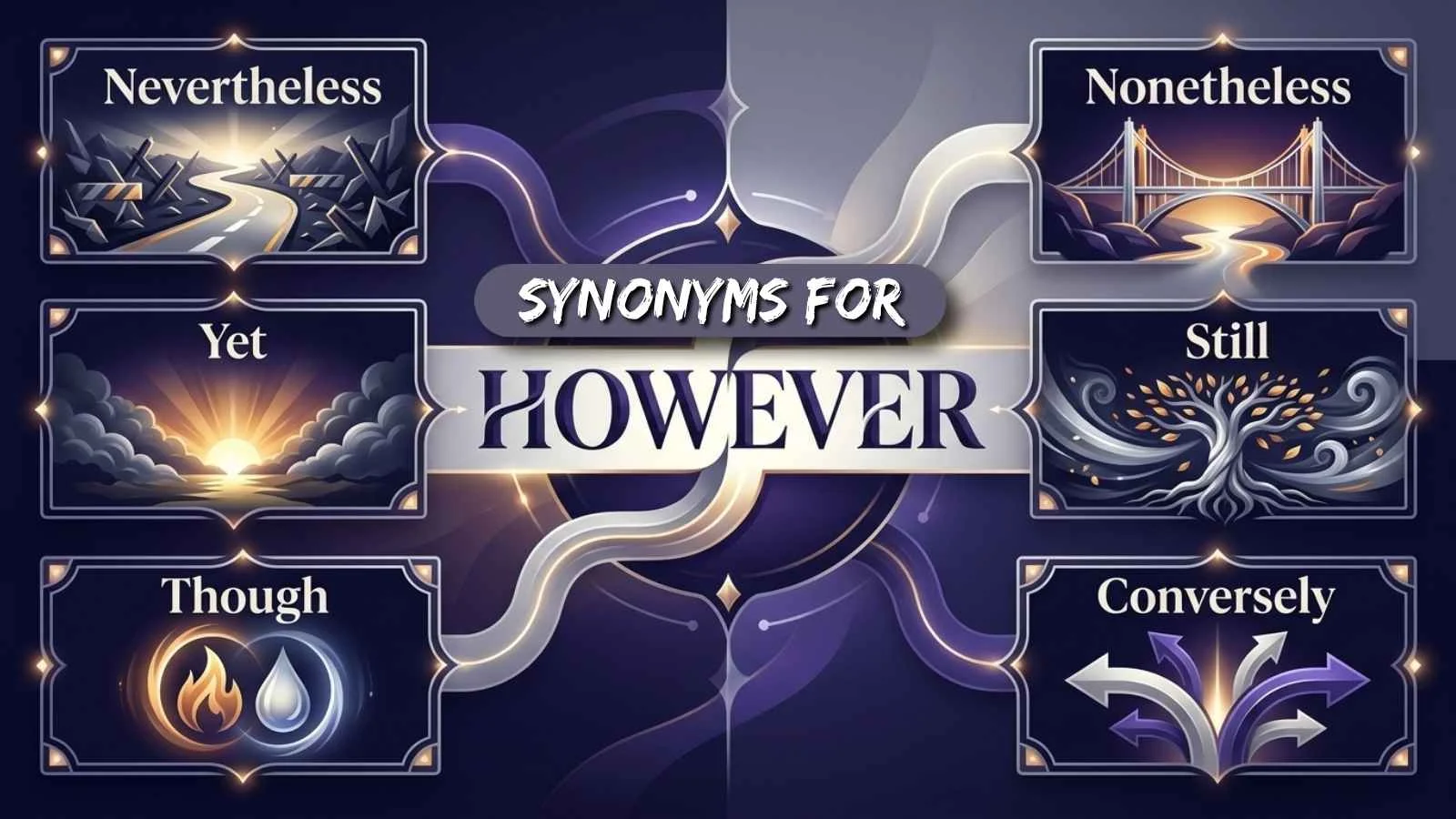
Let us look at 50 great synonyms for however you can start using today.
Meaning of However
However is a connecting word. It joins two sentences that disagree or contrast with each other. It tells the reader that something different or opposite is coming next. It is like a small stop sign between two ideas.
1. But
Meaning:
A word that shows two ideas go in opposite directions.
Usage:
Used in everyday speech and writing to connect contrasting ideas simply and quickly.
Examples:
- I wanted to eat pizza, but we had no cheese.
- She studied hard, but the test was still very difficult.
2. Yet
Meaning:
A word that shows something surprising happens after what was just said.
Usage:
Used in writing and speech to show contrast, especially when the result is unexpected.
Examples:
- He was tired, yet he kept walking toward the finish line.
- The box looked small, yet it held so many things inside.
3. Still
Meaning:
A word that shows something continues to be true even after a change.
Usage:
Used to show that one thing remains true despite another thing happening.
Examples:
- It was cold outside, still she went for her morning walk.
- The road was blocked, still the driver found another way.
4. Nevertheless
Meaning:
A word that means something happens even though there is a reason it might not.
Usage:
Used in formal writing and speeches to show strong contrast between two ideas.
Examples:
- The rain was heavy. Nevertheless, the match went on.
- She felt nervous. Nevertheless, she gave a great speech.
5. Nonetheless
Meaning:
A word meaning in spite of what was just said, something else is still true.
Usage:
Used in formal and academic writing to show contrast without changing the point.
Examples:
- The task was hard. Nonetheless, the team finished on time.
- His score was low. Nonetheless, he passed the course.
6. Although
Meaning:
A word used to show that one thing is true even when something else is also true.
Usage:
Used at the start of a sentence to contrast two ideas in the same thought.
Examples:
- Although it was late, she finished all her homework.
- Although he was hungry, he waited for everyone to sit down first.
7. Though
Meaning:
A shorter way to say “although” when comparing two opposite ideas.
Usage:
Used in both casual and formal writing, often at the start or end of a sentence.
Examples:
- I liked the movie, though the ending surprised me.
- Though it was small, the room felt cozy and warm.
8. Even so
Meaning:
A phrase that means despite what was said before, this other thing is still true.
Usage:
Used to show that a fact does not change the outcome of the other statement.
Examples:
- The weather was bad. Even so, we had a great picnic.
- He forgot his notes. Even so, he spoke very clearly.
9. That said
Meaning:
A phrase used to introduce a point that contrasts with what was just mentioned.
Usage:
Used in conversational and blog writing to pivot to a different or opposite idea.
Examples:
- The book was long. That said, every chapter was interesting.
- She sings well. That said, dancing is her strongest skill.
10. On the other hand
Meaning:
A phrase used to present the opposite or different side of an idea.
Usage:
Used in essays and reports to compare two different points fairly.
Examples:
- Cats are quiet. On the other hand, dogs love to play outside.
- City life is exciting. On the other hand, villages are much more peaceful.
11. In contrast
Meaning:
A phrase that shows how two things are clearly different from each other.
Usage:
Used in academic and professional writing to highlight differences between two subjects.
Examples:
- Summer is hot and bright. In contrast, winter is cold and dark.
- He speaks slowly. In contrast, his sister talks very fast.
12. Conversely
Meaning:
A word that introduces the opposite of what was just said.
Usage:
Used in formal writing to flip an argument or show the other side of a point.
Examples:
- More sleep helps you feel better. Conversely, less sleep makes you tired.
- Working fast can cause mistakes. Conversely, working slowly helps you get it right.
13. On the contrary
Meaning:
A phrase that strongly disagrees with or flips what was just said.
Usage:
Used in debates, essays, and formal writing to reject a previous point.
Examples:
- I did not find the book boring. On the contrary, I loved every page.
- The trip was not a waste. On the contrary, it taught us so much.
14. By contrast
Meaning:
A phrase used to show how one thing is different when placed next to another.
Usage:
Used in analytical and academic writing to draw clear comparisons.
Examples:
- Dogs are very loyal. By contrast, cats tend to be more independent.
- The first half of the game was slow. By contrast, the second half was thrilling.
15. Despite this
Meaning:
A phrase meaning that something is true even though there is a reason it should not be.
Usage:
Used to show that a result happened regardless of an obstacle or challenge.
Examples:
- The roads were icy. Despite this, she drove to work safely.
- The budget was tight. Despite this, they built a beautiful garden.
16. Regardless
Meaning:
A word meaning without caring about or being stopped by something else.
Usage:
Used in everyday writing to show that a decision or fact stays true no matter what.
Examples:
- Regardless of the noise, she fell asleep quickly.
- He kept smiling regardless of how hard the day had been.
17. All the same
Meaning:
A phrase that means even though something is true, it does not change the result.
Usage:
Used in casual writing and conversation to show that a point holds firm despite an obstacle.
Examples:
- The price was high. All the same, she bought the coat.
- It was a long drive. All the same, they enjoyed the trip.
18. Be that as it may
Meaning:
A phrase that accepts what was said but then moves forward with a different point.
Usage:
Used in formal writing or debate to acknowledge one point before pushing past it.
Examples:
- Be that as it may, we still need to finish the project.
- Be that as it may, the results speak for themselves.
19. Having said that
Meaning:
A phrase that introduces a contrasting thought right after making a point.
Usage:
Used in presentations, blogs, and speeches to shift to a balanced or opposite view.
Examples:
- The plan has risks. Having said that, the reward could be great.
- She is very young. Having said that, she is also very talented.
20. Alternatively
Meaning:
A word that offers a different choice or possibility from what was just said.
Usage:
Used to present another option when comparing two different paths or ideas.
Examples:
- You can walk to school. Alternatively, you can take the bus.
- We could cook dinner at home. Alternatively, we could order from a restaurant.
21. Instead
Meaning:
A word that replaces one idea with a different one as a better or chosen option.
Usage:
Used to show a switch in action, plan, or choice from what was expected.
Examples:
- She did not cry. Instead, she laughed at the whole situation.
- He did not watch TV. Instead, he read a book before bed.
22. Rather
Meaning:
A word that shows a preference for one thing over another, or introduces a correction.
Usage:
Used to soften a contrast or show what is preferred or more accurate.
Examples:
- I would rather walk than take a taxi in this weather.
- The bag was not blue. Rather, it was a dark shade of green.
23. Contrariwise
Meaning:
A formal word meaning in the opposite way or direction from what was said.
Usage:
Used in literary and formal writing to present a direct reversal of a point.
Examples:
- He said the answer was yes. Contrariwise, the results showed otherwise.
- She expected failure. Contrariwise, every part of the plan worked.
24. Notwithstanding
Meaning:
A word meaning despite something, or in spite of a fact that was just mentioned.
Usage:
Used in legal, formal, and academic writing to show that something continues despite an obstacle.
Examples:
- Notwithstanding the delay, the event was a great success.
- Notwithstanding her fear, she climbed to the top of the hill.
25. Against that
Meaning:
A phrase used to present a point that works against or contradicts what was just said.
Usage:
Used in debate and analytical writing to weigh two opposing ideas.
Examples:
- The plan saves money. Against that, it takes a lot of time to set up.
- The job pays well. Against that, the hours are very long.
26. Oppositely
Meaning:
A word meaning in a way that is completely different or reversed.
Usage:
Used to show that two things go in totally different directions or have opposing results.
Examples:
- He thought the answer was simple. Oppositely, it turned out to be very complex.
- She expected a cold welcome. Oppositely, everyone greeted her with big smiles.
27. Then again
Meaning:
A phrase used to reconsider what was just said or to add an opposing thought.
Usage:
Used in casual and reflective writing to show second thoughts or balance.
Examples:
- I thought the movie was boring. Then again, the ending was really good.
- She wanted to stay home. Then again, the party sounded like fun.
28. At the same time
Meaning:
A phrase used to show that two opposite things can both be true together.
Usage:
Used when two contrasting facts exist side by side without canceling each other.
Examples:
- The job was stressful. At the same time, it taught her a lot.
- He was proud of his work. At the same time, he knew it could be better.
29. Even though
Meaning:
A phrase that shows something is true despite a reason it might not be.
Usage:
Used to join two ideas where one happens in spite of the other.
Examples:
- Even though it was raining, they played outside all afternoon.
- She finished her work even though she was very tired.
30. In spite of this
Meaning:
A phrase meaning that something still happens even though there is a reason against it.
Usage:
Used to show a result that holds firm despite a challenge or problem.
Examples:
- The path was steep. In spite of this, they reached the top.
- The signal was weak. In spite of this, the call went through clearly.
31. Withal
Meaning:
An old formal word meaning despite everything, or in addition to what was said.
Usage:
Used rarely in literary or very formal writing to show contrast or addition.
Examples:
- The task was long and hard. Withal, she finished it with a smile.
- He was tired and cold. Withal, he kept going without complaint.
32. For all that
Meaning:
A phrase meaning despite all of the reasons or things mentioned.
Usage:
Used in formal and literary writing to accept a situation but move past it.
Examples:
- The trip had many problems. For all that, they enjoyed every moment.
- The season was rough. For all that, the team played with great heart.
33. After all
Meaning:
A phrase that gives a reason or reminder that changes or explains a situation.
Usage:
Used to support a decision or conclusion by pointing to a logical reason.
Examples:
- She deserved the prize. After all, she had worked the hardest.
- We should be kind. After all, everyone is going through something.
34. That being said
Meaning:
A phrase that accepts a previous point but then shifts to a new or contrasting idea.
Usage:
Used in blogs, speeches, and reports to balance one view with another.
Examples:
- The first chapter is slow. That being said, the rest of the book is wonderful.
- The price is high. That being said, the quality is truly worth it.
35. As opposed to
Meaning:
A phrase used to show a clear difference between two things or choices.
Usage:
Used in comparisons to highlight what makes one thing different from another.
Examples:
- She prefers tea as opposed to coffee in the morning.
- The new method is faster as opposed to the old one.
36. While
Meaning:
A word that shows two things happening at the same time or in contrast to each other.
Usage:
Used to compare two ideas or show that both things are happening together.
Examples:
- While she loves math, her brother prefers art class.
- While the plan sounds simple, carrying it out is much harder.
37. Whereas
Meaning:
A word that shows a clear contrast between two different facts or situations.
Usage:
Used in formal and academic writing to compare two things that are clearly different.
Examples:
- Cats are quiet, whereas dogs tend to be much louder.
- She likes cold weather, whereas her friend hates anything below twenty degrees.
38. In any case
Meaning:
A phrase that means no matter what happened or was said, the result stays the same.
Usage:
Used to signal that a conclusion is firm regardless of what came before.
Examples:
- In any case, we need to make a decision by Friday.
- She was unsure of the plan. In any case, she showed up and helped.
39. Anyway
Meaning:
A casual word that moves past a problem or contrast to get to the main point.
Usage:
Used in informal writing and speech to brush past an issue and keep going.
Examples:
- It was a long day. Anyway, we all had a good time at dinner.
- I forgot my umbrella. Anyway, the rain stopped before I left.
40. Regardless of this
Meaning:
A phrase meaning that a fact or problem did not stop what happened next.
Usage:
Used to show that a result happened even when there was a reason it should not have.
Examples:
- The game was sold out. Regardless of this, they found two tickets online.
- The rules were strict. Regardless of this, the team found a creative solution.
41. Despite that
Meaning:
A phrase that means something still holds true even though a reason works against it.
Usage:
Used to contrast two ideas where one happens in spite of the other.
Examples:
- She had very little time. Despite that, she cooked a full meal for everyone.
- The wind was strong. Despite that, the kite stayed up all afternoon.
42. All the while
Meaning:
A phrase that shows something was true throughout a whole situation or period.
Usage:
Used to show that a feeling or fact existed the entire time something else was happening.
Examples:
- He acted calm, all the while feeling very nervous inside.
- She kept smiling, all the while wishing she could go home.
43. Irrespective of this
Meaning:
A phrase meaning that something is true without being affected by a given fact.
Usage:
Used in formal writing to show that a conclusion stands no matter what the other fact is.
Examples:
- Irrespective of this setback, the project will continue as planned.
- Irrespective of this detail, the main idea of the report is very clear.
44. With that said
Meaning:
A phrase used to acknowledge a point and then move to a contrasting or closing thought.
Usage:
Used in speeches, blogs, and reports to signal a transition in thinking.
Examples:
- The budget is small. With that said, we can still create something great.
- The review was mixed. With that said, many readers loved the book.
45. Except that
Meaning:
A phrase used to point out one thing that limits or changes what was just said.
Usage:
Used to introduce a small but important exception to a general statement.
Examples:
- The plan was perfect except that it cost too much money.
- She was ready to leave except that she could not find her keys.
46. On the flip side
Meaning:
A casual phrase used to show the opposite or other side of an idea.
Usage:
Used in blogs and conversations to present a contrasting view in a relaxed way.
Examples:
- Living in the city is exciting. On the flip side, it can also be very noisy.
- The job has long hours. On the flip side, the pay is very good.
47. In any event
Meaning:
A phrase meaning no matter what happens, this thing will still be true or done.
Usage:
Used in formal and semi-formal writing to show a firm conclusion despite uncertainty.
Examples:
- In any event, we will finish the work before the weekend.
- In any event, the guests arrived and the party was a great success.
48. Otherwise
Meaning:
A word that shows what would happen under different or opposite conditions.
Usage:
Used to introduce a consequence or alternative based on a contrasting situation.
Examples:
- You should study tonight. Otherwise, the test will be very hard tomorrow.
- She set an alarm. Otherwise, she would have slept through the morning.
49. In that case
Meaning:
A phrase that responds to a situation by showing what follows from it logically.
Usage:
Used in conversation and writing to connect a condition with its natural result.
Examples:
- In that case, we should leave earlier to avoid the traffic.
- In that case, let me bring extra food for everyone.
50. Even so, yet still
Meaning:
A compound phrase that strongly emphasizes something remaining true despite everything.
Usage:
Used in emotional or persuasive writing to hold a point firm against strong opposition.
Examples:
- The odds were against them. Even so, yet still, they won the championship.
- Every door seemed closed. Even so, yet still, she kept pushing forward every day.
FAQs
What is another word for however?
Common alternatives include but, yet, still, nevertheless, and on the other hand.
Can I use “but” instead of “however” in an essay?
Yes, but “however” sounds more formal. Use “but” in casual writing and “however” in academic essays.
What does however mean in simple words?
However means “despite that” or “on the other side.” It connects two ideas that disagree with each other.
Why should I learn synonyms for however?
Using the same connecting word too many times makes writing sound repetitive. Synonyms keep your writing fresh and clear.
Is “nevertheless” the same as “however”?
They are very close in meaning. Both show contrast. Nevertheless sounds a little more formal and strong.
Conclusion
Knowing synonyms for however makes your writing flow better. It keeps readers engaged and helps you sound more confident. Whether you are writing an email, an essay, or a blog post, using the right connecting word at the right time makes a big difference. Pick five words from this list and try them in your next piece of writing. You will notice the improvement right away.

I am Meer Hadi, a passionate language and content writer at SynonymLibrary.com. I focus on creating helpful word guides that make it easier for readers to choose the right words, understand meanings, and express their ideas more clearly. Through my work, I aim to support students, writers, and professionals in building stronger communication skills.