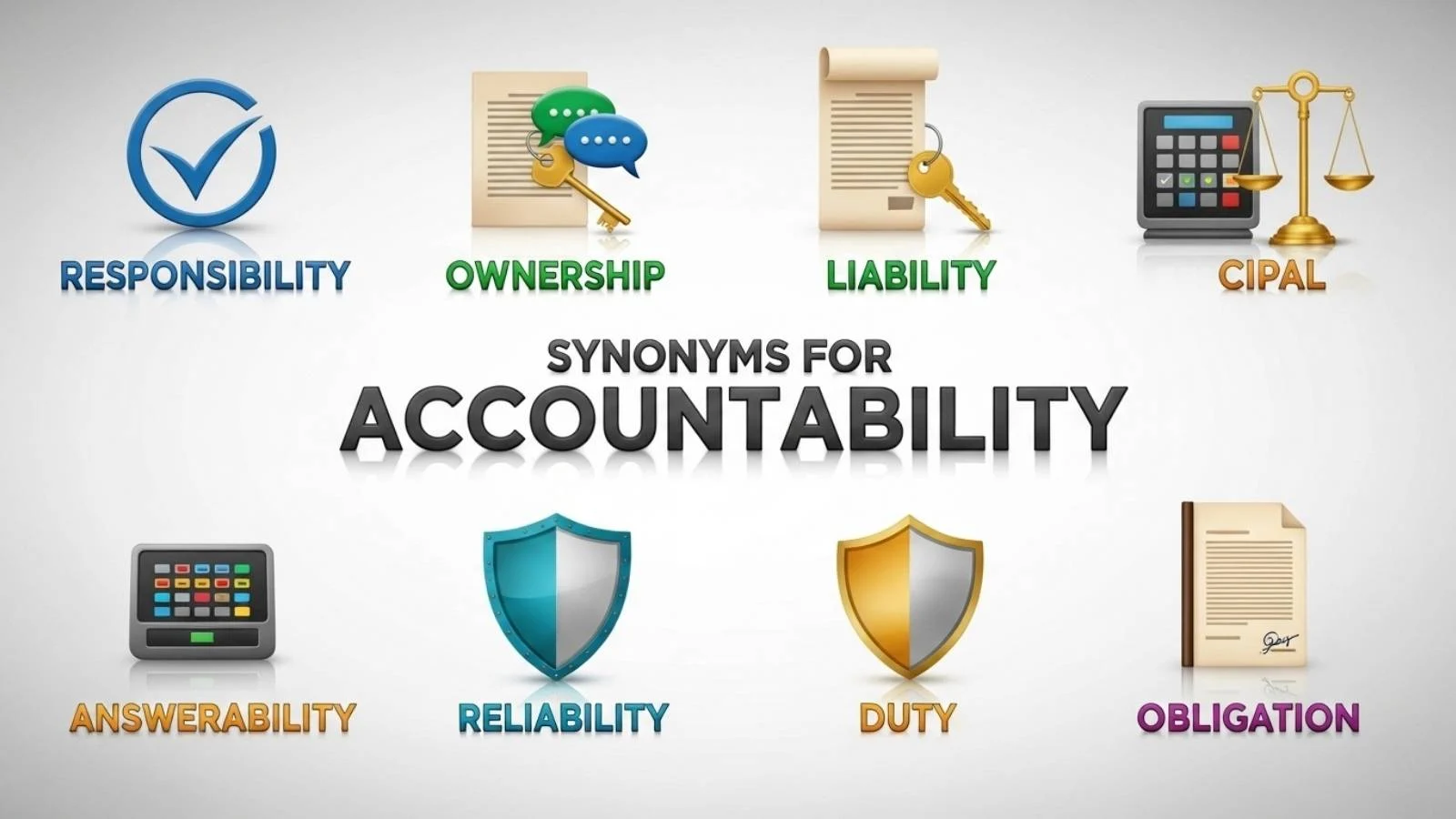
Need another word for accountability without changing what you mean? Synonyms for accountability include responsibility, answerability, ownership, obligation, and duty, but these words are not interchangeable in every context. Accountability generally means being answerable for your actions, decisions, duties, or results, often with an expectation to explain or accept the outcome.
For example, a manager may have responsibility for a project, while being accountable for its results. Ownership emphasizes accepting responsibility for a task or outcome, while answerability focuses on having to explain or justify an action.
Liability is more specific to legal or financial responsibility, while transparency supports accountability by making actions and decisions easier to examine. These distinctions matter in workplace, leadership, academic, and everyday writing. If you’re searching for synonyms for accountability for essays, professional writing, reports, or everyday English, this guide explains their meanings, differences, tone, and best uses.
What Is Accountability in Simple Words?
In simple words, accountability means taking responsibility for what you do, explaining your actions, and accepting the results.
For example, if you make a mistake at work and say, “I made the error, I understand what happened, and I will fix it,” you are showing accountability.
Accountability can be personal, professional, social, organizational, or financial. It often includes responsibility, honesty, ownership, follow-through, and answerability.
Synonyms for Accountability
Important: Some words below are close synonyms, while others are related words. The best choice depends on your sentence and intended meaning.
Responsibility
Meaning: Responsibility is the duty to handle something properly or answer for your actions.
- She accepted responsibility for the missed deadline.
- Taking responsibility helped solve the problem.
Answerability
Meaning: Answerability means having to explain or justify your actions, decisions, or results.
- The manager accepted answerability for the decision.
- Public officials may have answerability to the people they serve.
Ownership
Meaning: Ownership means accepting that a task, mistake, or result is yours to handle.
- He took ownership of the mistake.
- Taking ownership helped the team find a solution.
Obligation
Meaning: An obligation is a duty or commitment that you are expected to fulfill.
- She completed her obligation on time.
- Meeting your obligations builds trust.
Duty
Meaning: Duty is a responsibility connected to your role, position, promise, or moral values.
- It was his duty to report the problem.
- She performed her duty carefully.
Liability
Meaning: Liability means legal or financial responsibility for harm, loss, or an obligation.
- The company accepted liability for the damage.
- The contract explains who carries liability.
Culpability
Meaning: Culpability means responsibility for wrongdoing or causing a harmful result.
- The investigation examined his culpability.
- The evidence did not establish her culpability.
Dependability
Meaning: Dependability is the quality of being someone others can count on.
- Her dependability made her a trusted teammate.
- Dependability matters when deadlines are important.
Reliability
Meaning: Reliability means consistently doing what you promise or are expected to do.
- His reliability earned the team’s trust.
- Reliability is important in professional relationships.
Integrity
Meaning: Integrity means acting honestly and according to strong moral principles.
- She showed integrity by admitting her mistake.
- Integrity helps build lasting trust.
Honesty
Meaning: Honesty means telling the truth without hiding or changing important facts.
- He answered with honesty about what happened.
- Honesty made the problem easier to solve.
Transparency
Meaning: Transparency means openly sharing relevant information about actions, decisions, or processes.
- The company promised greater transparency.
- Transparency helped employees understand the decision.
Candor
Meaning: Candor means communicating openly and honestly, especially about difficult facts.
- She spoke with candor about the failure.
- His candor helped the team understand the problem.
Openness
Meaning: Openness means being willing to share information and discuss problems honestly.
- Openness made the conversation easier.
- The manager encouraged openness during meetings.
Trustworthiness
Meaning: Trustworthiness means being honest, dependable, and worthy of confidence.
- Her trustworthiness made her a good leader.
- Trustworthiness grows when you keep your promises.
Credibility
Meaning: Credibility is the quality of being believable and trusted.
- Admitting the error protected his credibility.
- Consistent actions can strengthen credibility.
Commitment
Meaning: Commitment means staying dedicated to a promise, duty, goal, or responsibility.
- Her commitment kept the project moving.
- Strong commitment helps people follow through.
Conscientiousness
Meaning: Conscientiousness means being careful, responsible, and attentive to your duties.
- His conscientiousness prevented several mistakes.
- Conscientiousness is valuable in detailed work.
Diligence
Meaning: Diligence means putting steady and careful effort into your responsibilities.
- Her diligence helped complete the report.
- Diligence can reduce avoidable mistakes.
Stewardship
Meaning: Stewardship means responsibly caring for something entrusted to you.
- Good stewardship protects shared resources.
- The organization emphasized responsible stewardship.
Oversight
Meaning: Oversight means monitoring work or decisions to make sure standards are followed.
- Independent oversight can identify problems.
- The project needed stronger oversight.
Supervision
Meaning: Supervision means watching, guiding, or managing work to keep it on track.
- The students worked under supervision.
- Regular supervision kept the project organized.
Governance
Meaning: Governance means the systems and processes used to direct and manage an organization.
- Strong governance clarifies responsibilities.
- Good governance supports responsible decision-making.
Compliance
Meaning: Compliance means following a rule, requirement, law, or instruction.
- Compliance with safety rules is essential.
- The audit checked compliance with company policies.
Professionalism
Meaning: Professionalism means behaving responsibly, respectfully, and competently at work.
- Her professionalism showed when she corrected the error.
- Professionalism includes meeting agreed deadlines.
Self-discipline
Meaning: Self-discipline means controlling your actions so you complete responsibilities without constant reminders.
- Self-discipline helped him meet his goals.
- Self-discipline supports personal accountability.
Vigilance
Meaning: Vigilance means staying alert to possible problems, risks, or mistakes.
- Vigilance helped the team spot the issue.
- Financial work requires careful vigilance.
Care
Meaning: Care means giving attention and effort to doing something properly.
- She handled the records with care.
- Careful work can prevent larger mistakes.
Scrupulousness
Meaning: Scrupulousness means being extremely careful about accuracy, honesty, and moral standards.
- His scrupulousness improved record accuracy.
- Scrupulousness matters when handling sensitive information.
Probity
Meaning: Probity means strong honesty and moral integrity, especially in a position of trust.
- The official was respected for his probity.
- Probity matters when managing public funds.
Rectitude
Meaning: Rectitude means strong moral correctness in behavior and decisions.
- Her rectitude guided the difficult decision.
- Rectitude involves following ethical standards.
Fairness
Meaning: Fairness means treating people and situations in a just and reasonable way.
- Fairness requires consistent decisions.
- The policy was reviewed for fairness.
Ethics
Meaning: Ethics are moral principles that guide decisions and behavior.
- Professional ethics influence responsible conduct.
- Strong ethics can prevent misuse of authority.
Morality
Meaning: Morality refers to principles about what is right and wrong.
- His morality influenced his decision.
- Morality can guide difficult choices.
Acknowledgment
Meaning: Acknowledgment means openly recognizing a fact, mistake, problem, or responsibility.
- Her acknowledgment of the error was appreciated.
- Acknowledgment was the first step toward a solution.
Admission
Meaning: Admission means openly stating that something is true, especially a mistake or fault.
- His admission ended the argument.
- The admission helped the team find a solution.
Explanation
Meaning: An explanation gives reasons or details about what happened or why a decision was made.
- The manager gave an explanation for the delay.
- A clear explanation can demonstrate accountability.
Justification
Meaning: Justification is a reason or evidence given to explain or defend an action.
- The manager provided justification for the change.
- The report included justification for the decision.
Follow-through
Meaning: Follow-through means completing an action or promise after agreeing to do it.
- Good follow-through turns promises into results.
- Her follow-through showed that she could be trusted.
Pledge
Meaning: A pledge is a serious promise to do something or support a principle.
- She made a pledge to improve the process.
- The pledge created a clear expectation.
Vow
Meaning: A vow is a very serious promise or commitment.
- He made a vow to correct the mistake.
- She kept her vow to finish the work.
Mandate
Meaning: A mandate is official authority or an instruction to carry out a particular task.
- The committee received a mandate to review the policy.
- The mandate defined the team’s responsibilities.
Responsibility-taking
Meaning: Responsibility-taking means accepting responsibility instead of avoiding it.
- Responsibility-taking helped resolve the conflict.
- The manager encouraged responsibility-taking after the mistake.
Self-accountability
Meaning: Self-accountability means holding yourself responsible for your choices, actions, and results.
- Self-accountability helps you learn from mistakes.
- Self-accountability can improve personal goals.
Account
Meaning: An account can be a report or explanation of what happened or what was done.
- The director gave an account of the incident.
- Her account explained what happened.
Charge
Meaning: Charge can mean responsibility or control over something entrusted to you.
- He was given charge of the project.
- She took charge of the team.
Duty of Care
Meaning: Duty of care means having a responsibility to act carefully and avoid foreseeable harm.
- Teachers have a duty of care toward students.
- The organization has a duty of care toward staff.
Due Diligence
Meaning: Due diligence means carefully checking information before making an important decision.
- The buyer performed due diligence before signing.
- Due diligence helped uncover the problem.
Reporting
Meaning: Reporting means providing information about actions, progress, decisions, or results.
- Regular reporting improved project visibility.
- Accurate reporting supports organizational accountability.
Responsible Conduct
Meaning: Responsible conduct means behaving with care, honesty, duty, and awareness of consequences.
- The policy encourages responsible conduct.
- Responsible conduct builds trust within a team.
What Is Another Word for Personal Accountability?
The closest choices are self-accountability, responsibility, ownership, and responsibility-taking.
Self-accountability is the most direct choice when you mean holding yourself responsible. Ownership is useful when you mean taking charge of a problem or result.
For example:
- “Self-accountability helped me improve my habits.”
- “I took ownership of my mistake.”
What Is Another Word for Holding Someone Accountable?
Instead of holding someone accountable, you can say:
- holding someone responsible
- requiring an explanation
- expecting answerability
- requiring someone to account for their actions
“Holding accountability” is less natural in standard English. The usual phrase is “holding someone accountable.”
Synonyms for Accountability and Responsibility
Responsibility and accountability are closely connected, but they are not identical.
Responsibility usually describes a duty, task, or role. Accountability adds the idea that someone must explain, justify, or answer for their actions and results.
For example, a manager may have responsibility for a project and accountability for its outcome.
Another Word for Accountability and Transparency
There is no single perfect synonym for both.
Use transparency when you mean openness or access to information. Use accountability when you mean responsibility and answerability.
Related words include openness, reporting, disclosure, answerability, and responsible governance.
Positive Synonyms for Accountability
If you need a positive accountability synonym, consider:
responsibility, ownership, integrity, reliability, dependability, commitment, trustworthiness, or follow-through.
These words can make professional writing sound constructive rather than focused only on mistakes or punishment.
Self-Accountability Synonyms
For self accountability synonym searches, useful choices include self-discipline, personal responsibility, ownership, responsibility-taking, and self-management.
The exact choice depends on context. Self-discipline focuses on controlling your behavior, while personal responsibility focuses on accepting responsibility for your choices.
Accountability Synonym for an Essay
In an essay, avoid replacing every use of accountability with the same word. Choose according to meaning:
- Responsibility — for a duty or role
- Answerability — for explaining decisions
- Ownership — for accepting a problem or result
- Transparency — for openness
- Culpability — for fault or wrongdoing
- Integrity — for honest moral behavior
- Governance — for organizational systems
This approach makes your writing more precise and avoids awkward synonym substitution.
Accountability vs. Blame
Accountability and blame are related, but they are not the same.
Accountability can involve acknowledging a mistake, explaining what happened, correcting the problem, and learning from it. Blame focuses more directly on identifying who caused a problem or is at fault.
For example, “She accepted accountability and fixed the error” is constructive. “She received the blame” focuses mainly on fault.
Accountability Antonyms
Common opposites of accountability include irresponsibility, avoidance, denial, neglect, evasion, and unaccountability.
These words describe situations where someone avoids responsibility, refuses to explain their actions, or fails to meet an expected duty.
Another Word for Taking Accountability
Natural alternatives include:
- taking responsibility
- taking ownership
- owning up
- accepting responsibility
- accepting the consequences
- answering for your actions
For everyday English, “taking responsibility” is usually the clearest choice.
Another Word for an Accountability Partner
An accountability partner is someone who helps you stay responsible for a goal, habit, task, or commitment.
Depending on the context, related terms include support partner, responsibility partner, goal partner, study partner, coach, mentor, or check-in partner.
However, these terms are not exact synonyms. An accountability partner specifically helps you stay committed and follow through.
Conclusion
The best synonym for accountability depends on the meaning you want to express. Responsibility is the closest everyday choice, while answerability emphasizes explanation, ownership emphasizes taking charge, culpability emphasizes fault, transparency emphasizes openness, and integrity emphasizes honest conduct.
Whether you need an accountability synonym for an essay, a professional email, workplace writing, or everyday English, choose the word that matches your exact idea. Good vocabulary is not about replacing one word with another at random; it is about choosing the most precise word for the situation.
