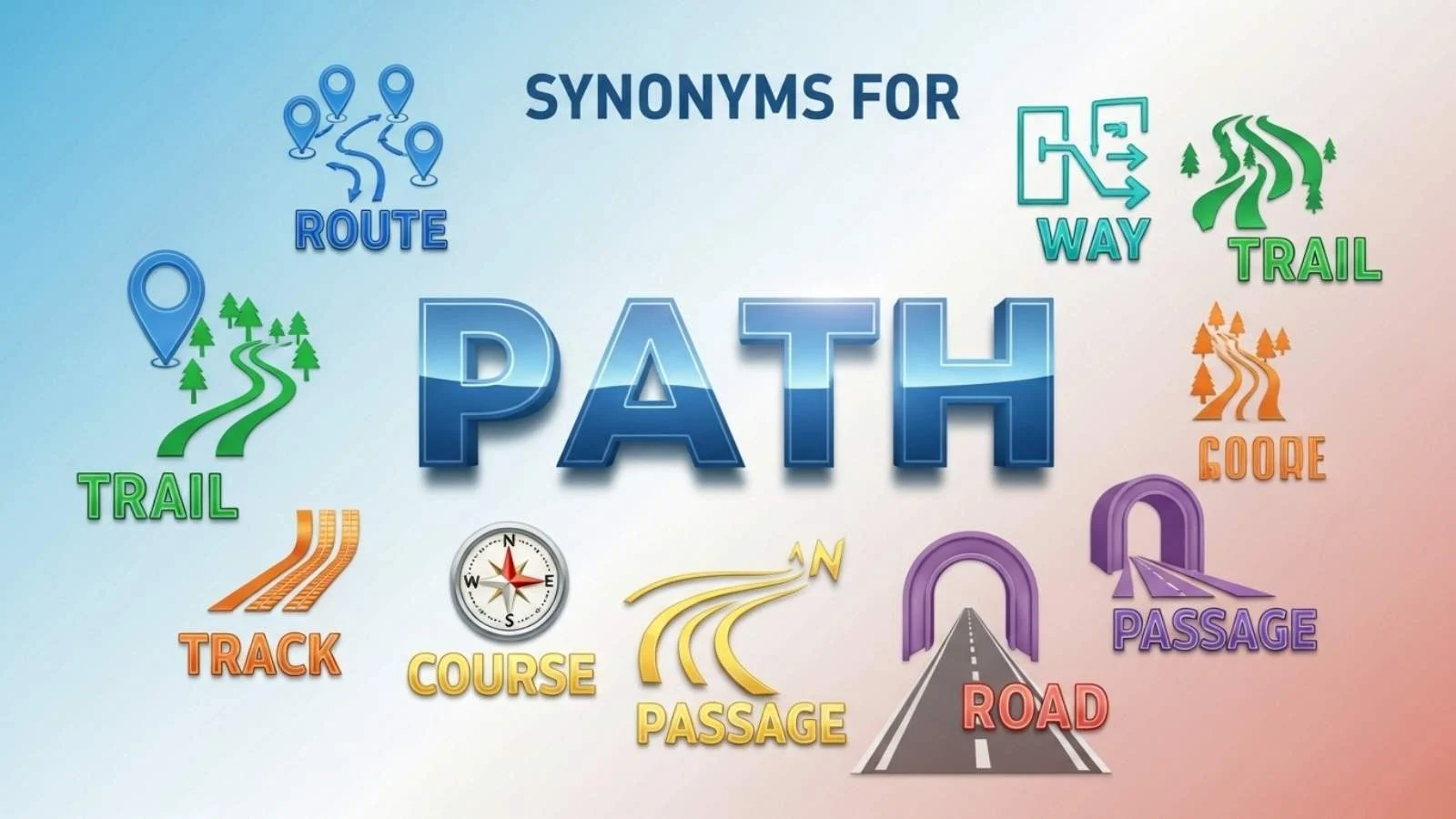
Looking for synonyms for path because you keep using the same word? The right alternative depends on what you mean by “path.” For a physical route, way, route, trail, track, walkway, and passage can fit. For figurative uses, such as a career or life direction, journey, course, direction, trajectory, or approach may sound more natural.
The tricky part is that these words are related but not always interchangeable. A forest path can be a trail, while a path to success may be a route, approach, or course toward a goal. Choosing the right another word for path can make your writing clearer and more precise, especially in essays, professional writing, and everyday English.
This guide covers useful path synonyms, their meanings, examples, levels of formality, and the contexts where each alternative works best.
What Is Another Word for Path?
Common words similar to path include way, trail, route, road, track, lane, pathway, walkway, footpath, passage, course, direction, journey, byway, shortcut, and trailway.
However, they are not all exact synonyms. Trail usually suggests a route through nature, route suggests a planned way between places, and journey describes the experience of traveling rather than the physical path itself.
Synonyms for Path
Way
Meaning: A general route, direction, or method for getting somewhere.
Examples:
- Can you show me the way to the station?
- She found her own way through the difficult problem.
Best for: General physical or figurative use.
Trail
Meaning: A path, especially one through a natural area such as a forest or mountain.
Examples:
- We followed the trail through the forest.
- The hiking trail leads to a beautiful waterfall.
Best for: Hiking, nature, and outdoor writing.
Route
Meaning: A planned or established way from one place to another.
Examples:
- We chose a faster route to the airport.
- The scenic route passes through several small towns.
Best for: Travel, transportation, and directions.
Road
Meaning: A prepared way for vehicles or people to travel.
Examples:
- The road leads to a small village.
- We drove along a winding mountain road.
Best for: Physical travel and figurative expressions.
Track
Meaning: A narrow or rough route used by people, animals, or vehicles.
Examples:
- We followed an old track through the fields.
- The muddy track became difficult to cross.
Best for: Rough paths, countryside, and animal routes.
Pathway
Meaning: A defined path, usually made for walking.
Examples:
- The stone pathway leads to the garden.
- We followed the pathway around the lake.
Best for: Gardens, parks, walking areas, and figurative writing.
Walkway
Meaning: A path designed mainly for people to walk on.
Examples:
- The wooden walkway crosses the wetland.
- A covered walkway connects the two buildings.
Best for: Walking paths and built environments.
Footpath
Meaning: A path intended mainly for people traveling on foot.
Examples:
- The footpath follows the river.
- We took a narrow footpath through the field.
Best for: Walking routes and countryside.
Lane
Meaning: A narrow road or passage, often in a quiet area.
Examples:
- A peaceful lane runs beside the farm.
- We walked down the narrow country lane.
Best for: Narrow roads, villages, and rural descriptions.
Passage
Meaning: A way through or between places or objects.
Examples:
- A hidden passage connected the two rooms.
- The narrow passage led into the courtyard.
Best for: Buildings, spaces, and figurative movement.
Passageway
Meaning: A narrow route connecting two spaces.
Examples:
- A dark passageway ran beneath the castle.
- The passageway was too narrow for two people.
Best for: Buildings and enclosed spaces.
Corridor
Meaning: An indoor passage that connects rooms or areas.
Examples:
- She walked down the long corridor.
- The classroom is at the end of the corridor.
Best for: Schools, offices, hospitals, and other buildings.
Alley
Meaning: A narrow street or passage between buildings.
Examples:
- We walked through a quiet alley.
- The shop has an entrance in the alley.
Best for: Cities and urban settings.
Avenue
Meaning: A broad road, often lined with trees or buildings.
Examples:
- Tall trees lined the avenue.
- The busy avenue runs through the city center.
Best for: Wide urban roads and descriptive writing.
Boulevard
Meaning: A wide city road, often with trees or a central strip.
Examples:
- Shops line the busy boulevard.
- We walked along the boulevard at sunset.
Best for: Large urban roads.
Byway
Meaning: A small or less-used road away from a main route.
Examples:
- We took a quiet byway through the countryside.
- The old byway was covered with leaves.
Best for: Rural roads and less-traveled routes.
Shortcut
Meaning: A shorter or faster way to reach a destination.
Examples:
- We took a shortcut through the park.
- This shortcut saves about ten minutes.
Best for: Faster alternative routes.
Detour
Meaning: An alternative route taken because the usual way is blocked or unsuitable.
Examples:
- The road closure forced us to take a detour.
- We made a detour around the construction.
Best for: Temporary alternative routes.
Course
Meaning: The direction or route followed by something.
Examples:
- The river changed its course.
- She stayed on course despite the difficulty.
Best for: Direction, movement, and figurative life paths.
Direction
Meaning: The way in which someone or something is moving or heading.
Examples:
- We walked in the direction of the mountains.
- He changed direction at the crossroads.
Best for: Movement, choices, and goals.
Journey
Meaning: The experience of traveling from one place, stage, or situation to another.
Examples:
- The journey took three hours.
- Her career journey was full of challenges.
Best for: Travel and figurative life experiences.
Trek
Meaning: A long or difficult journey, especially on foot.
Examples:
- The trek through the mountains lasted five days.
- It was a tiring trek through the jungle.
Best for: Long, difficult walks.
Passage
Meaning: The act or process of moving from one place or stage to another.
Examples:
- The passage through the mountains was difficult.
- Time changes us during the passage of life.
Best for: Travel, time, and figurative movement.
Promenade
Meaning: A public walking area, often beside the sea or in a pleasant open space.
Examples:
- Families walked along the seaside promenade.
- The promenade was crowded in the evening.
Best for: Seaside and public walking areas.
Esplanade
Meaning: A broad open walkway, often beside water.
Examples:
- We walked along the harbor esplanade.
- The esplanade offers a beautiful view of the sea.
Best for: Waterfront descriptions.
Causeway
Meaning: A raised road or path built across low ground, wetlands, or water.
Examples:
- The causeway connects the island to the mainland.
- We crossed the causeway before the tide rose.
Best for: Routes across water or wet ground.
Crossing
Meaning: A place or route used to move from one side to another.
Examples:
- We waited at the pedestrian crossing.
- The mountain crossing was covered with snow.
Best for: Roads, rivers, mountains, and boundaries.
Ascent
Meaning: An upward route or movement toward a higher place.
Examples:
- The ascent to the summit was difficult.
- We began the steep ascent early.
Best for: Mountain and upward movement.
Descent
Meaning: A downward route or movement toward a lower place.
Examples:
- The descent into the valley was steep.
- We began our careful descent after lunch.
Best for: Downward movement.
Circuit
Meaning: A route that forms a loop and returns toward its starting point.
Examples:
- The runners completed one circuit of the park.
- The walking circuit takes about an hour.
Best for: Looped routes and sports.
Roundabout Route
Meaning: A route that takes a less direct way around something.
Examples:
- We took a roundabout route to avoid traffic.
- His explanation followed a roundabout route.
Best for: Indirect physical or figurative movement.
Stretch
Meaning: A continuous section of a road, path, or route.
Examples:
- The final stretch of the trail was steep.
- We drove along a long stretch of empty road.
Best for: Describing part of a longer route.
Strip
Meaning: A long, narrow section of land or surface.
Examples:
- A narrow strip of pavement runs beside the road.
- They walked along a strip of land near the coast.
Best for: Narrow sections of land or pavement.
Line
Meaning: A direct path or direction between points.
Examples:
- Draw a line between the two points.
- The route follows a straight line across the field.
Best for: Straight or direct paths.
Bridge
Meaning: A structure that provides a route across a gap, river, or other obstacle.
Examples:
- The bridge provides a way across the river.
- We crossed the old stone bridge.
Best for: Routes across obstacles.
Channel
Meaning: A route through which water, information, or another flow moves.
Examples:
- The channel directs water toward the sea.
- The information passed through an official channel.
Best for: Water, communication, and figurative movement.
Groove
Meaning: A long, narrow track or channel cut into a surface.
Examples:
- The wheel left a groove in the mud.
- The ball moved along the groove.
Best for: Physical tracks in surfaces.
Flow
Meaning: A continuous movement from one place or point to another.
Examples:
- The flow of traffic was steady.
- The river’s flow carried the boat downstream.
Best for: Water, traffic, ideas, and movement.
Artery
Meaning: A major route carrying traffic, people, or activity.
Examples:
- The highway is a major artery between the cities.
- The street acts as an artery through downtown.
Best for: Figurative descriptions of major roads.
Vein
Meaning: A line or route running through something, often used figuratively.
Examples:
- A small road runs like a vein through the valley.
- The river forms a natural vein through the region.
Best for: Figurative descriptions of lines and routes.
Trajectory
Meaning: The direction or path followed by a moving object or developing situation.
Examples:
- The ball followed a curved trajectory.
- Her career took a new trajectory after graduation.
Best for: Science, movement, careers, and development.
Orbit
Meaning: The curved path of an object moving around another object in space.
Examples:
- The satellite remains in orbit around Earth.
- The spacecraft entered a stable orbit.
Best for: Astronomy and science; not an everyday substitute for path.
Vector
Meaning: A technical term describing movement with direction and magnitude.
Examples:
- The scientist calculated the particle’s velocity vector.
- The aircraft changed its flight vector.
Best for: Mathematics, physics, and technical writing.
Axis
Meaning: A central line around which something rotates or is organized.
Examples:
- Earth rotates around its axis.
- The graph uses time as its horizontal axis.
Best for: Mathematics, science, and geometry.
Lifeline
Meaning: An essential route or connection that keeps something functioning or supported.
Examples:
- The supply road became a lifeline for the village.
- The bridge is a lifeline for the isolated community.
Best for: Strong figurative descriptions.
Trailway
Meaning: A designated route or trail, especially one intended for walking or cycling.
Examples:
- The new trailway follows the river.
- Cyclists use the trailway to reach nearby towns.
Best for: Walking, cycling, and recreational routes.
Trackway
Meaning: A defined route or track used for movement.
Examples:
- The old trackway crossed the open fields.
- Researchers discovered an ancient trackway.
Best for: Historical, archaeological, or specialized descriptions.
Approach
Meaning: A way of reaching a place, goal, or result.
Examples:
- The northern approach leads to the mountain.
- Practice is one approach to improving your writing.
Best for: Physical access and figurative methods.
Passage Route
Meaning: A route that allows movement through or across a particular area.
Examples:
- The mountain passage route was difficult in winter.
- The old passage route connected the two settlements.
Best for: Historical or descriptive contexts.
Avenue of Progress
Meaning: A figurative way or opportunity for moving toward a goal.
Examples:
- Education can become an avenue of progress.
- Training opened a new avenue of progress for her career.
Best for: Formal and figurative writing.
Which Synonym for Path Should You Choose?
The right word depends on the meaning you need.
| Meaning of path | Useful word |
|---|---|
| Forest path | Trail |
| Hiking path | Trail |
| Walking path | Footpath, walkway |
| Narrow road | Lane |
| Planned travel path | Route |
| Rough country path | Track |
| City passage | Alley |
| Indoor path | Corridor |
| Shorter path | Shortcut |
| Alternative path | Detour |
| Path beside the sea | Promenade, esplanade |
| Path across water | Causeway |
| Upward path | Ascent |
| Downward path | Descent |
| Life path | Journey, course, direction |
| Career path | Course, trajectory, pathway |
| Path toward a goal | Route, approach, pathway |
| Scientific path | Trajectory, orbit |
| Essential route | Lifeline |
Another Word for Path in Life
When path means a person’s choices, development, or direction in life, physical words such as trail and footpath usually do not work.
Better alternatives include journey, course, direction, road, route, pathway, and trajectory.
For example:
- “She chose a new path in life.”
- “She chose a new direction in life.”
- “His life journey changed after graduation.”
- “She started a new career pathway.”
- “His career trajectory changed quickly.”
The distinction matters. Journey focuses on the experience, direction focuses on where someone is heading, course suggests an ongoing direction, and trajectory often emphasizes development over time.
Synonyms for Path Forward
If path means a way to make progress, useful alternatives include way forward, direction, route, approach, course, pathway, and road ahead.
For example:
- We need to find a way forward.
- The team chose a new approach.
- Education provided a pathway to new opportunities.
- She finally found a clear direction for her career.
These expressions are related rather than perfectly interchangeable, so choose the one that matches the sentence.
Words to Describe a Path
Sometimes you are not looking for another word for path. You simply want a stronger way to describe a path.
Useful descriptive words include:
- Narrow path — a path with little space on either side.
- Winding path — a path with many curves and turns.
- Rocky path — a path covered with or containing rocks.
- Dirt path — an unpaved path made mainly of soil.
- Forest path — a path running through woodland.
- Hidden path — a path that is difficult to see or find.
- Steep path — a path that rises or falls sharply.
- Peaceful path — a quiet, calm route.
- Muddy path — a path made wet and soft by rain or water.
- Narrow walkway — a small route designed for pedestrians.
These descriptions can make writing more vivid without forcing an unrelated synonym.
Path vs. Trail vs. Route vs. Road
These words are often confused.
Path is the broadest everyday term. It can describe a physical route or a figurative direction.
Trail usually suggests a marked or established route through natural surroundings.
Route emphasizes the planned way from one place to another.
Road normally refers to a constructed surface intended for travel, especially by vehicles.
For example, you might walk along a forest trail, plan a travel route, drive on a country road, or follow a garden path.
Final Answer
There is no single synonym that works in every sentence. Way is one of the most flexible alternatives, while trail, route, road, track, pathway, walkway, and footpath are better when you need a specific physical meaning.
For figurative uses, journey, course, direction, pathway, and trajectory can describe different kinds of life or career paths.
The key is to choose the word that matches the exact meaning—not simply the word that looks most similar in a thesaurus. That small difference makes your English more natural, precise, and effective.
