Have you ever written the word “small” three times in one paragraph? It happens to everyone. You want to say something is little, but the same word keeps coming back. That makes writing feel flat and boring.
Here is a simple example. You are writing a story about a tiny puppy. You type “small” again and again. Your reader gets tired of seeing the same word.
The word small means something that is not big. It is less than normal in size.
Knowing synonyms for small helps students write better stories. It helps bloggers make their posts more fun to read. It helps content writers sound more creative. And it helps everyday English users pick the right word every time.
Meaning and Origin of Small
Meaning:
Small means something that does not take up much space. It is the opposite of big or large. A pebble is small. A mouse is small. The button is small.
Origin:
The word “small” comes from the Old English word “smael.” It meant thin or narrow. Over time, it grew to mean anything little in size. It has been used in English for over a thousand years.
Let us look at 50 great synonyms for small you can start using today.
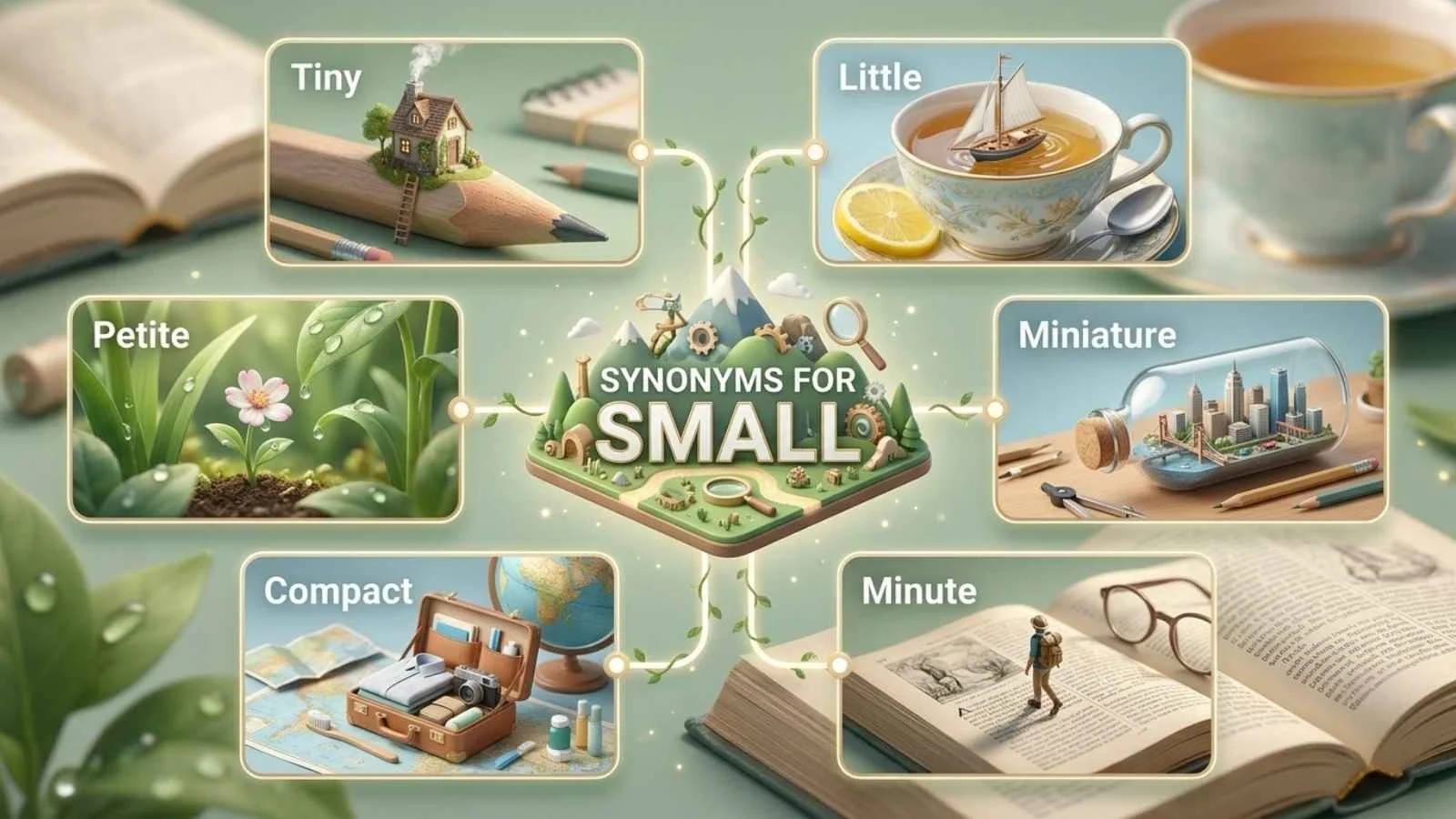
1. Tiny
Meaning:
Very, very small. Smaller than just small.
Usage:
Used when something is so little that it is almost hard to see or hold.
Examples:
- A tiny ant crawled across the kitchen floor.
- She wore a tiny ribbon in her hair.
2. Little
Meaning:
Not big in size. Close in meaning to small.
Usage:
Used in everyday speech and writing for things that are not large.
Examples:
- He found a little rock near the river.
- The little kitten sat on the window ledge.
3. Petite
Meaning:
Small and neat in size. Often used for people or things that are delicately small.
Usage:
Used to describe a person or object that is small but well-proportioned.
Examples:
- She was petite but very strong.
- The petite cup fit perfectly in her hand.
4. Miniature
Meaning:
A very small copy or version of something bigger.
Usage:
Used when something looks like a smaller model of a larger thing.
Examples:
- He painted a miniature version of the famous portrait.
- The toy set had a miniature kitchen inside it.
5. Microscopic
Meaning:
So small that you need a special tool to see it.
Usage:
Used in science and everyday speech to mean extremely tiny.
Examples:
- The doctor found a microscopic crack in the bone.
- Germs are microscopic and invisible to the naked eye.
6. Slight
Meaning:
Very small in amount or degree. Not much at all.
Usage:
Used when a change or difference is barely noticeable.
Examples:
- There was a slight noise coming from the hallway.
- She felt a slight pain in her finger after the fall.
7. Compact
Meaning:
Small but packed tightly together. Does not take up much room.
Usage:
Used for objects or spaces that are efficient and space-saving.
Examples:
- They bought a compact car to fit in the small garage.
- The compact backpack held everything she needed for school.
8. Slim
Meaning:
Thin and narrow. Not wide or thick.
Usage:
Used to describe things or people that are narrow in width.
Examples:
- He slipped the slim book into his jacket pocket.
- The slim phone fit easily in her hand.
9. Narrow
Meaning:
Small from side to side. Not wide.
Usage:
Used when something has very little space across its width.
Examples:
- The narrow path led to a hidden garden.
- She walked through the narrow doorway carefully.
10. Wee
Meaning:
Very small. Often used in a friendly or playful way.
Usage:
Used in casual speech, often with children or in storytelling.
Examples:
- The wee bird sat at the top of the tall tree.
- Just wait a wee moment and I will be right back.
11. Minute
Meaning:
Extremely small. Much tinier than average.
Usage:
Used in formal writing and science to describe something very tiny in detail.
Examples:
- The scientist found a minute speck of dust on the lens.
- There was a minute difference between the two samples.
12. Pint-Sized
Meaning:
Very small in size. Often used in a fun or affectionate way.
Usage:
Used in casual writing and speech to describe small people or things in a lighthearted way.
Examples:
- The pint-sized player scored the winning goal.
- Her pint-sized dog had a very loud bark.
13. Diminutive
Meaning:
Very small. Much smaller than what is normal.
Usage:
Used in formal or literary writing to describe something noticeably small.
Examples:
- The diminutive figure stood at the back of the tall crowd.
- She had a diminutive voice that was still very clear.
14. Pocket-Sized
Meaning:
Small enough to fit inside a pocket.
Usage:
Used for tools, books, or objects that are made to be carried easily.
Examples:
- He always carried a pocket-sized notebook with him.
- The pocket-sized camera took very clear photos.
15. Undersized
Meaning:
Smaller than the normal or expected size.
Usage:
Used when something does not reach the standard size it should be.
Examples:
- The undersized shirt did not fit him at all.
- The farmer was worried about the undersized vegetables this season.
16. Teeny
Meaning:
Very small. Used in a light and friendly way.
Usage:
Used in casual conversations, especially with children.
Examples:
- She cut a teeny piece of cake for her little sister.
- The teeny bug landed on the tip of his finger.
17. Bite-Sized
Meaning:
Small enough to eat or handle in one go.
Usage:
Used for food or information that comes in small, easy pieces.
Examples:
- The cook served bite-sized pieces of cheese on the plate.
- The teacher broke the lesson into bite-sized parts.
18. Dwarfish
Meaning:
Much smaller than normal. Like something that did not grow to full size.
Usage:
Used to describe plants, animals, or objects that are notably undersized.
Examples:
- The dwarfish tree only grew up to my knee.
- A dwarfish plant sat on the corner of her desk.
19. Squat
Meaning:
Short and wide. Low to the ground and compact.
Usage:
Used to describe things or buildings that are short and broad.
Examples:
- A squat little building stood at the end of the road.
- The squat pot was perfect for the small plant.
20. Stubby
Meaning:
Short and thick. Not long or tall.
Usage:
Used for fingers, pencils, or objects that are short and blunt.
Examples:
- He held the stubby pencil and started to draw.
- The dog had stubby little legs but ran very fast.
21. Itty-Bitty
Meaning:
Extremely small. Used in a playful and fun way.
Usage:
Used in casual speech, especially with young children.
Examples:
- She wore itty-bitty shoes that barely covered her feet.
- The baby held an itty-bitty toy in her hand.
22. Scanty
Meaning:
Very little in amount. Barely enough.
Usage:
Used to describe a small or limited quantity of something.
Examples:
- The campers had only a scanty supply of food left.
- She wore a scanty coat that was too thin for the cold.
23. Meager
Meaning:
Very small and not enough. Less than what is needed.
Usage:
Used to describe amounts of food, money, or resources that are too little.
Examples:
- The family survived on a meager meal of rice and bread.
- His meager savings were not enough to buy a new phone.
24. Sparse
Meaning:
Not many. Spread out with a lot of empty space between.
Usage:
Used when things are few and far apart in a space or area.
Examples:
- The forest had sparse trees near the edge of the hill.
- There was sparse furniture in the bare room.
25. Limited
Meaning:
Small in number or amount. Not much available.
Usage:
Used when there is only a small supply or a few choices.
Examples:
- There were only limited seats left for the show.
- She had limited time to finish the project.
26. Trivial
Meaning:
So small in importance that it barely matters.
Usage:
Used when something is too small or unimportant to spend time on.
Examples:
- He got upset over a trivial mistake in the email.
- Do not waste energy on trivial problems.
27. Minor
Meaning:
Small and not very important. Less serious than major.
Usage:
Used to describe small problems, changes, or details.
Examples:
- There was only a minor scratch on the car door.
- The doctor said it was a minor issue and not to worry.
28. Negligible
Meaning:
So small that it can be ignored. Almost nothing.
Usage:
Used in reports and science to say a difference or amount is too tiny to matter.
Examples:
- The cost difference between the two options was negligible.
- The effect of the small change was negligible.
29. Modest
Meaning:
Small but decent. Not too big or showy.
Usage:
Used for homes, amounts, or achievements that are simple and reasonable in size.
Examples:
- They lived in a modest house at the edge of the town.
- She asked for a modest raise after two years of work.
30. Puny
Meaning:
Very small and weak. Much smaller than expected.
Usage:
Used when something is disappointingly small in size or strength.
Examples:
- The puny plant looked lost in the giant garden bed.
- He laughed at the puny excuse his friend made up.
31. Faint
Meaning:
Very small in strength or amount. Barely there.
Usage:
Used for sounds, smells, or signs that are very light and hard to notice.
Examples:
- There was a faint smell of flowers in the hallway.
- She heard a faint knock on the door late at night.
32. Shrunken
Meaning:
Made smaller than it used to be. Got smaller over time.
Usage:
Used for things that have reduced in size due to washing, age, or change.
Examples:
- The shrunken sweater no longer fit after washing.
- His shrunken savings worried him a great deal.
33. Reduced
Meaning:
Made smaller in size, number, or amount.
Usage:
Used in business, shopping, and everyday life to mean something got smaller.
Examples:
- The store sold the shoes at a reduced price.
- She worked reduced hours after the baby was born.
34. Scaled-Down
Meaning:
Made smaller than the original. A smaller version of something.
Usage:
Used for models, plans, or projects that are smaller versions of the real thing.
Examples:
- They built a scaled-down model of the new bridge.
- The scaled-down version of the event was still a lot of fun.
35. Cramped
Meaning:
Small and tight. Not enough room to move or breathe.
Usage:
Used to describe small spaces that feel uncomfortable and crowded.
Examples:
- They lived in a cramped apartment with only one window.
- The cramped back seat made the long trip very uncomfortable.
36. Snug
Meaning:
Small and cozy. Tight but comfortable.
Usage:
Used for spaces or fits that are small but feel warm and safe.
Examples:
- The baby slept in a snug little bed by the window.
- The jacket was a snug fit but very warm.
37. Low
Meaning:
Small in height or level. Not high up.
Usage:
Used for things that are close to the ground or below the normal level.
Examples:
- The low fence was easy for the kids to jump over.
- He spoke in a low voice so no one else could hear.
38. Short
Meaning:
Not tall or not long. Less than the normal height or length.
Usage:
Used for people, objects, or time that is less in height or duration.
Examples:
- The short shelf only held a few books.
- She took a short walk before dinner each evening.
39. Brief
Meaning:
Small in time. Lasting only a short while.
Usage:
Used for moments, talks, or visits that do not last very long.
Examples:
- He made a brief stop at the shop on the way home.
- The teacher gave a brief explanation before the test.
40. Thin
Meaning:
Not thick or wide. Small across its width.
Usage:
Used for objects or layers that have very little thickness.
Examples:
- She cut a thin slice of bread for her sandwich.
- The thin wall did not block much of the noise.
41. Fine
Meaning:
Very thin or very small in detail. Delicate in size.
Usage:
Used for things with very small, detailed, or delicate parts.
Examples:
- The artist used a fine brush to paint the tiny flowers.
- There was a fine line between the two shades of blue.
42. Shallow
Meaning:
Small in depth. Not deep.
Usage:
Used for water, dishes, or understanding that does not go very deep.
Examples:
- The children played in the shallow end of the pool.
- The dish was too shallow to hold the soup properly.
43. Stunted
Meaning:
Stopped from growing to full size. Smaller than it should be.
Usage:
Used for plants, animals, or growth that did not reach its full potential.
Examples:
- The stunted tree barely grew above the garden wall.
- Poor nutrition can lead to stunted growth in young children.
44. Fractional
Meaning:
A very small part of a whole. Just a tiny piece.
Usage:
Used in math and everyday speech when something is only a small fraction of a total.
Examples:
- There was only a fractional difference in the two test scores.
- She made a fractional improvement with each practice session.
45. Nano
Meaning:
Incredibly small. Used especially in science and technology.
Usage:
Used in science, tech, and modern writing to describe the smallest possible size.
Examples:
- The nano chip fits inside a device no bigger than a coin.
- Scientists worked on nano technology to improve medicine.
46. Elfin
Meaning:
Very small and delicate. Like a tiny fairy or elf.
Usage:
Used in creative and descriptive writing to give a magical or dainty quality to small things.
Examples:
- She had an elfin face with big bright eyes.
- The elfin cottage sat quietly among the tall trees.
47. Bantam
Meaning:
Small but lively. Often used for small breeds of birds or small but spirited things.
Usage:
Used in farming, sports, and informal writing to describe something small but full of energy.
Examples:
- The bantam rooster made a lot of noise despite its small size.
- He was a bantam player but always the loudest on the field.
48. Runty
Meaning:
The smallest in a group. Smaller and weaker than the others.
Usage:
Used for the smallest animal in a litter or the smallest of any group.
Examples:
- The runty puppy was the last one to find a home.
- Do not call your little brother runty even if he is the shortest.
49. Teeny-Weeny
Meaning:
Extremely small. Even smaller than teeny alone.
Usage:
Used in playful, casual, or children’s writing to describe something very tiny.
Examples:
- She found a teeny-weeny shell on the beach.
- He ate only a teeny-weeny bite of the spicy food.
50. Dinky
Meaning:
Small and sometimes cute. A little too small to be taken seriously.
Usage:
Used in informal speech to describe something small in a slightly funny or affectionate way.
Examples:
- They lived in a dinky flat above the bakery.
- He drove a dinky little car that barely fit two people.
FAQs
What is another word for small?
Some great options are tiny, little, petite, miniature, and compact.
Can I use “minor” instead of “small”?
Yes, but only when talking about importance. Use “minor” for small problems or details, not for size.
What is the difference between tiny and small?
Tiny is stronger than small. Something tiny is much smaller than something that is just small.
Why should I use synonyms for small in my writing?
Using the same word too often makes writing dull. Synonyms keep your writing fresh and fun to read.
Which synonym for small works best in formal writing?
Words like diminutive, minute, negligible, and modest work well in formal essays and reports.
Conclusion
Using synonyms for small makes your writing more exciting and clear. Whether you are writing a school essay, a blog post, or a simple email, choosing the right word makes a big difference. Pick five words from this list and try them today. Practice them in your next story, message, or conversation. Your writing will get better every single time.

I am Joseph Clark, a vocabulary and language content writer at SynonymLibrary.com. I create clear, practical synonym guides that help readers improve their writing, word choice, and communication skills. My goal is to make language learning simple, accurate, and useful for students, writers, professionals, and everyday learners.