Have you ever stopped to look around and noticed how everything in nature works together?
Here is a small story. Zara wrote a science report about the rainforest for her class project. She described how the trees, animals, insects, rivers, and soil all depend on each other to survive. But in every single paragraph, she used the word “ecosystem” over and over again. Her science teacher circled it each time and wrote in the margin, “Great ideas, Zara. Now try some different words here.”
Zara stared at her report and had no idea where to begin.
That is exactly why knowing synonyms for ecosystem is so important.
An ecosystem is a place where living things like plants, animals, and insects all live together and depend on each other. It also includes the non-living parts like water, air, soil, and sunlight. For example, a pond is an ecosystem. A forest is an ecosystem. Even a tiny patch of soil in your garden is a small ecosystem.
Knowing synonyms for ecosystem helps students write better science essays and nature reports. Bloggers use these words to describe the natural world with much more variety and depth. Content writers use them to keep their articles fresh and engaging throughout. And everyday English users use them to talk about nature and the environment in smarter and more interesting ways.
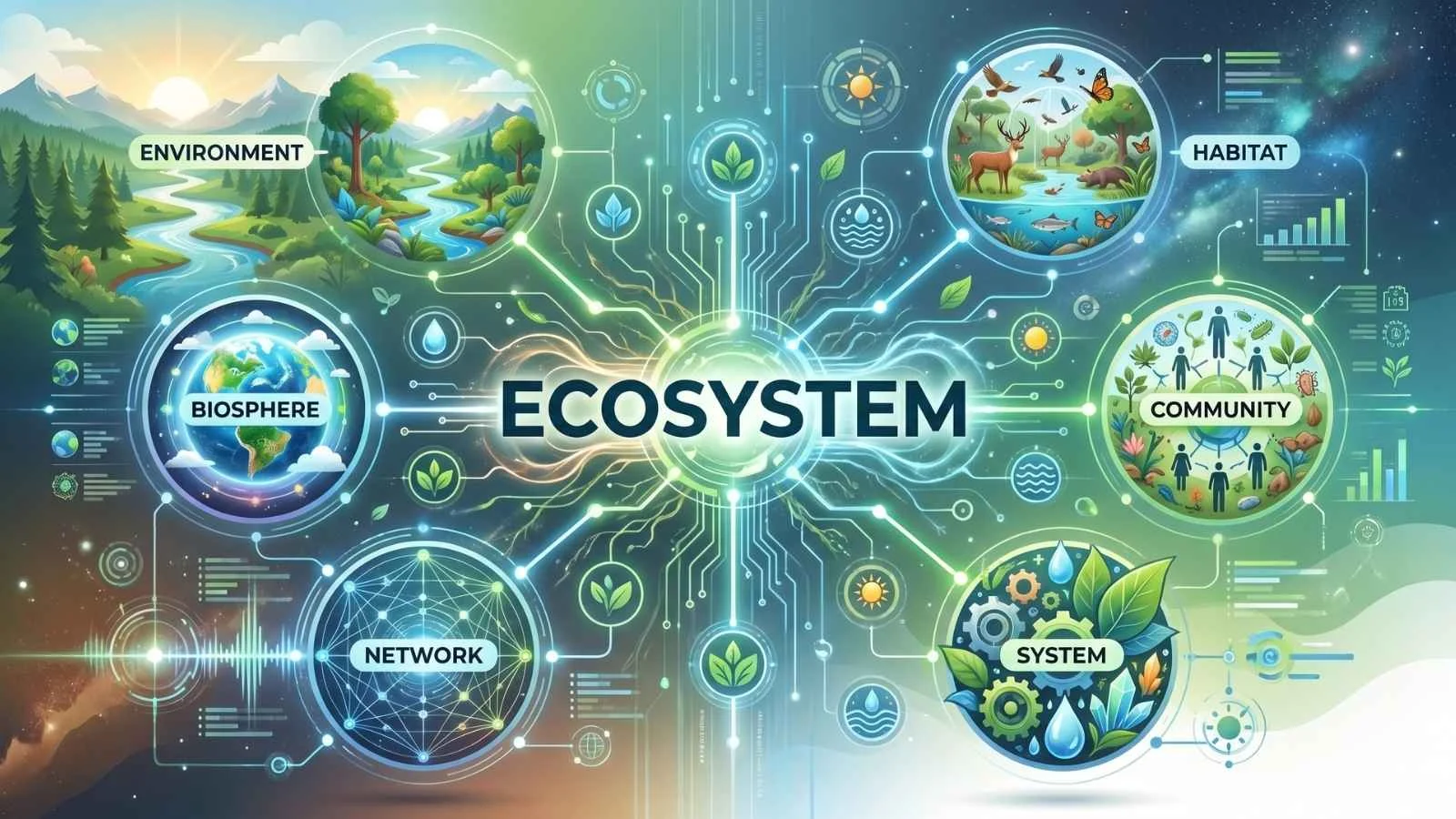
In this post, you will find 50 great synonyms for ecosystem. Each one has a simple meaning and two short real-life example sentences. Let us dive in!
1. Habitat
Meaning:
- The natural place where a living thing normally lives and grows.
Examples:
- The polar bear’s natural habitat is the cold and icy Arctic region.
- Cutting down trees destroys the habitat of hundreds of woodland creatures.
2. Environment
Meaning:
- All the living and non-living things that surround a creature or plant.
Examples:
- The marine environment near the coral reef teems with colorful sea life.
- She studied how pollution affects the environment around industrial cities.
3. Biome
Meaning:
- A very large area of the world is defined by its climate and the life that lives in it.
Examples:
- The tropical rainforest biome receives more rainfall than any other region on Earth.
- She wrote her geography report on the grassland biome and its unique wildlife.
4. Community
Meaning:
- A group of different living things that share the same space and depend on each other.
Examples:
- The forest community includes deer, owls, foxes, beetles, and thousands of plants.
- She studied how each member of the tide pool community plays a vital role.
5. Biosphere
Meaning:
- The total layer of Earth where all living things exist and interact together.
Examples:
- Human activity affects every corner of the biosphere in ways large and small.
- She described the biosphere as the thin living skin that covers the whole planet.
6. Ecology
Meaning:
- The study of how living things relate to each other and to their environment.
Examples:
- He chose ecology as his university major because he loved the natural world.
- The ecology of the wetland changed dramatically after the factory was built nearby.
7. Niche
Meaning:
- The special role or position a living thing fills within its community.
Examples:
- The owl fills the niche of nighttime hunter in the woodland food chain.
- Every plant and animal in the meadow occupies its own unique ecological niche.
8. Web of Life
Meaning:
- The complex network of connections between all living things in a natural setting.
Examples:
- Removing one species can unravel the whole web of life in that region.
- She explained the web of life to younger students using a piece of tangled string.
9. Food Web
Meaning:
- The network of who eats whom in a natural community of living things.
Examples:
- The disappearance of the wolf disrupted the entire food web of the valley.
- He drew a detailed food web showing how energy moves through the forest floor.
10. Food Chain
Meaning:
- A simple line showing how energy passes from one living thing to the next.
Examples:
- The food chain in the ocean starts with tiny plants called phytoplankton.
- She traced the food chain from the blade of grass all the way to the eagle.
11. Biotope
Meaning:
- A small and specific area where a certain group of living things shares conditions.
Examples:
- The rocky shoreline serves as a distinct biotope for barnacles and sea anemones.
- Researchers identified a rare biotope hidden deep inside the ancient forest.
12. Microhabitat
Meaning:
- A very small and specific place within a larger habitat that supports its own life.
Examples:
- The underside of a log creates a damp microhabitat for beetles and woodlice.
- She found an entire microhabitat living inside the hollow of the old oak tree.
13. Nature Reserve
Meaning:
- A protected area of land or water set aside to preserve its natural ecosystem.
Examples:
- The nature reserve near the river protects dozens of rare and endangered birds.
- He volunteered at the local nature reserve every weekend during the summer.
14. Wilderness
Meaning:
- A large natural area that remains mostly untouched by human activity.
Examples:
- The vast Alaskan wilderness supports grizzly bears, salmon, and bald eagles.
- She felt completely at peace hiking through the untouched wilderness of Patagonia.
15. Natural World
Meaning:
- Everything in nature that exists without human creation or interference.
Examples:
- David Attenborough spent his life documenting the beauty of the natural world.
- She grew up with a deep love and respect for the natural world around her home.
16. Domain
Meaning:
- The particular area or region where a specific group of living things thrives.
Examples:
- The deep ocean is the domain of creatures that never see sunlight at all.
- The Arctic tundra serves as the domain of the Arctic fox and the snowy owl.
17. Region
Meaning:
- A broad area of land or water that shares similar natural features and life.
Examples:
- The Amazon region shelters more species of life than anywhere else on Earth.
- She researched the alpine region and the tough plants that survive its harsh winters.
18. Zone
Meaning:
- A defined area with specific conditions that support particular types of life.
Examples:
- The intertidal zone supports creatures that survive both underwater and on dry land.
- Scientists divide the ocean into zones based on how deep and dark each level is.
19. Landscape
Meaning:
- The visible features of an area of land including plants, animals, and terrain.
Examples:
- The savanna landscape stretches across huge parts of the African continent.
- She painted a vivid picture of the changing landscape through the four seasons.
20. Territory
Meaning:
- An area that a specific animal or group claims and defends as its own space.
Examples:
- The male lion patrols and defends a vast territory on the open grassland.
- Each wolf pack claims a large territory and marks its boundaries carefully.
21. Surroundings
Meaning:
- The natural conditions and living things that exist around a particular creature.
Examples:
- The chameleon adapts its color to match its immediate surroundings perfectly.
- She noticed how the deer blended beautifully into its autumn surroundings.
22. System
Meaning:
- A set of connected parts that work together to keep a natural environment functioning.
Examples:
- The river system supports thousands of species from source to the open sea.
- She described the forest as a complex system where nothing exists in isolation.
23. Network
Meaning:
- A connected set of relationships between living things in a shared environment.
Examples:
- The underground fungal network connects thousands of trees across the forest floor.
- She explained how the ant colony operates as a highly organized natural network.
24. Realm
Meaning:
- A kingdom or world where certain forms of life rule and belong naturally.
Examples:
- The deep-sea realm hides creatures that science only discovered in recent decades.
- She described the reef as an underwater realm bursting with extraordinary color.
25. World
Meaning:
- A complete and self-contained natural environment with its own life and rules.
Examples:
- The world beneath the pond surface teems with life invisible to most people.
- She called the rainforest a world within a world because of its incredible layers.
26. Setting
Meaning:
- The specific natural place and conditions in which living things exist and interact.
Examples:
- The tropical island setting provided perfect conditions for rare orchids to thrive.
- He studied how animals adapt their behavior to fit their particular natural setting.
27. Terrain
Meaning:
- The physical shape and features of the land that influence the life it supports.
Examples:
- The rocky mountain terrain creates a harsh but fascinating highland ecosystem.
- She mapped the terrain of the valley to understand how water moves through it.
28. Locale
Meaning:
- A specific place or area with its own natural character and living community.
Examples:
- Each locale along the river supports a slightly different mix of plants and animals.
- The scientists chose this locale for their study because of its untouched conditions.
29. Preserve
Meaning:
- A protected area of land kept in its natural state to safeguard the life within it.
Examples:
- The wildlife preserve covers thousands of acres of pristine coastal wetland.
- She visited the preserve every spring to count the returning migratory birds.
30. Sanctuary
Meaning:
- A safe and protected place where wildlife and nature can exist without harm.
Examples:
- The bird sanctuary provides a quiet refuge for dozens of threatened species.
- He helped build a small garden sanctuary for bees and butterflies on the school grounds.
31. Reserve
Meaning:
- A protected natural area where wildlife and habitats receive official conservation care.
Examples:
- The marine reserve protects coral reefs from fishing and human disturbance.
- She studied the endangered species living inside the nearby nature reserve.
32. Catchment
Meaning:
- An area of land that collects water and directs it toward a river or lake system.
Examples:
- The catchment area of the river feeds wetlands that support hundreds of species.
- Scientists monitor the catchment zone to track changes in water quality and flow.
33. Watershed
Meaning:
- The area of land that drains all its water into a common river or body of water.
Examples:
- The entire watershed feeds the great river that flows through the national park.
- She studied how human activity in the watershed affects the river life downstream.
34. Basin
Meaning:
- A large natural hollow in the land that collects water and supports life around it.
Examples:
- The Congo Basin shelters one of the most diverse ecosystems on the entire planet.
- Animals gather at the wide basin during the long dry months of the year.
35. Biocenosis
Meaning:
- All the living things that share the same space and interact with each other.
Examples:
- The biocenosis of the meadow changes visibly with each shift of the season.
- She used the term biocenosis to describe the full community of the tide pool.
36. Ecosphere
Meaning:
- The part of the Earth and its atmosphere where living things can survive.
Examples:
- Pollution at any level threatens the delicate balance of the entire ecosphere.
- She explained that protecting the ecosphere means protecting all life on Earth.
37. Life Zone
Meaning:
- A band of altitude or climate where specific forms of life naturally exist together.
Examples:
- Each life zone on the mountain supports a completely different set of species.
- The alpine life zone sits above the tree line where only hardy plants can grow.
38. Microecosystem
Meaning:
- A tiny but complete ecosystem that functions on a very small and local scale.
Examples:
- A garden pond acts as a thriving microecosystem full of insects, frogs, and plants.
- She built a microecosystem in a glass jar using soil, moss, and a tiny fern.
39. Ecological System
Meaning:
- The full and connected system of living and non-living things in a natural place.
Examples:
- The mangrove forest forms a rich ecological system along tropical coastlines.
- He studied the ecological system of the kelp forest and its role in the ocean.
40. Habitat Zone
Meaning:
- A defined area within a larger environment where specific life forms cluster together.
Examples:
- The shady habitat zone under the forest canopy supports mosses and ferns.
- Each habitat zone in the park provides a different shelter for different animals.
41. Biotic Community
Meaning:
- All the living organisms that share and interact within the same natural area.
Examples:
- The biotic community of the estuary includes fish, crabs, herons, and marsh grasses.
- She described the biotic community of the desert as surprisingly rich and varied.
42. Living System
Meaning:
- A natural arrangement of living things that work together to keep each other alive.
Examples:
- The coral reef operates as a beautiful and fragile living system in warm seas.
- She called the forest a living system where every creature plays a necessary part.
43. Natural System
Meaning:
- A self-running system in nature where living things and conditions balance each other.
Examples:
- The wetland acts as a natural system that filters water and floods with ease.
- He described the prairie as a natural system that maintained itself for thousands of years.
44. Ecoregion
Meaning:
- A large area of land or water defined by its plants, animals, climate, and soil type.
Examples:
- The Mediterranean ecoregion supports unique plants that grow nowhere else on Earth.
- She studied the ecoregion of the Great Barrier Reef for her marine biology paper.
45. Plant Community
Meaning:
- A group of plant species that grow together and share the same area and conditions.
Examples:
- The plant community in the bog includes rare mosses, sundews, and cotton grass.
- She mapped the plant community along the riverbank during her field study trip.
46. Wildlife Corridor
Meaning:
- A strip of natural land that connects separate habitats and lets animals move safely.
Examples:
- The wildlife corridor allows elephants to travel between two national parks safely.
- She campaigned for a wildlife corridor to link the two separated forest patches.
47. Ecosystem Services
Meaning:
- The valuable benefits that a natural ecosystem provides to humans and other life forms.
Examples:
- Clean air, fresh water, and pollination all count as essential ecosystem services.
- She presented the value of ecosystem services to convince the town to protect the bog.
48. Flora and Fauna
Meaning:
- The plants and animals that live together naturally in a particular area.
Examples:
- The national park protects a rich and varied collection of local flora and fauna.
- She photographed the fascinating flora and fauna of the Caribbean islands for her blog.
49. Biotic Zone
Meaning:
- A defined region where specific living things flourish based on shared conditions.
Examples:
- Each biotic zone in the ocean hosts creatures specially adapted to that depth.
- The biotic zone at the top of the mountain supports only mosses and tough grasses.
50. Living Environment
Meaning:
- The complete natural surroundings that support and sustain all forms of life.
Examples:
- Plastic waste threatens the living environment of millions of marine creatures.
- She described the rainforest as the richest living environment on the whole planet.
Conclusion
Learning synonyms for ecosystem makes your science writing much more varied, interesting, and impressive. These words help you describe the natural world with greater depth and accuracy. They make your essays richer, your blog posts more informative, and your everyday conversations about nature much more expressive and alive.
Start today. Pick four or five words from this list. Use one in your next science report. Try one in your next nature journal entry. Say one when you describe a place in the natural world that you love.
Every new word you learn makes you a stronger thinker and a better writer. You now have 50 brilliant synonyms for ecosystem. Go out and use every single one of them with curiosity and confidence!

I am Joseph Clark, a vocabulary and language content writer at SynonymLibrary.com. I create clear, practical synonym guides that help readers improve their writing, word choice, and communication skills. My goal is to make language learning simple, accurate, and useful for students, writers, professionals, and everyday learners.