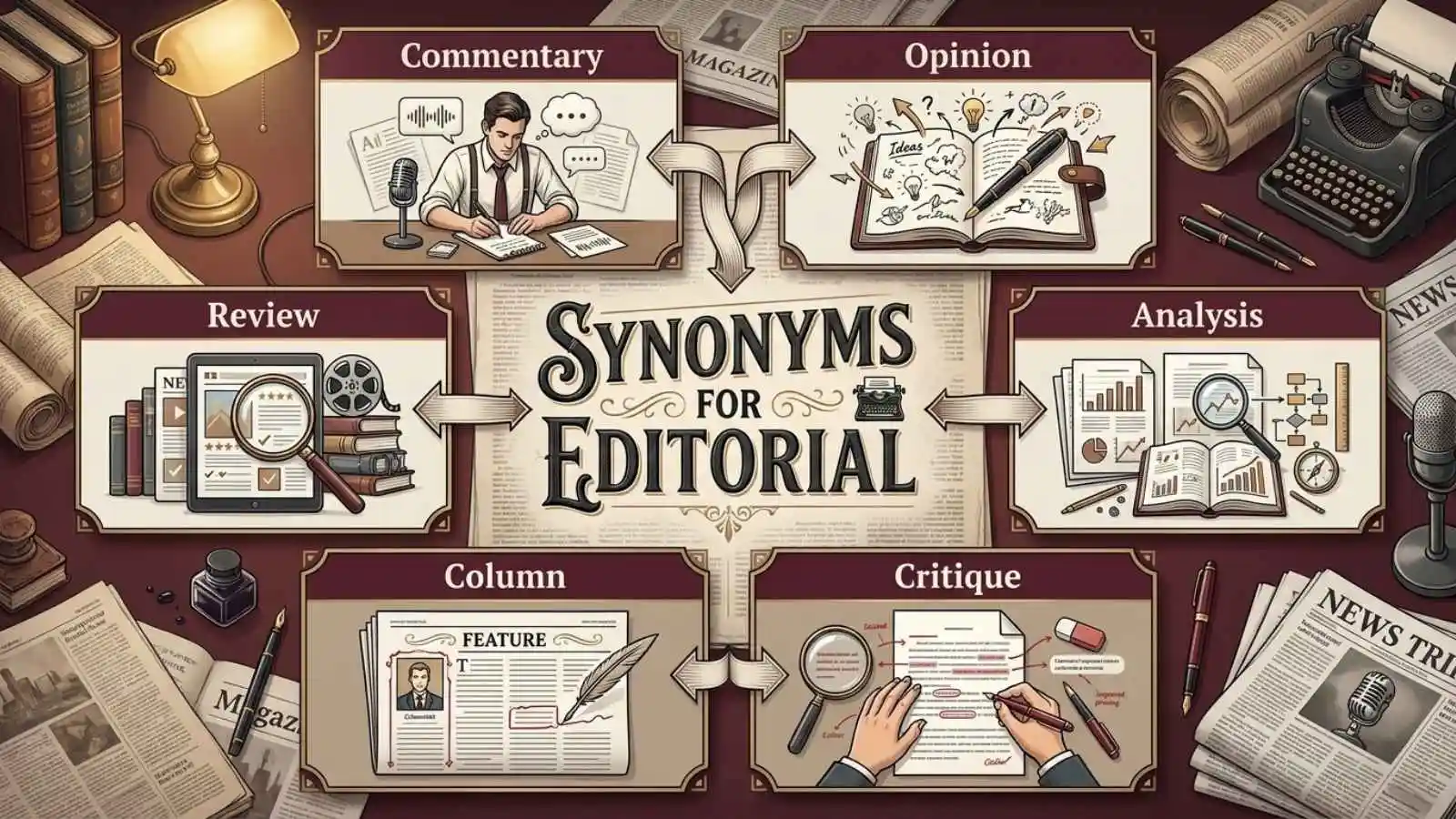
Have you ever read a newspaper and seen a piece that shares an opinion? Maybe the editor wrote about a big city problem. That piece is called an editorial. We see these often in papers, blogs, and magazines. An editorial is a written opinion piece. It shares views on news or topics.
The word “editorial” can also mean things linked to editing. Knowing more synonyms for editorial helps students write reports. It helps bloggers pick better words, it helps writers sound clear and smart, and it helps daily English users speak with care. This guide gives you 50 simple words. Each one will make your writing strong and clear. Let’s learn them together now.
Meaning and Origin of Editorial
Meaning
“Editorial” has two main meanings. First, it is an opinion piece in a paper or blog. It shares views on a topic. Second, it means things about editing or content. For example, an editorial team works on words and articles. It is a common word in media and writing.
Origin
The word “editorial” comes from “editor.” “Editor” comes from the Latin word “edere.” That word meant “to put out” or “to bring forth.” Over time, “editorial” grew to mean an editor’s written opinion. It has been used in this way for a long time.
1. Opinion Piece
Meaning:
This is a written work that shares one person’s views.
Usage:
People use this for articles in papers and blogs.
Examples:
- She wrote an opinion piece on schools.
- The paper ran his opinion piece today.
2. Commentary
Meaning:
This is a spoken or written set of remarks on a topic.
Usage:
Use this for views shared in news or media.
Examples:
- His commentary on the game was sharp.
- The site posts daily news commentary.
3. Column
Meaning:
This is a regular piece written by one author.
Usage:
People use this for writers who post often in papers.
Examples:
- She writes a weekly column on food.
- His column runs every Sunday.
4. Op-ed
Meaning:
This is an opinion piece by someone outside the staff.
Usage:
Use this for guest opinion writing in papers.
Examples:
- The mayor wrote an op-ed last week.
- His op-ed got many reads.
5. Leader
Meaning:
This is the main opinion piece in a newspaper.
Usage:
This word is common in British papers.
Examples:
- The leader spoke about the new law.
- The paper’s leader was bold today.
6. Viewpoint
Meaning:
This is a written or spoken way of seeing a topic.
Usage:
Use this when sharing a clear point of view.
Examples:
- She shared her viewpoint on the plan.
- The article gave a fresh viewpoint.
7. Perspective
Meaning:
This is a way of looking at and judging a thing.
Usage:
Use this in essays and thoughtful writing.
Examples:
- He wrote from a young person’s perspective.
- The piece gave a new perspective.
8. Article
Meaning:
This is a written piece in a paper or magazine.
Usage:
People use this for any short written work.
Examples:
- She read an article about space.
- The article was clear and short.
9. Essay
Meaning:
This is a short piece of writing on one topic.
Usage:
Use this for school work and opinion writing.
Examples:
- He wrote an essay on kindness.
- Her essay won first prize.
10. Editorial Comment
Meaning:
This is a short note that shares the editor’s view.
Usage:
Use this for brief opinions added to news.
Examples:
- The paper added an editorial comment.
- His editorial comment was firm.
11. Critique
Meaning:
This is a careful review of a work or idea.
Usage:
Use this when you judge something with care.
Examples:
- She wrote a critique of the film.
- His critique was fair and clear.
12. Analysis
Meaning:
This is a close study of a topic or event.
Usage:
Use this for deep, careful writing on news.
Examples:
- The analysis broke down the law.
- Her analysis was easy to follow.
13. Review
Meaning:
This is a written opinion about a work or event.
Usage:
People use this for books, films, and shows.
Examples:
- He wrote a review of the book.
- The review gave it high marks.
14. Position Paper
Meaning:
This is a piece that states a firm stand on a topic.
Usage:
Use this in formal and policy writing.
Examples:
- The group shared a position paper.
- Her position paper was strong.
15. Treatise
Meaning:
This is a long, formal piece on one subject.
Usage:
Use this for deep, serious written work.
Examples:
- He wrote a treatise on law.
- The treatise was very long.
16. Discourse
Meaning:
This is a long talk or piece on a topic.
Usage:
Use this for formal writing or speech.
Examples:
- Her discourse on art was rich.
- The book is a discourse on peace.
17. Feature
Meaning:
This is a special, longer story in a paper.
Usage:
Use this for big articles with more depth.
Examples:
- The feature covered the flood.
- She wrote a feature on local food.
18. Think Piece
Meaning:
This is an article meant to spark deep thought.
Usage:
Use this for blogs and modern media writing.
Examples:
- His think piece went viral.
- The think piece raised good points.
19. Manifesto
Meaning:
This is a public statement of aims and views.
Usage:
Use this for bold, clear declarations.
Examples:
- The group shared a manifesto.
- Her manifesto called for change.
20. Statement
Meaning:
This is a clear written or spoken claim.
Usage:
People use this for short, firm views.
Examples:
- The paper made a statement.
- His statement was brief.
21. Comment
Meaning:
This is a short remark on a topic.
Usage:
Use this for quick views in news or online.
Examples:
- She left a comment on the blog.
- His comment was very kind.
22. Exposition
Meaning:
This is writing that explains a topic clearly.
Usage:
Use this for teaching or formal writing.
Examples:
- The exposition was easy to read.
- Her exposition made it clear.
23. Dissertation
Meaning:
This is a long, deep written study.
Usage:
Use this for school and college work.
Examples:
- He wrote a dissertation on birds.
- Her dissertation took two years.
24. Brief
Meaning:
This is a short written summary of facts or views.
Usage:
Use this in law, news, and formal work.
Examples:
- The brief covered the main facts.
- She wrote a clear brief.
25. Report
Meaning:
This is a written account of facts or events.
Usage:
People use this for news and work writing.
Examples:
- The report shared the results.
- His report was well done.
26. Write-up
Meaning:
This is a written account or short article.
Usage:
Use this for casual articles and notes.
Examples:
- She did a write-up of the trip.
- The write-up was short and fun.
27. Editorial Content
Meaning:
This is written work made for readers, not ads.
Usage:
Use this in media and publishing talk.
Examples:
- The site has rich editorial content.
- They split ads from editorial content.
28. Position
Meaning:
This is a clear stand on an issue.
Usage:
Use this when stating where you stand.
Examples:
- The paper took a firm position.
- Her position was very clear.
29. Stance
Meaning:
This is a way of thinking about an issue.
Usage:
Use this for a person’s view on a topic.
Examples:
- His stance on the law was strong.
- She made her stance clear.
30. Argument
Meaning:
This is a set of reasons for a view.
Usage:
Use this in essays and debate writing.
Examples:
- Her argument was very strong.
- He made a clear argument.
31. Reflection
Meaning:
This is a thoughtful piece on an idea or event.
Usage:
Use this for calm, personal writing.
Examples:
- She wrote a reflection on her year.
- His reflection was deep and kind.
32. Memo
Meaning:
This is a short note that shares facts or views.
Usage:
Use this in work and office writing.
Examples:
- The boss sent a memo today.
- His memo was clear and short.
33. Editorial Board
Meaning:
This is the team that sets a paper’s views.
Usage:
Use this for the group behind opinion pieces.
Examples:
- The editorial board met today.
- The board wrote the main piece.
34. Polemic
Meaning:
This is a strong piece that argues against something.
Usage:
Use this for bold, firm opinion writing.
Examples:
- His polemic stirred up debate.
- The polemic was very sharp.
35. Editorial Line
Meaning:
This is the set view a paper takes on topics.
Usage:
Use this in media and publishing talk.
Examples:
- The paper kept its editorial line.
- Their editorial line was clear.
36. Take
Meaning:
This is a person’s quick view on a topic.
Usage:
This is a casual word used a lot online.
Examples:
- His take on the news was bold.
- I shared my take on the show.
37. Editorial Note
Meaning:
This is a short note added by the editor.
Usage:
Use this for brief editor remarks in text.
Examples:
- An editorial note was added.
- The editorial note explained more.
38. Submission
Meaning:
This is a piece sent in to be published.
Usage:
Use this in writing and media work.
Examples:
- She sent her submission today.
- His submission got picked.
39. Standpoint
Meaning:
This is the spot from which you judge a thing.
Usage:
Use this for a clear point of view.
Examples:
- From her standpoint, it was fair.
- He shared his standpoint well.
40. Editorial Voice
Meaning:
This is the tone and style of a paper’s writing.
Usage:
Use this in media and brand talk.
Examples:
- The blog has a warm editorial voice.
- Their editorial voice felt fresh.
41. Treatment
Meaning:
This is the way a topic is handled in writing.
Usage:
Use this for how a subject is covered.
Examples:
- The treatment of the topic was fair.
- Her treatment of facts was clear.
42. Editorialize
Meaning:
This means to add your own views to news.
Usage:
Use this when opinion mixes with facts.
Examples:
- The writer began to editorialize.
- He tends to editorialize too much.
43. Account
Meaning:
This is a written report of facts or events.
Usage:
Use this for clear, factual writing.
Examples:
- She gave an account of the day.
- His account was true and full.
44. Disquisition
Meaning:
This is a long, careful piece on a topic.
Usage:
Use this for formal, deep writing.
Examples:
- His disquisition was very detailed.
- The disquisition covered much ground.
45. Notice
Meaning:
This is a short public written remark.
Usage:
Use this for brief news or opinion items.
Examples:
- The paper ran a notice.
- Her notice was clear and short.
46. Editorial Stance
Meaning:
This is the firm view a paper or writer holds.
Usage:
Use this in media and opinion talk.
Examples:
- Their editorial stance was bold.
- The editorial stance stayed firm.
47. Treatise Piece
Meaning:
This is a deep, formal written work on one subject.
Usage:
Use this for serious, long writing tasks.
Examples:
- His treatise piece was thorough.
- The treatise piece took weeks.
48. Editorial Voice Piece
Meaning:
This is a work that shows a clear writing tone.
Usage:
Use this for branded or styled content.
Examples:
- The editorial voice piece felt warm.
- Her editorial voice piece stood out.
49. Expose
Meaning:
This is a piece that reveals hidden facts.
Usage:
Use this for bold news that uncovers truth.
Examples:
- The expose shocked the town.
- Her expose won an award.
50. Editorial Statement
Meaning:
This is a clear written claim of a paper’s view.
Usage:
Use this for formal opinion writing.
Examples:
- The editorial statement was firm.
- They issued an editorial statement.
FAQs
What is another word for editorial?
You can say “opinion piece,” “column,” “commentary,” or “op-ed.”
Can I use “op-ed” instead of “editorial”?
Yes, but “op-ed” means a guest writer, not the staff.
What is the difference between an editorial and an article?
An editorial shares an opinion. An article often just shares facts.
Which synonym is best for blogs?
Try “think piece,” “commentary,” or “take” for blog writing.
Is “editorial” used only in newspapers?
No. It is also used in blogs, magazines, and online media.
Conclusion
Learning synonyms for editorial makes your writing strong. Your reports will sound clear and smart, your blogs will feel fresh and new, and your speaking will carry more weight. Good words help you share ideas well. So try these new words today. Use them in your emails, use them in your essays, use them in your daily talk. The more you practice, the easier it gets. Soon, the right word will come fast. Keep going, and watch your English grow strong.

I am Meer Hadi, a passionate language and content writer at SynonymLibrary.com. I focus on creating helpful word guides that make it easier for readers to choose the right words, understand meanings, and express their ideas more clearly. Through my work, I aim to support students, writers, and professionals in building stronger communication skills.