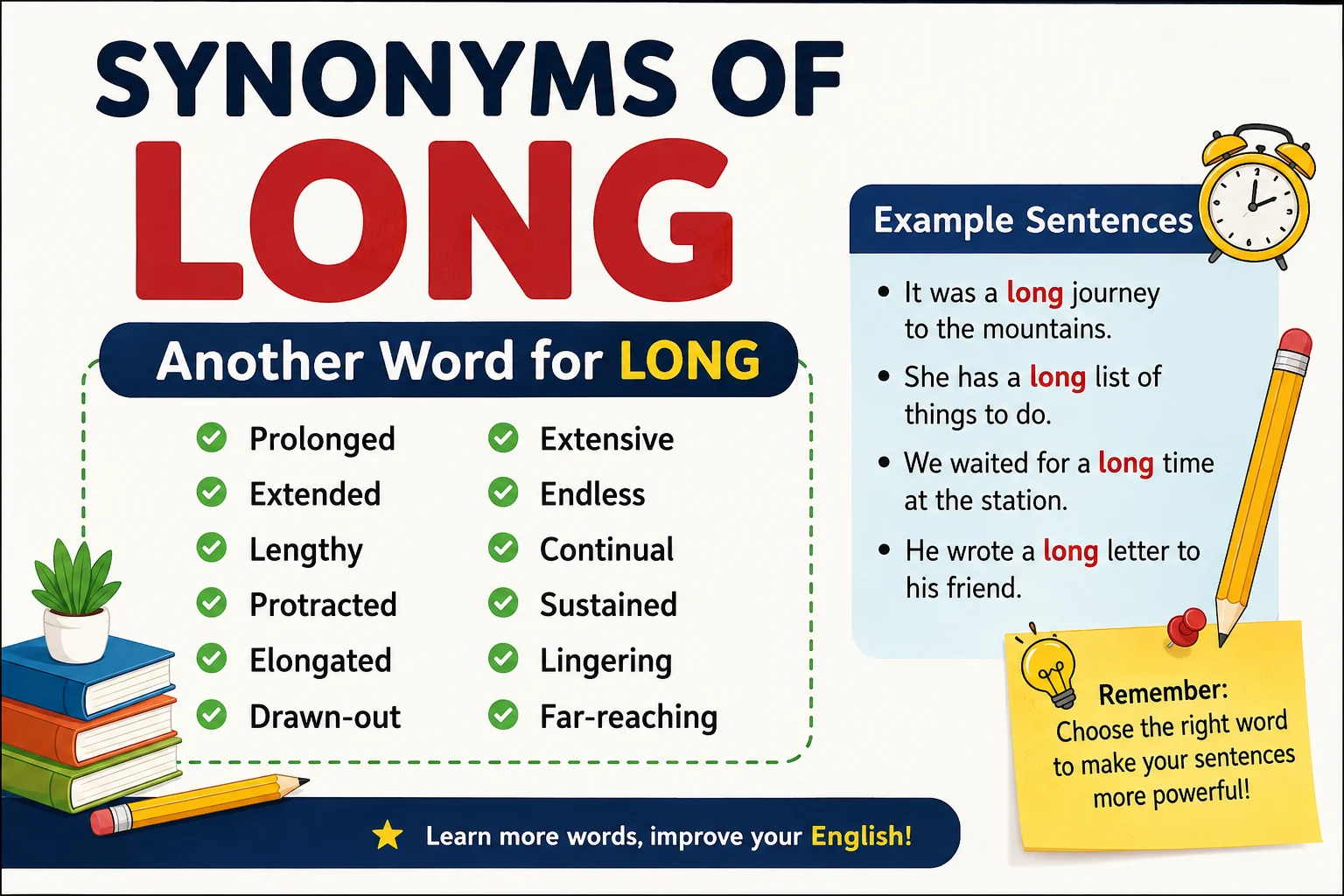
Looking for a better word than “long”? The best synonym depends on what “long” means in your sentence. For physical length, you might use lengthy or extended; for time, prolonged or lengthy may fit; for distance, far-reaching or distant can work in certain contexts; and when long means to strongly desire something, yearn or crave may be better choices.
If you’re searching for synonyms for long, you probably want more than a list of similar words—you want to know which alternatives are actually interchangeable, what each one means, how formal or natural it sounds, and when using it could change your sentence’s meaning.
That matters because long has several distinct senses, and a synonym that works for “a long meeting” may not work for “a long journey” or “I long for home.” This guide organizes useful synonyms for long by meaning, with clear definitions, context, tone, examples, and usage tips to help you choose the right word.
Lengthy
Meaning:
Lengthy means taking a lot of time or having great length.
Examples:
- The lengthy meeting ended after lunch.
- I had to read a lengthy report for class.
Extended
Meaning:
Extended means made longer or lasting longer than usual.
Examples:
- We enjoyed an extended holiday in July.
- The teacher gave us an extended deadline.
Prolonged
Meaning:
Prolonged means lasting longer than expected or needed.
Examples:
- The prolonged rain caused travel problems.
- We faced a prolonged wait at the clinic.
Lasting
Meaning:
Lasting means continuing for a long time.
Examples:
- The trip gave me a lasting memory.
- Her advice had a lasting effect on me.
Enduring
Meaning:
Enduring means continuing for a very long time.
Examples:
- Their enduring friendship began at school.
- The book has an enduring message.
Longstanding
Meaning:
Longstanding means existing or continuing for many years.
Examples:
- They have a longstanding business relationship.
- The school has a longstanding tradition.
Continued
Meaning:
Continued means still happening or going on.
Examples:
- The continued rain kept us indoors.
- His continued effort helped the team succeed.
Continuing
Meaning:
Continuing means going on without ending.
Examples:
- The continuing noise made it hard to study.
- We are monitoring the continuing problem.
Ongoing
Meaning:
Ongoing means still happening or being worked on.
Examples:
- The repairs are still ongoing.
- We talked about the ongoing project.
Sustained
Meaning:
Sustained means continuing at a steady level for some time.
Examples:
- The team made a sustained effort.
- The plant needs sustained sunlight to grow.
Protracted
Meaning:
Protracted means lasting much longer than expected.
Examples:
- The protracted debate delayed the vote.
- They finally ended the protracted dispute.
Lingering
Meaning:
Lingering means staying or continuing longer than expected.
Examples:
- A lingering smell filled the room.
- She had a lingering feeling of doubt.
Persistent
Meaning:
Persistent means continuing for a long time without stopping.
Examples:
- Persistent rain flooded several streets.
- He had a persistent problem with his laptop.
Chronic
Meaning:
Chronic means continuing for a long time, especially when describing a problem or condition.
Examples:
- The city has a chronic traffic problem.
- The project faced chronic delays.
Prolonged
Meaning:
Prolonged means continued for an unusually long period.
Examples:
- The patient needed rest after a prolonged illness.
- The prolonged heat made the summer difficult.
Drawn-Out
Meaning:
Drawn-out means lasting much longer than necessary.
Examples:
- The drawn-out meeting tested everyone’s patience.
- Nobody wanted another drawn-out argument.
Time-Consuming
Meaning:
Time-consuming means needing a lot of time to complete.
Examples:
- Writing the report was time-consuming.
- Cleaning every room can be time-consuming.
Lengthened
Meaning:
Lengthened means made longer in time, distance, or physical size.
Examples:
- The school lengthened the lunch break.
- Road work lengthened our journey.
Stretched
Meaning:
Stretched means extended over a longer time or distance.
Examples:
- We worked for a long stretch without a break.
- The road stretched across the valley.
Elongated
Meaning:
Elongated means made longer and thinner than usual.
Examples:
- The artist drew an elongated face.
- The table has an elongated shape.
Synonyms for Adverse: 50 Strong Words for Negative Situations
Far
Meaning:
Far means a great distance away.
Examples:
- My office is far from the station.
- We walked far before finding a hotel.
Distant
Meaning:
Distant means far away in space or time.
Examples:
- We could see distant hills from the window.
- He has a distant memory of that day.
Remote
Meaning:
Remote means far away from other places or people.
Examples:
- They live in a remote mountain village.
- The hikers reached a remote part of the forest.
Faraway
Meaning:
Faraway means located a great distance away.
Examples:
- She dreamed of visiting a faraway island.
- We watched the sun set over a faraway hill.
Far-Flung
Meaning:
Far-flung means spread across a very large area or located far away.
Examples:
- The company has offices in far-flung cities.
- Travelers came from far-flung parts of the country.
Outlying
Meaning:
Outlying means far from the center of a place.
Examples:
- The bus serves several outlying villages.
- We visited an outlying area of the city.
Extensive
Meaning:
Extensive means covering a large area or involving a large amount.
Examples:
- The writer did extensive research.
- The storm caused extensive damage.
Expansive
Meaning:
Expansive means covering a large area or space.
Examples:
- We enjoyed an expansive view of the sea.
- The hotel has an expansive garden.
Sprawling
Meaning:
Sprawling means spreading over a large area.
Examples:
- They live in a sprawling city.
- We explored the sprawling campus.
Wide-Ranging
Meaning:
Wide-ranging means covering many areas, topics, or types.
Examples:
- The podcast covers wide-ranging topics.
- She has wide-ranging interests.
Synonyms for Meter: 50 Useful Alternatives to Improve Your English
Far-Reaching
Meaning:
Far-reaching means extending a long distance or having effects in many places.
Examples:
- The new rule could have far-reaching effects.
- The discovery had far-reaching results.
Endless
Meaning:
Endless means seeming to have no end.
Examples:
- The children asked endless questions.
- We drove along an endless road.
Never-Ending
Meaning:
Never-ending means continuing without seeming to stop.
Examples:
- The office had a never-ending list of tasks.
- Her stories felt like a never-ending adventure.
Unending
Meaning:
Unending means continuing without an end.
Examples:
- The desert seemed to have an unending horizon.
- They worked through an unending stream of requests.
Ceaseless
Meaning:
Ceaseless means continuing without stopping.
Examples:
- The ceaseless rain kept everyone inside.
- We heard the ceaseless sound of traffic.
Incessant
Meaning:
Incessant means continuing without pause, often in an annoying way.
Examples:
- The incessant barking kept me awake.
- We were tired of the incessant noise.
Perpetual
Meaning:
Perpetual means continuing for a very long time or seeming never to stop.
Examples:
- The town has a perpetual traffic problem.
- His perpetual questions made everyone laugh.
Eternal
Meaning:
Eternal means lasting forever.
Examples:
- The poem speaks of eternal love.
- They hoped their friendship would be eternal.
Everlasting
Meaning:
Everlasting means lasting forever or for an extremely long time.
Examples:
- The story celebrates everlasting love.
- She wished them everlasting happiness.
Infinite
Meaning:
Infinite means having no end or limit.
Examples:
- The night sky seemed infinite.
- There are infinite ways to learn.
Boundless
Meaning:
Boundless means having no clear limit.
Examples:
- The child showed boundless energy.
- Her boundless curiosity helped her learn.
Limitless
Meaning:
Limitless means having no limit.
Examples:
- The internet gives us limitless information.
- His imagination seems limitless.
Interminable
Meaning:
Interminable means seeming to last for an extremely long time.
Examples:
- The interminable lecture made everyone tired.
- We sat through an interminable wait at the airport.
Uninterrupted
Meaning:
Uninterrupted means continuing without being stopped or disturbed.
Examples:
- I need an uninterrupted hour to finish this task.
- We enjoyed uninterrupted sleep last night.
Unbroken
Meaning:
Unbroken means continuing without a break or interruption.
Examples:
- We had two hours of unbroken sunshine.
- She enjoyed an unbroken period of quiet.
Marathon
Meaning:
Marathon can describe something informal that lasts for a very long time.
Examples:
- We had a marathon study session before the exam.
- The team held a marathon meeting yesterday.
Duration
Meaning:
Duration means the amount of time something lasts, so it is useful when talking about the length of an event.
Examples:
- Check the movie’s duration before you start it.
- The course has a duration of six weeks.
Span
Meaning:
Span means the full length of time or distance covered by something.
Examples:
- The project lasted over a span of three years.
- The bridge spans the entire river.
Stretch
Meaning:
Stretch can mean a continuous period of time or a length of space.
Examples:
- I studied for a four-hour stretch.
- We drove for a long stretch of highway.
Distance
Meaning:
Distance means the amount of space between two places or things.
Examples:
- The distance between the two towns is 50 miles.
- We covered a great distance on foot.
Formal vs. Casual Synonyms for Long
Not every alternative to long fits every situation. Some words sound natural in daily conversation, while others are better for formal writing.
| Word | Best Use | Style |
|---|---|---|
| lengthy | essays, meetings, reports | Neutral/Formal |
| extended | time, breaks, deadlines | Neutral |
| prolonged | delays, problems, events | Formal |
| longstanding | relationships, traditions | Neutral/Formal |
| far | physical distance | Everyday |
| distant | places, memories, times | Neutral |
| extensive | research, damage, work | Formal |
| endless | time, roads, tasks | Neutral |
| marathon | meetings, study sessions | Casual |
| interminable | very long events | Formal |
Which Synonym for Long Should You Use?
The best word depends on the meaning of long.
For a long period of time: use lengthy, extended, prolonged, lasting, or protracted.
For a long distance: use far, distant, remote, faraway, or far-flung.
For a large area or amount: use extensive, expansive, sprawling, or wide-ranging.
For something that seems to have no end: use endless, unending, ceaseless, or never-ending.
For something lasting forever: use eternal or everlasting.
For physical length: use elongated, lengthened, or stretched.
This distinction matters because synonyms are not always interchangeable.
Long vs. Lengthy
Long is the most common and flexible choice.
Lengthy often suggests that something takes a lot of time or has more length than expected.
For example:
- I read a long book. — Natural and general.
- I read a lengthy report. — More specific and slightly more formal.
Long vs. Far
Use long when talking about time or physical length.
Use far when talking about distance.
For example:
- The journey was long.
- The destination was far away.
You would not normally replace long with far in every sentence.
Long vs. Tall
These words describe different kinds of measurement.
Long usually describes distance from one end to another.
Tall describes height.
For example:
- a long table
- a tall building
So, tall is not a general synonym for long.
Long vs. Extended
These words can be close in meaning when talking about time.
Long is more common in everyday English.
Extended often suggests that something was made longer than planned or expected.
For example:
- We had a long break.
- We had an extended break.
Long vs. Prolonged
Both can describe something that lasts a long time, but prolonged often suggests that the situation lasted longer than wanted or expected.
For example:
- a long delay
- a prolonged delay
The second sounds more formal and often carries a negative feeling.
Long vs. Endless
Long means something lasts or measures a great amount.
Endless suggests that it has no apparent end.
For example:
- a long road means the road covers a great distance.
- an endless road suggests that the road seems to go on forever.
Better Words for Long in Essays and Blogs
If you are writing an essay, blog post, or report, avoid repeating long in every paragraph.
Try:
- lengthy for reports and discussions
- extended for periods or deadlines
- prolonged for delays or difficult situations
- extensive for research or work
- lasting for effects or memories
- longstanding for traditions or relationships
- far-reaching for effects or consequences
Choose the word that matches your exact meaning instead of using a synonym only to sound fancy.
Common Mistake When Using Synonyms for Long
The biggest mistake is assuming that every synonym can replace long in every sentence.
They cannot.
For example, far is mainly about distance, while lengthy often describes time or size. Tall describes height, and eternal suggests forever. Choosing the wrong word can change the meaning of your sentence.
A good rule is simple:
First decide what “long” means in your sentence. Then choose the synonym that matches that meaning.
Conclusion
Learning synonyms for long gives you more choices when you write and speak. Words such as lengthy, extended, prolonged, distant, and endless can make your English clearer and less repetitive. The key is to choose a word that fits the exact meaning. Practice these alternatives in emails, essays, blog posts, and daily conversations. With regular use, you will build a stronger vocabulary and communicate your ideas with more confidence.

I am Joseph Clark, a vocabulary and language content writer at SynonymLibrary.com. I create clear, practical synonym guides that help readers improve their writing, word choice, and communication skills. My goal is to make language learning simple, accurate, and useful for students, writers, professionals, and everyday learners.