Have you ever written the word “not” five times in just two sentences? It happens to almost every writer and student. The word starts to feel weak and repeated very fast.
Think about this. You write: “She did not come. He did not call. They did not try.” It gets boring and flat. But what if you wrote: “She failed to come. He never called. They refused to try”? Now every sentence has real punch and energy.
The word not is used to show that something is negative, untrue, or the opposite of what was said. It is one of the most used words in the whole English language. You see it in texts, emails, essays, and everyday speech all the time.
Learning synonyms for not helps you write negative ideas in a much stronger and more varied way. It makes your sentences more interesting and your message far more clear.
Let us now explore 50 great synonyms for not that you can use in your writing right away.
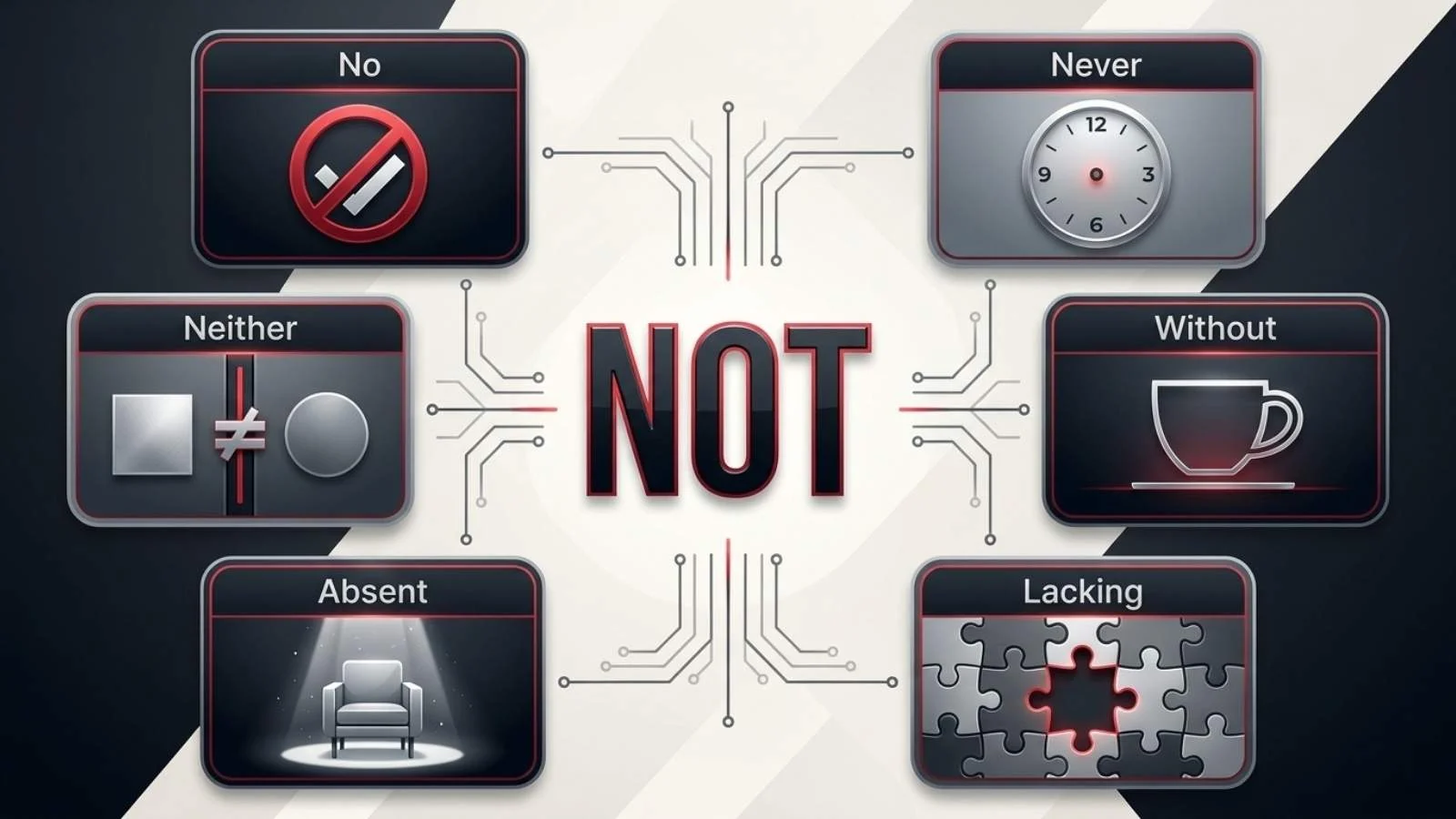
1. Never
Meaning:
Never means at no time at all, not even once in the past or future.
Examples:
- She never missed a single class during her entire first year at university.
- He never gave up on his dream even when everything felt impossible to him.
2. No
Meaning:
No means a direct refusal or the complete absence of something.
Examples:
- There is no reason to panic about the small delay in the delivery schedule.
- She said no to the offer because it did not match what she was looking for.
3. Neither
Meaning:
Neither means not one and not the other when talking about two choices or people.
Examples:
- Neither of the two plans was good enough to present to the full board yet.
- He liked neither the red shirt nor the blue one so he left the shop empty-handed.
4. Nor
Meaning:
Nor means also not, used to add another negative idea to what was already said.
Examples:
- She did not call nor did she send a single message to explain what happened.
- He could not eat nor sleep the night before the most important exam of his life.
5. Without
Meaning:
Without means in the absence of something or not having something at all.
Examples:
- She finished the whole project without any help from her teammates at all.
- He left the house without saying a single word to anyone that cold morning.
6. Lacking
Meaning:
Lacking means not having enough of something that is needed or expected.
Examples:
- The report was lacking in detail and needed a lot more work before submission.
- He felt lacking in confidence before the big speech but pushed through anyway.
7. Absent
Meaning:
Absent means not present or not there when something or someone was expected.
Examples:
- She was absent from the meeting because of a sudden and unexpected illness.
- Any real sense of teamwork was completely absent from the group during the project.
8. Void of
Meaning:
Void of means completely empty of something or having none of it at all.
Examples:
- His answer was void of any real explanation and left everyone more confused.
- The room felt void of warmth even after the heater had been running all day.
9. Free of
Meaning:
Free of means not having something, especially something bad or unwanted.
Examples:
- She wanted a life free of stress and moved to a quiet town by the sea.
- The new recipe is completely free of sugar and still tastes absolutely wonderful.
10. Devoid of
Meaning:
Devoid of means totally without something, leaving nothing of it at all.
Examples:
- His speech was devoid of any emotion and felt cold and hard to connect with.
- The old building was devoid of furniture and had been empty for many long years.
11. Refuse to
Meaning:
Refuse to means choosing not to do something on purpose and with full intention.
Examples:
- She refuses to give up on her goals no matter how many times she faces failure.
- He refused to accept the unfair terms that the other party kept pushing forward.
12. Fail to
Meaning:
Fail to means not doing something or not managing to get a result that was needed.
Examples:
- He failed to submit the assignment on time and lost marks because of that.
- She failed to notice the small but very important mistake at the bottom of the form.
13. Decline to
Meaning:
Decline to means politely choosing not to do or accept something offered to you.
Examples:
- She declined to comment on the story when the reporters approached her outside.
- He declined to take the promotion because it would have meant moving to another city.
14. Deny
Meaning:
Deny means to say that something is not true or to refuse to allow something.
Examples:
- He denied ever being at the location on the night the incident took place.
- She denied herself rest for weeks to finish the book before the print deadline.
15. Reject
Meaning:
Reject means to say no to something or to push it away and not accept it at all.
Examples:
- The committee decided to reject the proposal because of the high cost involved.
- She rejected the idea of giving up and kept working harder than ever before.
16. Oppose
Meaning:
Oppose means to be against something and work to stop it from happening.
Examples:
- Many local residents came out to strongly oppose the plan to cut the old forest.
- He opposed the new rule because he felt it was unfair to the junior staff members.
17. Negate
Meaning:
Negate means to cancel something out or make it have no effect or value at all.
Examples:
- One bad decision can negate all the hard work you have put in over many months.
- The second test negated the results of the first and forced a full re-evaluation.
18. Contradict
Meaning:
Contradict means to say or show the opposite of what someone else has said.
Examples:
- The new evidence directly contradicted the main witness statement in the case.
- She did not want to contradict her boss in front of the whole team in the room.
19. Nullify
Meaning:
Nullify means to make something have no legal or practical value or effect at all.
Examples:
- The judge decided to nullify the contract because it had been signed under pressure.
- A single missing signature was enough to nullify the entire legal agreement made.
20. Invalidate
Meaning:
Invalidate means to make something no longer acceptable, correct, or officially valid.
Examples:
- Using a pen instead of a pencil did not invalidate the answers on the test paper.
- The new findings threatened to invalidate years of widely accepted scientific research.
21. Omit
Meaning:
Omit means to leave something out and not include it where it was expected to be.
Examples:
- She accidentally omitted her phone number from the application form she submitted.
- He chose to omit the most painful part of the story when he retold it to his son.
22. Exclude
Meaning:
Exclude means to deliberately leave someone or something out of a group or plan.
Examples:
- The rules clearly state that children under five are excluded from the main event.
- She felt excluded from the conversation because no one asked for her thoughts.
23. Dismiss
Meaning:
Dismiss means to decide that something is not worth thinking about or taking seriously.
Examples:
- He dismissed the warning signs and later regretted not acting on them sooner.
- The manager dismissed the complaint without even reading the full written report.
24. Overlook
Meaning:
Overlook means to fail to notice something or to choose to ignore it on purpose.
Examples:
- She overlooked the small spelling mistake in the final version of the document.
- He tends to overlook the feelings of others when he is focused on getting results.
25. Disregard
Meaning:
Disregard means to pay no attention to something and act as if it does not exist.
Examples:
- He chose to disregard the negative comments and stayed focused on his work.
- She disregarded the warning signs and made the decision anyway without hesitation.
26. Ignore
Meaning:
Ignore means to fully know something is there but choose not to pay any attention to it.
Examples:
- She tried to ignore the noise outside but it was too loud for her to concentrate.
- He ignored all the advice he was given and ended up making the same mistake again.
27. Withhold
Meaning:
Withhold means to keep something back and not give it when it was expected.
Examples:
- The company decided to withhold payment until all the work had been fully completed.
- She chose to withhold the information until she was absolutely sure of the facts.
28. Abstain
Meaning:
Abstain means to choose to stay away from doing something on purpose.
Examples:
- He chose to abstain from voting because he did not agree with any of the options.
- She abstained from social media for a full month and found it very refreshing.
29. Refrain from
Meaning:
Refrain from means to stop yourself from doing something that you might want to do.
Examples:
- Please refrain from using your phone during the ceremony out of respect for others.
- She tried hard to refrain from saying something she would later deeply regret.
30. Avoid
Meaning:
Avoid means to stay away from something or to make sure it does not happen.
Examples:
- He tried to avoid making eye contact during the awkward conversation at the office.
- She avoided the main road during rush hour to get home much faster that evening.
31. Forbid
Meaning:
Forbid means to officially say that something must not be done under any condition.
Examples:
- The school forbids students from using their phones during any classroom lesson.
- His doctor forbade him from eating salty food until his blood pressure came down.
32. Prohibit
Meaning:
Prohibit means to officially ban something through a rule, law, or authority.
Examples:
- The law prohibits the sale of alcohol to anyone under the legal drinking age.
- Smoking is strictly prohibited in all areas inside the hospital building at all times.
33. Prevent
Meaning:
Prevent means to stop something from happening before it even gets a chance to start.
Examples:
- Washing your hands regularly can prevent the spread of many common illnesses.
- She acted quickly to prevent the small argument from turning into a bigger conflict.
34. Halt
Meaning:
Halt means to stop something completely and bring it to a sudden full standstill.
Examples:
- The referee blew his whistle to halt the game after a player got badly injured.
- Construction on the new road was halted because of safety concerns raised on site.
35. Stop
Meaning:
Stop means to cause something to no longer continue or move forward at all.
Examples:
- She asked him to stop talking during the film because others could not hear it.
- The government moved quickly to stop the spread of the harmful online content.
36. Block
Meaning:
Block means to get in the way and prevent something from passing or happening.
Examples:
- A fallen tree was blocking the road and no cars could pass through for hours.
- He tried to block the negative thoughts from taking over his mind that night.
37. Bar
Meaning:
Bar means to officially stop someone from entering a place or doing something.
Examples:
- He was barred from the competition after breaking one of the main rules of play.
- The new policy bars anyone without a valid pass from entering the secured area.
38. Restrict
Meaning:
Restrict means to put limits on something so that it cannot happen freely or fully.
Examples:
- The doctor restricted her diet to help manage her condition more effectively.
- Access to the private files is restricted to only the most senior staff members.
39. Curb
Meaning:
Curb means to hold something back and stop it from going too far or getting worse.
Examples:
- The city introduced new measures to curb the rising levels of air pollution.
- She tried to curb her spending habits after realizing how quickly money was going.
40. Suppress
Meaning:
Suppress means to hold something down and stop it from being seen or expressed.
Examples:
- He could barely suppress a smile when he heard the funny story at the meeting.
- The government tried to suppress the report but it was leaked to the press anyway.
41. Counter
Meaning:
Counter means to act against something in order to reduce or stop its effect.
Examples:
- She took extra vitamins to counter the tiredness she had been feeling all week.
- The new plan was designed to counter the growing number of complaints being made.
42. Resist
Meaning:
Resist means to fight against something and refuse to let it affect or change you.
Examples:
- He tried to resist the urge to check his phone every five minutes at his desk.
- She resisted the pressure to lower her standards and held firm on her decision.
43. Veto
Meaning:
Veto means to officially use your power to say no and block a decision or plan.
Examples:
- The president used his power to veto the bill before it became official law.
- She vetoed the idea of working over the weekend because the team was already tired.
44. Reverse
Meaning:
Reverse means to go back on something or make it go in the completely opposite direction.
Examples:
- The new manager decided to reverse the policy that had caused so many complaints.
- She reversed her earlier decision once she had heard the full side of the story.
45. Undo
Meaning:
Undo means to cancel the effect of something that was done and make it as if it never happened.
Examples:
- He pressed the button to undo the last three changes he had made to the document.
- No apology can fully undo the hurt that careless words cause to the people you love.
46. Overrule
Meaning:
Overrule means to use higher authority to say no and cancel someone else’s decision.
Examples:
- The judge decided to overrule the earlier decision made by the lower court panel.
- The senior manager overruled the plan and asked the team to start over from scratch.
47. Repudiate
Meaning:
Repudiate means to completely reject something or say that it is not true or valid.
Examples:
- She repudiated the false claims made about her in the news article that week.
- He repudiated the agreement the moment he found out key details had been hidden.
48. Renounce
Meaning:
Renounce means to formally give up or turn away from something you once held or believed.
Examples:
- She renounced her membership in the organization after learning about its actions.
- He renounced his right to the inheritance and gave everything to his younger siblings.
Conclusion
Knowing strong synonyms for not gives your writing real variety and power. You do not have to rely on the same small word every single time you want to express a negative idea. Try using words like “refuse to,” “devoid of,” or “withhold” in your next essay, email, or blog post. Practice these words in your daily conversations too. The more you use them, the more natural and strong your writing will become. Keep growing your vocabulary every day, and your writing will keep getting better.

I am Meer Hadi, a passionate language and content writer at SynonymLibrary.com. I focus on creating helpful word guides that make it easier for readers to choose the right words, understand meanings, and express their ideas more clearly. Through my work, I aim to support students, writers, and professionals in building stronger communication skills.