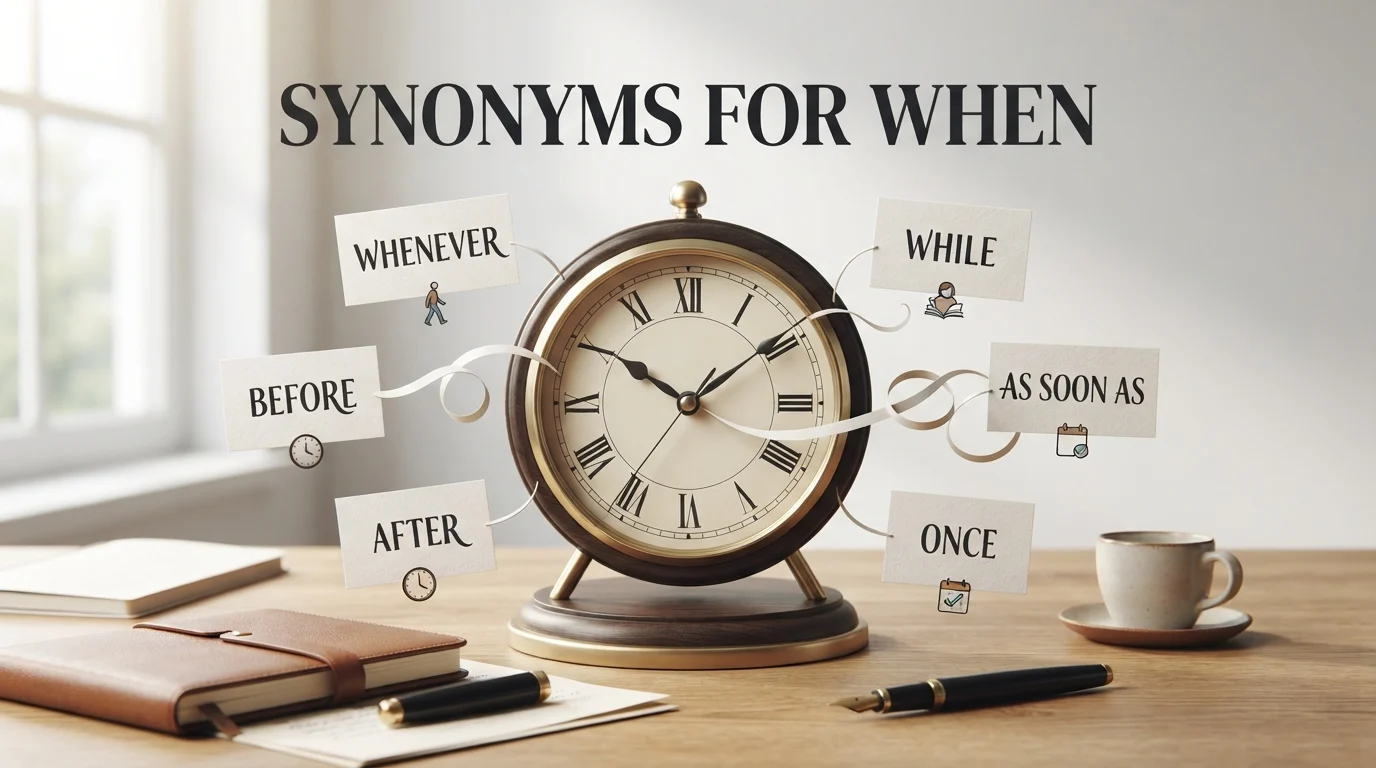
Need another word for when but not sure which alternative fits your sentence? Synonyms for when can include whenever, while, once, as soon as, after, before, as, and every time, but these alternatives are not interchangeable in every context.
When can refer to the time an event happens, describe two actions occurring during the same period, or introduce a situation that occurs under certain circumstances. For example, “Call me when you arrive” can become “Call me once you arrive,” while “I listen to music when I study” can become “I listen to music while I study.” Whenever emphasizes repetition, as soon as emphasizes immediate sequence, and after or before clearly establishes the order of events.
Every time can replace when when an action repeatedly occurs under the same circumstances. If you’re searching for synonyms for when for essays, schoolwork, professional writing, or everyday English, this guide explains their meanings, differences, and best uses.
Once
Meaning: “Once” means after or at the time that something happens.
Examples:
- Call me once you get home.
- We can eat once everyone arrives.
Whenever
Meaning: “Whenever” means at any time or every time something happens.
Examples:
- Visit us whenever you are free.
- I feel happy whenever I hear that song.
While
Meaning: “While” shows that two actions happen during the same period.
Examples:
- I listened to music while I cleaned.
- She called while I was cooking.
As
Meaning: “As” can mean at the same time that something happens.
Examples:
- I saw him as I left the store.
- She smiled as the children entered.
As Soon As
Meaning: “As soon as” means immediately after something happens.
Examples:
- Text me as soon as you arrive.
- He went outside as soon as the rain stopped.
The Moment
Meaning: “The moment” means at exactly the time something happens.
Examples:
- I knew the answer the moment I saw it.
- She smiled the moment he walked in.
The Instant
Meaning: “The instant” means immediately when something happens.
Examples:
- The alarm rang the instant I fell asleep.
- He called the instant he heard the news.
The Minute
Meaning: “The minute” means immediately after or when something happens.
Examples:
- Tell me the minute you hear anything.
- She left the minute the meeting ended.
The Second
Meaning: “The second” means immediately when something happens.
Examples:
- I knew he was upset the second I saw him.
- She ran outside the second she heard the noise.
After
Meaning: “After” shows that one event happens later than another.
Examples:
- We went home after the movie ended.
- She called me after she finished work.
Before
Meaning: “Before” shows that one event happens earlier than another.
Examples:
- Wash your hands before you eat.
- Please call me before you leave.
Until
Meaning: “Until” shows that something continues up to a certain time.
Examples:
- Wait here until I come back.
- He stayed awake until the show ended.
By the Time
Meaning: “By the time” shows that one event has happened before another time or event.
Examples:
- By the time I arrived, they had left.
- She had finished dinner by the time we called.
Every Time
Meaning: “Every time” means on each occasion that something happens.
Examples:
- He laughs every time I tell that joke.
- Every time I visit, she makes tea.
Each Time
Meaning: “Each time” means on every separate occasion.
Examples:
- She learns something new each time she travels.
- Each time I read it, I notice something new.
Any Time
Meaning: “Any time” means at any time or on any occasion.
Examples:
- You can call me any time.
- Come over any time you are nearby.
At the Time
Meaning: “At the time” refers to a particular period or moment already understood from context.
Examples:
- I was living in Boston at the time.
- We did not know the truth at the time.
At That Time
Meaning: “At that time” points to a specific time mentioned earlier.
Examples:
- At that time, I was still in school.
- She was working there at that time.
At That Point
Meaning: “At that point” refers to a particular stage or moment in an event.
Examples:
- At that point, we decided to go home.
- I did not understand the problem at that point.
At the Same Time
Meaning: “At the same time” shows that two things happen together.
Examples:
- We both started laughing at the same time.
- She was talking and writing at the same time.
From the Moment
Meaning: “From the moment” shows that something begins at a particular moment.
Examples:
- I trusted her from the moment we met.
- He felt welcome from the moment he arrived.
From the Time
Meaning: “From the time” shows when a period begins.
Examples:
- She loved books from the time she was a child.
- He worked there from the time he left college.
Since
Meaning: “Since” refers to a point in the past from which something continues or has an effect.
Examples:
- I have known her since we were children.
- He has felt better since he changed his routine.
Note: “Since” is not a general replacement for “when.” Use it when you mean “from that past time until now” or a later point.
After That
Meaning: “After that” means later than the event just mentioned.
Examples:
- We had lunch and went shopping after that.
- She finished her work and rested after that.
Afterward
Meaning: “Afterward” means at a later time after an event.
Examples:
- We went for coffee afterward.
- She felt tired afterward.
Afterwards
Meaning: “Afterwards” also means at a later time after something happens.
Examples:
- They went home afterwards.
- I called my friend afterwards.
Thereafter
Meaning: “Thereafter” means from that time forward or after that event.
Examples:
- He moved to London and lived there thereafter.
- The company changed its rules and followed them thereafter.
Subsequently
Meaning: “Subsequently” means later or after something else happens.
Examples:
- She applied for the job and subsequently got an interview.
- The team changed its plan subsequently.
Later On
Meaning: “Later on” means at a later time.
Examples:
- I will call you later on.
- We can discuss the problem later on.
Soon After
Meaning: “Soon after” means a short time after something happens.
Examples:
- She called soon after the meeting.
- We left soon after dinner.
Shortly After
Meaning: “Shortly after” means a short time later.
Examples:
- He arrived shortly after lunch.
- The lights came back shortly after the storm.
Immediately After
Meaning: “Immediately after” means directly following an event with almost no delay.
Examples:
- Wash the dishes immediately after dinner.
- She called me immediately after the interview.
Prior To
Meaning: “Prior to” means before something happens and is more formal than “before.”
Examples:
- Please register prior to the event.
- He checked the details prior to the meeting.
Beforehand
Meaning: “Beforehand” means before a particular event or time.
Examples:
- I prepared everything beforehand.
- Please let me know beforehand.
Previously
Meaning: “Previously” means at an earlier time.
Examples:
- I had previously visited the city.
- She had previously worked at the school.
Earlier
Meaning: “Earlier” means at a time before now or before another event.
Examples:
- I saw him earlier today.
- She had arrived earlier than us.
Before That
Meaning: “Before that” refers to a time or event that happened earlier.
Examples:
- I lived in Chicago before that.
- She had never met him before that.
Just Before
Meaning: “Just before” means a very short time before something.
Examples:
- I called her just before dinner.
- He arrived just before the class started.
Synonyms for Showing: 56+ Words for Display, Evidence & Expression
Shortly Before
Meaning: “Shortly before” means a short time earlier than something.
Examples:
- She called shortly before the meeting.
- We arrived shortly before sunset.
Immediately Before
Meaning: “Immediately before” means directly before something happens.
Examples:
- Turn off the lights immediately before leaving.
- He spoke to me immediately before the interview.
During the Time
Meaning: “During the time” refers to a period in which something happens.
Examples:
- I learned a lot during the time I lived abroad.
- She stayed with us during the time her house was repaired.
In the Meantime
Meaning: “In the meantime” refers to the period before another event happens.
Examples:
- Dinner is cooking; in the meantime, set the table.
- The doctor will be here soon, so wait in the meantime.
Meanwhile
Meaning: “Meanwhile” describes something happening during the same period as another event.
Examples:
- I prepared dinner; meanwhile, he cleaned the kitchen.
- The children played outside; meanwhile, their parents talked.
Upon
Meaning: “Upon” can mean immediately after something happens and is common in formal writing.
Examples:
- Upon arrival, please check in at the desk.
- She smiled upon seeing her old friend.
On Arrival
Meaning: “On arrival” means immediately when someone reaches a place.
Examples:
- Please call me on arrival.
- Guests receive a welcome drink on arrival.
After Arriving
Meaning: “After arriving” means after reaching a place.
Examples:
- After arriving home, I made some tea.
- She rested after arriving at the hotel.
Before Leaving
Meaning: “Before leaving” means earlier than the time you go away.
Examples:
- Lock the door before leaving.
- I called my parents before leaving home.
At the Point
Meaning: “At the point” refers to a particular stage or moment in a situation.
Examples:
- At the point, we decided to stop.
- I was ready to quit at that point.
At the Moment
Meaning: “At the moment” refers to a particular time, especially the present.
Examples:
- I am busy at the moment.
- She is not available at the moment.
Around the Time
Meaning: “Around the time” means near a particular period or event.
Examples:
- We moved around the time she started school.
- He arrived around the time dinner began.
Over the Course of
Meaning: “Over the course of” refers to something happening throughout a period.
Examples:
- She improved over the course of the year.
- We became close over the course of the trip.
In the Course of
Meaning: “In the course of” means during a particular period or activity.
Examples:
- I learned many things in the course of my studies.
- We solved the problem in the course of the discussion.
On the Occasion Of
Meaning: “On the occasion of” refers to a particular event or special time.
Examples:
- We gathered on the occasion of her birthday.
- He gave a speech on the occasion of the award ceremony.
In the Event That
Meaning: “In the event that” introduces a possible situation and is mainly used in formal writing.
Examples:
- Call this number in the event that you need help.
- The plan may change in the event that the flight is delayed.
If
Meaning: “If” introduces a condition that may or may not happen.
Examples:
- Call me if you need help.
- We will go outside if the rain stops.
Note: “If” is not always a synonym for “when.” “When” often suggests that a future event is expected, while “if” presents it as uncertain or conditional.
Provided That
Meaning: “Provided that” means something can happen only if a condition is met.
Examples:
- You can borrow my car provided that you drive carefully.
- We can go provided that everyone agrees.
As Long As
Meaning: “As long as” means something can happen if a certain condition remains true.
Examples:
- You can stay as long as you are quiet.
- We can play outside as long as it does not rain.
Synonyms for Analyze: 46+ Words for Careful Study
FAQ About Synonyms for When
What is the closest synonym for “when”?
The closest alternative depends on the sentence. Once, whenever, while, as, and as soon as can be close alternatives in different time-related contexts.
Can “once” replace “when”?
Sometimes. “Once” works well when you mean that one event happens after another event occurs.
For example:
- When you arrive, call me.
- Once you arrive, call me.
The second sentence suggests that the call should happen after arrival.
What is the difference between “when” and “whenever”?
“When” often points to a particular time or event. “Whenever” usually means every time or any time.
For example:
- Call me when you arrive.
- Call me whenever you need help.
The first refers to a particular event. The second allows repeated or unspecified occasions.
Can “if” replace “when”?
Not always. “When” often refers to a future event that the speaker expects to happen, while “if” introduces a possible condition.
Compare:
- When I see Sarah, I will tell her.
- If I see Sarah, I will tell her.
The first suggests that seeing Sarah is expected. The second suggests that it is uncertain.
What is the difference between “when” and “while”?
“When” can introduce a particular event or time. “While” usually shows that two actions or events happen during the same period.
For example:
- I was cooking when he called.
- I was cooking while he was setting the table.
“While” is especially useful when two ongoing actions overlap.
Is “since” a synonym for “when”?
Not generally. “Since” can refer to the time when something started and show that the situation continues from that point.
For example:
- I have lived here since 2020.
It should not be used as a general replacement for “when.”
Which alternatives to “when” are best for formal writing?
For formal writing, context matters. Useful choices can include prior to, subsequently, upon, following, thereafter, and in the event that. However, these expressions do not all have exactly the same meaning as “when,” so choose them according to the sentence.
Conclusion
Learning synonyms for when gives you more ways to express time, order, and conditions. The key is not to replace “when” with a random word just to avoid repetition. Choose an alternative that keeps the original meaning clear. Students can practice these expressions in essays, while bloggers and content writers can use them to make articles smoother. Daily English users can also practice them in emails, messages, and conversations. With regular practice, your writing can become more natural, varied, and precise.

I am Joseph Clark, a vocabulary and language content writer at SynonymLibrary.com. I create clear, practical synonym guides that help readers improve their writing, word choice, and communication skills. My goal is to make language learning simple, accurate, and useful for students, writers, professionals, and everyday learners.







