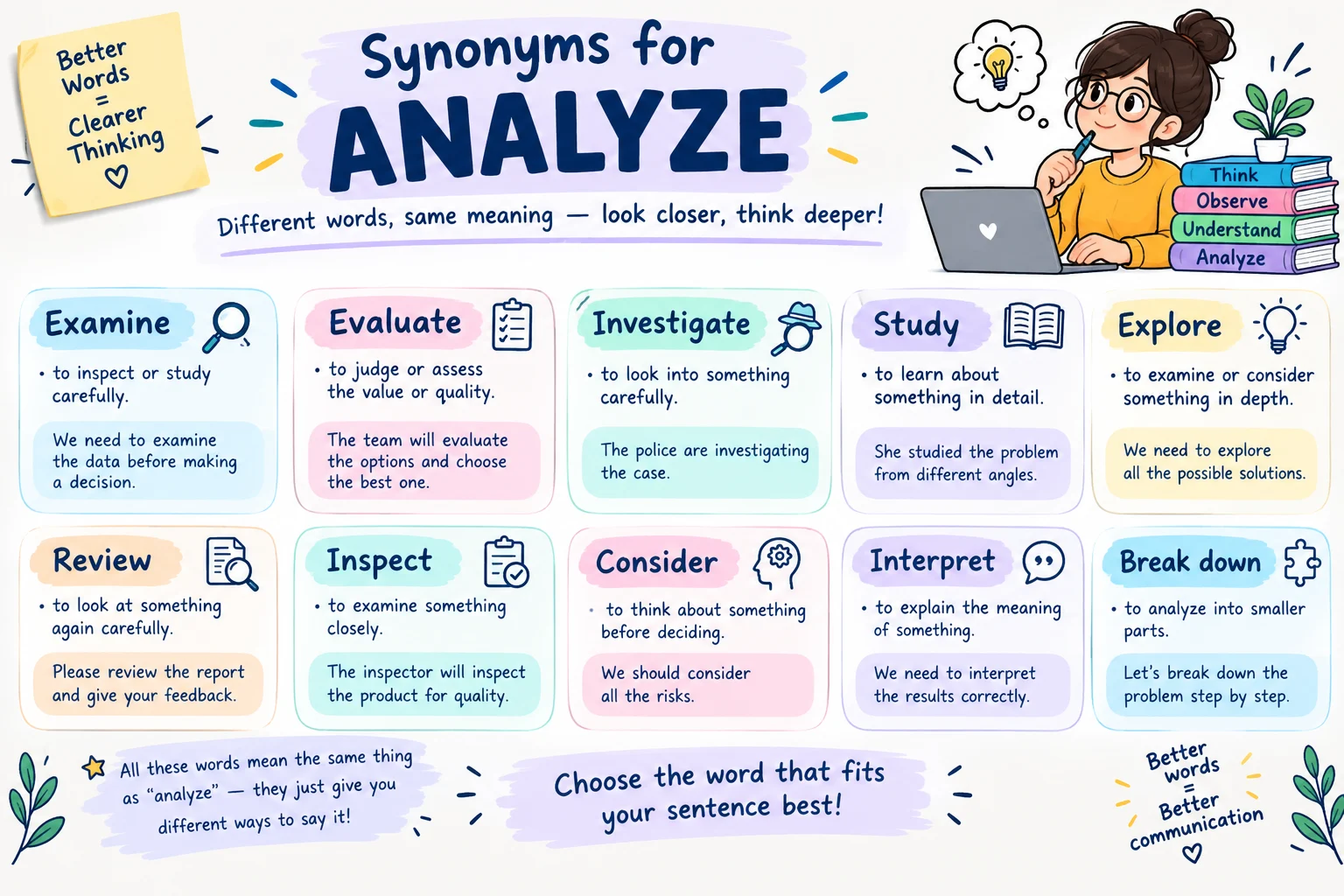
Need another word for analyze but want to describe the exact kind of examination you mean? Synonyms for analyze include examine, assess, evaluate, investigate, interpret, study, and break down, but these alternatives are not interchangeable in every context.
Analyze generally means examining something carefully to understand its parts, details, evidence, patterns, relationships, or meaning. For example, a student may analyze a poem, a researcher may examine data, and a manager may evaluate a project’s results.
Assess focuses on judging quality, value, or condition, while investigate emphasizes finding facts or causes. Interpret focuses on explaining meaning, whereas study is broader and does not always involve detailed analysis. Break down means separating something into smaller parts and is more informal. If you’re searching for synonyms for analyze for essays, schoolwork, research, professional writing, or everyday English, this guide explains their meanings, differences, and best uses.
Examine
Meaning: To look at something carefully to understand its details or condition.
Examples:
- The teacher asked us to examine the poem carefully.
- Please examine the report before the meeting.
Best use: A strong, general alternative to analyze, especially in academic and professional writing.
Study
Meaning: To look at something carefully so you can understand it better.
Examples:
- We studied the results before making a decision.
- She studied the painting for several minutes.
Best use: A simple and natural alternative that works well in school, research, and everyday English.
Investigate
Meaning: To examine something carefully to discover facts, causes, or problems.
Examples:
- The team investigated the cause of the error.
- The reporter investigated the unusual claim.
Best use: Use it when the goal is to find out what happened or why something happened.
Evaluate
Meaning: To examine something and judge its quality, value, or usefulness.
Examples:
- We evaluated the new plan before using it.
- The teacher evaluated each student’s project.
Best use: Use it when analysis leads to a judgment about quality or value.
Assess
Meaning: To examine something and judge its condition, level, or possible effect.
Examples:
- The manager assessed the risks before starting the project.
- The doctor assessed the patient’s condition.
Best use: Common in education, business, health, and professional settings.
Inspect
Meaning: To look at something carefully to find problems or important details.
Examples:
- The mechanic inspected the car for damage.
- We inspected the equipment before the trip.
Best use: More focused on careful checking than deep interpretation.
Scrutinize
Meaning: To examine something very carefully, often looking for problems or small details.
Examples:
- The editor scrutinized every sentence in the article.
- The lawyer scrutinized the contract before signing it.
Best use: A stronger and more formal word when the examination is very detailed.
Review
Meaning: To look at something carefully, often again, to understand or check it.
Examples:
- I reviewed my notes before the exam.
- The team reviewed the results after the test.
Best use: Useful when you are checking existing information rather than starting a completely new investigation.
Consider
Meaning: To think carefully about something before reaching a decision or view.
Examples:
- We considered several solutions to the problem.
- She considered the possible effects of the change.
Best use: Best when analysis involves careful thought about choices, effects, or ideas.
Interpret
Meaning: To explain or understand the meaning of information, words, actions, or signs.
Examples:
- The students interpreted the poem in different ways.
- She interpreted the data carefully.
Best use: Use it when the main goal is understanding or explaining meaning.
Explore
Meaning: To study a subject or idea to learn more about it.
Examples:
- The article explores the causes of stress.
- We explored several ideas during the meeting.
Best use: A flexible choice when you want to investigate a topic without sounding overly technical.
Probe
Meaning: To investigate something deeply to discover information that may not be obvious.
Examples:
- The journalist probed the reasons behind the decision.
- Researchers probed the issue for several months.
Best use: Stronger than examine when the investigation goes beneath the surface.
Research
Meaning: To collect and study information about a subject.
Examples:
- I researched the topic before writing my essay.
- She researched customer opinions for the article.
Best use: Use it when analysis involves gathering information from different sources or evidence.
Inspect
Meaning: To check something closely for details, damage, or errors.
Examples:
- The worker inspected the machine before using it.
- I inspected the document for spelling errors.
Best use: This word focuses more on checking than interpreting, so it is not always a full replacement for analyze.
Break Down
Meaning: To separate something into smaller parts so it is easier to understand.
Examples:
- The teacher broke down the difficult question.
- Let me break down the main points for you.
Best use: Excellent for explaining complex ideas in simple language.
Dissect
Meaning: To separate something into parts and examine each part carefully.
Examples:
- The class dissected the argument in the article.
- We dissected the poem to understand its message.
Best use: Useful for detailed analysis of writing, arguments, ideas, and structures.
Appraise
Meaning: To examine something and form an opinion about its value or quality.
Examples:
- The expert appraised the value of the painting.
- We appraised the plan before accepting it.
Best use: More formal and often connected with judging value, quality, or worth.
Judge
Meaning: To form an opinion about something after considering its facts or qualities.
Examples:
- We should not judge the results too quickly.
- The panel judged each entry fairly.
Best use: Works when analysis leads to an opinion or decision.
Assay
Meaning: To examine or test something carefully, especially its contents or quality.
Examples:
- The lab assayed the sample for harmful substances.
- Scientists assayed the material before using it.
Best use: A technical word most common in science, medicine, chemistry, and laboratory work.
Survey
Meaning: To examine or study something as a whole to understand its main features.
Examples:
- The researchers surveyed the local market.
- We surveyed the available options before choosing one.
Best use: Useful for broad examinations, especially in research and business.
Search
Meaning: To look carefully for information, facts, or something specific.
Examples:
- We searched the records for useful information.
- She searched the data for a clear pattern.
Best use: A broader and simpler word that works when analysis involves looking for specific information.
Question
Meaning: To examine an idea or claim by asking whether it is correct, true, or reasonable.
Examples:
- The study questions the old explanation.
- We should question the results before accepting them.
Best use: Use it when analysis involves challenging an idea rather than simply examining it.
Synonyms for Important: 59+ Words for Significance, Necessity & Influence
Think Through
Meaning: To consider all parts of a problem carefully before deciding what to do.
Examples:
- Let’s think through the problem together.
- She thought through every possible result.
Best use: A natural, conversational alternative for careful reasoning.
Reason Out
Meaning: To find an answer by using careful and logical thinking.
Examples:
- He reasoned out the answer step by step.
- We reasoned out why the plan had failed.
Best use: Good when analysis is focused on reaching an answer through logic.
Think Over
Meaning: To consider something carefully before making a decision.
Examples:
- I need time to think over your idea.
- She thought over the offer before replying.
Best use: More casual than analyze and better for decisions or personal choices.
Look Into
Meaning: To investigate or study something to find out more about it.
Examples:
- I will look into the problem this afternoon.
- The manager looked into the customer’s complaint.
Best use: A common conversational alternative to investigate or analyze.
Look At
Meaning: To consider or examine something carefully.
Examples:
- Let’s look at the results before deciding.
- We need to look at the problem from another angle.
Best use: A simple, flexible phrase for everyday English.
Go Over
Meaning: To review or check something carefully.
Examples:
- Let’s go over the report one more time.
- I went over my answers before submitting the test.
Best use: Casual and natural when reviewing information that you already have.
Work Through
Meaning: To deal with a problem by examining its parts and solving it step by step.
Examples:
- We worked through the difficult problem together.
- She worked through the data before writing the report.
Best use: Useful when analysis involves a process that leads toward a solution.
Break Apart
Meaning: To separate something into smaller parts so its structure can be understood.
Examples:
- The lesson breaks apart the argument into simple points.
- We broke apart the problem to find its cause.
Best use: Helpful when focusing on the separate parts of a complex idea.
Separate
Meaning: To divide something into parts so each part can be examined.
Examples:
- The scientist separated the samples for testing.
- We separated the main ideas from the extra details.
Best use: Works when analysis requires dividing information into distinct parts.
Resolve
Meaning: To find an answer to a problem after examining its details.
Examples:
- The team resolved the issue after studying the data.
- We resolved the mystery by checking the evidence.
Best use: This is an outcome of analysis rather than a direct replacement in every sentence.
Determine
Meaning: To find out or establish something after careful thought or examination.
Examples:
- We analyzed the results to determine the cause.
- The test helped determine which method worked best.
Best use: Best when analysis is used to reach a clear answer.
Ascertain
Meaning: To find out something with certainty after checking the available facts.
Examples:
- The team worked to ascertain the cause of the failure.
- We need to ascertain whether the information is correct.
Best use: A formal alternative when the goal is to establish facts.
Identify
Meaning: To recognize or find a specific problem, feature, pattern, or cause.
Examples:
- The study identified three major problems.
- We identified a pattern in the results.
Best use: Use it when analysis helps you find something specific.
Detect
Meaning: To notice or discover something that may be difficult to see or find.
Examples:
- The software detected an unusual pattern.
- The test detected a small error.
Best use: Useful when analysis is used to find hidden problems, patterns, or changes.
Uncover
Meaning: To find information or facts that were hidden or not known before.
Examples:
- The research uncovered a surprising pattern.
- The investigation uncovered several important facts.
Best use: Strong when analysis reveals information that was previously hidden.
Discover
Meaning: To find something that was not known or noticed before.
Examples:
- We discovered a clear trend in the data.
- She discovered a useful detail in the report.
Best use: Use it when analysis leads to a new finding.
Classify
Meaning: To arrange things into groups based on their shared features.
Examples:
- Researchers classified the responses into four groups.
- We classified the samples by size.
Best use: A context-specific alternative when analysis involves sorting information into categories.
Categorize
Meaning: To put things into groups based on their type or features.
Examples:
- The software categorized the customer comments.
- We categorized the results by age group.
Best use: Useful for analyzing large amounts of information by organizing it into groups.
Compare
Meaning: To examine two or more things to find their similarities and differences.
Examples:
- We compared the two reports carefully.
- She compared the results from both tests.
Best use: Use it when analysis focuses specifically on similarities and differences.
Contrast
Meaning: To examine two things by focusing on their differences.
Examples:
- The essay contrasts two different opinions.
- We contrasted the old data with the new data.
Best use: More specific than compare because the focus is on differences.
Parse
Meaning: To examine the parts of language, data, or a structure to understand how they work.
Examples:
- The program parses the sentence automatically.
- Students parsed the sentence to understand its grammar.
Best use: A technical term often used for language, grammar, programming, and structured data.
Diagnose
Meaning: To identify the cause of a problem by examining its signs or evidence.
Examples:
- The technician diagnosed the computer problem.
- The doctor diagnosed the cause after several tests.
Best use: Best for health, machines, systems, and other situations where a specific problem must be identified.
Deconstruct
Meaning: To break something into parts and examine how those parts create the whole.
Examples:
- The students deconstructed the advertisement.
- She deconstructed the speech to understand its message.
Best use: Useful in literature, media, art, language, and critical discussion.
Weigh
Meaning: To carefully consider different facts, benefits, risks, or choices.
Examples:
- We weighed the benefits and risks before deciding.
- She weighed several options before choosing one.
Best use: Best when analysis involves comparing choices before making a decision.
Explain
Meaning: To make an idea or result clear by showing how or why it works.
Examples:
- The report explains why sales fell.
- Can you explain what the results mean?
Best use: Not a direct synonym in every sentence, but useful when analysis is followed by making its meaning clear.
Discuss
Meaning: To examine a subject by presenting and considering different ideas about it.
Examples:
- The essay discusses the causes of the problem.
- We discussed the results during the meeting.
Best use: Especially useful in academic writing when examining different views or aspects of a topic.
Delve Into
Meaning: To study something deeply and carefully.
Examples:
- The article delves into the causes of the problem.
- She delved into the history of the company.
Best use: A strong phrase for deep research or detailed discussion.
Examine Critically
Meaning: To study something carefully while looking for strengths, weaknesses, errors, or problems.
Examples:
- Students should examine the argument critically.
- We examined the proposal critically before accepting it.
Best use: Particularly useful in academic and analytical writing.
Reassess
Meaning: To examine something again and decide whether your original view is still correct.
Examples:
- We reassessed the plan after the results changed.
- The team reassessed the risks before continuing.
Best use: Use it when something has already been studied and needs a fresh evaluation.
Reevaluate
Meaning: To examine something again and form a new judgment about it.
Examples:
- The company reevaluated its strategy after the results.
- We reevaluated the decision after receiving new information.
Best use: Useful when new evidence changes the need for an earlier judgment.
Ponder
Meaning: To think about something carefully and deeply.
Examples:
- She pondered the meaning of the strange message.
- He pondered the possible results before answering.
Best use: More reflective and personal than analyze, especially for ideas, choices, or meaning.
Deliberate
Meaning: To think carefully about something before making a decision.
Examples:
- The committee deliberated before making its choice.
- We deliberated over the possible solutions.
Best use: Best when careful analysis leads to a formal or important decision.
Synonyms for Prioritize: 50 Words for Ranking, Focusing & Putting First
FAQs About Synonyms for Analyze
What is the best synonym for analyze?
There is no single best synonym for every situation. Examine is one of the closest general alternatives, while evaluate works better when judging quality, investigate when finding facts or causes, and interpret when explaining meaning.
What is a simple word for analyze?
Study is one of the simplest alternatives. Examine is also common and easy to understand.
What is a formal synonym for analyze?
Words such as examine, investigate, evaluate, assess, scrutinize, interpret, and appraise can sound formal. The best choice depends on the exact meaning of the sentence.
What is a casual synonym for analyze?
For casual English, phrases such as look into, look at, go over, think through, and think over can work well. They often sound more natural in everyday conversations.
What is the difference between analyze and examine?
Analyze usually means studying something carefully to understand its parts, structure, meaning, or causes. Examine is broader and mainly means looking at or studying something carefully. In some situations, they can be used almost interchangeably.
What is the difference between analyze and evaluate?
Analyze focuses on understanding the parts, facts, structure, or causes of something. Evaluate focuses on judging its quality, value, effectiveness, or importance. You can analyze something before you evaluate it.
Can I replace analyze with study?
Yes, in many contexts. For example, “Scientists analyzed the results” and “Scientists studied the results” can both work. However, analyze often suggests a more detailed or systematic examination, while study is broader.
conclusion
Learning synonyms for analyze gives you more control over your writing. Instead of repeating analyze, you can choose examine for careful study, evaluate for judgment, investigate for finding causes, or interpret for explaining meaning. Students can use these words in essays, while bloggers and content writers can use them to make articles more precise. Practice them in emails, schoolwork, reports, and daily conversations. The more you use them, the easier it becomes to choose the right word naturally.