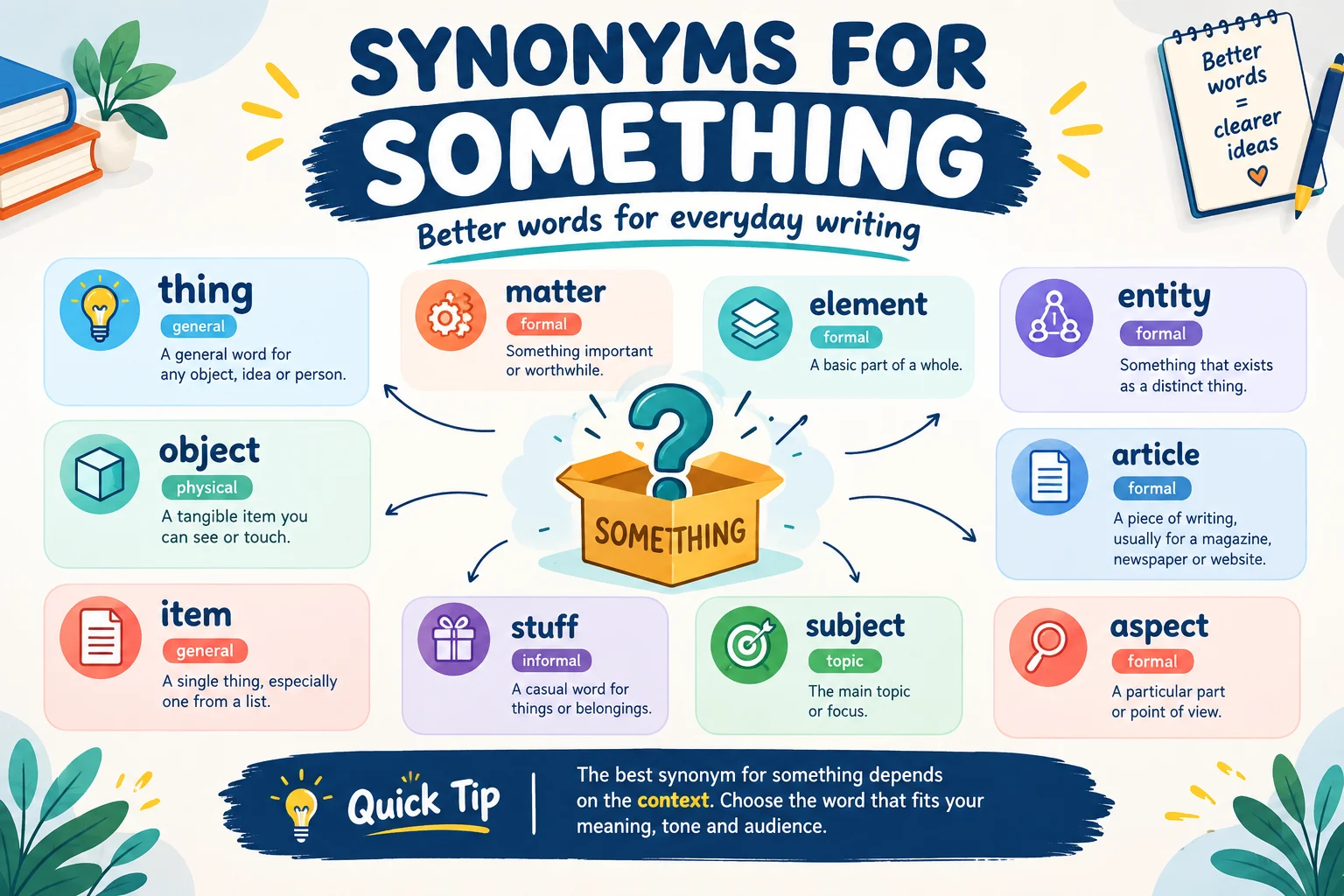
“Something” is useful, but repeating it can make your writing feel vague or less precise. If you need synonyms for something, the right alternative depends on what you mean: an object, item, issue, event, activity, or a general group of things. For example, thing is a broad everyday choice, item often refers to a particular object, matter can describe an issue or subject for discussion, and event works when you mean something that happened.
These alternatives are related, but they are not interchangeable in every sentence. Stuff is an informal way to refer to things collectively, while anything and whatever have different meanings and should not automatically replace “something.”
If you need another word for something, this guide gives you useful alternatives by context, with simple meanings and examples. You’ll learn how to choose a word that keeps your original meaning while making your English clearer and more precise.
What Are the Best Synonyms for Something?
The best synonyms for something include thing, item, object, article, entity, matter, stuff, idea, concept, issue, problem, situation, event, example, option, and alternative.
Choose the word based on the meaning. Use item for an object, idea for a thought, issue for a problem, event for something that happens, and option for a choice.
Thing
Meaning: A thing is a person, object, idea, or matter that you do not name exactly.
Examples:
- I need one thing from the store.
- There is one thing I want to tell you.
Item
Meaning: An item is one object or thing in a group.
Examples:
- I bought one item from the shop.
- Please check every item on the list.
Object
Meaning: An object is usually a physical thing that you can see or touch.
Examples:
- I found a strange object under the table.
- The small object belongs to my brother.
Article
Meaning: An article can mean one object, especially a particular item or piece of property.
Examples:
- Every article in the box was checked.
- The museum displayed an ancient article.
Entity
Meaning: An entity is a person, organization, thing, or existence viewed as a separate unit.
Examples:
- The company is a separate legal entity.
- Each entity has a different role.
Being
Meaning: A being is a living person or creature, or something thought to exist.
Examples:
- Every living being needs water.
- The story describes a strange being.
Substance
Meaning: A substance is a type of physical material or matter.
Examples:
- The bottle contained an unknown substance.
- Water is a common natural substance.
Matter
Meaning: Matter can mean a subject, problem, situation, or physical material.
Examples:
- We need to discuss this matter.
- The matter was finally solved.
Stuff
Meaning: Stuff is an informal word for things or material when you do not name each thing.
Examples:
- I left my stuff in the car.
- She has some stuff to finish today.
Material
Meaning: Material can mean a physical substance or useful content.
Examples:
- We need more material for the project.
- The teacher gave us study material.
Commodity
Meaning: A commodity is a useful product or item that can be bought or sold.
Examples:
- Oil is an important commodity.
- The store sells basic food commodities.
Element
Meaning: An element is one part of a larger thing.
Examples:
- Trust is an important element of friendship.
- The story has a funny element.
Component
Meaning: A component is one part that helps make a larger thing work.
Examples:
- The battery is an important component.
- Each component must work correctly.
Part
Meaning: A part is one piece or section of something larger.
Examples:
- This is my favorite part of the movie.
- We need another part for the machine.
Piece
Meaning: A piece is one part or portion of something.
Examples:
- I found a small piece of glass.
- She gave me a piece of useful advice.
Unit
Meaning: A unit is one single item or part of a larger group.
Examples:
- Each unit costs ten dollars.
- The machine has five separate units.
Detail
Meaning: A detail is a small piece of information about something.
Examples:
- One detail caught my attention.
- Tell me every important detail.
Feature
Meaning: A feature is an important or noticeable part of something.
Examples:
- The camera has a useful feature.
- The large window is a key feature of the room.
Aspect
Meaning: An aspect is one part or side of a subject or situation.
Examples:
- Cost is one important aspect of the plan.
- We need to consider every aspect.
Point
Meaning: A point is an idea, fact, or part of a discussion.
Examples:
- She made an important point.
- I understand your point now.
Subject
Meaning: A subject is the person, thing, or idea being discussed or studied.
Examples:
- Money is a difficult subject to discuss.
- The teacher changed the subject.
Topic
Meaning: A topic is the subject that people are talking or writing about.
Examples:
- We chose an interesting topic.
- Climate change was the main topic.
Idea
Meaning: An idea is a thought, plan, or suggestion in your mind.
Examples:
- I have an idea for our project.
- That idea could save us time.
Thought
Meaning: A thought is an idea or feeling that comes into your mind.
Examples:
- I had a strange thought this morning.
- That thought made me smile.
Notion
Meaning: A notion is an idea or belief about something.
Examples:
- He had a strange notion about success.
- I like the notion of working from home.
Concept
Meaning: A concept is a general idea about something.
Examples:
- The teacher explained the concept clearly.
- The concept is easy to understand.
Quality
Meaning: A quality is a feature or characteristic that something has.
Examples:
- Patience is a useful quality.
- Kindness is her best quality.
Attribute
Meaning: An attribute is a quality or feature that describes someone or something.
Examples:
- Honesty is an important attribute.
- Speed is a useful attribute in this job.
Characteristic
Meaning: A characteristic is a feature that makes someone or something recognizable.
Examples:
- Bright colors are a key characteristic of the design.
- Patience is a common characteristic of good teachers.
Fact
Meaning: A fact is something that is known or proven to be true.
Examples:
- That is an important fact.
- We need to check every fact first.
Issue
Meaning: An issue is a problem or subject that needs attention.
Examples:
- We need to solve this issue.
- Money became a major issue.
Problem
Meaning: A problem is something difficult that needs to be solved.
Examples:
- We have a small problem.
- She found a way to solve the problem.
Concern
Meaning: A concern is something that causes worry or needs attention.
Examples:
- Safety is my main concern.
- Cost is another concern for buyers.
Question
Meaning: A question is something you ask when you want information or an answer.
Examples:
- I have a question for you.
- That question has no easy answer.
Case
Meaning: A case is a particular situation, example, or set of facts.
Examples:
- This is a special case.
- In this case, we should wait.
Situation
Meaning: A situation is the set of conditions or events happening at a certain time.
Examples:
- We need to handle this situation calmly.
- The situation became better later.
Circumstance
Meaning: A circumstance is a condition or fact that affects a situation.
Examples:
- Under these circumstances, we should leave.
- Her circumstances changed last year.
Event
Meaning: An event is something that happens at a particular time.
Examples:
- The event starts at six.
- It was a special event for our family.
Incident
Meaning: An incident is an event, especially one that is unusual or causes a problem.
Examples:
- A strange incident happened yesterday.
- The police investigated the incident.
Occurrence
Meaning: An occurrence is something that happens or takes place.
Examples:
- Such an occurrence is very rare.
- The unusual occurrence surprised everyone.
Experience
Meaning: An experience is something that happens to you and teaches or affects you.
Examples:
- It was a great experience.
- Travel can be a useful experience.
Affair
Meaning: An affair is a matter, event, or situation that concerns someone.
Examples:
- That is a private affair.
- We should not interfere in their affairs.
Phenomenon
Meaning: A phenomenon is an event, fact, or situation that can be observed or studied.
Examples:
- The rainbow is a natural phenomenon.
- Scientists studied this unusual phenomenon.
Example
Meaning: An example is something that shows what an idea or situation is like.
Examples:
- Can you give me an example?
- This story is a good example of courage.
Instance
Meaning: An instance is one particular example or occurrence.
Examples:
- This is one instance of poor planning.
- I remember an instance when she helped me.
Option
Meaning: An option is one possible choice.
Examples:
- We have another option.
- This option is cheaper.
Alternative
Meaning: An alternative is another choice that can be used instead.
Examples:
- We need an alternative plan.
- Tea is a good alternative to coffee.
Possibility
Meaning: A possibility is something that may happen or be true.
Examples:
- There is a possibility of rain.
- Moving abroad is another possibility.
Prospect
Meaning: A prospect is something that may happen or become possible in the future.
Examples:
- A new job is an exciting prospect.
- The prospect of travel made her happy.
Resource
Meaning: A resource is something useful that helps you do or achieve something.
Examples:
- This book is a useful resource.
- Good teachers are valuable resources.
Synonyms for Nervous: 54+ Words for Every Context
The Best Synonym for Something Depends on Context
Not every word above can replace something in every sentence. This is the most important point to remember.
“Something” is a broad word. It can refer to an object, idea, event, problem, quality, action, or situation. The correct replacement changes with the meaning.
| If you mean… | Better word |
|---|---|
| An everyday thing | thing |
| A physical object | object |
| One product or object | item |
| An informal group of things | stuff |
| An idea | idea |
| A thought | thought |
| A general idea | concept |
| A subject | topic |
| A problem | issue / problem |
| A worry | concern |
| An event | event |
| A bad event | incident |
| A situation | situation |
| A small piece of information | detail |
| One part | part / element |
| A noticeable part | feature |
| A choice | option |
| Another choice | alternative |
| Something that may happen | possibility |
| Something useful | resource |
This is why simply replacing something with the first word in a thesaurus is not always a good idea.
Synonyms for Something in Common
When you say two things have something in common, you mean they share a quality, feature, idea, or experience.
Useful alternatives include:
- shared feature
- similarity
- common point
- connection
- shared quality
- common trait
For example:
Original:
“The two books have something in common.”
More precise:
“The two books share a common theme.”
The best replacement depends on what the two things actually share.
Synonyms for Something New
When you mean something new, the best word depends on the type of new thing.
You could use:
- innovation for a new idea or method
- creation for something newly made
- development for a new change or advancement
- product for something newly made and sold
- novelty for something new and unusual
- discovery for something newly found
For example:
“The company introduced a new product.”
is more precise than:
“The company introduced something new.”
Synonyms for Something Good
“Something good” is very broad. Choose a more exact word based on what makes it good.
You could use:
- benefit for something helpful
- advantage for something that gives you a better position
- success for a good result
- improvement for a positive change
- reward for something received because of good work
- positive result for a favorable outcome
For example:
“Regular exercise has many benefits.”
is clearer than:
“Regular exercise has many good things.”
Synonyms for Something Different
For something different, you can use:
- alternative
- variation
- change
- contrast
- difference
- option
For example:
“We need an alternative plan.”
is more precise than:
“We need something different.”
Synonyms for Something Bad Happening
If you mean something bad happening, the best word depends on the type of event.
- incident — an unusual or troubling event
- accident — an unexpected harmful event
- setback — something that slows progress
- misfortune — an unlucky event
- problem — something that needs to be solved
- crisis — a serious problem that needs urgent action
For example:
“The team suffered a major setback.”
is more specific than:
“Something bad happened to the team.”
Synonyms for Something Small
For something small, choose a word based on what you mean:
- piece — a small part
- bit — a small amount or piece
- detail — a small piece of information
- item — one small object
- part — one section of something
- element — one part of a larger whole
For example:
“One small detail changed the story.”
sounds clearer than:
“Something small changed the story.”
Synonyms for Something Beautiful
For something beautiful, possible alternatives include:
- beauty — something beautiful or the quality of being beautiful
- masterpiece — an extremely impressive work
- artwork — a work of art
- creation — something made with skill or care
- treasure — something greatly valued
- wonder — something that creates amazement
Do not treat these as exact replacements. A painting can be an artwork or a masterpiece, but a sunset would not normally be called an artwork.
Synonyms for Something Else
When someone says something else, they usually mean another thing or another choice.
Useful alternatives include:
- another thing
- another option
- alternative
- replacement
- something different
For example:
“Would you like something else?”
can become:
“Would you like another option?”
Synonyms for Something Shitty
“Shitty” is very informal and can sound rude. The best replacement depends on what you mean.
For everyday speech, you could use:
- bad
- awful
- terrible
- poor
- unpleasant
- disappointing
For formal writing, more precise choices include:
- low-quality
- poorly made
- unsatisfactory
- unpleasant
For example:
“The product was low-quality.”
is more suitable for formal writing than:
“The product was shitty.”
Synonyms for Something Valuable
For something valuable, use a word that explains why it has value.
- asset — something useful or valuable
- treasure — something highly valued
- resource — something useful
- possession — something owned
- prize — something valuable won or received
- investment — something expected to provide future value
For example:
“Experience is a valuable resource.”
Synonyms for Something That Smells Good
When describing something that smells good, useful words include:
- scent
- fragrance
- aroma
- perfume
- smell
The best choice depends on the context.
Aroma often works well for food and drinks.
Fragrance often works well for flowers, perfumes, and pleasant products.
For example:
“The aroma of fresh bread filled the kitchen.”
Synonyms for Something Wrong
If you mean something wrong, choose a word based on the problem:
- problem — something that needs fixing
- issue — a problem or matter needing attention
- mistake — something done incorrectly
- error — an incorrect result or action
- fault — a defect or cause of a problem
- concern — something that causes worry
For example:
“There is an error in the report.”
is much clearer than:
“There is something wrong in the report.”
Synonyms for Something Important
For something important, useful alternatives include:
- priority
- matter
- issue
- concern
- point
- factor
- element
For example:
“Safety is our top priority.”
is stronger than:
“Safety is something important.”
Synonyms for Something Special
Depending on the meaning, you can use:
- unique
- rare
- exceptional
- treasure
- highlight
- favorite
- keepsake
For example:
“This necklace is a special keepsake.”
That gives the reader much more information than simply saying:
“This necklace is something special.”
Synonyms for Something That Stands Out
When something is very noticeable, you can use:
- highlight
- standout
- feature
- attraction
- distinction
- eye-catcher
For example:
“The bright red door is the standout feature of the house.”
This is more precise than:
“The bright red door is something that stands out.”
Synonyms for Something Bad
For something bad, possible alternatives include:
- problem
- issue
- setback
- mistake
- failure
- negative result
- misfortune
Choose the word that describes the exact problem.
A mistake is an incorrect action.
A setback slows progress.
A failure means something did not succeed.
A misfortune is an unlucky event.
Synonyms for Something to Say
If you need synonyms for something to say, choose the word based on what you want to say:
- comment — a short spoken or written opinion
- remark — something said about a subject
- statement — a clear expression of information or opinion
- response — an answer to something
- answer — a reply to a question
- message — information sent to someone
- point — an idea you want to express
For example:
“I have a comment to make.”
sounds more specific than:
“I have something to say.”
Another Word for Something in an Essay
In an essay, something can often be replaced with a more exact academic word.
Good choices include:
- idea
- concept
- example
- factor
- aspect
- element
- issue
- point
- argument
- evidence
For example:
Weak:
“Something affects student performance.”
Better:
“Several factors affect student performance.”
The second sentence tells the reader exactly what kind of information is being discussed.
Synonyms for Something in English
In everyday English, the closest alternatives to something are often:
thing, item, object, stuff, matter, idea, event, issue, and anything.
But they are not all interchangeable.
For example:
- “I bought an item.”
- “I had an idea.”
- “We have an issue.”
- “Something happened.”
- “There is something in the box.”
Each word fits a different meaning.
Something Antonyms
The most common antonym of something is nothing.
Compare:
- Something happened.
- Nothing happened.
However, the exact opposite can depend on the sentence.
Something means an unspecified thing exists or occurs.
Nothing means no thing exists or occurs.
Anything is not usually a direct antonym. It is used differently, especially in questions and negative sentences.
What Kind of Word Is “Something”?
Something is an indefinite pronoun.
It refers to an object, situation, quality, action, or idea without saying exactly what it is.
Examples:
- “Something is wrong.”
- “I need something to eat.”
- “She said something funny.”
- “Something happened yesterday.”
The word is useful because you can talk about an unknown or unnamed thing without giving its exact name.
What Is Another Way of Saying Something?
The best alternative depends on your sentence.
You can use:
- thing for a general thing
- item for an object
- idea for a thought
- matter for a subject or situation
- issue for a problem
- event for something that happens
- option for a choice
- example for something that demonstrates an idea
For example:
“I need something for my presentation.”
could become:
“I need an example for my presentation.”
if you mean an example.
What Is a Better Word Than “Things”?
“Things” is often too vague, especially in formal writing.
Better words include:
- items
- objects
- details
- ideas
- products
- materials
- topics
- elements
- issues
- factors
For example:
Vague:
“I learned many things in class.”
Better:
“I learned several useful concepts in class.”
The second sentence gives the reader a clearer idea.
What Is a Better Word for “Using Something”?
The best replacement for using something depends on the action.
You can use:
- applying — using an idea, method, or rule
- operating — controlling a machine
- employing — using something for a purpose
- handling — working with or managing something
- using — the simple everyday choice
- making use of — a more formal phrase
Examples:
“She is applying a new writing method.”
“He is operating the machine.”
“They are using the software.”
Do not replace using with a longer word just to sound formal. The simple word is often the best choice.
Synonyms for Horny: 56+ Alternatives From Subtle to Direct
What Is Another Word for Having Something?
The best alternative depends on what having means.
Use:
- owning — when you legally possess something
- possessing — when you have or own something
- holding — when something is in your hands or control
- carrying — when you have something with you
- keeping — when you continue to have something
- containing — when one thing has another thing inside it
- receiving — when something is given to you
Examples:
“She owns a new car.”
“He is carrying a small bag.”
“The box contains five books.”
These words are not exact synonyms in every sentence, so choose according to the meaning.
Something Similar Synonym
If you are searching for a something similar synonym, the right word depends on the context.
Useful choices include:
- thing
- item
- object
- alternative
- option
- equivalent
- counterpart
- match
For example, if you want another product like the first one, alternative or similar item may work better than simply saying something.
Common Mistakes When Using Synonyms for Something
Mistake 1: Replacing “something” with any random synonym
Not every related word fits every sentence.
Wrong:
“I bought an issue at the store.”
Better:
“I bought an item at the store.”
Mistake 2: Using “stuff” in formal writing
“Stuff” is natural in casual speech, but it can sound vague in an essay or professional report.
Casual:
“I need some stuff for school.”
Formal:
“I need some materials for school.”
Mistake 3: Using “thing” when a precise word is available
“Thing” is useful, but repeated use can make writing weak.
Vague:
“There are many things that affect health.”
Better:
“Several factors affect health.”
Mistake 4: Treating related words as exact synonyms
Idea, issue, event, object, option, and example have different meanings.
A good synonym should preserve the meaning of the sentence.
Mistake 5: Using complicated words just to sound smarter
You do not need a difficult word when a simple word is clearer.
Simple:
“We have a problem.”
Unnecessarily complicated:
“We have encountered a significant complication.”
Clear English is usually better English.
Frequently Asked Questions
What is the best synonym for something?
There is no single best synonym. Thing, item, object, matter, idea, issue, event, and option can work depending on the sentence.
What is another word for something in English?
Common alternatives include thing, item, object, article, matter, stuff, idea, issue, event, and option. The right choice depends on the meaning.
What is a better word than something in an essay?
Use a precise noun such as idea, example, factor, issue, aspect, element, concept, or evidence. Specific words make academic writing clearer.
What is the opposite of something?
The most common opposite is nothing. For example, “Something happened” becomes “Nothing happened.”
Is “thing” a synonym for something?
Yes. Thing is one of the closest everyday alternatives, but it does not fit every sentence. Choose a more specific word when possible.
How can I stop using something too much?
Ask yourself what you really mean. If you mean an object, use item or object. If you mean an idea, use idea or concept. If you mean a problem, use issue or problem. This makes your writing more precise.
Conclusion
Learning synonyms for something can make your writing clearer, more natural, and less repetitive. The key is not to replace “something” with a difficult word every time. Instead, choose the word that explains your exact meaning. Use item for an object, idea for a thought, issue for a problem, event for something that happens, and option for a choice. Practice these words in your emails, essays, blog posts, and daily conversations. With regular practice, your English will become more precise and confident.

I am Joseph Clark, a vocabulary and language content writer at SynonymLibrary.com. I create clear, practical synonym guides that help readers improve their writing, word choice, and communication skills. My goal is to make language learning simple, accurate, and useful for students, writers, professionals, and everyday learners.







