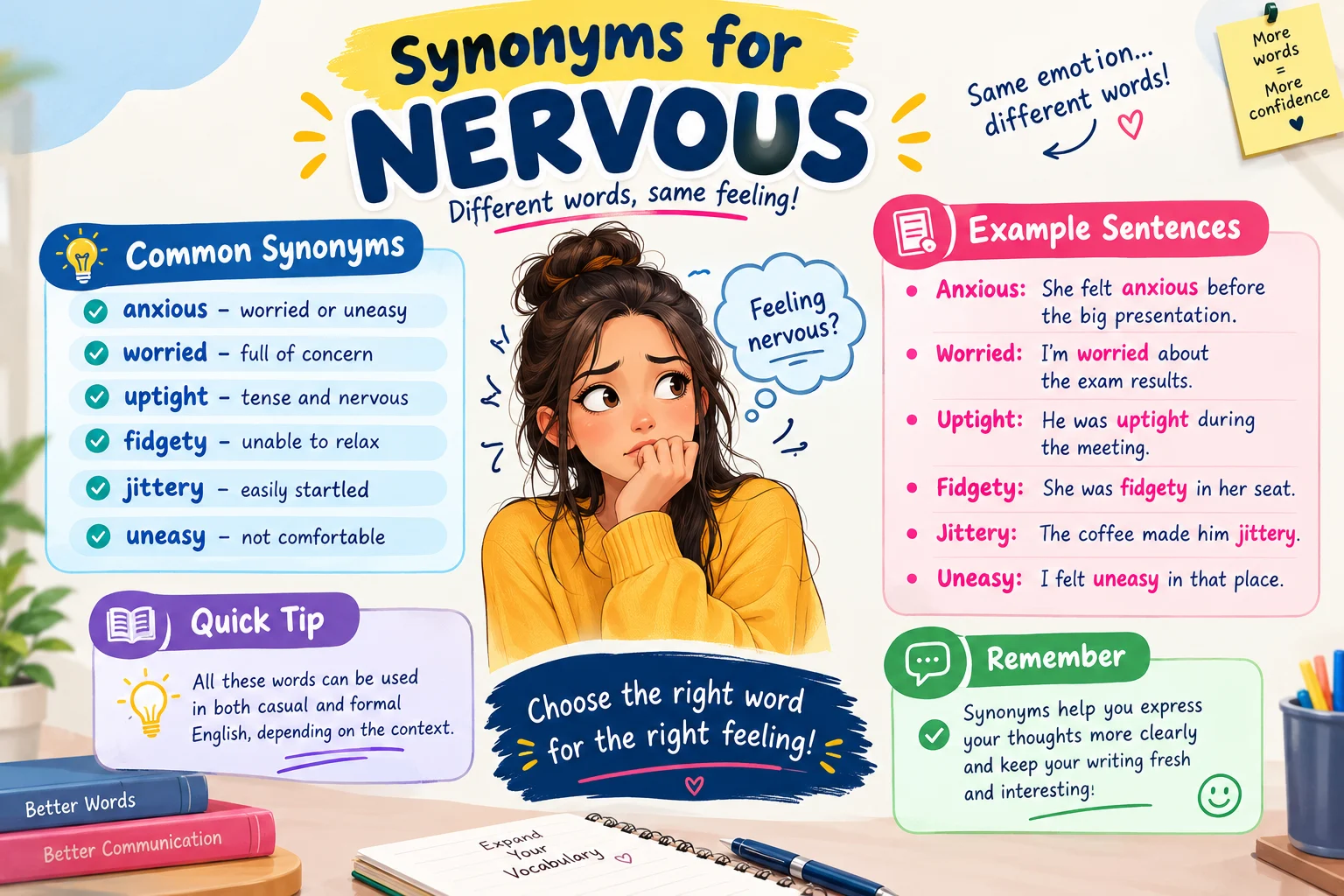
“Nervous” can describe anything from mild uneasiness before a meeting to strong worry about what might happen. If you need synonyms for nervous, the right alternative depends on the situation, intensity, and feeling you want to express. Anxious, uneasy, apprehensive, and worried can describe mental uneasiness, while tense, restless, edgy, or on edge may better describe a strained or uncomfortable state.
These alternatives are related, but they are not interchangeable in every sentence. You might feel anxious before an exam, apprehensive about an uncertain outcome, or tense before an important presentation. If someone lacks confidence, insecure or self-conscious may fit better, while hesitant usually describes uncertainty about taking action.
This guide covers useful synonyms for nervous, with simple meanings, examples, intensity levels, and context-based differences to help you choose the most precise word.
Synonyms for Nervous
The most useful synonyms for nervous include anxious, uneasy, worried, apprehensive, tense, jittery, edgy, restless, fearful, concerned, and uneasy.
The best word depends on the feeling. Use anxious for worry, tense for pressure, jittery for restless nervous energy, apprehensive for fear about the future, and uneasy for uncomfortable doubt.
Anxious
Meaning: Anxious means feeling worried about something that may happen.
Examples:
- I felt anxious before my exam.
- She was anxious about the interview.
Uneasy
Meaning: Uneasy means feeling uncomfortable, worried, or unsure.
Examples:
- I felt uneasy in the empty house.
- His strange message made me uneasy.
Worried
Meaning: Worried means thinking about a problem with fear or concern.
Examples:
- I was worried about the test.
- Mom looked worried when I came home late.
Apprehensive
Meaning: Apprehensive means worried that something bad may happen.
Examples:
- She felt apprehensive before the meeting.
- He was apprehensive about moving to a new city.
Tense
Meaning: Tense means feeling unable to relax because of worry or pressure.
Examples:
- I felt tense before my speech.
- The room became tense before the announcement.
Jittery
Meaning: Jittery means very nervous, shaky, or unable to stay calm.
Examples:
- Too much coffee made me jittery.
- He felt jittery before going on stage.
Edgy
Meaning: Edgy means nervous, tense, and sometimes easily annoyed.
Examples:
- I get edgy when I have too much work.
- She seemed edgy before the final match.
Restless
Meaning: Restless means unable to relax or stay still because of worry or energy.
Examples:
- I was restless the night before my flight.
- The long wait made him restless.
Fidgety
Meaning: Fidgety means moving your hands or body because you cannot stay still.
Examples:
- The nervous student became fidgety.
- I get fidgety before important meetings.
Jumpy
Meaning: Jumpy means easily frightened or nervous.
Examples:
- I felt jumpy after hearing the loud noise.
- He was jumpy before the results came out.
Panicky
Meaning: Panicky means feeling sudden and strong fear.
Examples:
- I felt panicky when I lost my phone.
- She became panicky when the door would not open.
Fearful
Meaning: Fearful means feeling afraid or worried about danger.
Examples:
- The child was fearful of the dark.
- He felt fearful before entering the cave.
Scared
Meaning: Scared means feeling fear because something seems dangerous or frightening.
Examples:
- I was scared during the storm.
- She looked scared after hearing the noise.
Frightened
Meaning: Frightened means feeling strong fear.
Examples:
- The sudden sound left me frightened.
- He was frightened by the barking dog.
Alarmed
Meaning: Alarmed means suddenly worried or afraid because something seems wrong.
Examples:
- I was alarmed by the loud crash.
- She looked alarmed when the lights went out.
Troubled
Meaning: Troubled means worried because of a problem.
Examples:
- He looked troubled after the phone call.
- I felt troubled by her silence.
Distressed
Meaning: Distressed means very upset and worried.
Examples:
- She was distressed after hearing the news.
- He looked distressed during the argument.
Agitated
Meaning: Agitated means unable to stay calm because you are worried or upset.
Examples:
- He became agitated while waiting.
- She sounded agitated on the phone.
Flustered
Meaning: Flustered means confused or upset because you feel nervous.
Examples:
- I got flustered during the interview.
- She became flustered when everyone looked at her.
Stressed
Meaning: Stressed means feeling worried because of pressure or problems.
Examples:
- I feel stressed before final exams.
- He was stressed about his deadline.
Overwhelmed
Meaning: Overwhelmed means feeling unable to handle everything at once.
Examples:
- I felt overwhelmed by the amount of work.
- She was overwhelmed before the wedding.
Uncomfortable
Meaning: Uncomfortable means not feeling relaxed or at ease.
Examples:
- I felt uncomfortable speaking to the crowd.
- He became uncomfortable during the silence.
Insecure
Meaning: Insecure means not feeling confident about yourself or your abilities.
Examples:
- She felt insecure about her presentation.
- He became insecure after the criticism.
Self-Conscious
Meaning: Self-conscious means worried about how other people see you.
Examples:
- I felt self-conscious in front of the audience.
- She became self-conscious about her accent.
Timid
Meaning: Timid means shy and not confident in difficult situations.
Examples:
- The timid boy spoke very softly.
- She was too timid to ask a question.
Shy
Meaning: Shy means feeling uncomfortable or nervous around other people.
Examples:
- He is shy around new classmates.
- I was shy when I first joined the group.
Bashful
Meaning: Bashful means shy or easily embarrassed.
Examples:
- She gave a bashful smile.
- He became bashful when they praised him.
Hesitant
Meaning: Hesitant means unsure about doing something.
Examples:
- I was hesitant to make the first call.
- She felt hesitant about accepting the offer.
Uncertain
Meaning: Uncertain means not sure about what will happen or what to do.
Examples:
- I felt uncertain before making my choice.
- He was uncertain about the next step.
Doubtful
Meaning: Doubtful means not confident that something will happen or work.
Examples:
- She felt doubtful about the plan.
- I was doubtful that they would arrive on time.
Wary
Meaning: Wary means careful because you think there may be danger or trouble.
Examples:
- I was wary of the unfamiliar road.
- She stayed wary around the strange dog.
Concerned
Meaning: Concerned means worried about someone or something.
Examples:
- My parents were concerned about me.
- She looked concerned after reading the message.
Perturbed
Meaning: Perturbed means slightly worried or upset.
Examples:
- I was perturbed by his sudden silence.
- She seemed perturbed by the delay.
Synonyms for Horny: 56+ Alternatives From Subtle to Direct
Disconcerted
Meaning: Disconcerted means confused or unsettled by something unexpected.
Examples:
- I felt disconcerted by the strange question.
- She looked disconcerted after the sudden change.
Restive
Meaning: Restive means unable to relax because of worry or impatience.
Examples:
- The waiting crowd grew restive.
- He became restive during the long delay.
Skittish
Meaning: Skittish means easily frightened, nervous, or startled.
Examples:
- The skittish horse moved away quickly.
- She became skittish after the sudden noise.
Excitable
Meaning: Excitable means becoming very excited or nervous very easily.
Examples:
- The puppy is excitable around guests.
- He became excitable before the concert.
Antsy
Meaning: Antsy means unable to relax because you are nervous or impatient.
Examples:
- I was getting antsy before the results.
- The kids became antsy during the long wait.
Uptight
Meaning: Uptight means very tense and unable to relax.
Examples:
- He seemed uptight before the interview.
- Try not to get uptight about small mistakes.
Shaken
Meaning: Shaken means upset or nervous after something frightening or surprising.
Examples:
- I was shaken after the accident.
- She looked shaken by the sudden news.
Rattled
Meaning: Rattled means nervous or confused after something unexpected happens.
Examples:
- The difficult question rattled me.
- He looked rattled after the mistake.
Unsettled
Meaning: Unsettled means worried because something does not feel right.
Examples:
- I felt unsettled after that conversation.
- The strange sound left us unsettled.
Frazzled
Meaning: Frazzled means very stressed and unable to think calmly.
Examples:
- I was frazzled after a busy day.
- She looked frazzled before the deadline.
Nervy
Meaning: Nervy means nervous because you are under pressure or unsure.
Examples:
- It was a nervy final few minutes.
- He felt nervy before his first performance.
Trepidatious
Meaning: Trepidatious means nervous or afraid about what may happen.
Examples:
- She felt trepidatious before the big move.
- He was trepidatious about meeting the new team.
High-Strung
Meaning: High-strung means easily worried, tense, or upset.
Examples:
- He gets high-strung before important events.
- Her high-strung nature makes waiting difficult.
Shaky
Meaning: Shaky means trembling or unsteady because of fear, worry, or pressure.
Examples:
- My hands were shaky before the speech.
- She had a shaky voice during the interview.
On Edge
Meaning: On edge means feeling tense and unable to relax.
Examples:
- I have been on edge all morning.
- The strange noise left everyone on edge.
Wound-Up
Meaning: Wound-up means very tense, nervous, or unable to relax.
Examples:
- I was too wound-up to sleep.
- She felt wound-up before the competition.
Ill at Ease
Meaning: Ill at ease means feeling uncomfortable or nervous in a situation.
Examples:
- I felt ill at ease among strangers.
- He looked ill at ease during the interview.
Unnerved
Meaning: Unnerved means made nervous or frightened by something unexpected.
Examples:
- The sudden noise unnerved me.
- She was unnerved by the strange message.
How to Choose the Right Synonym for Nervous
Not every synonym for nervous has exactly the same feeling. The best word depends on why someone feels nervous and how strong the feeling is.
Use worried, anxious, concerned, or apprehensive when the main feeling is concern about the future.
Use tense, stressed, uptight, wound-up, or on edge when someone cannot relax because of pressure.
Use jittery, fidgety, shaky, restless, or jumpy when nervousness shows through movement.
Use scared, frightened, fearful, alarmed, or panicky when fear is stronger.
Use shy, timid, bashful, or self-conscious when nervousness happens mainly around people or attention.
This makes your writing more precise than simply repeating the word “nervous.”
What Are 3 Synonyms for Nervous?
If you only need 3 synonyms for nervous, these are excellent everyday choices:
Anxious — worried about something that may happen.
Uneasy — uncomfortable or slightly worried.
Tense — unable to relax because of pressure or worry.
These three are easy to understand and useful in everyday English.
What Are Synonyms for Nervous and Anxious?
Some useful words for nervous and anxious are:
- Worried
- Uneasy
- Apprehensive
- Concerned
- Tense
- Troubled
- Restless
- On edge
- Jittery
- Agitated
However, they are not identical. Anxious often focuses on worry, while jittery focuses more on restless nervous energy.
Nervous and Scared: What Is the Difference?
Nervous usually describes worry, tension, or fear about something that may happen.
Scared focuses more directly on fear.
For example:
- I am nervous about my exam.
- I am scared of that large dog.
You can be nervous without being truly scared. A person may feel nervous before giving a speech even when there is no danger.
Another Word for Nervous in a Good Way
Sometimes nervousness comes with happiness and excitement. In this situation, nervous excitement is a useful phrase.
For example, you may feel nervous excitement before:
- A wedding
- A concert
- Graduation
- A first date
- A dream job interview
- A big trip
The person is not simply afraid. They are excited because something important is about to happen.
47+ Synonyms of Vulnerable: From Exposed to Susceptible
What Is Another Word for Being Nervous?
There are many choices depending on the situation.
For everyday worry, use anxious or worried.
For mild discomfort, use uneasy.
For pressure, use tense or stressed.
For strong fear, use frightened or scared.
For restless energy, use jittery or antsy.
For formal writing, apprehensive is a strong choice.
Another Word for a Nervous Person
There is no single word that describes every nervous person.
Use shy when someone feels uncomfortable around people.
Use timid when someone lacks confidence.
Use anxious when someone often worries.
Use high-strung when someone is easily tense or upset.
Use jittery when someone shows nervous energy through movement.
The right word depends on the person’s behavior and the reason for their nervousness.
Synonyms for Nervously
If you need an alternative to nervously, you can use phrases such as:
- Uneasily
- Anxiously
- Hesitantly
- Fearfully
- Restlessly
- Self-consciously
For example:
- She smiled nervously.
- She smiled uneasily.
The second sentence gives the reader a slightly different feeling.
Nervous Behavior: Common Signs
Nervous behavior can include:
- Fidgeting
- Shaking
- Tapping a foot
- Speaking quickly
- Avoiding eye contact
- Laughing nervously
- Repeatedly checking something
- Having a shaky voice
For example, someone may tap their fingers while waiting for an interview. Another person may speak very quickly because they feel nervous.
These behaviors can suggest nervousness, but they do not always prove what someone is feeling.
Nervous Antonyms
Common nervous antonyms include:
- Calm
- Relaxed
- Confident
- Comfortable
- Composed
- Assured
- Peaceful
- Fearless
For example:
Nervous → Calm
Anxious → Relaxed
Insecure → Confident
Tense → Composed
These opposite words are useful when you want to show a change from worry to confidence.
Nervous vs. Anxious
Nervous and anxious are often interchangeable when talking about a specific event.
- I feel nervous before my interview.
- I feel anxious before my interview.
Both sentences sound natural.
However, nervous is especially common for important events such as exams, interviews, speeches, and performances. Anxious can also describe stronger or ongoing worry.
Nervous vs. Worried
Worried focuses on concern about a problem or possible result.
Nervous can include worry, but it may also include physical tension or fear.
- I am worried about my exam results.
- I am nervous about taking the exam.
The first focuses on the result. The second focuses more on the feeling before the event.
Nervous vs. Uneasy
Uneasy usually describes a feeling that something is not quite right.
- I felt nervous before meeting the manager.
- I felt uneasy after hearing the strange noise.
Uneasy is often a good choice when you feel uncomfortable but cannot fully explain why.
Nervous vs. Tense
Nervous describes a feeling of worry or fear.
Tense focuses more on pressure, tightness, or lack of relaxation.
- She felt nervous before the interview.
- Her voice sounded tense during the interview.
“Tense” can also describe an atmosphere or situation, while “nervous” usually describes a person or their reaction.
Nervous vs. Jittery
Nervous is a broad word.
Jittery is more specific. It suggests nervous energy, shakiness, or restless movement.
- I was nervous before the presentation.
- I felt jittery after drinking too much coffee.
Use jittery when the nervous feeling is physically noticeable.
Nervous vs. Afraid
Nervous can be mild and can happen before ordinary stressful events.
Afraid is more directly connected to fear.
- I was nervous before my first flight.
- I was afraid when the plane shook badly.
This is why nervous and afraid are related but not always interchangeable.
Nervous vs. Shy
Nervous can happen before any stressful or uncertain event.
Shy usually describes discomfort around other people or attention.
- He was nervous before his exam.
- He was shy around his new classmates.
A shy person may often feel nervous socially, but nervous does not always mean shy.
How Do You Say Nervous in a Fancy Way?
For formal or more advanced writing, apprehensive is one of the best alternatives to nervous.
Other choices include:
- Trepidatious
- Perturbed
- Disconcerted
- Uneasy
- Ill at ease
For example:
Simple: I was nervous about the meeting.
More formal: I was apprehensive about the meeting.
What Is Slang for Nervous?
Informal words and phrases can make casual English sound more natural.
Common choices include:
- Antsy
- Jittery
- Jumpy
- Edgy
- Nervy
- Uptight
- On edge
- Wound-up
For example:
“I was getting antsy while waiting for the call.”
This sounds more casual than “I was becoming nervous.”
Synonyms for Nervous Excitement
Nervous excitement describes a mix of happiness, anticipation, and nervousness.
Related words and phrases include:
- Excited
- Eager
- Thrilled
- Anticipatory
- Nervy
- Jittery
- On edge
The best choice depends on the emotion you want to emphasize.
Nervous excitement is especially useful before something important and positive.
Synonyms for Nervous Breakdown
“Nervous breakdown” is not a normal synonym for nervous.
It is an informal phrase used when someone feels unable to cope with severe emotional or mental stress.
Better words for the ordinary feeling of nervousness are:
- Anxious
- Worried
- Tense
- Uneasy
- Stressed
- Overwhelmed
Do not use “nervous breakdown” as a replacement for “nervous” in an ordinary sentence.
Synonyms for Nervous System
“Nervous system” is also not a synonym for nervous.
It refers to the body’s system of nerves and related structures.
If you mean the adjective nervous, use words such as:
- Anxious
- Uneasy
- Worried
- Tense
- Apprehensive
If you mean the body system, “nervous system” is the correct term.
Word Whizzle Synonyms for Nervous
If you are searching for synonyms for nervous Word Whizzle, Word Whizzle synonyms for nervous, or Word Whizzle synonyms for nervous answers, possible answers can include:
- Anxious
- Tense
- Uneasy
- Edgy
- Jumpy
- Jittery
- Afraid
- Worried
The correct answer depends on the clue and the number of letters required.
For a short Word Whizzle answer, always check both the meaning and the required letter count.
When Not to Use Nervous
Sometimes another word gives your sentence a much clearer meaning.
Instead of:
She was nervous about the final result.
You could say:
She was worried about the final result.
Instead of:
He was nervous after the crash.
You could say:
He was shaken after the crash.
Instead of:
The meeting was nervous.
You could say:
The meeting was tense.
Instead of:
She was nervous around the audience.
You could say:
She was self-conscious around the audience.
Choosing a more exact word makes your writing stronger.
Common Mistakes With Nervous Synonyms
One common mistake is treating every related word as a perfect synonym.
For example, shy is not always the same as nervous. A person can be shy without feeling nervous.
Another mistake is using terrified when the feeling is mild. Terrified is much stronger than nervous.
Using excited can also change the meaning. Excited usually sounds positive, while nervous usually suggests worry or fear. However, nervous excitement combines both feelings.
The goal is not to find a word that simply looks similar. The goal is to choose the word that gives the exact feeling you mean.
FAQs
What are synonyms for nervous?
Common synonyms for nervous include anxious, uneasy, worried, tense, apprehensive, jittery, edgy, restless, fearful, concerned, and on edge.
What are some synonyms for nervous?
Useful synonyms include anxious, worried, uneasy, tense, apprehensive, concerned, jittery, jumpy, fearful, stressed, and restless.
What are 5 synonyms for scared?
Five common synonyms for scared are afraid, frightened, fearful, terrified, and alarmed. The strength of the feeling changes from word to word.
How do you say nervous in a fancy way?
Apprehensive is a natural formal alternative to nervous. Trepidatious, perturbed, and disconcerted are more advanced choices.
What is slang for nervous?
Common informal choices include antsy, jittery, jumpy, edgy, nervy, uptight, on edge, and wound-up.
What’s another word for being nervous?
Depending on the situation, you can use anxious, uneasy, worried, tense, apprehensive, jittery, stressed, or on edge.
Conclusion
Learning synonyms for nervous gives you more ways to describe worry, fear, tension, shyness, and excitement. Instead of repeating “nervous,” you can choose a more exact word such as anxious, uneasy, tense, jittery, or apprehensive. This improves writing, blogging, speaking, and everyday communication. Practice these words in emails, essays, messages, and daily conversations. The more you use them, the easier it becomes to choose the right word for every situation.

I am Meer Hadi, a passionate language and content writer at SynonymLibrary.com. I focus on creating helpful word guides that make it easier for readers to choose the right words, understand meanings, and express their ideas more clearly. Through my work, I aim to support students, writers, and professionals in building stronger communication skills.







