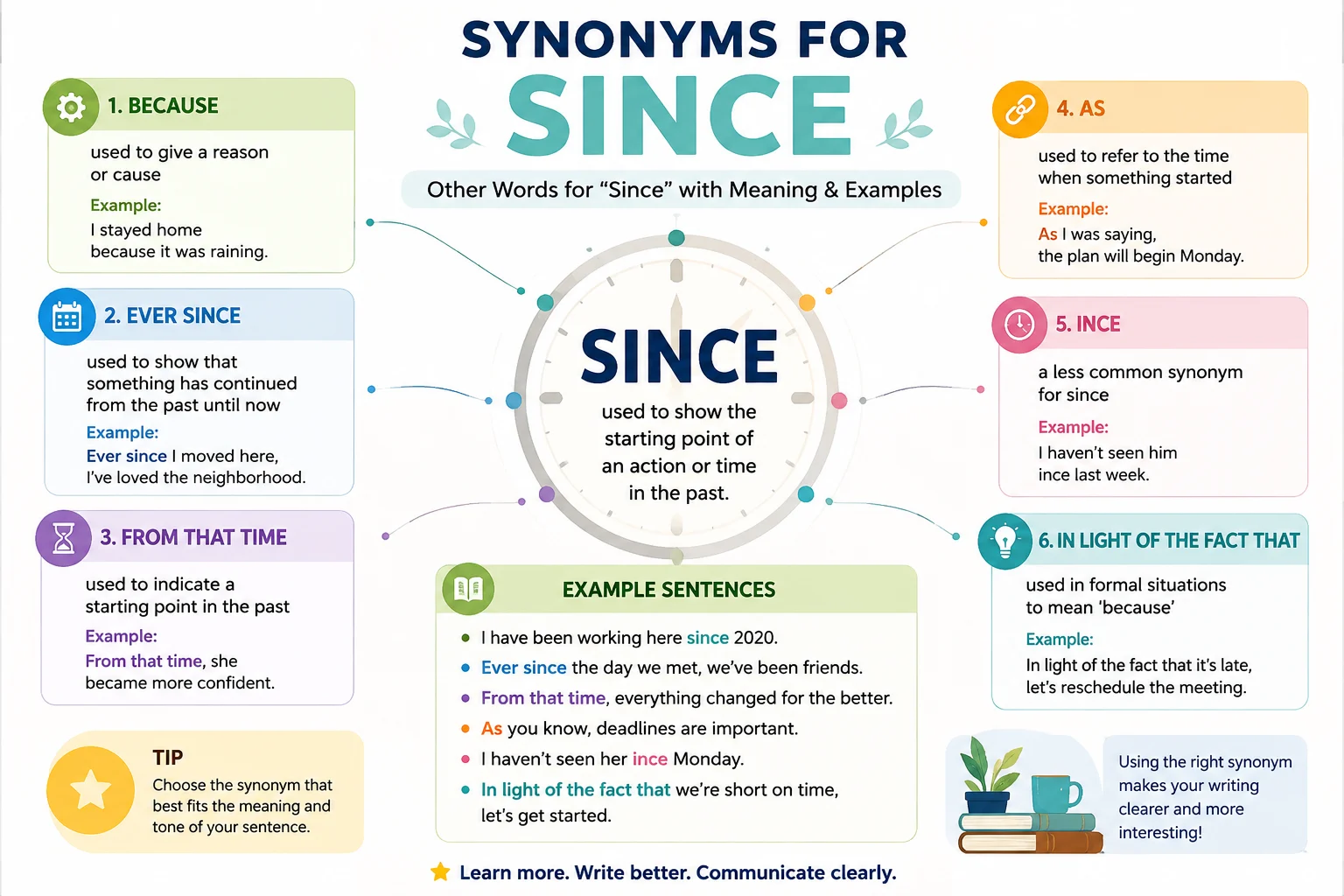
Need another word for “since” without changing your meaning? The best alternative depends on how “since” is used in your sentence. When since refers to time, phrases such as ever since or starting from may fit certain contexts; when it gives a reason, because, as, or given that can be more appropriate.
If you’re searching for synonyms for since, you probably want to avoid repetition, make your writing more precise, or find an alternative that sounds natural without changing the sentence’s meaning.
That can be tricky because since has two major uses: it can mark a starting point in time or introduce a reason or cause. For example, “I’ve lived here since 2020” refers to time, while “Since it was raining, we stayed home” gives a reason. A word that works for one meaning may not work for the other.
This guide covers useful synonyms for since by meaning, context, tone, and usage, with clear examples and practical tips to help you choose the right alternative.
Synonyms for Since Meaning “From a Past Time”
When since talks about time, it usually points to a moment in the past when something began and often shows that it continued until another time, often the present.
Ever since
Meaning: “Ever since” means from a particular time in the past until now.
Examples:
- I have loved reading ever since I was a child.
- She has lived here ever since 2020.
Best use: This is one of the closest natural alternatives when you want to stress that something has continued.
From
Meaning: “From” shows the time when something starts.
Examples:
- The office is open from Monday.
- I worked there from 2020 to 2024.
Best use: “From” is useful for showing a starting point, but it does not always replace since in the same sentence structure.
Starting from
Meaning: “Starting from” clearly shows when something begins.
Examples:
- The new class starts from Monday.
- We will use the new system starting from July.
Best use: Use it when you want to make the starting point very clear.
Beginning in
Meaning: “Beginning in” means starting at a particular time.
Examples:
- She began her job in 2021.
- The new rule will apply beginning in January.
Best use: This works well with years, months, and other time periods.
Starting in
Meaning: “Starting in” means beginning during a stated time.
Examples:
- The course begins starting in September.
- He will work here starting in June.
Best use: It is common when talking about future schedules or planned changes.
Dating from
Meaning: “Dating from” means starting at a particular past time.
Examples:
- The building is a historic site dating from 1850.
- The letters are dating from the early 1900s.
Best use: This is more common in formal or historical writing.
From then on
Meaning: “From then on” means starting at that past time and continuing afterward.
Examples:
- We became friends, and from then on we talked every day.
- He changed his routine, and from then on he felt better.
Best use: Use it after a past event has already been mentioned.
From then onward
Meaning: “From then onward” means from that past point and continuing after it.
Examples:
- She started training, and from then onward she practiced daily.
- He made a new plan and followed it from then onward.
Best use: This is a slightly more formal version of “from then on.”
From that point on
Meaning: “From that point on” means starting at a certain stage or moment.
Examples:
- From that point on, the project became easier.
- We worked together from that point on.
Best use: It is useful when talking about a change in a process or situation.
From that point onward
Meaning: “From that point onward” means starting at a certain point and continuing afterward.
Examples:
- From that point onward, she took her studies seriously.
- The team improved from that point onward.
Best use: This is a clear and slightly formal time expression.
From that moment on
Meaning: “From that moment on” means starting at one particular moment.
Examples:
- From that moment on, he trusted her.
- They stayed close from that moment on.
Best use: Use it when a specific moment changes what happens next.
From that moment onward
Meaning: “From that moment onward” means beginning at a particular moment and continuing after it.
Examples:
- From that moment onward, she worked with confidence.
- He followed the new plan from that moment onward.
Best use: This is helpful in stories, essays, and formal writing.
From that day on
Meaning: “From that day on” means starting on a particular day and continuing afterward.
Examples:
- From that day on, they met every Friday.
- She practiced every morning from that day on.
Best use: It works especially well when a specific day is important.
From that day onward
Meaning: “From that day onward” means starting on that day and continuing after it.
Examples:
- From that day onward, he kept a daily journal.
- They worked together from that day onward.
Best use: This is a slightly more formal version of “from that day on.”
From that day forward
Meaning: “From that day forward” means beginning on that day and continuing into the future.
Examples:
- From that day forward, she made time for exercise.
- He promised to be more careful from that day forward.
Best use: It is common in storytelling and writing about personal change.
From that time on
Meaning: “From that time on” means starting at a past time and continuing afterward.
Examples:
- From that time on, we stayed in touch.
- He became more careful from that time on.
Best use: Use it when the exact date is not important.
From that time onward
Meaning: “From that time onward” means from a stated past period and continuing after it.
Examples:
- From that time onward, the company grew quickly.
- She stayed with the team from that time onward.
Best use: This works well in formal or explanatory writing.
From the time
Meaning: “From the time” introduces the point when something began.
Examples:
- From the time we met, we became good friends.
- She was interested in art from the time she was young.
Best use: Use it before a clause that explains when something started.
From the moment
Meaning: “From the moment” means beginning at a particular moment.
Examples:
- From the moment we met, we talked easily.
- He liked the place from the moment he entered.
Best use: This is natural when the starting point is a clear moment.
From the day
Meaning: “From the day” shows that something began on a certain day.
Examples:
- From the day we moved here, we loved the neighborhood.
- She worked hard from the day she joined the team.
Best use: It is useful when a specific day marks the beginning.
From the year
Meaning: “From the year” shows that something began in a certain year.
Examples:
- The records are available from the year 2000.
- The museum has displayed the painting from the year it opened.
Best use: Use it when a year is the important starting point.
Synonyms for Together: 56+ Better Alternatives With Examples
From that date
Meaning: “From that date” means starting on a stated date.
Examples:
- The new policy applies from that date.
- All payments were recorded from that date.
Best use: This expression is especially useful in official or business writing.
As of
Meaning: “As of” refers to a particular date or time when a situation is true.
Examples:
- As of June, the new rule is active.
- As of today, we have received ten applications.
Best use: “As of” can replace the time idea of since in some contexts, but it does not always have the same grammar or meaning.
Since then
Meaning: “Since then” means from a past time or event until another time.
Examples:
- We met in college and have stayed friends since then.
- He moved in 2022 and has worked there since then.
Best use: This is actually a continuation expression built from since, so it is useful when avoiding repetition across nearby sentences.
Synonyms for Since Meaning “Because”
When since gives a reason, it means something close to because. These alternatives explain why an action or event happened.
Because
Meaning: “Because” gives a clear reason for something.
Examples:
- I stayed home because I was tired.
- She smiled because she was happy.
Best use: This is usually the clearest and strongest replacement for the reason meaning of since.
As
Meaning: “As” can introduce a reason for something.
Examples:
- As it was late, we went home.
- As she was busy, I called later.
Best use: “As” is useful when the reason is already known or not the main focus.
Given that
Meaning: “Given that” means because a certain fact is true.
Examples:
- Given that it was raining, we stayed inside.
- Given that he was new, he did very well.
Best use: It works well when the reason is a fact that should be considered.
Seeing that
Meaning: “Seeing that” means because a fact is clear.
Examples:
- Seeing that you are tired, you should rest.
- Seeing that the store was closed, we went home.
Best use: This is natural when the reason is obvious from the situation.
Seeing as
Meaning: “Seeing as” means because and is common in informal English.
Examples:
- Seeing as you are here, we can begin.
- Seeing as it is late, I will leave now.
Best use: It is friendly and conversational, but less formal than because.
Considering that
Meaning: “Considering that” means because you are thinking about a certain fact.
Examples:
- Considering that he was new, he did very well.
- Considering that it was cold, we stayed inside.
Best use: Use it when a fact makes an action or result understandable.
Now that
Meaning: “Now that” gives a reason based on a new situation.
Examples:
- Now that you are here, we can start.
- Now that the rain has stopped, we can go outside.
Best use: Use it when a new situation creates a reason for what happens next.
In view of the fact that
Meaning: “In view of the fact that” means because a certain fact is being considered.
Examples:
- In view of the fact that it was raining, we canceled the trip.
- In view of the fact that the road was closed, we changed our route.
Best use: This is formal and often better suited to official writing than daily conversation.
In light of the fact that
Meaning: “In light of the fact that” means because new or known information affects a decision.
Examples:
- In light of the fact that sales fell, we changed the plan.
- In light of the fact that the road was unsafe, we turned back.
Best use: This is useful in reports and formal explanations.
On the grounds that
Meaning: “On the grounds that” means because a particular reason is given.
Examples:
- The request was denied on the grounds that it was incomplete.
- He left on the grounds that he felt unsafe.
Best use: This is formal and often appears in official or legal-style writing.
For the reason that
Meaning: “For the reason that” means because.
Examples:
- We left early for the reason that the weather was getting worse.
- The event ended for the reason that the lights failed.
Best use: It is grammatically possible but more wordy than because, so use it only when the longer structure fits your sentence.
Synonyms for Is: 56+ Alternatives for Different Contexts
On account of
Meaning: “On account of” means because of something.
Examples:
- The match was delayed on account of rain.
- We stayed home on account of the storm.
Best use: This is a useful alternative to because of, especially in formal or traditional writing.
Because of
Meaning: “Because of” shows the cause of something.
Examples:
- We were late because of traffic.
- The picnic ended because of the rain.
Best use: Use because of before a noun or noun phrase, not normally before a full clause.
Due to
Meaning: “Due to” means because of something.
Examples:
- The flight was delayed due to bad weather.
- The event was canceled due to heavy rain.
Best use: This is common in formal and informational writing, especially before a noun phrase.
Owing to
Meaning: “Owing to” means because of something.
Examples:
- The road closed owing to flooding.
- We arrived late owing to heavy traffic.
Best use: This is a formal alternative to because of.
Thanks to
Meaning: “Thanks to” means because of something that caused a helpful or good result.
Examples:
- Thanks to your help, I finished early.
- Thanks to the new system, work is faster.
Best use: Use it mainly for a positive cause or result.
As a result of
Meaning: “As a result of” shows what caused an event or result.
Examples:
- The match stopped as a result of heavy rain.
- She improved as a result of regular practice.
Best use: This is useful in essays, reports, and explanatory writing.
As a consequence of
Meaning: “As a consequence of” means because something caused a result.
Examples:
- The road closed as a consequence of the flood.
- He missed the class as a consequence of the delay.
Best use: This is more formal and focuses strongly on the result of a cause.
In consequence of
Meaning: “In consequence of” means because of something that happened.
Examples:
- The event was canceled in consequence of the storm.
- The company changed its plan in consequence of the new rule.
Best use: This is formal and uncommon in everyday conversation.
In light of
Meaning: “In light of” means because of information or facts being considered.
Examples:
- In light of the news, we changed our plans.
- In light of the problem, the team met again.
Best use: It is common in formal explanations and decision-making.
In view of
Meaning: “In view of” means because a certain fact is being considered.
Examples:
- In view of the weather, we canceled the trip.
- In view of the delay, we changed our schedule.
Best use: This is more formal than because and works well in reports or notices.
Given
Meaning: “Given” can mean because of a known fact or situation.
Examples:
- Given the traffic, we should leave early.
- Given his experience, he handled the job well.
Best use: “Given” is usually followed by a noun phrase, so it does not have exactly the same grammar as since.
Inasmuch as
Meaning: “Inasmuch as” means because or to the extent that something is true.
Examples:
- Inasmuch as the road was blocked, we had to turn back.
- The plan worked inasmuch as it saved some time.
Best use: This is very formal and uncommon in everyday English.
Insofar as
Meaning: “Insofar as” means to the extent that something is true.
Examples:
- The plan worked insofar as it saved time.
- I agree insofar as the facts support the idea.
Best use: This is a formal expression and is not a general replacement for since. Use it when you mean “to the extent that.”
On the basis that
Meaning: “On the basis that” means because a decision is based on a certain fact or idea.
Examples:
- We accepted the plan on the basis that it was safe.
- The request was approved on the basis that all rules were followed.
Best use: This works best when explaining the reason or condition behind a decision.
On the basis of
Meaning: “On the basis of” means because of or using certain facts as support.
Examples:
- The decision was made on the basis of new evidence.
- She was chosen on the basis of her experience.
Best use: Use it before a noun phrase rather than a full reason clause.
By reason of
Meaning: “By reason of” means because of something.
Examples:
- He was absent by reason of illness.
- The road was closed by reason of safety concerns.
Best use: This is very formal and is rarely needed in everyday English.
How to Choose the Right Synonym for Since
The most important thing to remember is that since has two main meanings.
When “since” means time
Look at this sentence:
I have lived here since 2020.
Here, since tells us when something started.
Useful alternatives or related expressions include:
- ever since
- from
- starting from
- dating from
- from then on
- from that point onward
- from that moment onward
- from that day forward
However, some of these expressions need a different sentence structure.
When “since” means reason
Look at this sentence:
Since it was raining, we stayed home.
Here, since means because.
The most useful alternatives include:
- because
- as
- given that
- seeing that
- considering that
- now that
Other expressions such as because of, due to, owing to, and on account of also show cause, but they normally need a noun or noun phrase.
Common Mistakes When Using Synonyms for Since
The biggest mistake is assuming that every alternative can replace since in every sentence.
For example:
I have lived here since 2020.
You cannot simply change it to:
I have lived here because 2020.
The meaning and grammar do not work.
Likewise:
Since it was raining, we stayed home.
can become:
Because it was raining, we stayed home.
But because of needs a different structure:
We stayed home because of the rain.
So always check both the meaning and the grammar before replacing since.
Frequently Asked Questions About Synonyms for Since
What are the best synonyms for since?
The best choice depends on the meaning. For time, ever since and from are useful. For reason, because is usually the clearest alternative.
Is “because” a synonym for “since”?
Yes, when since means “because.” For example, “Since I was tired, I went home” can become “Because I was tired, I went home.”
Is “from” a synonym for “since”?
Sometimes. Both can show a starting point, but they do not always have the same grammar. Since often connects a past starting point with a later or present time.
Can I use “as” instead of “since”?
Yes, when since gives a reason. For example, “Since it was late, we left” can become “As it was late, we left.”
What is the difference between “since” and “because”?
When since means a reason, the two can be similar. However, because usually makes the reason clearer and stronger.
What can I use instead of “since” in formal writing?
For time, expressions such as dating from or from that time onward may work. For reason, formal options include given that, in view of the fact that, and in light of the fact that.
Why should I learn synonyms for since?
Learning alternatives helps you avoid repetition and choose words that fit your exact meaning. This can make your essays, blog posts, emails, and conversations clearer.
Conclusion
Learning synonyms for since can make your writing and speaking more flexible. The key is to first decide whether since means “from a past time” or “because.” Then choose an alternative that matches both the meaning and the grammar. Practice these expressions in emails, essays, blog posts, and daily conversations. With regular use, you will avoid repetition, write more naturally, and communicate your ideas with greater confidence.

I am Joseph Clark, a vocabulary and language content writer at SynonymLibrary.com. I create clear, practical synonym guides that help readers improve their writing, word choice, and communication skills. My goal is to make language learning simple, accurate, and useful for students, writers, professionals, and everyday learners.