Need another word for relatable but want to express the exact kind of connection you mean? Synonyms for relatable can include recognizable, familiar, understandable, relevant, resonant, and easy to identify with, but these alternatives are not interchangeable in every context.
Relatable usually describes something that people can connect with because it reflects their own experiences, emotions, struggles, or everyday situations. For example, a character who worries about making friends may feel relatable to someone who has experienced the same thing. Familiar emphasizes something known or recognized, while relevant means connected to someone’s needs or situation.
Understandable focuses on ease of comprehension, whereas resonant suggests that something creates a strong emotional connection. Recognizable can describe an experience or feeling that people easily identify from their own lives. Because relatable is especially common in everyday and social-media language, the best alternative depends on the context and level of formality. If you’re searching for synonyms for relatable for essays, stories, captions, professional writing, or everyday English, this guide explains their meanings, differences, and best uses.
What Is Another Word for Relatable?
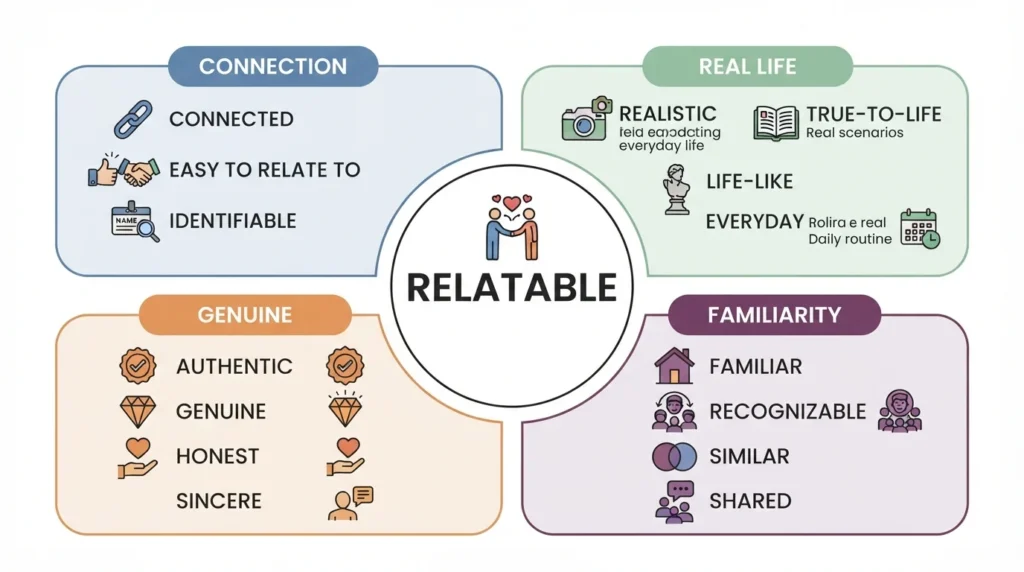
Some useful synonyms for relatable are familiar, recognizable, understandable, identifiable, realistic, true-to-life, personal, authentic, genuine, human, down-to-earth, connected, and easy to identify with.
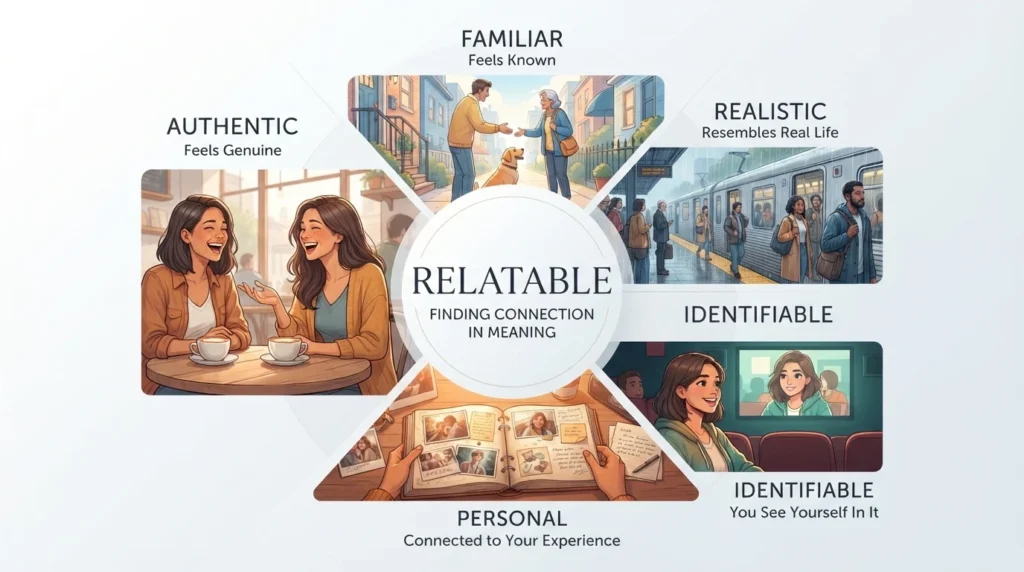
The best choice depends on the sentence. For example, use familiar when something feels known and identifiable when people can see themselves in a person, story, or situation.
What Does Relatable Mean?
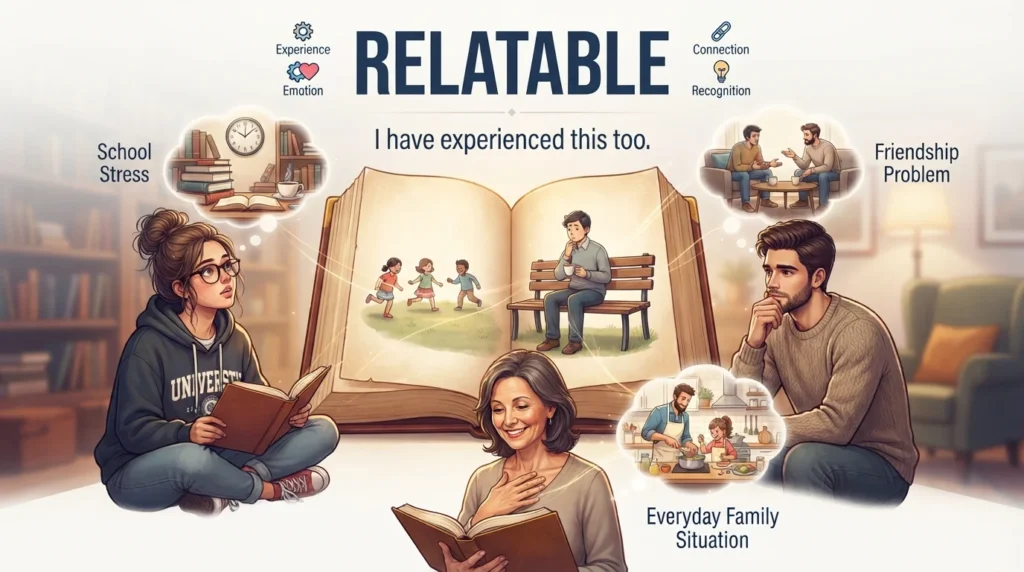
Relatable describes something that people can understand or connect with because it reflects experiences, emotions, situations, or qualities they recognize in themselves or others.
For example:
- Her story is relatable because I went through something similar.
- The character is relatable to many teenagers.
- That post is so relatable.
The word is especially common in informal English, social media, reviews, blogs, conversations, and everyday writing.
Is Relatable a Word?
Yes. Relatable is a standard English word.
It comes from the verb relate with the suffix -able. In modern everyday English, it commonly describes something that people can personally connect with or identify with.
The correct spelling is:
relatable
Common misspellings such as relateable, relateble, relatble, reletable, and relatale are incorrect.
Familiar
Meaning: Something feels known because you have seen, experienced, or recognized something similar.
Examples:
- Her situation felt familiar to me.
- The character’s worries were familiar to many students.
Recognizable
Meaning: Easy to recognize because it resembles something known.
Examples:
- His reaction was recognizable to everyone.
- The story contains recognizable family problems.
Understandable
Meaning: Easy to understand or make sense of.
Examples:
- Her reaction was understandable.
- The character’s fear was understandable.
Identifiable
Meaning: Easy for someone to recognize themselves or their experiences in.
Examples:
- The character is identifiable to young readers.
- The situation was identifiable to many parents.
Realistic
Meaning: Similar to how people or situations are in real life.
Examples:
- The movie has realistic characters.
- Her problems felt realistic.
True-to-life
Meaning: Very similar to real life.
Examples:
- The novel gives a true-to-life picture of school life.
- His performance felt true-to-life.
Life-like
Meaning: Having qualities that make something seem real.
Examples:
- The character feels life-like.
- The story creates life-like conversations.
Real
Meaning: Genuine or similar to actual life rather than artificial.
Examples:
- Her emotions felt real.
- The conversation sounded real.
Genuine
Meaning: Honest, sincere, and not fake.
Examples:
- His reaction was genuine.
- She gave a genuine response.
Authentic
Meaning: True to the real person, experience, or situation.
Examples:
- The character feels authentic.
- Her writing has an authentic voice.
Human
Meaning: Showing ordinary human feelings, weaknesses, or experiences.
Examples:
- His mistakes made the character feel human.
- The story shows a very human fear.
Personal
Meaning: Closely connected to someone’s own experiences or feelings.
Examples:
- The story felt personal to me.
- She shared a personal experience.
Down-to-earth
Meaning: Natural, practical, and not artificial or overly formal.
Examples:
- She has a down-to-earth personality.
- His writing feels down-to-earth.
Grounded
Meaning: Realistic, sensible, and connected to everyday life.
Examples:
- The character feels grounded.
- Her advice was honest and grounded.
Natural
Meaning: Not forced or artificial; it feels normal and genuine.
Examples:
- Their conversation sounded natural.
- Her reaction felt natural.
Common
Meaning: Happening often or experienced by many people.
Examples:
- It is a common problem for students.
- The story describes a common experience.
Everyday
Meaning: Connected with ordinary daily life.
Examples:
- The book focuses on everyday struggles.
- The story uses everyday situations.
Ordinary
Meaning: Normal and not unusual.
Examples:
- The story follows an ordinary family.
- She writes about ordinary problems.
Shared
Meaning: Experienced or felt by more than one person.
Examples:
- They had a shared experience.
- The song expresses a shared feeling.
Universal
Meaning: Experienced or understood by people across many backgrounds.
Examples:
- Love is a universal theme.
- The story explores a universal fear.
Similar
Meaning: Almost the same or having important qualities in common.
Examples:
- Her experience was similar to mine.
- We faced similar problems.
Comparable
Meaning: Similar enough to be compared.
Examples:
- His experience is comparable to hers.
- The two situations are comparable.
Parallel
Meaning: Similar in an important way, especially when comparing experiences.
Examples:
- The story has a parallel to my own life.
- Their experiences followed parallel paths.
Connected
Meaning: Linked to something through feelings, experiences, or ideas.
Examples:
- I felt connected to the character.
- Readers became connected to her story.
Relevant
Meaning: Directly connected to a person’s situation, needs, or interests.
Examples:
- The example is relevant to students.
- Her advice is relevant to new writers.
Easy to connect with
Meaning: Easy to feel a personal connection with.
Examples:
- The speaker was easy to connect with.
- Her story is easy to connect with.
Easy to identify with
Meaning: Easy to see yourself or your experiences in.
Examples:
- Many students found the character easy to identify with.
- The situation is easy to identify with.
Close to home
Meaning: Emotionally connected to someone’s own experience.
Examples:
- The story hit close to home.
- Her words felt close to home.
True
Meaning: Accurately expressing a real feeling or experience.
Examples:
- His description felt true to life.
- The poem expresses a true emotion.
Honest
Meaning: Open and sincere about real thoughts or feelings.
Examples:
- She gave an honest description of failure.
- His writing feels honest.
Open
Meaning: Willing to show real thoughts or feelings.
Examples:
- She was open about her struggles.
- His open writing helped readers connect.
Candid
Meaning: Honest and direct, especially about personal experiences.
Examples:
- She gave a candid account of college life.
- His candid story felt personal.
Sincere
Meaning: Genuine and honest in feeling or expression.
Examples:
- Her apology was sincere.
- His sincere words connected with readers.
Empathetic
Meaning: Showing an understanding of another person’s feelings.
Examples:
- The character is empathetic toward others.
- Her empathetic response made him feel understood.
Sympathetic
Meaning: Showing care and understanding toward someone who is struggling.
Examples:
- The teacher gave a sympathetic response.
- Her sympathetic character was easy to understand.
Approachable
Meaning: Friendly and easy to talk to.
Examples:
- The teacher seemed approachable.
- His approachable personality made people comfortable.
Accessible
Meaning: Easy to understand or use.
Examples:
- The writer uses accessible language.
- Her explanation is accessible to beginners.
Clear
Meaning: Easy to understand.
Examples:
- His explanation was clear.
- She gave a clear description of the problem.
Simple
Meaning: Easy to understand without unnecessary complexity.
Examples:
- She uses simple language.
- The example gives a simple explanation.
Plainspoken
Meaning: Using direct, simple, and honest language.
Examples:
- His plainspoken style feels natural.
- She gave a plainspoken answer.
Resonant
Meaning: Creating a strong emotional or personal connection with people.
Examples:
- The message was emotionally resonant.
- Her story was resonant with many readers.
Meaningful
Meaning: Having personal or emotional value.
Examples:
- The story was meaningful to me.
- His message was meaningful to many students.
Touching
Meaning: Creating strong feelings, especially sympathy or emotion.
Examples:
- Her story was touching.
- The ending was touching.
Heartfelt
Meaning: Showing sincere and strong feelings.
Examples:
- He wrote a heartfelt message.
- Her heartfelt words moved the audience.
Appealing
Meaning: Attractive or interesting to a particular person or group.
Examples:
- The character is appealing to younger readers.
- The simple style is appealing to beginners.
Likable
Meaning: Easy to like or enjoy.
Examples:
- The main character is likable.
- His friendly personality makes him likable.
Engaging
Meaning: Interesting enough to hold someone’s attention.
Examples:
- She is an engaging speaker.
- The story is engaging from the beginning.
Easy to relate to
Meaning: Easy to connect with because it reflects your own feelings or experiences.
Examples:
- The main character is easy to relate to.
- Her experience is easy to relate to.
Relatable to
Meaning: Easy for a particular person or group to connect with.
Examples:
- The character is relatable to teenagers.
- This advice is relatable to new writers.
Relatable-feeling
Meaning: Giving the impression that something reflects a real or familiar personal experience.
Examples:
- The post has a relatable-feeling message.
- The character has a relatable-feeling personality.
Best Synonyms for Relatable in Different Contexts
The closest word depends on the kind of connection you want to describe.
| What you mean | Best choice |
|---|---|
| Something feels known | Familiar |
| People see themselves in it | Identifiable |
| It resembles real life | Realistic |
| It is extremely similar to real life | True-to-life |
| It feels genuine | Authentic / Genuine |
| It connects to someone’s experience | Personal |
| It feels natural and realistic | Down-to-earth / Grounded |
| It is easy to understand | Understandable |
| It is relevant to someone | Relevant |
| It creates an emotional connection | Resonant |
| It is easy to like | Likable |
| It holds attention | Engaging |
This distinction is important. Relatable is mainly about connection or identification. A story can be engaging without being relatable, and a character can be likable without being relatable.
Synonyms for a Relatable Situation
If you are specifically looking for a synonym for relatable situation, these phrases can work depending on the meaning:
- familiar situation
- common situation
- recognizable situation
- real-life situation
- everyday situation
- shared experience
- common experience
- familiar experience
- similar experience
- realistic situation
For example:
The movie shows a relatable situation.
You could write:
The movie shows a familiar situation that many students have experienced.
That sentence is often more precise because it explains why the situation is relatable.
Another Word for Relatable Feelings
For relatable feelings, useful alternatives include:
- shared feelings
- familiar emotions
- common emotions
- universal emotions
- recognizable feelings
- human emotions
- similar feelings
- understandable emotions
For example:
The character expresses relatable feelings.
→ The character expresses emotions that many readers recognize.
What Are Some Other Words for “Relate”?
If you mean the verb relate, the answer is different from a synonym for relatable.
Depending on the sentence, relate can mean:
- connect
- identify with
- understand
- associate
- link
- refer
- describe
- correspond
For example:
I can relate to her experience.
→ I can identify with her experience.
But:
The article relates to student life.
→ The article concerns student life.
So, relate and relatable should not automatically be treated as interchangeable.
What Is Another Word for “So Relatable”?
“So relatable” is informal and common in conversations and social media.
Depending on the situation, you can say:
- I can totally relate.
- I feel the same way.
- That hits close to home.
- I know exactly what you mean.
- That feels familiar.
- That is so true.
- I have been there too.
- I can identify with that.
Example:
That exam stress is so relatable.
A natural alternative is:
I can totally relate to that.
What Is a Formal Way to Say Relatable?
In formal or academic writing, relatable may sometimes sound conversational. A more precise phrase can be better.
Depending on the context, try:
- personally relevant
- widely recognizable
- easy to identify with
- relevant to the reader
- reflective of common experiences
- representative of everyday experiences
- accessible to the intended audience
For example:
Informal:
The character is very relatable.
More formal:
The character reflects experiences that many readers can identify with.
This is usually stronger than replacing relatable with an unnecessarily complicated word.
Is It Correct to Say “Very Relatable”?
Yes. “Very relatable” is grammatically correct and natural, especially in informal English.
Examples:
- Her experience is very relatable.
- That video is very relatable.
- His reaction was very relatable.
You can also say:
- highly relatable
- extremely relatable
- deeply relatable
- so relatable
- truly relatable
The choice depends on tone.
In formal writing, instead of simply adding very, you can explain what makes something relatable:
The character reflects the everyday concerns of many young readers.
Relatable Meaning in Slang and Social Media
In casual online English, relatable often means:
“I have experienced this too,” “I feel the same way,” or “This describes me.”
For example:
“Me checking my phone every five minutes is so relatable.”
Someone might reply:
“That is so relatable!”
Here, the speaker is not necessarily saying that the post is realistic or believable. They are saying that the situation matches their own experience.
This is why relatable is especially common in memes, Instagram posts, TikTok captions, comments, and casual chats.
What Is the Opposite of Relatable?
The most direct opposite is usually:
unrelatable
Other choices depend on the context:
- unfamiliar
- difficult to identify with
- hard to connect with
- unrecognizable
- alienating
- detached
For example:
The character felt unrelatable to the audience.
Or:
The situation was unfamiliar to most readers.
There is no single antonym that works perfectly in every sentence.
Relatable Examples in a Sentence
Here are some natural examples of relatable:
- Her story is relatable because many students experience the same pressure.
- The character feels relatable because she makes ordinary mistakes.
- That social media post is so relatable.
- His experience was relatable to people starting their first job.
- The writer created a realistic and relatable character.
- The situation felt relatable because it reminded me of school.
- Her relatable writing made the story feel personal.
- Many readers found the character easy to relate to.
Relatable vs. Similar: What Is the Difference?
These words are close, but they are not identical.
Similar means two things have qualities in common.
Relatable means something creates a personal connection because a person recognizes their own experience, feelings, or situation in it.
For example:
Her story is similar to mine.
This simply compares two stories.
Her story is relatable to me.
This emphasizes my personal connection to the story.
So, something can be similar without being personally relatable.
Relatable vs. Realistic: What Is the Difference?
Realistic means something resembles real life.
Relatable means people can connect with it personally.
A fictional character can be realistic but not relatable. Likewise, a simple joke can be relatable even though it is not meant to represent real life accurately.
For example:
The movie has realistic dialogue.
This describes how closely the dialogue resembles real conversation.
The movie has relatable dialogue.
This suggests that viewers recognize the thoughts, feelings, or situations in the dialogue.
Relatable vs. Relevant: What Is the Difference?
Relevant means connected to a particular topic, person, need, or situation.
Relatable focuses more on personal connection or identification.
For example:
The advice is relevant to students.
It applies to students.
The advice is relatable to students.
Students may recognize their own experiences in it.
The two words can overlap, but they are not interchangeable in every sentence.
Final Thoughts
The best synonym for relatable depends on the exact meaning you want to express. Use familiar when something feels known, realistic when it resembles real life, identifiable when readers can see themselves in it, personal when it connects with someone’s own experience, and authentic when something feels genuine.
For casual English, expressions such as “I can totally relate,” “that hits close to home,” and “so relatable” sound natural. For essays and formal writing, phrases such as “personally relevant,” “widely recognizable,” and “reflective of common experiences” can be more precise.
The most important rule is simple: do not replace “relatable” with a random thesaurus word. Choose a word that preserves the exact idea and tone of your sentence.
That small distinction can make your English sound clearer, more natural, and more confident.

I am Joseph Clark, a vocabulary and language content writer at SynonymLibrary.com. I create clear, practical synonym guides that help readers improve their writing, word choice, and communication skills. My goal is to make language learning simple, accurate, and useful for students, writers, professionals, and everyday learners.