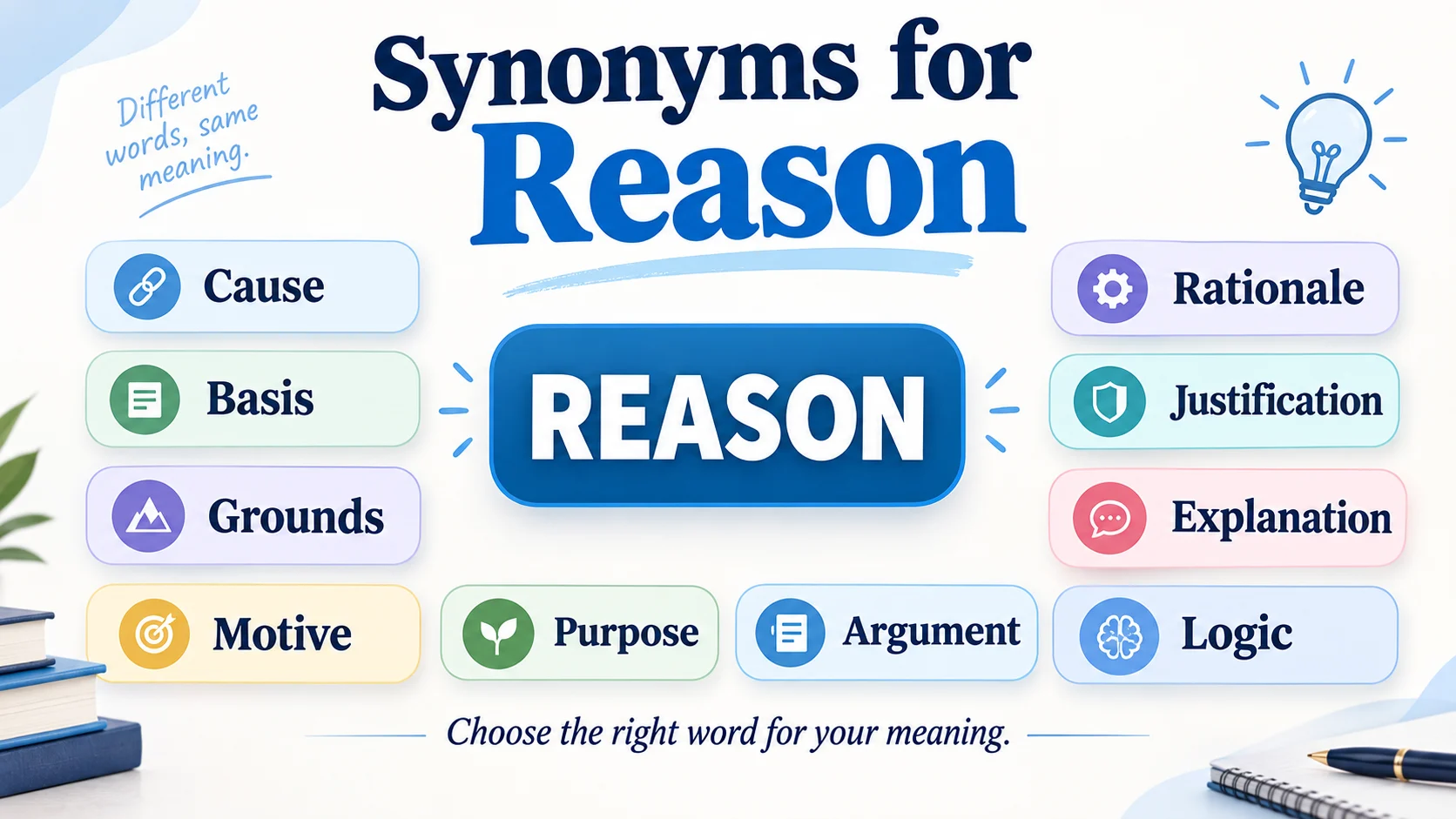
Repeating “reason” in your writing can make your sentences feel repetitive, especially when you need a more precise word. The best synonym for reason depends on what you mean. Cause explains why something happened, motive describes the reason behind someone’s action, and explanation gives information that makes something clear. Justification focuses on a reason used to defend a decision, while basis refers to the foundation or grounds supporting an idea or action.
These alternatives are related, but they are not interchangeable in every sentence. You might ask for the reason for a delay, identify the cause of a problem, explain someone’s motive, or give a justification for a decision. “Reason” can also mean the ability to think logically, in which case words such as logic, rationality, or reasoning may fit better.
This guide covers useful synonyms for reason, including everyday, formal, academic, and context-based alternatives, with simple meanings and examples to help you choose the most accurate word.
Cause
Meaning: A cause is something that makes an event or situation happen.
Examples:
- Heavy rain was the cause of the flood.
- The doctor found the cause of her pain.
Explanation
Meaning: An explanation tells why something happened or why someone did something.
Examples:
- She gave an explanation for missing the class.
- His explanation made the problem easier to understand.
Motive
Meaning: A motive is the personal reason that makes someone do something.
Examples:
- The police wanted to know his motive.
- Her motive for helping was simple kindness.
Purpose
Meaning: Purpose is the reason something is done or the goal it is meant to achieve.
Examples:
- The purpose of this meeting is to plan the event.
- What is the purpose of this new rule?
Rationale
Meaning: A rationale is the logical reason behind a decision or action.
Examples:
- The report explains the rationale behind the policy.
- She gave a clear rationale for changing the plan.
Basis
Meaning: A basis is the main support or reason on which something is built or decided.
Examples:
- The decision was made on the basis of new evidence.
- Trust is the basis of their partnership.
Ground
Meaning: A ground is a reason that supports an action, decision, or belief.
Examples:
- We have good ground for making this request.
- The court had no legal ground to reject the claim.
Grounds
Meaning: Grounds are reasons that support an official or formal action.
Examples:
- They had strong grounds for their complaint.
- The company had grounds to end the contract.
Justification
Meaning: A justification is a reason used to show that an action or choice is reasonable.
Examples:
- He gave no justification for the extra cost.
- The manager asked for written justification.
Factor
Meaning: A factor is something that helps influence a result or decision.
Examples:
- Price was an important factor in our choice.
- Poor planning was a major factor in the delay.
Consideration
Meaning: A consideration is something you think about before making a decision.
Examples:
- Cost was an important consideration for us.
- Safety should be your first consideration.
Motivation
Meaning: Motivation is the reason or desire that makes someone want to act.
Examples:
- Her motivation for studying was to pass the exam.
- Money was not his main motivation.
Incentive
Meaning: An incentive is something that encourages a person to do something.
Examples:
- The company offered a bonus as an incentive.
- Free delivery was a strong incentive to buy.
Impetus
Meaning: An impetus is something that gives a person or action a strong push to start.
Examples:
- The new law gave impetus to the project.
- Her teacher provided the impetus for her research.
Stimulus
Meaning: A stimulus is something that causes or encourages a reaction or action.
Examples:
- The discount was a stimulus for more sales.
- The discovery became a stimulus for further research.
Catalyst
Meaning: A catalyst is something that causes a change or makes it happen faster.
Examples:
- The accident was a catalyst for new safety rules.
- Her speech became a catalyst for change.
Driver
Meaning: A driver is a strong factor that causes or pushes a change or result.
Examples:
- Cost is a major driver of customer choices.
- Technology is a key driver of business growth.
Root
Meaning: The root is the basic cause of a problem or situation.
Examples:
- We need to find the root of the conflict.
- Poor communication was at the root of the problem.
Source
Meaning: A source is the person, thing, or situation from which something comes.
Examples:
- Stress was the source of his trouble.
- The team found the source of the error.
Origin
Meaning: Origin is the point where something begins or comes from.
Examples:
- Researchers studied the origin of the problem.
- The story has its origin in an old legend.
Account
Meaning: An account is an explanation of why something happened or how it happened.
Examples:
- She gave her account of the accident.
- His account explained why the meeting failed.
Occasion
Meaning: Occasion can mean the event or circumstance that causes something to happen.
Examples:
- The visit was the occasion for a family meeting.
- His mistake gave occasion for a serious discussion.
Excuse
Meaning: An excuse is a reason given to explain or defend a fault or action.
Examples:
- He gave an excuse for being late.
- Forgetting the date is not a good excuse.
Usage note: “Excuse” often suggests that the reason may not be fully convincing, so it is not neutral like “cause” or “explanation.”
Pretext
Meaning: A pretext is a stated reason used to hide the real reason for an action.
Examples:
- He used work as a pretext for leaving early.
- The meeting was only a pretext for discussing the real issue.
Reasoning
Meaning: Reasoning is the process of using facts and ideas to reach a conclusion.
Examples:
- I understand your reasoning now.
- Her reasoning was clear and easy to follow.
Logic
Meaning: Logic is a sensible way of thinking that connects ideas clearly.
Examples:
- I can see the logic behind your decision.
- His argument follows simple logic.
Sense
Meaning: Sense can mean good judgment or a reasonable basis for an action.
Examples:
- Your plan makes sense to me.
- There is no sense in waiting any longer.
Argument
Meaning: An argument is a reason used to support an idea or opinion.
Examples:
- She made a strong argument for better public transport.
- His main argument was easy to understand.
Case
Meaning: A case is a set of facts or reasons that supports an idea or decision.
Examples:
- The report makes a strong case for change.
- They built a case against the new rule.
Point
Meaning: A point is an idea or reason used to support what someone says.
Examples:
- You made a good point about school safety.
- She raised an important point during the meeting.
Premise
Meaning: A premise is an idea or statement used as the basis for an argument.
Examples:
- The argument is based on a false premise.
- His main premise was easy to understand.
Principle
Meaning: A principle is a basic belief or rule that guides a decision or action.
Examples:
- Fairness was the principle behind the decision.
- She refused to break her principles.
Foundation
Meaning: A foundation is the basic support on which an idea, decision, or system is built.
Examples:
- Trust is the foundation of their friendship.
- Evidence formed the foundation of the report.
Support
Meaning: Support is information or a reason that helps prove or strengthen an idea.
Examples:
- The study provides support for the new theory.
- We need more support for this claim.
Backing
Meaning: Backing is support for an idea, decision, or argument.
Examples:
- The proposal has strong public backing.
- She gave facts as backing for her opinion.
Determinant
Meaning: A determinant is something that strongly affects or decides a result.
Examples:
- Income can be a major determinant of housing choices.
- Age was an important determinant in the study.
Antecedent
Meaning: An antecedent is an earlier event or condition that comes before another event.
Examples:
- Researchers examined the antecedents of the conflict.
- Stress was an antecedent to his poor performance.
Usage note: “Antecedent” is mainly useful in academic or technical writing, especially when discussing earlier conditions.
Circumstance
Meaning: A circumstance is a condition or situation that affects what happens.
Examples:
- Under these circumstances, we should wait.
- Family circumstances changed her plans.
Usage note: “Circumstance” is a related alternative, not a universal replacement for “reason.”
Condition
Meaning: A condition is a situation that affects an action or result.
Examples:
- Poor road conditions caused the delay.
- The payment was made on one condition.
Usage note: Use “condition” when you mean a situation that affects an outcome, not simply any reason.
Aim
Meaning: An aim is what someone wants to achieve.
Examples:
- The main aim of the project is to help students.
- His aim was to improve customer service.
Objective
Meaning: An objective is a clear goal that someone wants to achieve.
Examples:
- Our main objective is to reduce costs.
- The study has a clear research objective.
Goal
Meaning: A goal is something a person or group wants to achieve.
Examples:
- My main goal is to improve my English.
- The team shared the same goal.
Intention
Meaning: Intention is what someone plans or wants to do.
Examples:
- My intention was to help you.
- She had no intention of causing trouble.
Intent
Meaning: Intent is the purpose or plan behind an action.
Examples:
- The police questioned him about his intent.
- Her intent was to protect the children.
End
Meaning: An end is a goal that an action is meant to achieve.
Examples:
- They worked together to this end.
- The rule was created to that end.
Usage note: “End” works as a synonym for “purpose” in formal expressions, but it is not a general replacement for “reason.”
Need
Meaning: A need is something that makes an action necessary.
Examples:
- The need for more space led to the move.
- There is a clear need for better training.
Necessity
Meaning: Necessity is a situation in which something must be done.
Examples:
- Financial necessity forced him to find work.
- The necessity of change became clear.
Provocation
Meaning: Provocation is something that causes a strong reaction, especially anger.
Examples:
- His comment was a provocation for the argument.
- The attack happened after a serious provocation.
Prompt
Meaning: A prompt is something that causes someone to take action.
Examples:
- The complaint prompted the company to act.
- Her question prompted a long discussion.
Usage note: “Prompt” is best when you mean something that caused a response or action.
Inspiration
Meaning: Inspiration is something that gives someone an idea or desire to create or act.
Examples:
- Her childhood was the inspiration for the novel.
- The beautiful view gave him inspiration for his painting.
Synonyms for Unity: 56+ Words From Oneness to Solidarity
Desire
Meaning: Desire is a strong wish that can motivate someone to act.
Examples:
- His desire to help others led him to volunteer.
- She has a strong desire to learn English.
Usage note: “Desire” is closest to “reason” when the reason is an inner wish or personal motivation.
What Is the Best Synonym for Reason?
The best synonym depends on the meaning of the sentence. Use cause for why something happened, motive for why a person acted, purpose for an intended goal, factor for something that influenced a result, and rationale for the logical basis of a decision.
For example:
- Cause: Heavy rain caused the delay.
- Motive: His motive was unclear.
- Purpose: The purpose of the meeting was to plan.
- Factor: Cost was an important factor.
- Rationale: The report explains the rationale.
There is no single synonym that works perfectly in every situation.
What Are Synonyms for Reason in English?
Common synonyms for reason in English include cause, explanation, motive, purpose, basis, rationale, justification, grounds, factor, reasoning, and argument.
The right word depends on context. “Cause” is useful for events, while “motive” usually describes a person’s intention. “Rationale” sounds more formal and is useful in professional or academic writing.
What Is a Synonym for Reason to Do Something?
When reason means why someone chooses to do something, useful alternatives include motive, purpose, motivation, incentive, intention, and desire.
For example:
- “My reason for studying is to improve my English.”
- “My purpose in studying is to improve my English.”
- “My motivation for studying is to improve my English.”
Choose incentive when something encourages action, such as money, a reward, or a benefit.
What Is a Formal Synonym for Reason?
The strongest formal alternatives include rationale, justification, basis, grounds, and explanation.
Use rationale when explaining the thinking behind a decision.
Use justification when defending a decision or action.
Use grounds for formal, official, or legal reasons.
Use basis when something supports a decision, claim, or belief.
These choices are especially useful in professional reports, academic writing, and formal emails.
What Is a Synonym for Reason in Research?
In research writing, useful alternatives include cause, factor, determinant, rationale, basis, antecedent, and underlying factor.
However, these words are not identical.
- Cause suggests something that produces an outcome.
- Factor suggests something that contributes to an outcome.
- Determinant suggests something that strongly affects an outcome.
- Rationale explains why a research method or decision was chosen.
- Antecedent refers to something that came before another event.
Choosing the precise word makes research writing clearer.
What Are Synonyms for Reason in an Essay?
For an essay, useful alternatives include cause, factor, argument, basis, explanation, rationale, motive, and justification.
For example:
“There are several reasons why people work from home.”
You could write:
“There are several factors that encourage people to work from home.”
Or:
“There are several causes of the growing shift toward remote work.”
For IELTS and academic essays, accuracy matters more than using difficult words.
What Are Reason Synonyms for IELTS?
Useful reason synonyms for IELTS include cause, factor, motive, rationale, basis, justification, explanation, and determinant.
For example:
“There are several reasons for this trend.”
can become:
“There are several factors behind this trend.”
But do not replace “reason” with a complex word just to sound advanced. IELTS vocabulary should be accurate and natural. Using a precise simple word is better than using an impressive word incorrectly.
What Is Another Word for the Main Reason?
Depending on the sentence, you can use main cause, primary cause, key factor, principal reason, major factor, or main motive.
For example:
“Cost was the main reason for the change.”
You could say:
“Cost was the key factor behind the change.”
Use primary cause when discussing what directly produced something, and key factor when discussing an influence.
What Can I Say Instead of “Another Reason”?
You can say another factor, an additional reason, another cause, another consideration, or another point, depending on the context.
For example:
“Another reason for the change was cost.”
can become:
“Another factor behind the change was cost.”
In essays, another factor and an additional reason are natural choices.
Synonyms for Ugly: 57+ Words for Every Shade of Meaning
What Is a Formal Synonym for “Reasons”?
Good formal alternatives include rationale, grounds, justification, factors, causes, considerations, and basis.
The best choice depends on meaning.
For example:
- “The rationale for the decision” focuses on the thinking behind it.
- “The grounds for the decision” sounds official.
- “The factors behind the decision” focuses on influences.
- “The causes of the decision” focuses on what led to it.
How Do You Say “Reason” Formally?
Instead of “reason,” you can use rationale, justification, basis, grounds, explanation, cause, motive, or factor when the context allows.
For example:
Simple:
“What is the reason for the change?”
Formal:
“What is the rationale for the change?”
Another option is:
“What is the basis for the change?”
The best formal word depends on whether you mean logic, support, cause, or motivation.
What Are Synonyms for Reason Behind?
Common alternatives for reason behind include cause of, rationale behind, basis for, motive behind, factor behind, and explanation for.
For example:
“What is the reason behind this decision?”
can become:
“What is the rationale behind this decision?”
Or:
“What is the basis for this decision?”
Use cause of when talking about an event or problem, and rationale behind when discussing a decision or plan.
What Are Synonyms for Reason For?
Depending on the sentence, alternatives include cause of, basis for, explanation for, motive for, purpose of, and factor behind.
For example:
“What is the reason for the delay?”
can become:
“What is the cause of the delay?”
But:
“What is the reason for the meeting?”
is better changed to:
“What is the purpose of the meeting?”
This shows why context matters.
What Are Synonyms for Reason Why?
You can often use cause, explanation, motive, factor, or basis, depending on the meaning.
For example:
“I understand the reason why she left.”
can become:
“I understand the reason she left.”
Or:
“I understand the cause of her departure.”
You do not always need to replace “reason why.” It is already natural English.
What Are Synonyms for Reason Being?
Instead of reason being, you can often use because, since, as, or the reason is that.
For example:
“I left early, the reason being that I was tired.”
can become:
“I left early because I was tired.”
In everyday English, “because” is usually shorter and more natural.
What Are Reason Antonyms?
There is no single antonym for reason because the word has several meanings.
When reason means logical thinking, possible opposites include irrationality, illogic, nonsense, and incoherence.
When reason means a cause or explanation, there is no simple one-word opposite.
For example:
- Reason: logical thinking
- Antonym: irrationality
So the correct antonym depends on the meaning of “reason” in the sentence.
What Is the Difference Between Reason and Cause?
Reason is a broad word that can explain an event, action, decision, or belief.
Cause usually points to the thing that directly makes something happen.
Compare:
- “The reason I left was that I felt tired.”
- “The cause of the accident was heavy rain.”
You can sometimes use “cause” where “reason” appears, but not always. “Reason” can describe a personal choice or purpose, while “cause” usually focuses on what produced an event.
What Is the Difference Between Reason and Motive?
A reason is a general explanation for something.
A motive usually describes the personal intention or desire behind someone’s action.
For example:
- “The reason she left was that she felt sick.”
- “The motive behind the crime was money.”
“Motive” is especially common when discussing behavior, investigations, crime, or hidden intentions.
What Is the Difference Between Reason and Purpose?
A reason explains why something happens or why someone does something.
A purpose focuses on the goal that someone wants to achieve.
For example:
- “The reason I went to the store was that we needed milk.”
- “The purpose of the meeting was to plan the project.”
Both can answer “why,” but “purpose” is more strongly connected to a goal or intended result.
What Is the Difference Between Reason and Rationale?
A reason can be any explanation for an action or event.
A rationale is the logical thinking or reasoning behind a decision, plan, or approach.
For example:
- “What is the reason for the delay?”
- “What is the rationale behind the new policy?”
“Rationale” is more formal and is common in academic, business, professional, and research writing.
What Is the Difference Between Reason and Justification?
A reason explains why something happened or was done.
A justification is a reason used to defend an action or show that it was reasonable.
For example:
- “She gave a reason for leaving early.”
- “She gave a justification for breaking the rule.”
“Justification” can suggest that someone needs to prove or defend their choice.
What Is the Difference Between Reason and Explanation?
A reason tells why something happened or why someone did something.
An explanation gives information that helps someone understand it.
For example:
- “What was your reason for leaving?”
- “Can you give me an explanation?”
A reason may be short, while an explanation can include more details.
What Is the Difference Between Reason and Excuse?
A reason can be a genuine explanation.
An excuse is a reason given to explain or defend an action, often when the reason may seem weak or doubtful.
For example:
- “Traffic was the reason I was late.”
- “He gave traffic as an excuse for being late.”
“Excuse” can carry a negative meaning, so it should not replace “reason” in every sentence.
What Is the Difference Between Reason and Logic?
A reason can mean an explanation for something.
Logic means clear and sensible thinking.
For example:
- “What is the reason for the change?”
- “I understand the logic behind the change.”
Use “logic” when you are talking about whether an idea or decision makes sense.
What Is the Difference Between Reason and Factor?
A reason can explain why something happens.
A factor is something that contributes to or influences a result.
For example:
- “Cost was the reason I chose the cheaper option.”
- “Cost was an important factor in my decision.”
“Factor” is especially useful in academic, business, and research writing.
Common Mistakes When Using Synonyms for Reason
Using “cause” for every type of reason
“Cause” is best for events and results. It may sound wrong when discussing someone’s purpose or intention.
Using “motive” for ordinary causes
“Motive” usually relates to a person’s action or intention. Do not use it for every physical cause.
Using “purpose” when you mean cause
The purpose of something is its intended goal. The cause is what made it happen.
Using “rationale” in casual conversation
“Rationale” is correct, but it sounds formal. In everyday speech, “reason” or “explanation” may sound more natural.
Using “excuse” as a neutral synonym
“Excuse” can suggest that a reason is weak or unconvincing.
Writing “the reason is because”
This is often unnecessarily repetitive.
Prefer:
“The reason is that I was tired.”
Or simply:
“I was tired, so I left.”
Conclusion
Learning synonyms for reason helps you choose words that fit your exact meaning. Use cause for what makes something happen, motive for personal intention, purpose for a goal, factor for an influence, rationale for formal reasoning, and justification when defending a choice. These alternatives can improve essays, IELTS answers, blog posts, emails, and everyday conversations. Practice them in your own sentences, and you will soon know which word sounds most natural in each situation.