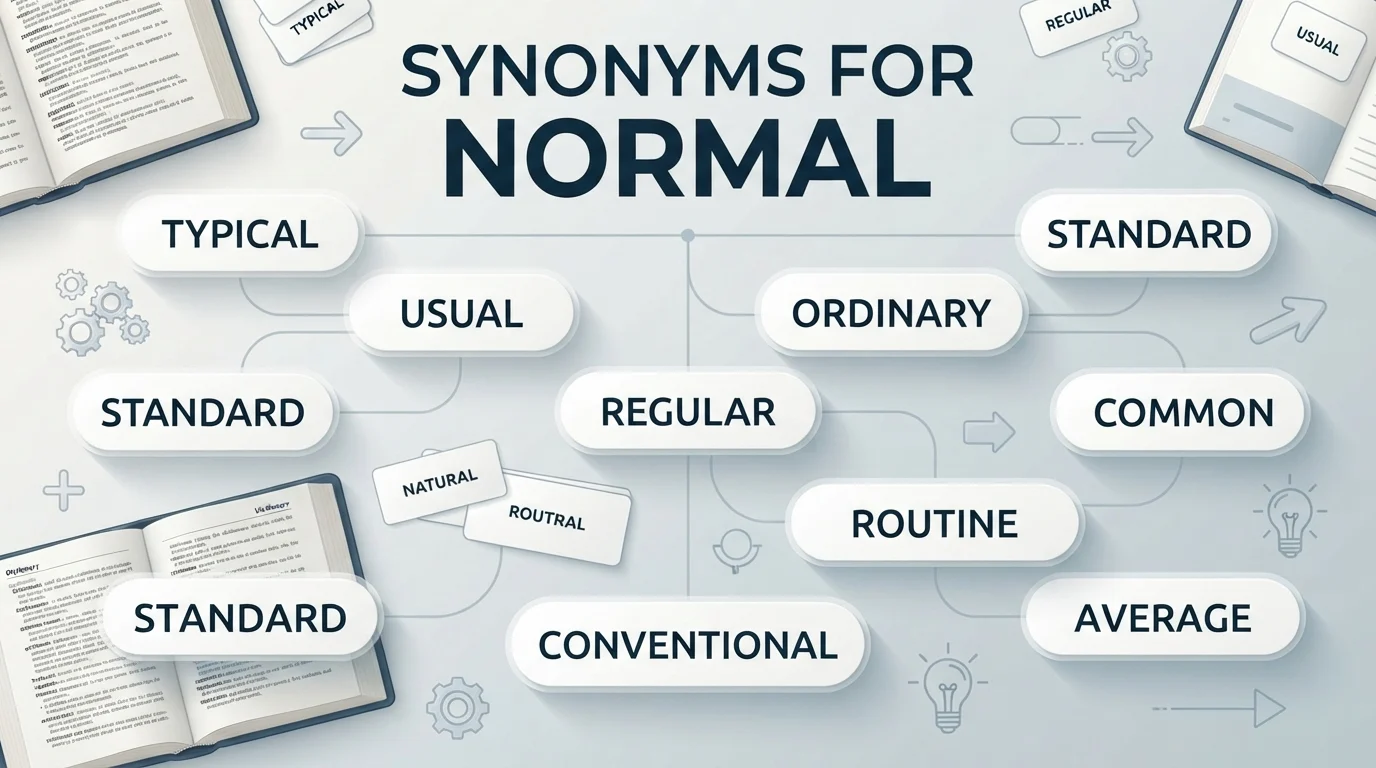
Need another word for “normal” but not sure which one fits your sentence? Synonyms for normal include usual, typical, ordinary, standard, regular, common, and conventional, but these alternatives are not always interchangeable.
Normal can describe something that is usual, expected, ordinary, or within an accepted range. For example, usual emphasizes what commonly happens, while typical describes what is generally expected. Ordinary suggests that something is not unusual or special, whereas standard can refer to an accepted level or model. Conventional often describes something that follows established customs or practices.
These differences matter when you want your writing to sound precise rather than repetitive. If you’re searching for synonyms for normal for essays, schoolwork, articles, professional writing, or everyday English, choosing the right alternative can improve clarity. This guide explains useful synonyms, their differences, and when to use each one.
Usual
Meaning:
Something usual happens or appears in the way it normally does.
Examples:
- I arrived at my usual time.
- She ordered her usual breakfast.
Ordinary
Meaning:
Something ordinary is not special, exciting, or unusual.
Examples:
- It was an ordinary day at work.
- He lives in an ordinary house.
Typical
Meaning:
Something typical has the usual qualities you expect from a person, thing, or situation.
Examples:
- That is typical behavior for him.
- This is a typical school day.
Common
Meaning:
Something common happens often or is found in many places or people.
Examples:
- Headaches are common after a long day.
- This is a common mistake in English.
Standard
Meaning:
Something standard follows an accepted level, form, or practice.
Examples:
- We use the standard size for this product.
- Wearing a helmet is standard practice here.
Natural
Meaning:
Something natural feels normal, expected, or easy in a situation.
Examples:
- It is natural to feel nervous before a speech.
- Her reaction was natural after hearing the news.
Regular
Meaning:
Something regular happens often or follows a steady pattern.
Examples:
- He is a regular visitor at the library.
- I take regular breaks while studying.
Routine
Meaning:
Something routine happens regularly as part of a familiar process.
Examples:
- The nurse performed a routine check.
- Checking my email is part of my morning routine.
Average
Meaning:
Something average is around the usual level or amount.
Examples:
- His test score was about average.
- The room is average in size.
Expected
Meaning:
Something expected is what people think will happen or what they consider usual.
Examples:
- A little traffic was expected this morning.
- Her answer was exactly what I expected.
Customary
Meaning:
Something customary is normally done because it is an accepted practice.
Examples:
- It is customary to greet guests when they arrive.
- A small gift is customary at the celebration.
Conventional
Meaning:
Something conventional follows a commonly accepted or traditional way.
Examples:
- They chose a conventional wedding style.
- He prefers conventional business clothes.
Traditional
Meaning:
Something traditional follows a long-used custom or practice.
Examples:
- We prepared a traditional family meal.
- They wore traditional clothes at the festival.
Everyday
Meaning:
Something everyday is common and connected with ordinary daily life.
Examples:
- These are useful shoes for everyday wear.
- We all face everyday problems.
Familiar
Meaning:
Something familiar is known because you have seen, heard, or experienced it before.
Examples:
- Her voice sounded familiar.
- I recognized the familiar smell of coffee.
Habitual
Meaning:
Something habitual is done regularly because it has become a habit.
Examples:
- He took his habitual seat near the window.
- Her habitual morning walk keeps her active.
Accustomed
Meaning:
Someone who is accustomed to something is used to it because it is familiar.
Examples:
- I am accustomed to waking up early.
- She is accustomed to working under pressure.
Established
Meaning:
Something established is already accepted or commonly used over time.
Examples:
- We followed the established procedure.
- The company has an established system.
Accepted
Meaning:
Something accepted is generally considered suitable or correct by a group.
Examples:
- This is an accepted way to solve the problem.
- The rule is widely accepted.
Conventionalized
Meaning:
Something conventionalized has become a commonly accepted form or practice.
Examples:
- The symbol became conventionalized over time.
- The gesture is now conventionalized in formal settings.
Commonplace
Meaning:
Something commonplace is so common that it does not seem unusual.
Examples:
- Smartphones are commonplace today.
- Online payments are now commonplace.
Prevalent
Meaning:
Something prevalent is common among many people or in a particular place.
Examples:
- This belief is prevalent among young adults.
- The problem is prevalent in large cities.
Widespread
Meaning:
Something widespread exists or happens across many people or places.
Examples:
- The storm caused widespread damage.
- Internet access is widespread in the city.
General
Meaning:
Something general applies to many people or situations rather than one specific case.
Examples:
- The teacher gave some general advice.
- We discussed the general rules first.
Representative
Meaning:
Something representative is typical of a larger group or situation.
Examples:
- This sample is representative of the larger group.
- The painting is representative of his early work.
Conforming
Meaning:
Something conforming matches an accepted rule, pattern, or standard.
Examples:
- The design is conforming to safety rules.
- The product is conforming to the required standard.
Conformable
Meaning:
Something conformable can fit or agree with an accepted rule or standard.
Examples:
- The plan is conformable to local rules.
- The design must be conformable to safety requirements.
Constant
Meaning:
Something constant stays the same or remains at a similar level.
Examples:
- The machine needs a constant supply of power.
- Her constant support helped me.
Steady
Meaning:
Something steady remains stable and does not change suddenly.
Examples:
- The company has steady growth.
- He made steady progress in class.
Stable
Meaning:
Something stable remains in a safe or steady condition.
Examples:
- The patient’s condition is stable.
- Prices have stayed stable this month.
Synonyms for Led: 54+ Words to Match the Meaning
Consistent
Meaning:
Something consistent stays similar or follows the same pattern over time.
Examples:
- Her work quality is consistent.
- Try to keep a consistent study schedule.
Unchanging
Meaning:
Something unchanging stays the same without noticeable differences.
Examples:
- The basic rule has remained unchanging.
- His calm attitude was almost unchanging.
Orderly
Meaning:
Something orderly is arranged or carried out in a normal, organized way.
Examples:
- The students left the room in an orderly way.
- The office follows an orderly process.
Methodical
Meaning:
Something methodical is done in a regular and organized manner.
Examples:
- She has a methodical approach to her work.
- He checked each answer in a methodical way.
Prescribed
Meaning:
Something prescribed follows a set rule, instruction, or required procedure.
Examples:
- Take the medicine at the prescribed time.
- The workers followed the prescribed safety steps.
Set
Meaning:
Something set is fixed or established as the usual arrangement.
Examples:
- We have a set meeting time each week.
- The team follows a set procedure.
Fixed
Meaning:
Something fixed stays at a decided time, place, amount, or level.
Examples:
- The class has a fixed schedule.
- We agreed on a fixed price.
Settled
Meaning:
Something settled has become stable or decided after change or uncertainty.
Examples:
- The situation is finally settled.
- We have a settled routine at home.
Familiarized
Meaning:
Something familiarized has been made known or easier to understand through experience.
Examples:
- The training familiarized workers with the new system.
- The tour familiarized us with the building.
Wonted
Meaning:
Something wonted is usual or customary, though this word is more formal and less common in everyday English.
Examples:
- She returned to her wonted routine.
- He greeted everyone with his wonted smile.
Workaday
Meaning:
Something workaday is ordinary and related to normal daily work or life.
Examples:
- He wore a simple workaday jacket.
- The story focuses on workaday family life.
Run-of-the-mill
Meaning:
Something run-of-the-mill is ordinary and not especially interesting or special.
Examples:
- It was a run-of-the-mill office job.
- We had a run-of-the-mill lunch.
Humdrum
Meaning:
Something humdrum is ordinary and often feels boring because nothing changes.
Examples:
- He wanted a break from his humdrum routine.
- The job became humdrum after several years.
Unexceptional
Meaning:
Something unexceptional is ordinary and does not stand out.
Examples:
- The meal was simple and unexceptional.
- It was an unexceptional afternoon.
Plain
Meaning:
Something plain is simple and not unusual, fancy, or decorative.
Examples:
- She chose a plain black dress.
- We stayed in a plain but comfortable room.
Simple
Meaning:
Something simple is basic and does not have anything unusual or complicated about it.
Examples:
- He gave a simple explanation.
- We had a simple meal at home.
Commonly Seen
Meaning:
Something commonly seen appears often enough to seem normal or familiar.
Examples:
- This bird is commonly seen in local parks.
- That design is commonly seen in modern homes.
Commonly Used
Meaning:
Something commonly used is used often by many people.
Examples:
- This phrase is commonly used in emails.
- English has many commonly used abbreviations.
Widely Accepted
Meaning:
Something widely accepted is considered suitable or correct by many people.
Examples:
- This spelling is widely accepted in English.
- The method is widely accepted by teachers.
Widely Used
Meaning:
Something widely used is used by many people or organizations.
Examples:
- This software is widely used in schools.
- The phrase is widely used online.
Mainstream
Meaning:
Something mainstream is widely accepted, followed, or used by many people.
Examples:
- Online shopping has become mainstream.
- The idea is now part of mainstream culture.
Synonyms for Determination: 57+ Words for Resolve and Persistence
Matter-of-Course
Meaning:
Something matter-of-course is treated as normal, expected, or unsurprising.
Examples:
- She treats daily exercise as a matter-of-course habit.
- He accepted the extra work as a matter-of-course part of his job.
Par
Meaning:
Something that is par is at the usual or expected level.
Examples:
- His performance was par for the course.
- The service was about par for this type of restaurant.
Healthy
Meaning:
Something healthy can mean normal and suitable for good physical or emotional well-being in the right context.
Examples:
- The doctor said her weight was in a healthy range.
- Some stress is a healthy part of life.
Reasonable
Meaning:
Something reasonable is sensible and within an acceptable range.
Examples:
- That is a reasonable amount of homework.
- The seller offered a reasonable price.
Rational
Meaning:
Something rational is based on clear thinking rather than confusion or unreasonable ideas.
Examples:
- She gave a rational explanation.
- We need a rational response to the problem.
Sound
Meaning:
Something sound is sensible, reliable, and reasonable in a particular situation.
Examples:
- He made a sound decision.
- That is sound advice for new writers.
FAQ:
What is the easiest synonym for normal?
Usual is one of the easiest and most common synonyms for normal. It works well when you mean something that normally happens or is expected.
For example:
“Her normal bedtime is 10 p.m.”
can become:
“Her usual bedtime is 10 p.m.”
However, ordinary, typical, common, and regular may be better depending on the sentence.
What is a good synonym for normal in writing?
Good choices include usual, ordinary, typical, standard, natural, regular, conventional, and common.
The best word depends on your meaning. Use ordinary when something is not special, typical when it represents what is expected, and standard when something follows an accepted level or rule.
What are formal synonyms for normal?
Some more formal alternatives include standard, conventional, customary, established, accepted, representative, and conforming.
For formal writing, choose the word that expresses your exact idea instead of simply choosing the most advanced word.
What is another word for a normal person?
Depending on the context, you can say ordinary person, average person, or typical person.
Be careful with the phrase normal person. It can sometimes suggest that people who are different are not normal. A more specific description is often clearer and more respectful.
What is a synonym for normal behavior?
Useful alternatives include typical, usual, customary, expected, habitual, and conventional.
For example, “His behavior was normal” could become “His behavior was typical” when you mean that his behavior was what people expected from him.
What is the difference between normal, usual, and ordinary?
Normal is a broad word that can mean usual, expected, or within an accepted range.
Usual focuses on something that happens regularly.
Ordinary focuses more on something that is not special or unusual.
For example:
- “The temperature is normal.” → It is within the expected range.
- “I took my usual bus.” → I normally take that bus.
- “It was an ordinary day.” → Nothing special happened.
How can I avoid repeating the word normal?
First, ask what normal means in your sentence. Then choose a more exact alternative.
Use usual for something that happens regularly, typical for something expected, common for something seen often, ordinary for something not special, and standard for something accepted or officially used.
This makes your writing more precise instead of simply replacing one word with another.
Conclusion
Learning synonyms for normal gives you more control over your English. It helps you make essays, blogs, emails, and conversations clearer and less repetitive. Instead of using normal every time, choose a word that shows your exact meaning. Practice words such as usual, ordinary, typical, common, regular, standard, and natural in your own sentences. The more you use these alternatives, the easier it becomes to choose the right word naturally and confidently.

I am Joseph Clark, a vocabulary and language content writer at SynonymLibrary.com. I create clear, practical synonym guides that help readers improve their writing, word choice, and communication skills. My goal is to make language learning simple, accurate, and useful for students, writers, professionals, and everyday learners.