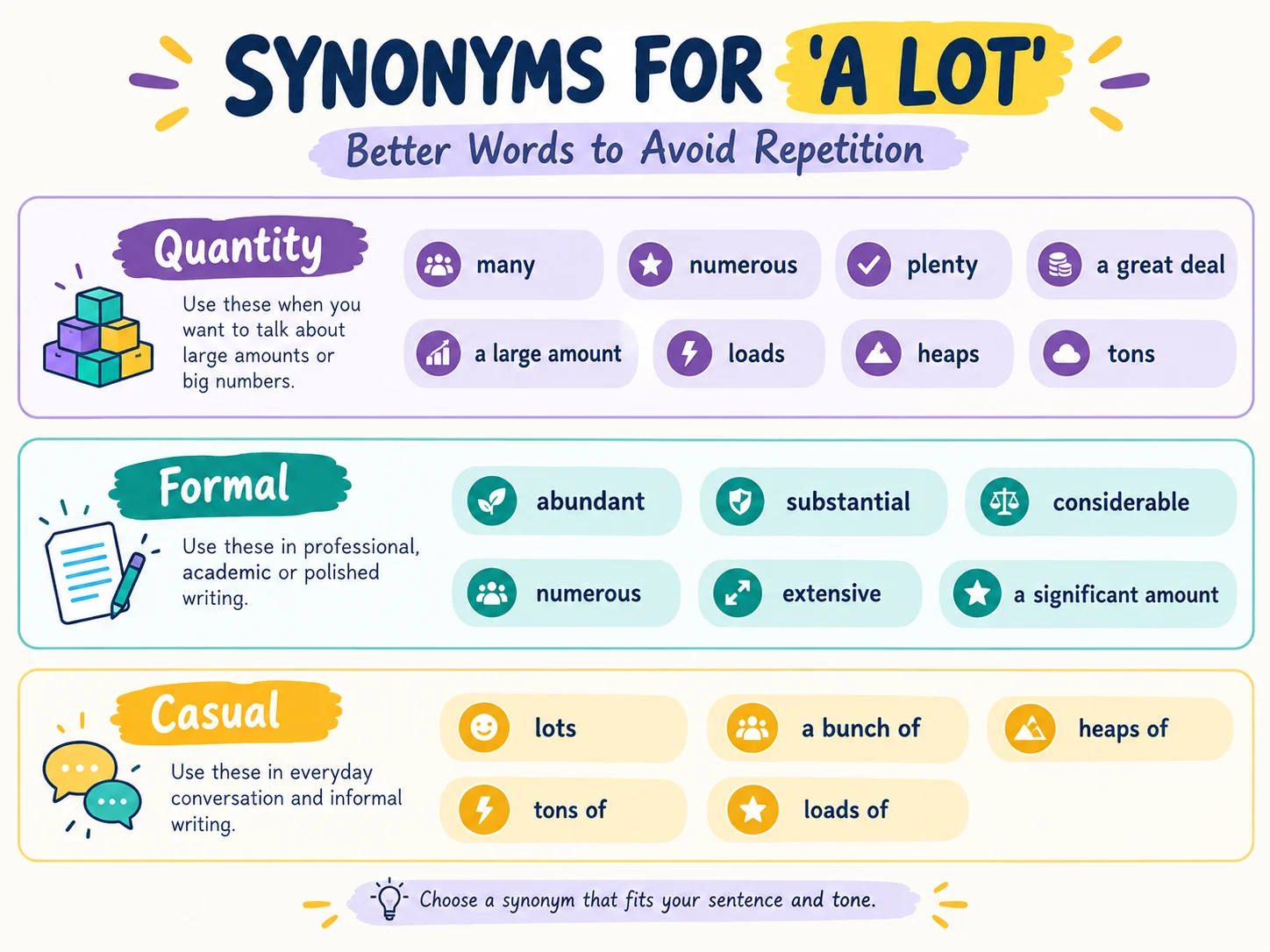
Need a better way to say a lot without repeating the same phrase? The right alternative depends on how you are using it. First, the standard spelling is “a lot,” written as two words, not “alot.” It can describe a large quantity, a large number, or something that happens frequently.
For example, many works with countable nouns (“a lot of books” → “many books”), while much works with uncountable nouns (“a lot of time” → “much time”). Other useful alternatives include numerous, plenty of, a great deal of, a large amount of, a large number of, frequently, often, considerably, and significantly. However, these are not interchangeable in every sentence. Plenty of can suggest more than enough, while frequently describes how often something happens rather than quantity.
This guide breaks down the best alternatives to a lot by meaning, grammar, formality, and context, with clear examples for everyday, academic, and professional English.
Many
Meaning: Many means a large number of people or things that can be counted.
Best for: People, books, ideas, students, questions, and other plural countable nouns.
Examples:
- Many students use online tools to study.
- She has many friends at work.
Much
Meaning: Much means a large amount of something that cannot usually be counted one by one.
Best for: Time, money, work, effort, information, and other uncountable nouns.
Examples:
- We do not have much time left.
- He does not need much money for the trip.
Plenty
Meaning: Plenty means enough or more than enough of something.
Best for: Casual and everyday English when you want to show that there is enough.
Examples:
- We have plenty of food for everyone.
- You have plenty of time to finish the task.
Numerous
Meaning: Numerous means a large number of people or things.
Best for: Formal writing, essays, reports, and countable nouns.
Examples:
- Numerous students joined the program.
- The report contains numerous examples.
A Great Deal Of
Meaning: A great deal of means a large amount of something.
Best for: Formal writing and uncountable nouns such as time, money, effort, and work.
Examples:
- The project required a great deal of effort.
- She spent a great deal of time studying.
A Large Number Of
Meaning: A large number of means many people or things.
Best for: Countable plural nouns and formal writing.
Examples:
- A large number of people attended the event.
- A large number of books were donated.
A Large Amount Of
Meaning: A large amount of means a big quantity of something.
Best for: Uncountable nouns such as money, time, work, and information.
Examples:
- The project needs a large amount of money.
- We collected a large amount of information.
A Good Deal Of
Meaning: A good deal of means a fairly large amount of something.
Best for: Formal or neutral writing about time, work, effort, knowledge, or money.
Examples:
- She has a good deal of experience.
- We learned a good deal from the course.
A Considerable Number Of
Meaning: A considerable number of means a large number that is noticeable or important.
Best for: Formal writing with countable plural nouns.
Examples:
- A considerable number of students passed the exam.
- A considerable number of visitors arrived early.
A Considerable Amount Of
Meaning: A considerable amount of means a fairly large amount of something.
Best for: Formal writing about time, money, effort, work, or resources.
Examples:
- The repair cost a considerable amount of money.
- The task took a considerable amount of time.
A Significant Number Of
Meaning: A significant number of means a large number that is important or noticeable.
Best for: Reports, essays, research, and other formal writing.
Examples:
- A significant number of users chose the new plan.
- A significant number of students changed their answers.
A Significant Amount Of
Meaning: A significant amount of means a large amount that matters or can be noticed.
Best for: Money, time, effort, data, change, and formal writing.
Examples:
- The company invested a significant amount of money.
- The change required a significant amount of work.
A Substantial Number Of
Meaning: A substantial number of means a large number that is important or considerable.
Best for: Formal writing, reports, applications, and countable groups.
Examples:
- A substantial number of customers renewed their plans.
- A substantial number of workers joined the meeting.
A Substantial Amount Of
Meaning: A substantial amount of means a large and important quantity.
Best for: Money, funding, effort, evidence, work, and formal writing.
Examples:
- The business needs a substantial amount of funding.
- She put in a substantial amount of effort.
A Wealth Of
Meaning: A wealth of means a large and valuable amount of something.
Best for: Experience, knowledge, information, resources, and ideas.
Examples:
- She has a wealth of experience in teaching.
- The website provides a wealth of useful information.
An Abundance Of
Meaning: An abundance of means a very large or plentiful amount of something.
Best for: Food, natural resources, choices, ideas, opportunities, and descriptive writing.
Examples:
- The market has an abundance of fresh fruit.
- The website offers an abundance of helpful resources.
Ample
Meaning: Ample means more than enough for a particular need.
Best for: Time, space, opportunity, room, and resources.
Examples:
- We have ample time to prepare.
- The room provides ample space for the guests.
Extensive
Meaning: Extensive means covering a large amount, range, or area.
Best for: Experience, knowledge, research, work, studies, and reviews.
Examples:
- She has extensive experience in marketing.
- The team carried out extensive research.
Copious
Meaning: Copious means existing in very large amounts.
Best for: Formal or literary writing, especially with notes, information, details, or amounts.
Examples:
- The researcher took copious notes during the lecture.
- The writer collected copious amounts of data.
A Multitude Of
Meaning: A multitude of means a very large number of people or things.
Best for: Formal, descriptive, or literary writing with countable nouns.
Examples:
- A multitude of choices is available online.
- A multitude of visitors filled the park.
A Myriad Of
Meaning: A myriad of means a very large number or wide variety of things.
Best for: Formal or descriptive writing with countable nouns.
Examples:
- A myriad of stars filled the night sky.
- The app offers a myriad of useful features.
A Plethora Of
Meaning: A plethora of means a very large number or amount, often suggesting more choices than needed.
Best for: Formal writing when there is an unusually large selection or supply.
Examples:
- The website gives users a plethora of options.
- She faced a plethora of choices.
An Array Of
Meaning: An array of means a wide and varied selection of things.
Best for: Choices, products, services, ideas, tools, and features.
Examples:
- The store sells an array of useful products.
- The course covers an array of important topics.
A Host Of
Meaning: A host of means a large number of people or things.
Best for: Formal and polished writing about features, issues, benefits, or people.
Examples:
- The update includes a host of new features.
- A host of questions came up during the meeting.
A Wide Range Of
Meaning: A wide range of means many different types or kinds of something.
Best for: Products, topics, choices, skills, opinions, and subjects.
Examples:
- The website covers a wide range of topics.
- The store offers a wide range of sizes.
A Vast Number Of
Meaning: A vast number of means an extremely large number.
Best for: Very large groups or quantities in formal or descriptive writing.
Examples:
- A vast number of people watched the event.
- A vast number of records are stored online.
A Vast Amount Of
Meaning: A vast amount of means an extremely large quantity.
Best for: Data, information, time, resources, or other uncountable things.
Examples:
- The project generated a vast amount of data.
- The task required a vast amount of patience.
A Huge Number Of
Meaning: A huge number of means a very large number.
Best for: Everyday English, reports, and strong emphasis.
Examples:
- A huge number of fans watched the game.
- A huge number of people entered the contest.
A Huge Amount Of
Meaning: A huge amount of means a very large quantity.
Best for: Money, work, time, effort, energy, or other uncountable things.
Examples:
- She spent a huge amount of money on repairs.
- The job took a huge amount of energy.
A Massive Number Of
Meaning: A massive number of means an extremely large number.
Best for: Strong emphasis in everyday, business, or descriptive writing.
Examples:
- A massive number of users downloaded the app.
- A massive number of messages arrived overnight.
56+ Synonyms of Resilience: Words for Strength & Recovery
A Massive Amount Of
Meaning: A massive amount of means an extremely large quantity.
Best for: Data, work, money, information, or other uncountable things.
Examples:
- The company collected a massive amount of data.
- He has a massive amount of work to finish.
An Enormous Number Of
Meaning: An enormous number of means an extremely large number.
Best for: Strong emphasis when talking about people or countable things.
Examples:
- An enormous number of people visited the website.
- An enormous number of applications were received.
An Enormous Amount Of
Meaning: An enormous amount of means an extremely large quantity.
Best for: Money, effort, work, time, energy, or information.
Examples:
- The project required an enormous amount of effort.
- She has an enormous amount of energy.
An Immense Number Of
Meaning: An immense number of means an extremely large number.
Best for: Formal or descriptive writing about very large groups.
Examples:
- An immense number of books are available online.
- An immense number of users joined the platform.
An Immense Amount Of
Meaning: An immense amount of means an extremely large quantity.
Best for: Time, work, effort, pressure, or other uncountable ideas.
Examples:
- Learning a language takes an immense amount of practice.
- The project required an immense amount of work.
A Tremendous Number Of
Meaning: A tremendous number of means a very large number.
Best for: Strong emphasis in descriptive or professional writing.
Examples:
- A tremendous number of people supported the event.
- A tremendous number of entries were submitted.
A Tremendous Amount Of
Meaning: A tremendous amount of means a very large quantity.
Best for: Effort, work, time, energy, or money.
Examples:
- He put in a tremendous amount of effort.
- The change saved a tremendous amount of time.
A High Volume Of
Meaning: A high volume of means a large amount or number being handled or received.
Best for: Calls, orders, traffic, messages, sales, and business activity.
Examples:
- The store receives a high volume of orders.
- The website gets a high volume of traffic.
A Large Quantity Of
Meaning: A large quantity of means a big amount of something.
Best for: Goods, materials, products, food, and other measurable supplies.
Examples:
- The factory uses a large quantity of water.
- We ordered a large quantity of supplies.
A Great Many
Meaning: A great many means a very large number of people or things.
Best for: Formal or emphatic writing with plural countable nouns.
Examples:
- A great many people attended the ceremony.
- She has read a great many books.
A Good Many
Meaning: A good many means quite a large number.
Best for: Neutral or slightly formal English with countable nouns.
Examples:
- A good many students chose the same topic.
- We met a good many visitors during the trip.
A Fair Number Of
Meaning: A fair number of means a reasonably large number.
Best for: Everyday and neutral English when the number is large enough to notice.
Examples:
- A fair number of students joined the club.
- We received a fair number of replies.
A Fair Amount Of
Meaning: A fair amount of means a reasonably large amount.
Best for: Time, work, money, effort, or other uncountable nouns.
Examples:
- We spent a fair amount of time preparing.
- She has a fair amount of experience.
A Great Quantity Of
Meaning: A great quantity of means a very large amount of something.
Best for: Formal or descriptive writing about materials, goods, or resources.
Examples:
- The factory produces a great quantity of steel.
- The farm grows a great quantity of wheat.
A Sizable Number Of
Meaning: A sizable number of means a fairly large number.
Best for: Reports, surveys, groups, and neutral formal writing.
Examples:
- A sizable number of users chose the free plan.
- A sizable number of students joined the workshop.
A Sizable Amount Of
Meaning: A sizable amount of means a fairly large amount.
Best for: Money, time, work, savings, or resources.
Examples:
- He saved a sizable amount of money.
- The project needs a sizable amount of funding.
Heaps Of
Meaning: Heaps of is an informal way to say a large amount or number.
Best for: Casual conversations and friendly writing.
Examples:
- I have heaps of homework tonight.
- She has heaps of ideas for the party.
Loads Of
Meaning: Loads of is an informal way to say a large amount or number.
Best for: Casual speech, texts, and friendly conversations.
Examples:
- We have loads of work to do.
- There were loads of people at the concert.
Tons Of
Meaning: Tons of is a very informal way to say a very large amount or number.
Best for: Casual speech and informal online writing.
Examples:
- I have tons of photos from the trip.
- She gets tons of messages every day.
Scores Of
Meaning: Scores of means a large number of people or things.
Best for: Descriptive or slightly literary writing with countable nouns.
Examples:
- Scores of fans waited outside the stadium.
- Scores of visitors came to see the exhibition.
The Best Synonyms for “A Lot” by Context
There is no single replacement that works in every sentence. The right choice depends on the noun, tone, and meaning.
Synonyms for a Lot of People
For a lot of people, use:
- many people
- numerous people
- a large number of people
- a great many people
- a considerable number of people
- scores of people
For formal writing, numerous people or a large number of people usually sounds more polished.
Example:
A lot of people attended the meeting.
You could write:
Numerous people attended the meeting.
Synonyms for a Lot of Work
For a lot of work, use:
- much work
- a great deal of work
- a large amount of work
- considerable work
- substantial work
- loads of work
- tons of work
The formal choices work better in essays and reports, while loads of work and tons of work are better for casual conversation.
Example:
I have a lot of work today.
More formal:
I have a great deal of work today.
Synonyms for a Lot of Money
For a lot of money, use:
- much money
- a large amount of money
- a considerable amount of money
- a significant amount of money
- a substantial amount of money
- a huge amount of money
- a vast amount of money
For professional writing, a substantial amount of money or a significant amount of money often fits well.
Synonyms for a Lot of Time
For a lot of time, use:
- much time
- plenty of time
- a great deal of time
- a considerable amount of time
- a significant amount of time
- ample time
Use ample time when you mean that there is enough or more than enough time.
Example:
We have a lot of time to finish.
Better:
We have ample time to finish.
Synonyms for a Lot of Experience
For a lot of experience, the most natural alternatives are:
- extensive experience
- a wealth of experience
- considerable experience
- substantial experience
- a great deal of experience
Extensive experience is especially useful in professional writing, resumes, profiles, and business content.
Example:
She has a lot of experience in marketing.
More professional:
She has extensive experience in marketing.
Synonyms for a Lot of Love
For a lot of love, natural choices include:
- much love
- so much love
- lots of love
- a great deal of love
- an abundance of love
- plenty of love
The best choice depends on tone. Lots of love is warm and casual, while an abundance of love sounds more literary.
Example:
The child received a lot of love from her family.
A warmer alternative is:
The child received so much love from her family.
Synonyms for a Lot More
When you want to say a lot more, the best alternatives depend on what follows.
Use:
- much more
- far more
- considerably more
- significantly more
- substantially more
- many more
Use many more with countable plural nouns:
We need many more examples.
Use much more with uncountable nouns or when there is no noun:
We need much more time.
Use far more for strong comparison:
This method is far more effective.
57+ Synonyms of Stoic: Words for Calm & Endurance
Formal Synonyms for “A Lot”
If you are writing an essay, report, application, article, or professional email, some alternatives sound more polished than casual expressions.
Good formal choices
For people or countable nouns:
- numerous
- a large number of
- a considerable number of
- a significant number of
- a substantial number of
- a sizable number of
For uncountable nouns:
- a great deal of
- a large amount of
- a considerable amount of
- a significant amount of
- a substantial amount of
- an extensive amount of
Be careful with extensive. It is usually more natural before nouns such as experience, research, knowledge, work, or coverage than before every type of quantity.
Another Word for “A Lot” in an Essay
When searching for another word for a lot in an essay, do not replace every “a lot” with the same word.
Instead, look at the noun.
Instead of:
A lot of students use smartphones.
Write:
Many students use smartphones.
Or:
Numerous students use smartphones.
Instead of:
Students spend a lot of time online.
Write:
Students spend a considerable amount of time online.
Instead of:
The topic has a lot of importance.
A more natural sentence is:
The topic is highly important.
The goal is not to use the fanciest word. The goal is to choose the most natural and precise word.
How Do You Say “Lots” Professionally?
Lots is common and natural in casual English, but professional writing often uses a more precise alternative.
Casual:
We received lots of applications.
Professional:
We received numerous applications.
Casual:
The project needs lots of money.
Professional:
The project requires a substantial amount of funding.
Casual:
She has lots of experience.
Professional:
She has extensive experience.
This shows why context matters more than simply choosing a “fancy” synonym.
How Do You Say “A Lot” in Fancy Words?
If you want more polished vocabulary, you can use:
- numerous
- substantial
- considerable
- extensive
- a great deal of
- an abundance of
- a wealth of
- a myriad of
But a fancy word is not always a better word.
For example, a wealth of experience sounds natural because experience is something valuable. A myriad of options works because options can be numerous. The best synonym should match the noun.
What Can I Use Instead of “A Lot Of”?
You can replace a lot of with different words depending on the noun.
For countable nouns:
- many
- numerous
- a large number of
- a great many
- a considerable number of
For uncountable nouns:
- much
- a great deal of
- a large amount of
- a considerable amount of
- a substantial amount of
For enough or more than enough:
- plenty of
- ample
For knowledge or experience:
- extensive
- a wealth of
For casual speech:
- lots of
- loads of
- tons of
- heaps of
Synonyms for “A Lot of Something”
When looking for synonyms for a lot of something, first ask whether the noun can be counted.
If you can count it, use many or a large number of.
many books
a large number of books
If you cannot count it separately, use much or a large amount of.
much information
a large amount of information
For formal writing, you can also use:
a great deal of information
This simple rule helps you choose the right alternative without forcing a synonym into the sentence.
A Lot vs. Lots vs. Alot
These three forms are easy to confuse.
A lot
A lot is the standard two-word form.
I have a lot of homework.
Lots
Lots is also correct and is generally more casual.
I have lots of homework.
Alot
Alot is generally not the standard spelling of the phrase.
So if you are writing an essay, article, email, or professional message, use a lot, not alot.
Many vs. Much vs. A Lot
This is one of the most important distinctions when learning alternatives to a lot.
Many
Use many with plural countable nouns.
many people
many books
many ideas
many students
Much
Use much with singular uncountable nouns.
much money
much time
much work
much information
A Lot Of
Use a lot of with both plural countable nouns and singular uncountable nouns.
a lot of people
a lot of books
a lot of money
a lot of time
This makes a lot of very flexible in everyday English.
Casual vs. Formal Alternatives
Choosing a synonym is also about tone.
| Casual | Neutral | More Formal |
|---|---|---|
| tons of | a lot of | a substantial amount of |
| loads of | plenty of | a great deal of |
| heaps of | many | numerous |
| lots of | much | a large amount of |
| tons of people | many people | a large number of people |
You do not need formal vocabulary in every sentence. In everyday conversation, simple words often sound more natural.
Quick Guide: Which Synonym Should You Use?
| What you mean | Useful alternative |
|---|---|
| A lot of people | many, numerous |
| A lot of books | many, a large number of |
| A lot of money | a substantial amount of |
| A lot of time | much, a great deal of, ample |
| A lot of work | much, a great deal of |
| A lot of experience | extensive experience |
| A lot of knowledge | extensive knowledge, a wealth of knowledge |
| A lot of information | much information, a great deal of information |
| A lot of love | lots of love, so much love |
| A lot more | much more, far more |
| Professional writing | numerous, substantial, considerable |
| Casual speech | loads of, tons of, heaps of |
Frequently Asked Questions
Is “alot” correct English?
No. When you mean a large amount or number, the standard form is “a lot,” written as two words.
What is the best synonym for “a lot”?
There is no single synonym that works in every sentence. Common choices include many, much, plenty, numerous, a great deal of, and a large amount of.
What is a formal synonym for “a lot”?
Formal alternatives include numerous, considerable, substantial, significant, extensive, a great deal of, and a large number of. The correct choice depends on the noun.
What is another word for a lot of people?
Use many people, numerous people, a large number of people, a great many people, or a considerable number of people.
What is another word for a lot of work?
You can use much work, a great deal of work, a large amount of work, considerable work, or substantial work. For casual speech, loads of work is also natural.
What can I say instead of “a lot” in an essay?
Try many, numerous, a great deal of, a considerable amount of, substantial, or significant, depending on the sentence. Do not replace every “a lot” with the same word.
Can I use “a lot” in professional writing?
Yes. A lot is correct English, but professional writing may benefit from a more specific alternative when one fits naturally. For example, “extensive experience” is more precise than “a lot of experience.”
Conclusion
Learning synonyms for alot gives you more ways to express quantity without repeating the same phrase. Remember that the correct spelling is “a lot,” not “alot.” Use many for countable things, much for uncountable things, and more formal choices such as numerous, substantial, considerable, or a great deal of when the situation calls for them. Practice these alternatives in your emails, essays, blog posts, and daily conversations. The more you use them, the easier it becomes to write and speak clear, natural English.

I am Meer Hadi, a passionate language and content writer at SynonymLibrary.com. I focus on creating helpful word guides that make it easier for readers to choose the right words, understand meanings, and express their ideas more clearly. Through my work, I aim to support students, writers, and professionals in building stronger communication skills.







