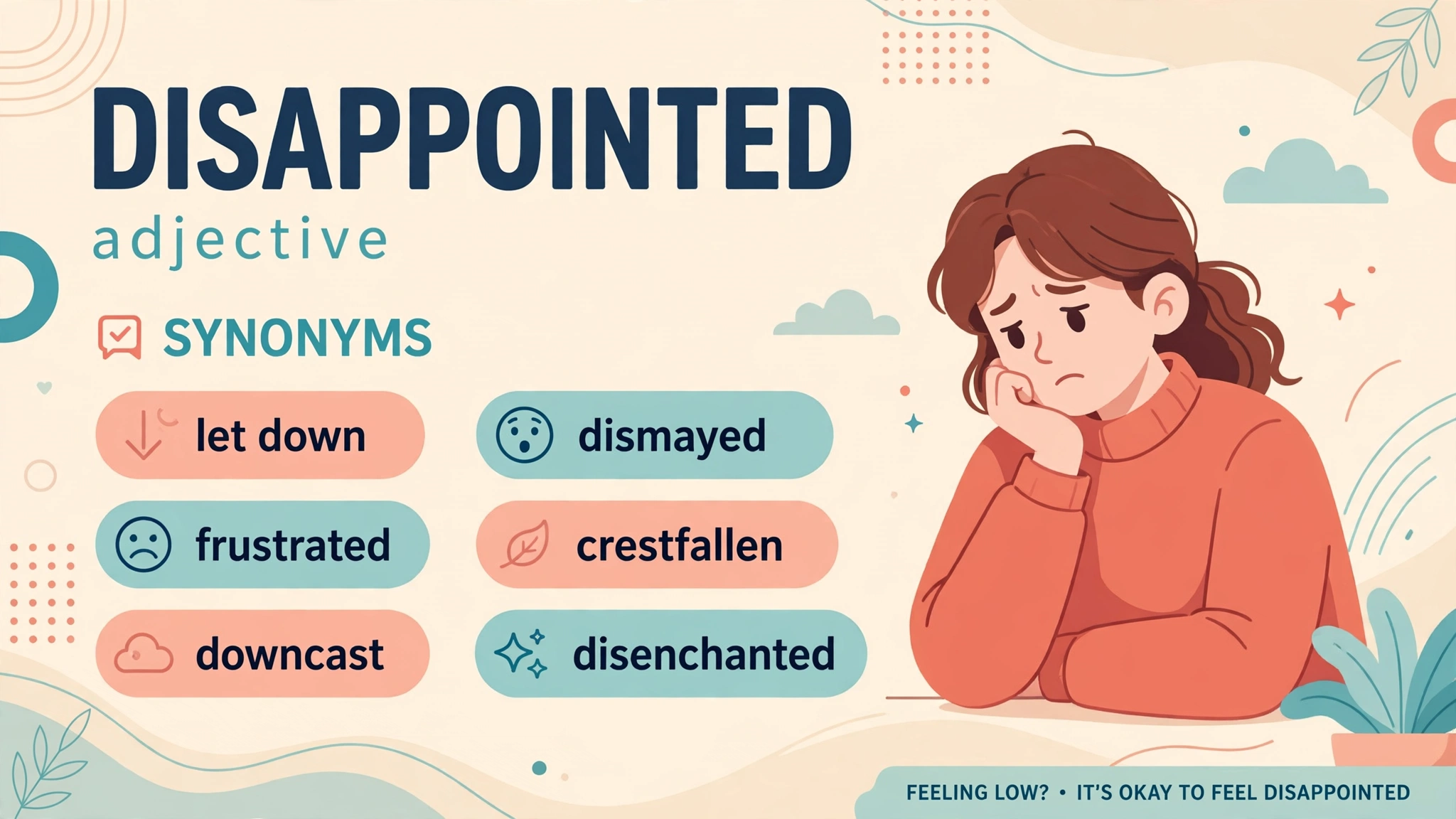
Looking for synonyms for disappointed because you want a more precise or natural way to describe how someone feels? Disappointed usually means feeling unhappy because something did not happen as expected or hoped. The best alternative depends on what caused the feeling and how strongly you experience it. Dissatisfied often describes unhappiness with a product, service, or result, while disheartened suggests losing hope or confidence. Frustrated focuses more on being unable to achieve a desired result, and dismayed can express strong surprise and disappointment. The informal expression let down can describe feeling disappointed by someone or something.
These words overlap, but they are not interchangeable in every sentence. You might feel disappointed by an unexpected result, dissatisfied with poor service, frustrated by repeated problems, or disheartened after a difficult setback. Choosing the right alternative helps you express the exact emotion, cause, and intensity you mean.
This guide covers useful synonyms for disappointed, including everyday, formal, emotional, strong, polite, and context-based alternatives, with simple meanings and examples to help you choose the word that best fits your sentence.
Disheartened
Meaning: Feeling less hopeful because something did not go as you hoped.
Examples:
- She felt disheartened after losing the final match.
- I was disheartened by the poor response.
Discouraged
Meaning: Feeling less confident or hopeful after a problem or failure.
Examples:
- He felt discouraged after failing the test.
- Do not feel discouraged by one bad result.
Dissatisfied
Meaning: Feeling unhappy because something did not meet your expectations.
Examples:
- The customer was dissatisfied with the service.
- I was dissatisfied with my final score.
Discontented
Meaning: Feeling unhappy because you are not satisfied with a situation.
Examples:
- She felt discontented with her current job.
- He became discontented with the new rules.
Displeased
Meaning: Feeling unhappy or annoyed about something.
Examples:
- The manager was displeased with the report.
- My parents were displeased with my decision.
Disillusioned
Meaning: Feeling disappointed after discovering that someone or something is not as good as you believed.
Examples:
- She became disillusioned with the company.
- He felt disillusioned after learning the truth.
Disenchanted
Meaning: No longer feeling excited or impressed because reality was disappointing.
Examples:
- He became disenchanted with his new workplace.
- She felt disenchanted after seeing how the system worked.
Dejected
Meaning: Feeling very sad because something did not happen as hoped.
Examples:
- He looked dejected after the defeat.
- She felt dejected when her application was rejected.
Crestfallen
Meaning: Feeling suddenly sad after losing hope or getting bad news.
Examples:
- He looked crestfallen after hearing the decision.
- She was crestfallen when the event was canceled.
Downcast
Meaning: Looking or feeling sad after something goes wrong.
Examples:
- He looked downcast after the interview.
- She seemed downcast during dinner.
Downhearted
Meaning: Feeling sad because you have lost hope.
Examples:
- The team felt downhearted after the loss.
- I was downhearted by the sudden change.
Deflated
Meaning: Feeling less excited, confident, or happy after something disappointing.
Examples:
- I felt deflated after hearing the result.
- She was deflated when her idea was rejected.
Dispirited
Meaning: Feeling less hopeful or energetic after a setback.
Examples:
- The players were dispirited after the defeat.
- He felt dispirited after several failed attempts.
Demoralized
Meaning: Feeling that you have lost confidence or hope.
Examples:
- The workers felt demoralized after the sudden cuts.
- She was demoralized by repeated criticism.
Frustrated
Meaning: Feeling upset because you cannot get the result you want.
Examples:
- I was frustrated by the slow progress.
- She felt frustrated when the plan failed.
Upset
Meaning: Feeling unhappy or hurt because something went wrong.
Examples:
- He was upset about the canceled trip.
- I felt upset when my friend forgot my birthday.
Saddened
Meaning: Made sad by something that happened.
Examples:
- We were saddened by the unexpected news.
- She felt saddened when her friend moved away.
Hurt
Meaning: Feeling emotional pain because of someone’s actions or words.
Examples:
- I was hurt by his comment.
- She felt hurt when they ignored her.
Wounded
Meaning: Feeling deeply hurt by someone’s words or actions.
Examples:
- He felt wounded by the harsh criticism.
- She was wounded by her friend’s betrayal.
Distressed
Meaning: Feeling very upset or worried because of something bad.
Examples:
- He was distressed by the sudden decision.
- She felt distressed after hearing the news.
Troubled
Meaning: Feeling unhappy or worried because of a problem.
Examples:
- He looked troubled after the meeting.
- She was troubled by the sudden change.
Gloomy
Meaning: Feeling sad and expecting things to go badly.
Examples:
- I felt gloomy after the failed interview.
- He became gloomy about his chances.
Glum
Meaning: Looking or feeling quiet and unhappy.
Examples:
- He looked glum after the announcement.
- She was glum because her plans changed.
Morose
Meaning: Feeling very unhappy and not wanting to talk much.
Examples:
- He became morose after the argument.
- She seemed morose all evening.
Melancholy
Meaning: Feeling quietly and deeply sad.
Examples:
- He felt melancholy after leaving his hometown.
- The old song gave her a melancholy feeling.
Sorrowful
Meaning: Feeling or showing deep sadness.
Examples:
- She looked sorrowful after saying goodbye.
- He gave a sorrowful smile.
Disconsolate
Meaning: Extremely sad and unable to feel better easily.
Examples:
- He was disconsolate after the final loss.
- She looked disconsolate after hearing the news.
Despondent
Meaning: Feeling very sad and without hope.
Examples:
- He became despondent after several failures.
- She felt despondent about her future.
Woebegone
Meaning: Looking very sad and unhappy.
Examples:
- He wore a woebegone expression after the loss.
- She looked woebegone when the plan failed.
Low-Spirited
Meaning: Feeling sad, discouraged, or without much energy.
Examples:
- I felt low-spirited after the rejection.
- She was low-spirited for several days.
Low
Meaning: Feeling sad or unhappy.
Examples:
- I have been feeling low since yesterday.
- She felt low after the argument.
Blue
Meaning: Feeling sad or unhappy in informal English.
Examples:
- I am feeling blue after the bad news.
- He looked a little blue today.
Bummed Out
Meaning: Feeling sad or disappointed about something.
Examples:
- I was really bummed out about the cancellation.
- She felt bummed out after missing the concert.
Let Down
Meaning: Feeling disappointed because someone or something failed to meet your hopes.
Examples:
- I felt let down by my friend.
- The final result really let me down.
Dismayed
Meaning: Feeling upset and disappointed by something unexpected or bad.
Examples:
- She was dismayed by the poor result.
- He felt dismayed when the plan failed.
Chagrined
Meaning: Feeling upset or embarrassed because something went wrong.
Examples:
- He was chagrined by his careless mistake.
- She felt chagrined after missing the deadline.
Discomfited
Meaning: Feeling confused, embarrassed, or uncomfortable after an unexpected setback.
Examples:
- He looked discomfited by the sudden criticism.
- She was discomfited by the unexpected question.
Foiled
Meaning: Feeling disappointed because your plan or goal was stopped.
Examples:
- We were foiled by the sudden storm.
- His travel plans were foiled by the delay.
Thwarted
Meaning: Feeling disappointed because your effort or plan was prevented from succeeding.
Examples:
- Her plans were thwarted by the unexpected problem.
- He felt thwarted when the project was canceled.
Defeated
Meaning: Feeling as if you have lost after trying to achieve something.
Examples:
- She felt defeated after another failed attempt.
- He looked defeated when the deal fell through.
Underwhelmed
Meaning: Feeling that something was less exciting or impressive than expected.
Examples:
- I was underwhelmed by the new restaurant.
- She felt underwhelmed by the performance.
Unimpressed
Meaning: Not feeling pleased or excited because something failed to impress you.
Examples:
- I was unimpressed by the final presentation.
- She looked unimpressed with the new design.
Unhappy
Meaning: Feeling sad or not pleased about something.
Examples:
- She was unhappy with her grade.
- I am unhappy about how things ended.
Synonyms for Elite: 46+ Words for Top-Tier, Select & Prestigious
Unfulfilled
Meaning: Feeling unhappy because a hope, wish, or goal was not achieved.
Examples:
- He felt unfulfilled after leaving the project.
- She was unfulfilled by the result.
Disgruntled
Meaning: Feeling annoyed and unhappy about something.
Examples:
- Several customers were disgruntled by the delay.
- The employee became disgruntled after the change.
Aggrieved
Meaning: Feeling upset because you believe you were treated unfairly.
Examples:
- He felt aggrieved by the unfair decision.
- She was aggrieved after being left out.
Devastated
Meaning: Feeling extremely upset because something very important went badly.
Examples:
- She was devastated after losing the opportunity.
- He felt devastated when his dream came to an end.
Crushed
Meaning: Feeling extremely sad because a strong hope has failed.
Examples:
- She was crushed when she did not get the job.
- He felt crushed by the rejection.
Gutted
Meaning: Feeling extremely disappointed or upset in informal English.
Examples:
- I was gutted when the concert was canceled.
- She was absolutely gutted by the result.
Heartsick
Meaning: Feeling deeply sad because something you wanted did not happen.
Examples:
- She was heartsick after losing the relationship.
- He felt heartsick when his dream failed.
How to Choose the Right Synonym for Disappointed
Not every synonym for disappointed has exactly the same meaning. The best word depends on why you are disappointed, how strong the feeling is, and where you are using it.
For example:
- Dissatisfied works well in professional situations.
- Let down sounds natural in everyday conversation.
- Disheartened suggests that you have lost hope.
- Underwhelmed suggests that something was less impressive than expected.
- Devastated describes very strong emotional pain.
- Gutted is a strong informal expression.
- Disillusioned suggests that your belief in someone or something has changed.
This is why simply replacing “disappointed” with any word from a thesaurus can sometimes make a sentence sound unnatural.
Another Word for Disappointed Professionally
If you need another word for disappointed professionally, choose a word that sounds calm, clear, and respectful.
Good choices include dissatisfied, displeased, concerned, discouraged, and disappointed itself.
For example:
- “I was disappointed with the outcome.”
- “I was dissatisfied with the service.”
- “I was concerned about the final result.”
- “I had hoped for a different outcome.”
In a work email, a softer sentence is often better than a very emotional one. Instead of saying, “I am extremely upset about this,” you could say, “I was disappointed with the outcome and had hoped for a different result.”
Very Disappointed Synonyms Formal
When you need a formal way to express strong disappointment, you can use deeply disappointed, disheartened, dismayed, disillusioned, or distressed.
The best choice depends on the situation.
Deeply disappointed is direct and professional.
Disheartened focuses on lost hope.
Dismayed suggests that something was unexpectedly bad.
Disillusioned suggests that your trust or belief has been damaged.
For example:
“We were deeply disappointed with the final outcome.”
This is strong but still suitable for formal communication.
Synonyms for a Disappointed Person
A disappointed person can be described as:
- Disheartened — when they have lost hope.
- Discouraged — when their confidence has fallen.
- Dejected — when they are very sad.
- Crestfallen — when they suddenly lose hope.
- Downcast — when their sadness is visible.
- Deflated — when their excitement suddenly disappears.
- Dissatisfied — when something did not meet their expectations.
- Dispirited — when they have lost energy or hope.
- Disconsolate — when they are deeply unhappy.
The right choice depends on the exact emotion.
Another Word for Disappointed in Someone
When you feel disappointed in someone, the problem usually involves their actions, behavior, or failure to meet your expectations.
You can say:
- “I’m disappointed in you.”
- “I feel let down by you.”
- “I expected better from you.”
- “I’m hurt by what happened.”
- “I’m unhappy with your decision.”
If you want to sound less harsh, “I expected better” is often a good choice.
If you want to sound more emotional, “I feel let down” clearly shows that you trusted the person.
Disappointed and Sad: Are They the Same?
Disappointed and sad are related, but they are not exactly the same.
Disappointment usually happens when your hopes or expectations are not met. Sadness is a broader feeling and can have many causes.
For example:
- You may feel sad because you miss someone.
- You may feel disappointed because they canceled your plans.
- You may feel both sad and disappointed when an important goal fails.
This distinction helps you choose a more precise word.
Disappointed Synonym Slang
For casual English, some common ways to express disappointment are:
- Bummed
- Bummed out
- Gutted
- Let down
- Crushed
“Bummed” and “bummed out” are casual and friendly.
“Gutted” is a stronger informal expression, especially common in British English.
For example:
- “I’m really bummed about the cancellation.”
- “I was gutted when I heard the news.”
- “That result really let me down.”
These expressions are better for texts, chats, and casual conversations than formal emails.
Disappointed Synonyms: Let Down
Let down is one of the most natural alternatives to disappointed in everyday English.
It often means that someone or something failed to meet your expectations.
For example:
- “I felt let down by my friend.”
- “The movie really let me down.”
- “We were let down by the service.”
It can describe disappointment caused by a person, event, product, result, or situation.
Synonyms for Valuable: 46+ Words From Precious to Priceless
What Is a Stronger Word for Disappointed?
There is no single strongest word for every situation.
If you feel very strong emotional pain, devastated or crushed may fit.
If you have lost hope, disheartened or despondent may be better.
If someone or something has changed your beliefs, disillusioned may be the right word.
If you want a strong informal expression, gutted can work.
For a professional setting, deeply disappointed is often the safest choice.
How Do You Say Disappointed in a Nice Way?
You can express disappointment without sounding rude or aggressive.
Try these softer expressions:
- “I was hoping for a different result.”
- “I’m a little disappointed with the outcome.”
- “I had hoped things would go differently.”
- “I expected something different.”
- “That was not quite what I had hoped for.”
These phrases work well in conversations, emails, feedback, and professional situations.
They focus on your expectations instead of directly blaming another person.
What Is a Synonym for Disappointment?
If you mean the feeling of disappointment, useful related words include letdown, dissatisfaction, discouragement, dismay, disillusionment, and frustration.
However, these words are not always interchangeable.
A letdown is a common everyday expression.
Dissatisfaction sounds more formal.
Discouragement focuses on losing confidence.
Disillusionment suggests that your belief in something has changed.
Dismay suggests shock or distress.
How Do You Express Disappointment in One Word?
There is no single word that works perfectly in every situation.
You can use:
- Dissatisfied for unmet expectations.
- Disheartened for lost hope.
- Dejected for deep sadness.
- Dismayed for shock and disappointment.
- Disillusioned when your belief has changed.
- Crushed for very strong emotional disappointment.
Choose the word that matches the reason and strength of your feeling.
Disappointed Antonyms
The opposite of disappointed depends on the situation.
Common disappointed antonyms include:
- Satisfied
- Pleased
- Happy
- Delighted
- Content
- Thrilled
- Elated
- Gratified
For example, if something simply meets your expectations, satisfied works well.
If something is much better than expected, delighted or thrilled may be stronger.
Disappointed vs. Disappointing
This is an important difference.
Disappointed describes how a person feels.
Disappointing describes the thing that causes the feeling.
For example:
- “I was disappointed by the result.”
- “The result was disappointing.”
Do not say “I am disappointing” when you mean “I am disappointed.” The first sentence can mean that you are causing disappointment to other people.
Disappointed vs. Frustrated
These words are close, but they focus on different feelings.
Disappointed usually means that something did not meet your hopes or expectations.
Frustrated usually means that something is stopping you from getting the result you want.
For example:
- “I was disappointed by my grade.”
- “I was frustrated because the website would not work.”
You can feel both at the same time.
Disappointed in, With, or By?
All three forms can be correct, but they are often used in slightly different ways.
Disappointed in
Use disappointed in when talking about a person or someone’s behavior.
- “I’m disappointed in you.”
- “She was disappointed in her friend.”
Disappointed with
Use disappointed with for a thing, result, service, or situation.
- “I’m disappointed with the product.”
- “He was disappointed with his score.”
Disappointed by
Use disappointed by when focusing on the action, event, or thing that caused the feeling.
- “We were disappointed by the decision.”
- “She was disappointed by the poor service.”
FAQs
What is the best synonym for disappointed?
Let down is one of the most natural everyday alternatives. Dissatisfied works well in professional situations, while disheartened is useful when disappointment causes you to lose hope.
What is a stronger word for disappointed?
Devastated and crushed can express much stronger feelings. Disheartened is better when the main feeling is loss of hope, while disillusioned suggests that your belief in someone or something has changed.
What is a professional way to say disappointed?
You can say dissatisfied, displeased, or concerned about the outcome. “I was disappointed with the outcome” is also clear and professional.
What is a slang word for disappointed?
Bummed, bummed out, and gutted are informal choices. Let down is also very common in everyday conversation.
What is the difference between disappointed and sad?
Disappointed usually comes from an unmet hope or expectation. Sad is a broader emotion that can come from many different situations.
What is the opposite of disappointed?
Common opposites include satisfied, pleased, happy, delighted, content, and elated. The best antonym depends on how positive the situation is.
Conclusion
Learning synonyms for disappointed gives you more precise ways to express your feelings. You can choose a simple word for daily conversation, a professional term for work, or a stronger expression for deep emotions. These words can improve your writing, blogging, speaking, and communication skills. Practice them in emails, essays, messages, and everyday conversations. Once you understand the small differences between these words, you can choose the one that fits your meaning, tone, and situation best.

I am Joseph Clark, a vocabulary and language content writer at SynonymLibrary.com. I create clear, practical synonym guides that help readers improve their writing, word choice, and communication skills. My goal is to make language learning simple, accurate, and useful for students, writers, professionals, and everyday learners.







