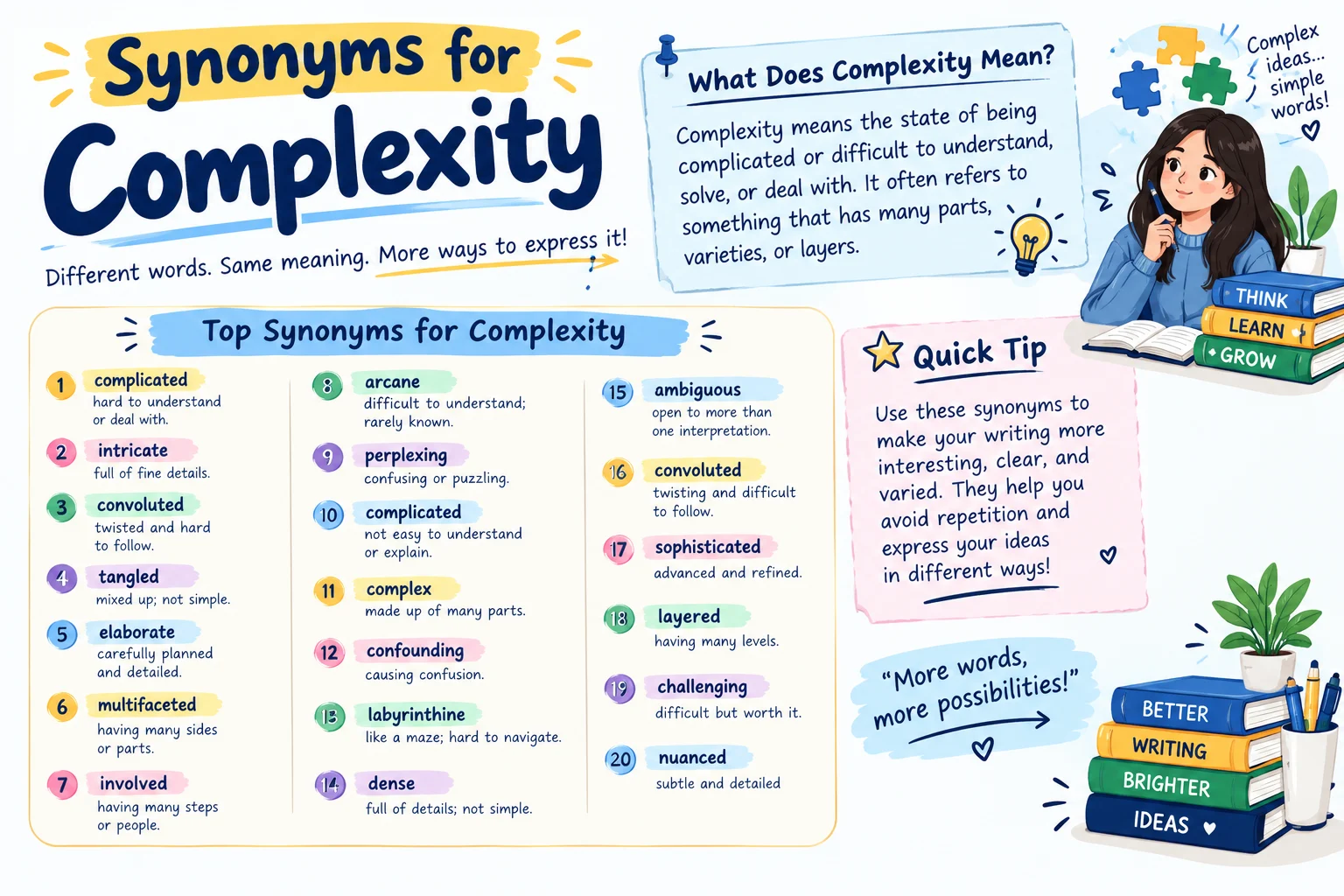
Looking for the right synonyms for complexity can make your writing clearer, more natural, and more precise. If you keep using complexity in an essay, report, blog post, or everyday conversation, you do not always need the same word again.
In simple English, complexity means the state of having many connected parts, details, ideas, or factors that make something difficult to understand, manage, or explain. The best alternative depends on your meaning. You might use intricacy for many small details, complication for an extra problem, difficulty for something hard, or multifacetedness for something with many different sides.
Below are 60+ useful synonyms and close alternatives, followed by simple explanations, examples, writing tips, and answers to common searches such as “what is another word for complexity?” and “what is a simple synonym for complexity?”
What Is Another Word for Complexity?
The best general synonyms for complexity include intricacy, complicatedness, complication, difficulty, sophistication, convolution, involvedness, multifacetedness, multiplicity, interconnectedness, and entanglement.
The right choice depends on the sentence. Use intricacy when something contains many detailed parts, difficulty when something is hard, complication when an additional problem is involved, and multifacetedness when an issue has several different aspects.
What Does Complexity Mean in Simple Words?
Complexity means that something is not simple because it contains many parts, details, relationships, or factors.
For example:
The complexity of the machine makes it difficult to repair.
Here, complexity refers to the machine having many connected parts.
Another example is:
The complexity of the issue requires careful discussion.
Here, the issue has several factors that must be considered.
Complexity can describe ideas, systems, problems, relationships, emotions, arguments, processes, designs, organizations, technology, or situations.
It can be positive, negative, or neutral. A complex novel may be rich and interesting, while a complex process may be difficult to manage.
Best Synonyms for Complexity
Intricacy
Meaning: The quality of having many small, detailed, or closely connected parts.
Example: The intricacy of the design impressed the visitors.
Best for: Designs, systems, arguments, patterns, and detailed structures.
Complicatedness
Meaning: The state of being complicated rather than simple.
Example: The complicatedness of the process caused delays.
Best for: General descriptions, although complexity is usually more natural.
Complication
Meaning: An additional problem or factor that makes a situation harder.
Example: A technical error created another complication.
Best for: Problems, situations, plans, and unexpected difficulties.
Difficulty
Meaning: The quality of being hard to understand, complete, or solve.
Example: The difficulty of the assignment surprised the students.
Best for: Tasks, lessons, problems, and activities.
Sophistication
Meaning: A high level of development, refinement, or technical complexity.
Example: The software has an impressive level of sophistication.
Best for: Technology, systems, designs, writing, and methods.
Convolution
Meaning: A complicated arrangement that is difficult to follow or understand.
Example: The convolution of the argument weakened its main point.
Best for: Arguments, explanations, stories, and complicated reasoning.
Involvedness
Meaning: The quality of involving many details, factors, or relationships.
Example: The involvedness of the case required careful research.
Best for: Formal discussions of complicated situations.
Multifacetedness
Meaning: The quality of having many different sides or aspects.
Example: The multifacetedness of the issue makes a simple answer impossible.
Best for: Social issues, ideas, problems, and academic writing.
Multiplicity
Meaning: The presence of many different elements, possibilities, or forms.
Example: The multiplicity of factors influenced the decision.
Best for: Academic and formal writing.
Interconnectedness
Meaning: The condition in which many parts are closely connected.
Example: The interconnectedness of economic and social issues is clear.
Best for: Systems, society, technology, and academic discussions.
Entanglement
Meaning: A situation in which different things become closely mixed or connected.
Example: The dispute became an entanglement of legal and financial issues.
Best for: Relationships, disputes, problems, and connected situations.
Intricateness
Meaning: The quality of being highly detailed or complicated.
Example: The intricateness of the mechanism was difficult to understand.
Best for: Technical systems, art, designs, and structures.
Multifactorial nature
Meaning: A condition influenced by several different factors.
Example: The multifactorial nature of the problem makes it difficult to solve.
Best for: Academic, scientific, business, and analytical writing.
Interdependence
Meaning: A condition in which different parts depend on one another.
Example: The interdependence of the departments increased the challenge.
Best for: Business, economics, systems, and relationships.
Ambiguity
Meaning: The quality of having more than one possible meaning or interpretation.
Example: The ambiguity of the statement caused confusion.
Best for: Language, writing, laws, arguments, and communication.
Nuance
Meaning: A small difference or subtle detail that adds meaning.
Example: The writer captured the nuance of the relationship.
Best for: Writing, emotions, opinions, and academic discussion.
Depth
Meaning: The quality of containing several layers of meaning or thought.
Example: The novel has remarkable depth.
Best for: Literature, ideas, discussions, and emotions.
Richness
Meaning: The quality of containing many varied or meaningful elements.
Example: The richness of the discussion made it valuable.
Best for: Culture, language, literature, art, and ideas.
Density
Meaning: The quality of containing a large amount of information or material in a limited space.
Example: The density of the textbook made it difficult to read quickly.
Best for: Text, information, data, and technical material.
Layeredness
Meaning: The quality of having several levels, meanings, or elements.
Example: The layeredness of the story becomes clearer after another reading.
Best for: Stories, arguments, art, and ideas.
Complication
Meaning: A factor that adds difficulty to an already existing situation.
Example: A lack of funding became a major complication.
Best for: Plans, projects, problems, and situations.
Conundrum
Meaning: A difficult and confusing problem with no obvious answer.
Example: Choosing between the two options became a conundrum.
Best for: Difficult decisions and intellectual problems.
Challenge
Meaning: Something difficult that requires effort or skill.
Example: Managing such a large project was a challenge.
Best for: Work, education, personal goals, and tasks.
Puzzle
Meaning: Something difficult to understand or solve.
Example: The unusual behavior remained a puzzle.
Best for: Mysteries, problems, questions, and situations.
Confusion
Meaning: A state in which something is unclear or difficult to understand.
Example: The complicated instructions created confusion.
Best for: Communication and unclear situations.
Uncertainty
Meaning: A lack of certainty or clear knowledge about something.
Example: The uncertainty surrounding the decision delayed the project.
Best for: Plans, predictions, decisions, and situations with unknown outcomes.
Tangle
Meaning: A confusing mixture of things that are difficult to separate.
Example: The discussion became a tangle of conflicting opinions.
Best for: Problems, arguments, relationships, and ideas.
Maze
Meaning: Something difficult to navigate because it contains many confusing paths or parts.
Example: The new regulations felt like a maze.
Best for: Rules, procedures, systems, and confusing processes.
Labyrinth
Meaning: A highly complicated system or situation that is difficult to navigate.
Example: The legal process seemed like a labyrinth.
Best for: Formal descriptions of very complicated systems or procedures.
Web
Meaning: A group of closely connected factors or relationships.
Example: The investigation uncovered a web of financial connections.
Best for: Relationships, causes, problems, and networks of influence.
Interrelation
Meaning: The way different things are connected and affect one another.
Example: The study examines the interrelation of language and culture.
Best for: Academic and analytical writing.
Interconnection
Meaning: A connection among different parts, ideas, or systems.
Example: The interconnection of the systems is important to understand.
Best for: Technology, science, society, and systems.
Overlap
Meaning: A situation in which different areas or ideas partly share the same features.
Example: There is some overlap between the two subjects.
Best for: Topics, responsibilities, ideas, and categories.
Combination
Meaning: Several different elements joined together.
Example: The problem resulted from a combination of factors.
Best for: General writing and simple explanations.
Mixture
Meaning: A combination of different things or qualities.
Example: The situation was a mixture of social and economic factors.
Best for: Simple everyday English.
Variety
Meaning: A range of different types or forms.
Example: The variety of opinions made the discussion more interesting.
Best for: Different choices, opinions, elements, or forms.
Diversity
Meaning: The presence of many different types, qualities, or viewpoints.
Example: The diversity of perspectives added depth to the discussion.
Best for: People, opinions, cultures, ideas, and perspectives.
Range
Meaning: A broad set of different elements or possibilities.
Example: The report considers a wide range of factors.
Best for: Options, factors, ideas, and possibilities.
Scope
Meaning: The extent or range of something being considered.
Example: The scope of the project made planning difficult.
Best for: Projects, research, business, and academic writing.
Extent
Meaning: The degree or size to which something exists or develops.
Example: We underestimated the extent of the problem.
Best for: Problems, effects, changes, and situations.
Scale
Meaning: The size or level of something.
Example: The scale of the operation increased its complexity.
Best for: Business, projects, systems, and operations.
Complicated nature
Meaning: The quality of being difficult because of many connected factors.
Example: The complicated nature of the case delayed the decision.
Best for: General and formal writing.
Complex nature
Meaning: The quality of containing several connected or difficult elements.
Example: The complex nature of human behavior makes simple explanations difficult.
Best for: Academic, social, and psychological discussions.
Detailed nature
Meaning: The quality of containing many specific points or small elements.
Example: The detailed nature of the report helped the researchers.
Best for: Reports, explanations, instructions, and descriptions.
Multifactor nature
Meaning: A situation influenced by several different causes or factors.
Example: The multifactor nature of the problem requires careful analysis.
Best for: Formal and academic writing.
Intricate structure
Meaning: An arrangement containing many closely connected details.
Example: The intricate structure of the system requires specialist knowledge.
Best for: Machines, systems, organizations, and designs.
Sophisticated structure
Meaning: A highly developed structure containing advanced elements.
Example: The software uses a sophisticated structure.
Best for: Technology, systems, and advanced designs.
Elaborate arrangement
Meaning: A carefully developed arrangement containing many details.
Example: The event required an elaborate arrangement.
Best for: Plans, events, designs, and systems.
Complex network
Meaning: A group of many connected elements or relationships.
Example: The city depends on a complex network of roads.
Best for: Transportation, technology, communication, and relationships.
Interwoven nature
Meaning: A condition in which several elements are closely mixed or connected.
Example: The interwoven nature of the themes gives the novel depth.
Best for: Literature, culture, ideas, and relationships.
Intricate pattern
Meaning: A pattern containing many detailed or connected elements.
Example: The artist created an intricate pattern.
Best for: Art, design, decoration, and visual descriptions.
Elaborate detail
Meaning: A large amount of carefully developed information.
Example: The report provides elaborate detail about the process.
Best for: Formal descriptions and detailed reports.
Advanced design
Meaning: A design developed with sophisticated or complex features.
Example: The device uses an advanced design.
Best for: Technology and engineering.
Complex thinking
Meaning: Thinking that considers several connected ideas or factors.
Example: The problem requires complex thinking rather than a quick answer.
Best for: Education, analysis, and decision-making.
Complex information
Meaning: Information that contains many connected details or ideas.
Example: The guide explains complex information in simple language.
Best for: Academic, technical, and educational writing.
Technical complexity
Meaning: Complexity created by technical details, components, or processes.
Example: The technical complexity of the software requires expert knowledge.
Best for: Technology, engineering, software, and science.
Operational complexity
Meaning: Complexity created by the number of processes, tasks, people, or systems involved in an operation.
Example: The company reduced operational complexity by simplifying its workflow.
Best for: Business and management writing.
Structural complexity
Meaning: Complexity caused by the way different parts are arranged and connected.
Example: The structural complexity of the organization makes changes difficult.
Best for: Systems, organizations, science, and technical writing.
Emotional complexity
Meaning: The presence of several different or conflicting emotions at the same time.
Example: The character’s emotional complexity makes the story more realistic.
Best for: Literature, relationships, psychology, and personal writing.
Moral complexity
Meaning: A situation in which right and wrong are not easy to separate.
Example: The novel explores the moral complexity of difficult choices.
Best for: Literature, ethics, philosophy, and social issues.
Complexity of thought
Meaning: The presence of several connected or sophisticated ideas in someone’s thinking.
Example: The complexity of thought in the essay is impressive.
Best for: Academic and intellectual writing.
Synonyms for Complexity in an Essay
If you are searching for another word for complexity in an essay, do not choose a synonym randomly. Pick the word that describes the exact type of complexity.
Use intricacy for many detailed parts.
Use multifacetedness for an issue with many sides.
Use interconnectedness when different factors affect one another.
Use sophistication when something is advanced or highly developed.
Use nuance when subtle differences matter.
Use complication when an additional problem is making something harder.
Use ambiguity when something has more than one possible meaning.
For example:
The complexity of the social issue is difficult to explain.
A more precise academic version could be:
The multifaceted nature of the social issue makes it difficult to explain.
Or:
The interconnectedness of its social and economic factors makes the issue difficult to explain.
The best synonym improves meaning rather than simply replacing a repeated word.
Simple Synonyms for Complexity
If you need a simple word for complexity, use words such as difficulty, problem, challenge, confusion, complication, puzzle, detail, mixture, or depth, depending on your sentence.
For example:
The complexity of the instructions confused me.
Simple alternatives include:
The difficulty of the instructions confused me.
The complicated nature of the instructions confused me.
The first is easier and more conversational. The second is more formal.
Formal and Academic Synonyms for Complexity
For formal or academic writing, useful alternatives include:
intricacy, sophistication, multifacetedness, multiplicity, interconnectedness, interdependence, convolution, ambiguity, nuance, multifactorial nature, and structural complexity.
However, sophisticated vocabulary should never be used merely to sound intelligent. A clear word that communicates the intended meaning is usually stronger than a rare word that sounds impressive but feels unnatural.
Synonyms for High Complexity
For high complexity, useful expressions include great intricacy, high sophistication, considerable interconnectedness, multifaceted nature, complicated structure, intricate system, and highly involved structure.
For example:
The system has a high level of complexity.
More precise:
The system has considerable intricacy because its components are closely interconnected.
This version explains why the system is complex instead of simply using a stronger adjective.
Synonyms for Low Complexity
If you are looking for a low complexity synonym, the best alternatives depend on what you mean.
Use simplicity when something has few parts.
Use straightforwardness when something is easy to follow.
Use clarity when something is easy to understand.
Use ease when something is easy to perform.
Example:
The low complexity of the process makes it easy to learn.
A natural alternative is:
The simplicity of the process makes it easy to learn.
Complexity vs. Difficulty
These words are related but not identical.
Complexity describes how many parts, factors, or relationships something contains.
Difficulty describes how hard something is to understand or do.
A task can be complex without being extremely difficult, and a task can be difficult without being complex.
The software has considerable complexity because it contains many interconnected functions.
The software has considerable difficulty for beginners because it is hard to learn.
This distinction is especially useful in academic writing.
Complexity vs. Complication
Complexity usually describes the overall condition of having many connected elements.
Complication usually describes an additional problem that makes something harder.
The complexity of the project comes from its many stages.
A shortage of workers created a complication.
So, use complexity for the overall complicated nature of something and complication for an added problem.
Complexity vs. Sophistication
Complexity means something has many connected parts or details.
Sophistication often suggests advanced development, refinement, or technical capability.
The machine has considerable complexity.
The machine has impressive sophistication.
The second sentence suggests that the machine is not merely complicated but also advanced or refined.
What Is the Opposite of Complexity?
The most common antonym of complexity is simplicity.
Other possible opposites include clarity, straightforwardness, ease, plainness, and transparency, depending on context.
For example:
The designer reduced the complexity of the system.
The designer increased the simplicity of the system.
If the issue is understanding rather than structure, clarity may be the better opposite.
Complexity in a Sentence
Here are natural examples of complexity in a sentence:
The complexity of the problem required a different approach.
Scientists are studying the complexity of the human brain.
The writer explains the complexity of the issue clearly.
We underestimated the complexity of the project.
The emotional complexity of the character makes the story compelling.
These examples show that complexity can describe technical, academic, practical, and emotional situations.
Common Mistakes When Choosing a Complexity Synonym
The most common mistake is treating every related word as a direct synonym.
For example, network is not a general synonym for complexity. A network can create complexity because it contains many connections, but the words do not mean the same thing.
Similarly, structure describes how parts are arranged, while complexity describes how complicated that arrangement or system is.
Difficulty focuses on how hard something is.
Confusion focuses on a lack of clarity.
Complication focuses on an added problem.
Intricacy focuses on detailed and closely connected parts.
Choosing the word that matches the exact meaning makes your writing much stronger.
Another mistake is using an unnecessarily difficult synonym simply to avoid repetition. Good writing is not about replacing every repeated word with a complicated one. It is about choosing the clearest and most accurate word.
Final Takeaway
There is no single perfect synonym for complexity in every sentence. The best alternative depends on the idea you want to express.
Choose intricacy for detailed interconnected parts, difficulty for something hard, complication for an added problem, sophistication for advanced development, multifacetedness for several sides, interconnectedness for linked factors, nuance for subtle differences, and ambiguity for multiple possible meanings.
If you are writing an essay, report, blog post, or everyday message, focus on precision rather than simply using a more difficult word. The right synonym should make your sentence clearer, not more confusing.

I am Meer Hadi, a passionate language and content writer at SynonymLibrary.com. I focus on creating helpful word guides that make it easier for readers to choose the right words, understand meanings, and express their ideas more clearly. Through my work, I aim to support students, writers, and professionals in building stronger communication skills.