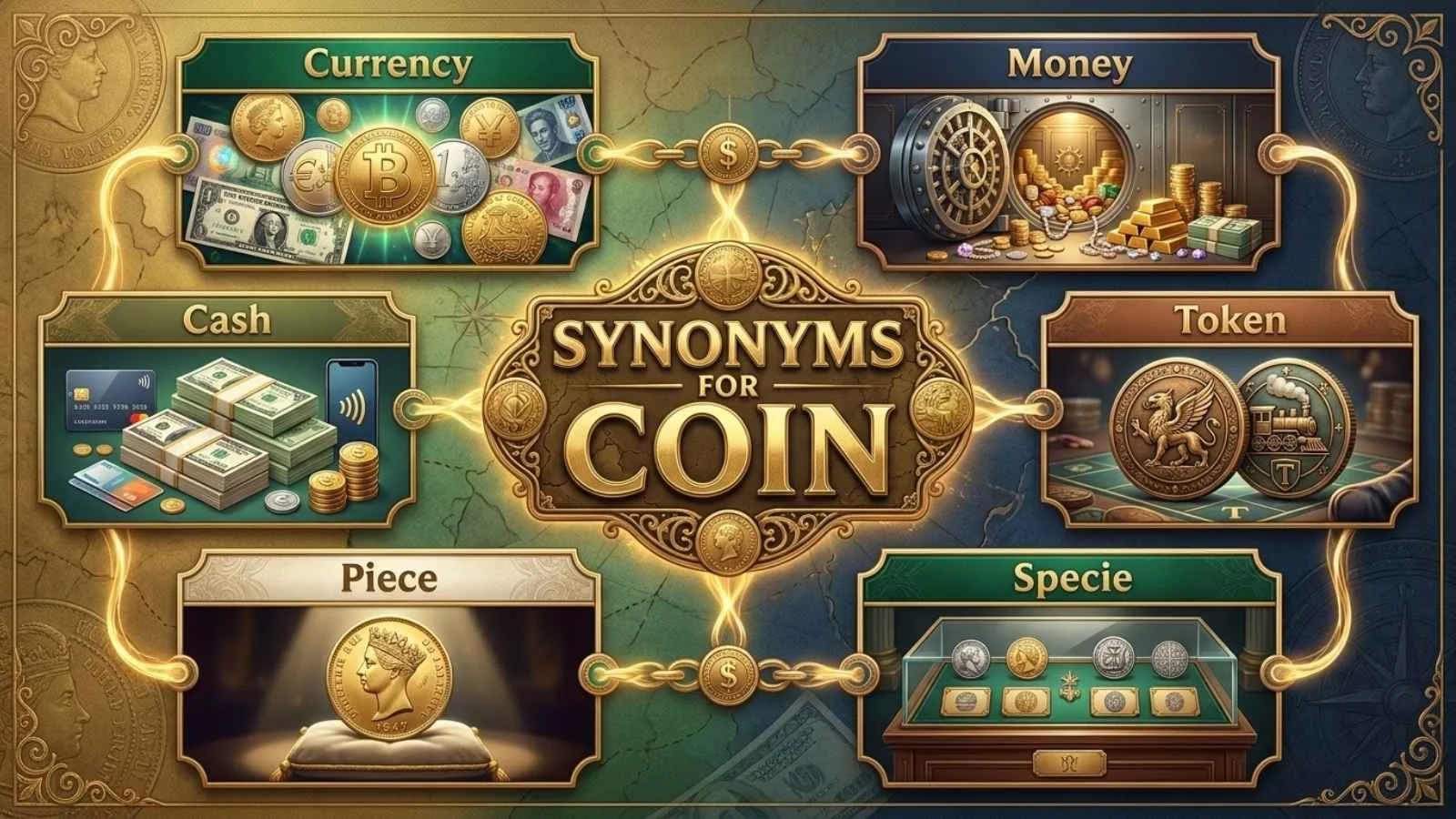
Have you ever found a small coin in your pocket and wondered what else you could call it? Many people use the word “coin” every day, but there are many other words that can fit different situations.
For example, a child may save coins in a piggy bank. A collector may look for rare coins from other countries. In both cases, knowing different words can make your writing more interesting.
The word “coin” usually means a small piece of metal money. Learning synonyms for coin can help students, bloggers, content writers, and daily English users choose the best word for each situation. These synonyms for coin can also make your speaking and writing more clear and engaging.
Meaning and Origin of Coin
Meaning
A coin is a small piece of metal used as money. People use coins to buy things. Coins come in different sizes and values.
Origin
The word “coin” comes from the Old French word coigne and the Latin word cuneus. It has been used for many centuries to describe metal money.
1. Currency
Meaning:
Money used in a country.
Usage:
Commonly used when talking about a nation’s money.
Examples:
- The shop accepts foreign currency.
- I exchanged my currency before the trip.
2. Money
Meaning:
Something used to buy goods and services.
Usage:
Used in everyday conversations.
Examples:
- I need more money for lunch.
- She saved money all year.
3. Cash
Meaning:
Physical money that people carry.
Usage:
Used when talking about bills and coins.
Examples:
- I paid with cash today.
- He keeps cash in his wallet.
4. Change
Meaning:
Small coins returned after payment.
Usage:
Used in shopping situations.
Examples:
- Keep the change.
- I found some change on the table.
5. Specie
Meaning:
Money in the form of coins.
Usage:
Often used in historical writing.
Examples:
- The tax was paid in specie.
- Traders preferred specie for payments.
6. Token
Meaning:
A piece used instead of money.
Usage:
Common in transport and games.
Examples:
- I used a token for the ride.
- The machine accepts tokens.
7. Piece
Meaning:
A single coin or unit of money.
Usage:
Often used in older English.
Examples:
- He found a gold piece.
- The museum displayed a silver piece.
8. Penny
Meaning:
A small-value coin.
Usage:
Common in countries that use pennies.
Examples:
- I picked up a penny.
- The penny rolled under the chair.
9. Nickel
Meaning:
A five-cent coin in the United States.
Usage:
Used when discussing U.S. money.
Examples:
- I found a nickel in my bag.
- The nickel was shiny.
10. Dime
Meaning:
A ten-cent coin in the United States.
Usage:
Common in American English.
Examples:
- She dropped a dime.
- The dime was very small.
11. Quarter
Meaning:
A twenty-five-cent coin.
Usage:
Used in American currency.
Examples:
- I needed a quarter for parking.
- The quarter fell from my pocket.
12. Cent
Meaning:
A unit of money equal to one hundredth of a dollar.
Usage:
Used in many countries.
Examples:
- The candy costs fifty cents.
- I found one cent on the ground.
13. Sovereign
Meaning:
A historic gold coin.
Usage:
Often used in history and collecting.
Examples:
- The collector bought a sovereign.
- The sovereign was made of gold.
14. Ducat
Meaning:
An old gold or silver coin.
Usage:
Found in historical contexts.
Examples:
- The treasure contained a ducat.
- He studied an ancient ducat.
15. Doubloon
Meaning:
An old Spanish gold coin.
Usage:
Often mentioned in stories and history.
Examples:
- Pirates searched for doubloons.
- The doubloon looked valuable.
16. Bullion Coin
Meaning:
A coin made from precious metal.
Usage:
Used in investing and collecting.
Examples:
- She purchased a bullion coin.
- The bullion coin contained gold.
17. Medallion
Meaning:
A coin-like metal piece.
Usage:
Often used for awards or decoration.
Examples:
- He received a medallion.
- The medallion had a special design.
18. Disk
Meaning:
A flat round metal object.
Usage:
Sometimes used to describe coin-shaped items.
Examples:
- The disk looked like a coin.
- She found a metal disk in the box.
19. Piece of Money
Meaning:
A single unit of money.
Usage:
Used in simple descriptions of coins.
Examples:
- He picked up a piece of money.
- The old piece of money was rare.
20. Legal Tender
Meaning:
Money accepted by law for payment.
Usage:
Used in financial and legal contexts.
Examples:
- The coin is legal tender.
- Shops must accept legal tender.
21. Metallic Currency
Meaning:
Money made from metal.
Usage:
Used when discussing coin-based money.
Examples:
- Metallic currency was common long ago.
- The museum displayed metallic currency.
22. Hard Cash
Meaning:
Physical money, especially coins and notes.
Usage:
Used in everyday speech.
Examples:
- I paid in hard cash.
- She prefers hard cash.
23. Silver Piece
Meaning:
A coin made of silver.
Usage:
Common in historical discussions.
Examples:
- The chest held a silver piece.
- He collected a rare silver piece.
24. Gold Piece
Meaning:
A coin made of gold.
Usage:
Used in history and fantasy stories.
Examples:
- The king paid with a gold piece.
- She found a gold piece in the collection.
25. Commemorative Coin
Meaning:
A coin made to honor an event or person.
Usage:
Popular among collectors.
Examples:
- I bought a commemorative coin.
- The commemorative coin marked the anniversary.
26. Minted Piece
Meaning:
A coin produced by a mint.
Usage:
Used in coin collecting.
Examples:
- The minted piece looked new.
- He examined the minted piece carefully.
27. Token Coin
Meaning:
A coin with limited or special use.
Usage:
Used for transport, games, or events.
Examples:
- The arcade used token coins.
- I saved a token coin as a souvenir.
28. Trade Coin
Meaning:
A coin used in trade between regions.
Usage:
Common in historical writing.
Examples:
- Merchants exchanged trade coins.
- The trade coin traveled across countries.
29. Collector’s Coin
Meaning:
A coin valued by collectors.
Usage:
Used in numismatics.
Examples:
- He bought a collector’s coin.
- The collector’s coin was rare.
30. Ancient Coin
Meaning:
A coin from a very old time.
Usage:
Used in history and archaeology.
Examples:
- The dig uncovered an ancient coin.
- She studied the ancient coin.
31. Mint Issue
Meaning:
A coin officially released by a mint.
Usage:
Used in collecting circles.
Examples:
- The mint issue sold quickly.
- He ordered the new mint issue.
32. Numismatic Piece
Meaning:
A coin collected for study or value.
Usage:
Used by coin collectors.
Examples:
- The numismatic piece was expensive.
- She displayed a numismatic piece.
33. Currency Piece
Meaning:
A piece of money used in trade.
Usage:
Used in formal discussions of money.
Examples:
- The currency piece was damaged.
- He found an old currency piece.
34. Monetary Unit
Meaning:
A standard unit of money.
Usage:
Used in economic discussions.
Examples:
- The coin became a monetary unit.
- Each monetary unit had a value.
35. Tender
Meaning:
Money accepted as payment.
Usage:
Used in legal and financial contexts.
Examples:
- The coin is valid tender.
- Shops accepted the tender.
36. Copper Coin
Meaning:
A coin made mostly from copper.
Usage:
Used when describing coin materials.
Examples:
- I found a copper coin.
- The copper coin looked old.
37. Bronze Coin
Meaning:
A coin made from bronze.
Usage:
Common in history and collecting.
Examples:
- The museum displayed a bronze coin.
- She cleaned a bronze coin.
38. Silver Coin
Meaning:
A coin made from silver.
Usage:
Used in collecting and history.
Examples:
- He inherited a silver coin.
- The silver coin was valuable.
39. Gold Coin
Meaning:
A coin made from gold.
Usage:
Used in investment and history.
Examples:
- She bought a gold coin.
- The gold coin was rare.
40. Token Piece
Meaning:
A special coin-like item used for a purpose.
Usage:
Common in games and transportation.
Examples:
- The machine required a token piece.
- I kept the token piece.
41. Minted Coin
Meaning:
A coin officially produced by a mint.
Usage:
Used in coin collecting.
Examples:
- The minted coin was flawless.
- He stored the minted coin safely.
42. Rare Coin
Meaning:
A coin that is difficult to find.
Usage:
Popular among collectors.
Examples:
- The auction featured a rare coin.
- She owned a rare coin.
43. Historic Coin
Meaning:
A coin connected to history.
Usage:
Used in museums and collections.
Examples:
- The exhibit showed a historic coin.
- He studied a historic coin.
44. Bullion Piece
Meaning:
A coin made from precious metal for investment.
Usage:
Used in precious metal markets.
Examples:
- She purchased a bullion piece.
- The bullion piece contained silver.
45. Exchange Coin
Meaning:
A coin used in trade or payment.
Usage:
Used in discussions about commerce.
Examples:
- The exchange coin passed through many hands.
- Traders valued the exchange coin.
46. Circulating Coin
Meaning:
A coin currently used by the public.
Usage:
Used in banking and economics.
Examples:
- The circulating coin showed wear.
- Millions use the circulating coin daily.
47. Payment Coin
Meaning:
A coin used to make payments.
Usage:
Used in simple discussions of money.
Examples:
- The payment coin was accepted everywhere.
- He handed over a payment coin.
48. Metal Currency
Meaning:
Money made from metal.
Usage:
Used when comparing coins and paper money.
Examples:
- Metal currency was common in the past.
- The collection featured metal currency.
49. Coinage
Meaning:
Coins collectively or the process of making coins.
Usage:
Used in history and economics.
Examples:
- The country’s coinage changed.
- Historians studied the coinage.
50. Specimen Coin
Meaning:
A specially made coin for display or collection.
Usage:
Used by collectors and museums.
Examples:
- The specimen coin was preserved carefully.
- She added a specimen coin to her collection.
FAQs
What is another word for coin?
Money, currency, cash, and token are common alternatives.
Can I use currency instead of coins?
Yes, but currency is a broader term that includes coins and paper money.
What is a rare coin?
A rare coin is difficult to find and is often valuable to collectors.
What is coinage?
Coinage means coins as a group or the process of making coins.
Why should I learn synonyms for coins?
They help improve writing, speaking, and vocabulary skills.
Conclusion
Learning synonyms for coin can make your writing and speaking more interesting. Different words help you express ideas in a better way. These synonyms are useful for students, bloggers, writers, and anyone learning English. Try using these words in emails, essays, school work, and daily conversations. The more you practice, the stronger your vocabulary will become.

I am Meer Hadi, a passionate language and content writer at SynonymLibrary.com. I focus on creating helpful word guides that make it easier for readers to choose the right words, understand meanings, and express their ideas more clearly. Through my work, I aim to support students, writers, and professionals in building stronger communication skills.