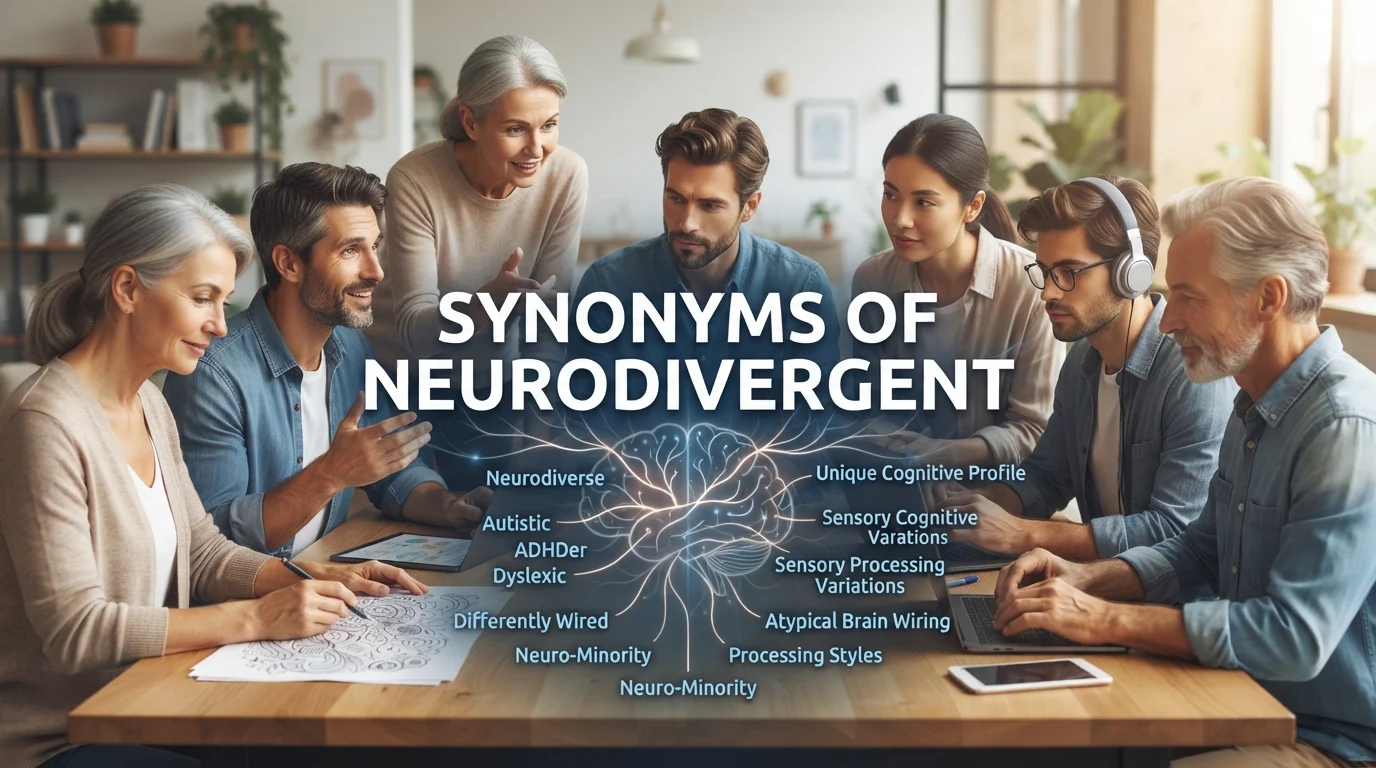
Need another way to say “neurodivergent” but not sure which term is actually accurate? Neurodivergent generally describes a person whose brain processes, learns, communicates, or experiences the world in ways that differ from what is considered typical.
However, there are only a few closely related alternatives, and they are not all exact synonyms. Terms such as neuroatypical and neurologically different may overlap with neurodivergent in some contexts, while neurodiverse usually describes diversity across a group rather than one individual. For example, you might describe one person as neurodivergent, but a group that includes people with different neurological profiles as neurodiverse. The right wording can therefore depend on your context and the terminology a person prefers.
If you’re searching for synonyms of neurodivergent for an essay, article, professional writing, education, or everyday communication, this guide explains the related terms, their differences, and when each one fits best.
Neuroatypical
Meaning:
Neuroatypical is a close synonym for neurodivergent and describes a person whose neurological functioning differs from what is considered typical.
Use: Formal or general writing.
Examples:
- The school supports neuroatypical students.
- She describes herself as neuroatypical.
Neurodifferent
Meaning:
Neurodifferent is a close alternative that describes someone whose brain works differently from the usual pattern.
Use: General and identity-focused writing.
Examples:
- He uses the term neurodifferent to describe himself.
- The group welcomes neurodifferent learners.
Neurologically Different
Meaning:
Neurologically different describes someone whose brain or nervous system functions differently from what is typical.
Use: General or explanatory writing.
Examples:
- She is neurologically different from most people.
- The teacher supports neurologically different students.
Neurologically Atypical
Meaning:
Neurologically atypical describes a person whose neurological functioning differs from the common pattern.
Use: Formal or technical writing.
Examples:
- The report discusses neurologically atypical learners.
- He works with neurologically atypical children.
Neuroatypical Person
Meaning:
A neuroatypical person is someone whose neurological functioning differs from what is considered typical.
Use: Formal or general writing.
Examples:
- She is a neuroatypical person.
- The program supports every neuroatypical person fairly.
Neurodivergent Person
Meaning:
A neurodivergent person is an individual whose brain works in ways that differ from what is considered typical.
Use: General and identity-focused writing.
Examples:
- He is a neurodivergent person.
- Each neurodivergent person has a different experience.
Neurodivergent Individual
Meaning:
A neurodivergent individual is a person whose neurological functioning differs from the typical pattern.
Use: Formal or professional writing.
Examples:
- The service supports each neurodivergent individual.
- A neurodivergent individual may prefer clear instructions.
Person With Neurological Differences
Meaning:
This phrase describes a person whose neurological functioning differs from that of many other people.
Use: General or person-focused writing.
Examples:
- The program supports people with neurological differences.
- A person with neurological differences may use different tools.
Individual With Neurological Differences
Meaning:
This phrase is a formal way to describe an individual whose neurological functioning differs from the usual pattern.
Use: Formal writing.
Examples:
- The study included individuals with neurological differences.
- Each individual with neurological differences may have different needs.
Person With a Different Neurological Profile
Meaning:
This phrase describes someone whose pattern of neurological functioning differs from the usual pattern.
Use: Formal or educational writing.
Examples:
- The school supports each person with a different neurological profile.
- A person with a different neurological profile may need flexible support.
Neurocognitively Different
Meaning:
Neurocognitively different describes someone whose thinking and information-processing patterns differ from the typical pattern.
Use: Formal or specialized writing.
Examples:
- The program welcomes neurocognitively different learners.
- He describes his experience as neurocognitively different.
Neurocognitively Atypical
Meaning:
Neurocognitively atypical describes cognitive functioning that differs from what is commonly expected.
Use: Formal or technical writing.
Examples:
- The article discusses neurocognitively atypical learners.
- She works with neurocognitively atypical students.
Neurological Minority
Meaning:
Neurological minority refers to people whose neurological patterns differ from those of the larger population.
Use: Formal or social-context writing.
Examples:
- The group represents a neurological minority.
- Members of a neurological minority may face communication barriers.
Neurominority
Meaning:
Neurominority is a term for a group of people whose neurological traits differ from those of the majority.
Use: Community or social-context writing.
Examples:
- The article discusses the experiences of a neurominority.
- A neurominority may have different support needs.
Brain-Wired Differently
Meaning:
Brain-wired differently is a casual phrase for someone whose brain works in a different way.
Use: Casual and friendly English.
Examples:
- He says he is brain-wired differently.
- Being brain-wired differently can affect how someone learns.
Wired Differently
Meaning:
Wired differently is a simple informal phrase for having a different way of thinking or processing information.
Use: Casual conversation.
Examples:
- She has always felt wired differently.
- People who are wired differently may solve problems in unique ways.
Thinks Differently
Meaning:
Thinks differently describes someone whose way of thinking differs from that of other people.
Use: Very simple everyday English.
Examples:
- He thinks differently and finds creative solutions.
- She thinks differently about everyday problems.
Processes Information Differently
Meaning:
This phrase describes someone who takes in and understands information in a different way.
Use: Educational or explanatory writing.
Examples:
- He processes information differently from his classmates.
- She processes information differently and prefers written instructions.
Learns Differently
Meaning:
Learns differently describes someone whose way of learning does not match the usual approach.
Use: Simple educational language.
Examples:
- She learns differently but understands the lesson well.
- Some students learn differently and need flexible lessons.
Communicates Differently
Meaning:
Communicates differently describes someone whose way of expressing or understanding messages differs from others.
Use: General or educational writing.
Examples:
- He communicates differently in large groups.
- She communicates differently when she feels overwhelmed.
Experiences the World Differently
Meaning:
This phrase describes someone whose way of sensing and understanding the world differs from others.
Use: Gentle and conversational writing.
Examples:
- She experiences the world differently from her classmates.
- He says he experiences the world differently.
Has a Different Way of Thinking
Meaning:
This phrase describes someone who approaches ideas or problems in a different way.
Use: Simple everyday English.
Examples:
- She has a different way of thinking.
- His different way of thinking helped the team.
Has a Different Way of Processing
Meaning:
This phrase describes someone who handles information or experiences in a different way.
Use: General or educational writing.
Examples:
- He has a different way of processing information.
- Her different way of processing explains why she needs quiet time.
Has a Different Thinking Style
Meaning:
A different thinking style means having a way of thinking that differs from other people’s approaches.
Use: Casual or educational writing.
Examples:
- She has a different thinking style.
- His different thinking style helps him spot patterns.
Has a Different Processing Style
Meaning:
A different processing style means handling information in a way that differs from the usual approach.
Use: Educational or professional writing.
Examples:
- He has a different processing style.
- Her processing style works better with visual information.
Has a Different Communication Style
Meaning:
A different communication style means expressing or understanding messages in a way that differs from other people.
Use: General or workplace writing.
Examples:
- She has a different communication style.
- His communication style is clear but different from mine.
Has a Different Sensory Profile
Meaning:
A different sensory profile means experiencing sounds, lights, touch, or other sensations differently.
Use: Educational or professional writing.
Examples:
- He has a different sensory profile.
- The classroom was changed to support her sensory profile.
Synonyms for Happiness: 45+Words to Capture Different Shades of Joy
Has a Different Cognitive Profile
Meaning:
A different cognitive profile means having a different pattern of thinking and processing information.
Use: Formal or educational writing.
Examples:
- Every learner may have a different cognitive profile.
- His cognitive profile affects how he solves problems.
Different Brain Wiring
Meaning:
Different brain wiring is an informal phrase for a brain that functions in a different pattern.
Use: Casual or explanatory writing.
Examples:
- Her different brain wiring helps her notice small details.
- Different brain wiring can affect how someone learns.
Different Neurological Wiring
Meaning:
Different neurological wiring is a descriptive phrase for neurological functioning that differs from the usual pattern.
Use: Informal or explanatory writing.
Examples:
- His different neurological wiring affects how he studies.
- People with different neurological wiring may prefer different tools.
Different Cognitive Wiring
Meaning:
Different cognitive wiring is an informal phrase for a different pattern of thinking and information processing.
Use: Casual or explanatory writing.
Examples:
- Her different cognitive wiring helps her see patterns quickly.
- Different cognitive wiring can shape problem-solving habits.
Alternative Cognitive Style
Meaning:
Alternative cognitive style describes a way of thinking or processing information that differs from a common approach.
Use: Formal or educational writing.
Examples:
- The workshop welcomes people with an alternative cognitive style.
- His alternative cognitive style brings new ideas to the team.
Different Cognitive Style
Meaning:
A different cognitive style means having a different way of thinking, learning, or processing information.
Use: General or educational writing.
Examples:
- She has a different cognitive style.
- A different cognitive style may require a different teaching approach.
Different Learning Approach
Meaning:
A different learning approach describes a way of learning that differs from the usual classroom method.
Use: Educational writing.
Examples:
- He uses a different learning approach.
- A different learning approach helped her understand the topic.
Different Communication Approach
Meaning:
A different communication approach describes a way of sharing or understanding information that differs from the usual approach.
Use: Workplace or educational writing.
Examples:
- She uses a different communication approach.
- A different communication approach helped the team work together.
Different Sensory Experience
Meaning:
A different sensory experience means experiencing sights, sounds, touch, or other sensations in a different way.
Use: General or explanatory writing.
Examples:
- Bright lights can create a different sensory experience for her.
- His different sensory experience affects how he uses public spaces.
Different Information-Processing Pattern
Meaning:
A different information-processing pattern describes a different way of taking in, organizing, or understanding information.
Use: Formal or educational writing.
Examples:
- She has a different information-processing pattern.
- A different information-processing pattern may affect study habits.
Different Cognitive Pattern
Meaning:
A different cognitive pattern describes a way of thinking or processing information that differs from the common pattern.
Use: Educational or formal writing.
Examples:
- The student shows a different cognitive pattern.
- His different cognitive pattern helps him approach problems creatively.
Atypical Cognitive Functioning
Meaning:
Atypical cognitive functioning describes thinking or information processing that differs from what is commonly expected.
Use: Formal or technical writing.
Examples:
- The paper discusses atypical cognitive functioning.
- Atypical cognitive functioning can affect how information is processed.
Atypical Neurological Functioning
Meaning:
Atypical neurological functioning describes brain functioning that differs from what is considered typical.
Use: Formal or technical writing.
Examples:
- The report discusses atypical neurological functioning.
- Atypical neurological functioning may influence learning and communication.
Synonyms for Essential: 54+Words for Necessary, Vital & Crucial
Non-Typical Neurological Functioning
Meaning:
Non-typical neurological functioning describes neurological functioning that differs from the most common pattern.
Use: Formal explanatory writing.
Examples:
- The guide explains non-typical neurological functioning.
- Non-typical neurological functioning can affect sensory experiences.
Diverse Neurological Functioning
Meaning:
Diverse neurological functioning describes the range of ways human brains can work.
Use: Broad or educational writing.
Examples:
- The workplace recognizes diverse neurological functioning.
- Diverse neurological functioning can create different support needs.
Varied Brain Functioning
Meaning:
Varied brain functioning describes differences in how people’s brains process information and experiences.
Use: General explanatory writing.
Examples:
- The classroom includes students with varied brain functioning.
- Varied brain functioning is part of human diversity.
Individual Neurological Differences
Meaning:
Individual neurological differences are the ways one person’s brain functioning can differ from another person’s.
Use: Educational or professional writing.
Examples:
- Teachers should consider individual neurological differences.
- Individual neurological differences can affect communication.
Cognitive Variation
Meaning:
Cognitive variation refers to differences in how people think, learn, remember, and process information.
Use: Broad educational writing.
Examples:
- Cognitive variation exists in every classroom.
- The project recognizes cognitive variation among learners.
Neurological Variation
Meaning:
Neurological variation refers to differences in how human brains and nervous systems function.
Use: Formal or educational writing.
Examples:
- Neurological variation is part of human diversity.
- The lesson explains neurological variation in simple terms.
Neurocognitive Diversity
Meaning:
Neurocognitive diversity refers to differences in how people think and process information.
Use: Formal or workplace writing.
Examples:
- The team values neurocognitive diversity.
- Neurocognitive diversity can bring different viewpoints.
Neurodiversity
Meaning:
Neurodiversity describes the natural range of differences in how human brains function, so it is related to neurodivergent but is not a direct replacement for the word.
Use: Broad concepts, groups, and discussions of neurological variation.
Examples:
- The company values neurodiversity.
- The lesson introduces students to neurodiversity.
Neurodiverse
Meaning:
Neurodiverse usually describes a group, environment, or setting that includes different neurological types rather than serving as a direct synonym for one person.
Use: Groups, workplaces, classrooms, and communities.
Examples:
- Our workplace is neurodiverse.
- The school has a neurodiverse student community.
Neurodiversity-Affirming
Meaning:
Neurodiversity-affirming describes an approach that respects neurological differences rather than treating them as something that should simply be hidden or erased.
Use: Professional, educational, and support contexts.
Examples:
- The school uses a neurodiversity-affirming approach.
- The therapist follows neurodiversity-affirming practices.
Neurodiversity-Informed
Meaning:
Neurodiversity-informed describes an approach that considers different ways of thinking, learning, communicating, and processing information.
Use: Professional and educational contexts.
Examples:
- The teacher uses a neurodiversity-informed approach.
- We created a neurodiversity-informed workplace guide.
Cognitive Diversity
Meaning:
Cognitive diversity refers to having different ways of thinking and solving problems within a group, so it is related to neurodivergence but is not an exact synonym.
Use: Workplace, education, and group settings.
Examples:
- Cognitive diversity can bring new ideas to a team.
- The company encourages cognitive diversity.
FAQs About Synonyms of Neurodivergent
What is another word for neurodivergent?
The closest alternatives include neuroatypical, neurodifferent, and neurologically different. The best choice depends on your audience and the level of formality you need.
Is neuroatypical the same as neurodivergent?
They can be used in very similar ways, especially when describing a person whose neurological functioning differs from what is considered typical. However, wording preferences can vary between people and communities.
Is neurodiverse the same as neurodivergent?
Not exactly. Neurodivergent generally describes an individual, while neurodiverse is commonly used for a group, setting, or community that includes different neurological types.
What is a simple way to say neurodivergent?
For simple everyday English, phrases such as “wired differently,” “thinks differently,” or “processes information differently” can explain part of the idea. These are descriptive phrases rather than exact replacements in every situation.
What is a formal synonym for neurodivergent?
Neuroatypical, neurologically atypical, and neurocognitively different can work in formal contexts, depending on the exact meaning you want to express.
Can I use “learns differently” as a synonym for neurodivergent?
You can use it as a simple description in some educational contexts, but it is not an exact synonym. A person can learn differently without necessarily identifying as neurodivergent.
Why should I be careful when choosing a synonym for neurodivergent?
Some alternatives change the meaning, tone, or context. A term may describe a group instead of an individual, sound more technical, or describe only one part of someone’s experience. Choosing the right phrase keeps your writing clear and respectful.
Conclusion
Learning synonyms of neurodivergent gives you more ways to communicate clearly without repeating the same word. The best alternative depends on your meaning, audience, and tone. Students can use suitable terms in essays, while bloggers and content writers can make their articles more varied and precise. Daily English users can also choose simple phrases for emails and conversations. Practice these alternatives in real sentences, and always check whether a word is an exact synonym or simply a related expression.

I am Professor Emily Clarke, a language researcher and vocabulary enthusiast passionate about making English words easier to understand. I write clear, practical guides to help readers improve their vocabulary, grammar, and everyday writing.