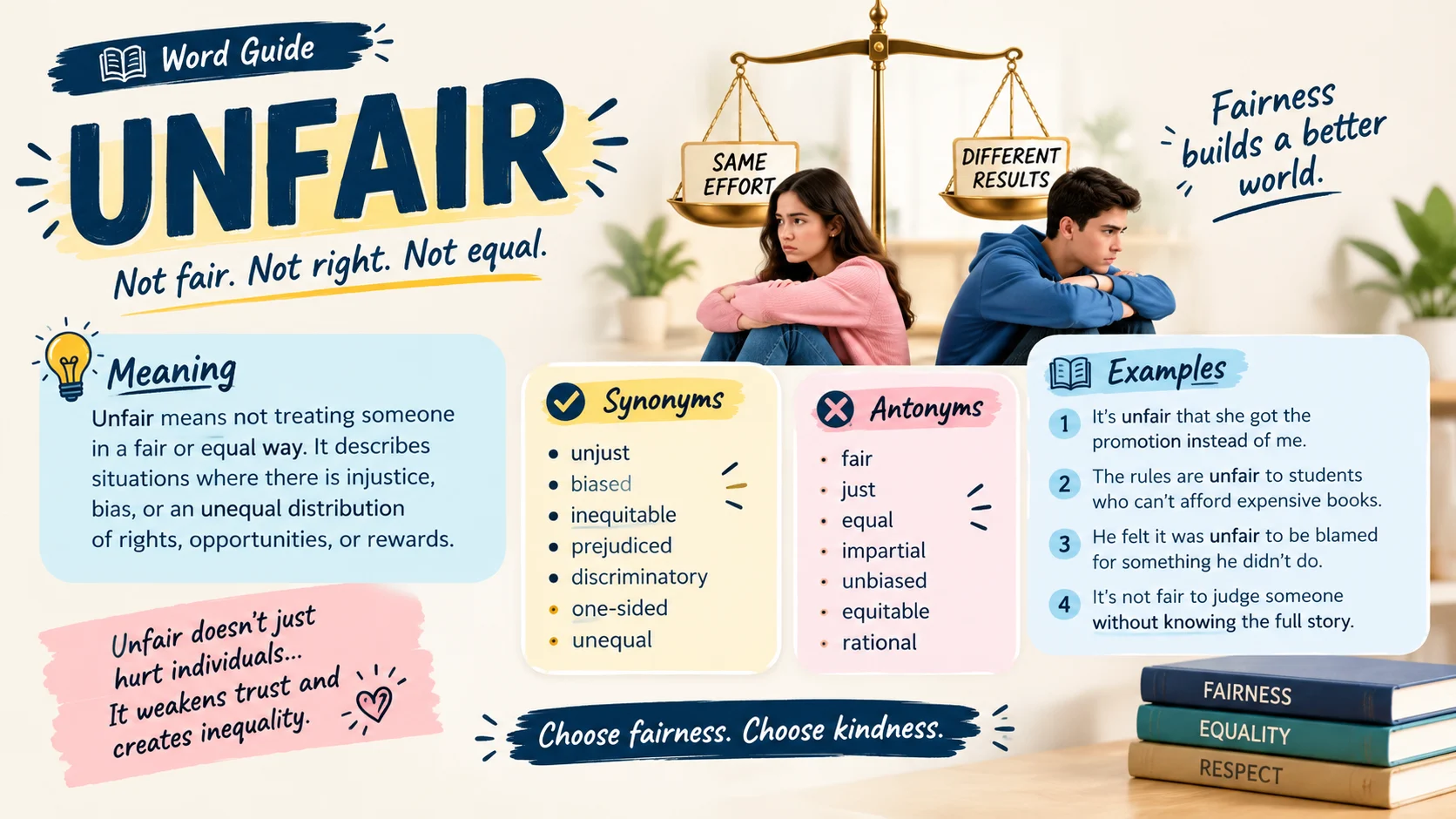
Need a better word than “unfair”? Common synonyms include unjust, inequitable, biased, unreasonable, discriminatory, one-sided, and partial, but the best choice depends on why something is unfair.
Unjust emphasizes a lack of justice, biased suggests unfair preference toward one side, while inequitable focuses on an unfair difference in treatment, opportunity, or distribution.
For example, an unjust decision violates a sense of justice, a biased referee favors one team, and an inequitable system gives people unequal opportunities. If you’re searching for the right synonyms for unfair for an essay, report, workplace message, story, or everyday conversation, this guide will help you choose a precise alternative.
You’ll discover useful words organized by meaning, context, and tone, with clear examples showing exactly when each synonym fits naturally. By the end, you’ll know not only which words can replace “unfair,” but which one best describes the specific kind of unfairness you mean.
Unjust
Meaning: Unjust means not fair, right, or morally acceptable.
Examples:
- The workers called the decision unjust.
- She was angry about the unjust rule.
Inequitable
Meaning: Inequitable means not fair or equal.
Examples:
- The workers faced an inequitable pay system.
- The new rule created an inequitable result.
Unjustified
Meaning: Unjustified means not supported by a good or fair reason.
Examples:
- His punishment was unjustified.
- The teacher said the complaint was unjustified.
Unjustifiable
Meaning: Unjustifiable means impossible to defend as fair or reasonable.
Examples:
- The manager’s action was unjustifiable.
- Such treatment is completely unjustifiable.
Iniquitous
Meaning: Iniquitous means very unfair or morally wrong.
Examples:
- They protested against the iniquitous law.
- The system was described as iniquitous.
Biased
Meaning: Biased means unfairly supporting one person, group, or side.
Examples:
- The judge seemed biased toward the home team.
- Her report was biased against small businesses.
Partial
Meaning: Partial means unfairly supporting one person or side.
Examples:
- The referee appeared partial during the match.
- The manager was accused of being partial.
Partisan
Meaning: Partisan means strongly supporting one side instead of being fair to both sides.
Examples:
- The report gave a partisan view of the issue.
- His comments sounded too partisan.
One-Sided
Meaning: One-sided means showing only one side while ignoring another.
Examples:
- The article presents a one-sided argument.
- Their discussion became one-sided.
Prejudiced
Meaning: Prejudiced means having an unfair opinion before knowing all the facts.
Examples:
- His prejudiced view hurt the new employee.
- We should avoid prejudiced judgments.
Prejudicial
Meaning: Prejudicial means unfairly harmful to a person, group, or case.
Examples:
- The comment could be prejudicial to the defendant.
- The report contained prejudicial statements.
Discriminatory
Meaning: Discriminatory means treating people unfairly because of a personal or group characteristic.
Examples:
- The company removed its discriminatory policy.
- She complained about discriminatory treatment.
Unreasonable
Meaning: Unreasonable means not fair, sensible, or acceptable.
Examples:
- The landlord made an unreasonable demand.
- That deadline seems unreasonable.
Arbitrary
Meaning: Arbitrary means based on personal choice instead of a fair reason or clear rule.
Examples:
- The manager made an arbitrary decision.
- Students disliked the arbitrary rule.
Unequal
Meaning: Unequal means not the same in amount, value, or treatment.
Examples:
- The two workers received unequal pay.
- The teams had unequal chances to win.
Imbalanced
Meaning: Imbalanced means lacking fairness or equality between different sides.
Examples:
- The agreement was clearly imbalanced.
- The system created an imbalanced result.
Unbalanced
Meaning: Unbalanced means not giving equal weight or treatment to different sides.
Examples:
- The article gives an unbalanced view.
- The debate became unbalanced.
Preferential
Meaning: Preferential means giving special treatment to one person or group.
Examples:
- The company gave preferential treatment to senior staff.
- The policy offered preferential access to a small group.
Synonyms of Sigma : Independent, Self-Reliant & Nonconformist
Favoritist
Meaning: Favoritist means showing unfair support for certain people because they are favorites.
Examples:
- His favoritist behavior upset the team.
- The manager was criticized for being favoritist.
Nepotistic
Meaning: Nepotistic means unfairly giving jobs or benefits to family members.
Examples:
- The hiring process looked nepotistic.
- Workers complained about nepotistic decisions.
Unmerited
Meaning: Unmerited means not deserved or earned.
Examples:
- She received unmerited criticism.
- He faced unmerited blame for the error.
Undeserved
Meaning: Undeserved means not earned or not properly deserved.
Examples:
- The player received an undeserved penalty.
- She faced undeserved criticism online.
Unwarranted
Meaning: Unwarranted means not needed, reasonable, or justified.
Examples:
- He received unwarranted criticism.
- The attack was completely unwarranted.
Disproportionate
Meaning: Disproportionate means much too large or small compared with what is reasonable.
Examples:
- The fine was disproportionate to the mistake.
- The punishment seemed disproportionate.
Excessive
Meaning: Excessive means much more than is reasonable or fair.
Examples:
- The company charged an excessive fee.
- The punishment was excessive for a small mistake.
Harsh
Meaning: Harsh means too strict, severe, or unkind.
Examples:
- The teacher gave a harsh punishment.
- His words were harsh and hurtful.
Oppressive
Meaning: Oppressive means using unfair power to control or hurt people.
Examples:
- Citizens lived under oppressive rules.
- Workers wanted to end the oppressive system.
Tyrannical
Meaning: Tyrannical means using power in a cruel and unfair way.
Examples:
- The ruler became tyrannical.
- People protested against the tyrannical leader.
Exploitative
Meaning: Exploitative means unfairly using someone for your own benefit.
Examples:
- The workers faced exploitative conditions.
- They rejected the exploitative contract.
Predatory
Meaning: Predatory means taking unfair advantage of people who are weaker or vulnerable.
Examples:
- The bank was accused of predatory lending.
- The law aims to stop predatory business practices.
Abusive
Meaning: Abusive means treating someone in a harmful, cruel, or unfair way.
Examples:
- She left an abusive workplace.
- The company was accused of abusive practices.
Unethical
Meaning: Unethical means not morally right or fair.
Examples:
- The company used unethical methods.
- He refused to support the unethical plan.
Immoral
Meaning: Immoral means going against basic ideas of right and wrong.
Examples:
- They called the action immoral.
- She refused to support the immoral policy.
Corrupt
Meaning: Corrupt means dishonest and willing to use power for personal gain.
Examples:
- The official was accused of being corrupt.
- Corrupt practices can hurt ordinary people.
Dishonest
Meaning: Dishonest means not truthful, fair, or trustworthy.
Examples:
- The seller used dishonest tactics.
- His dishonest actions damaged the team’s trust.
Deceptive
Meaning: Deceptive means misleading people by hiding or changing the truth.
Examples:
- The advertisement was deceptive.
- The seller used deceptive claims.
Synonyms for Went: 45+ Alternatives for Every Context
Manipulative
Meaning: Manipulative means unfairly controlling someone to get what you want.
Examples:
- His manipulative behavior caused problems.
- She noticed the manipulative sales tactic.
Underhanded
Meaning: Underhanded means secretly using dishonest or unfair methods.
Examples:
- He used an underhanded trick to win.
- The team rejected the underhanded plan.
Unscrupulous
Meaning: Unscrupulous means willing to act unfairly without caring about honesty or morals.
Examples:
- An unscrupulous seller may trick customers.
- The company was accused of unscrupulous conduct.
Inconsiderate
Meaning: Inconsiderate means not thinking about other people’s needs or feelings.
Examples:
- It was inconsiderate to leave her out.
- His inconsiderate actions upset the group.
Unkind
Meaning: Unkind means not caring, friendly, or fair toward someone.
Examples:
- Her unkind words made him sad.
- It was unkind to blame her in public.
Cruel
Meaning: Cruel means causing pain or suffering without care for others.
Examples:
- The punishment was cruel.
- His cruel comments upset the child.
Wrong
Meaning: Wrong can mean morally unfair, bad, or not right.
Examples:
- It was wrong to blame the new worker.
- She knew the decision was wrong.
Improper
Meaning: Improper means not right, suitable, or acceptable.
Examples:
- The manager used improper methods.
- The official received an improper benefit.
Inappropriate
Meaning: Inappropriate means not suitable or acceptable for the situation.
Examples:
- His comment was inappropriate.
- The teacher called the behavior inappropriate.
Unacceptable
Meaning: Unacceptable means too unfair, harmful, or wrong to be accepted.
Examples:
- The treatment of workers was unacceptable.
- Such behavior is completely unacceptable.
Disadvantageous
Meaning: Disadvantageous means putting someone in a less helpful or weaker position.
Examples:
- The contract was disadvantageous to small firms.
- The rule placed them in a disadvantageous position.
Unfavorable
Meaning: Unfavorable means not helpful, positive, or beneficial.
Examples:
- The workers faced unfavorable conditions.
- The deal included unfavorable terms.
Lopsided
Meaning: Lopsided means unfairly giving much more power or benefit to one side.
Examples:
- The contract was too lopsided.
- They rejected the lopsided agreement.
Inegalitarian
Meaning: Inegalitarian means supporting or creating unequal treatment or opportunities.
Examples:
- Critics called the system inegalitarian.
- The policy created an inegalitarian workplace.
Prejudicially
Meaning: Prejudicially means in a way that unfairly harms a person, group, or case.
Examples:
- The judge said the issue had been handled prejudicially.
- The matter was presented prejudicially.
Frequently Asked Questions About Synonyms for Unfair
What is the best synonym for unfair?
Unjust is one of the closest general synonyms for unfair. It works well when something is morally wrong or not fair.
What is a simple word for unfair?
Unjust, unequal, and biased are useful simple alternatives. The best choice depends on the situation.
What is another word for unfair treatment?
Useful choices include unjust, biased, discriminatory, inequitable, oppressive, and unequal. Each word has a slightly different meaning.
What is a synonym for unfair in an essay?
For an essay, strong choices include unjust, inequitable, biased, discriminatory, arbitrary, and unreasonable. These words can make your writing more precise.
What is the opposite of unfair?
The main opposite of unfair is fair. Other useful opposites include just, equal, reasonable, impartial, and balanced.
What is a synonym for unfair behavior?
Depending on the situation, you can use unjust, biased, dishonest, unethical, exploitative, manipulative, or underhanded.
How can I avoid repeating the word unfair?
Choose a synonym based on the exact meaning you want. Use biased when someone favors one side, unequal when people receive different treatment, arbitrary when there is no fair reason, and discriminatory when people are treated unfairly because of a personal or group characteristic.
Conclusion
Learning synonyms for unfair can make your writing, speaking, and communication stronger. The right word helps you explain unfair rules, decisions, treatment, and behavior more clearly. Students can practice these words in essays, while bloggers and writers can use them to avoid repetition. Try using new synonyms in emails, schoolwork, and daily conversations. The more you practice, the easier it becomes to choose the perfect word for every situation.

I am Joseph Clark, a vocabulary and language content writer at SynonymLibrary.com. I create clear, practical synonym guides that help readers improve their writing, word choice, and communication skills. My goal is to make language learning simple, accurate, and useful for students, writers, professionals, and everyday learners.