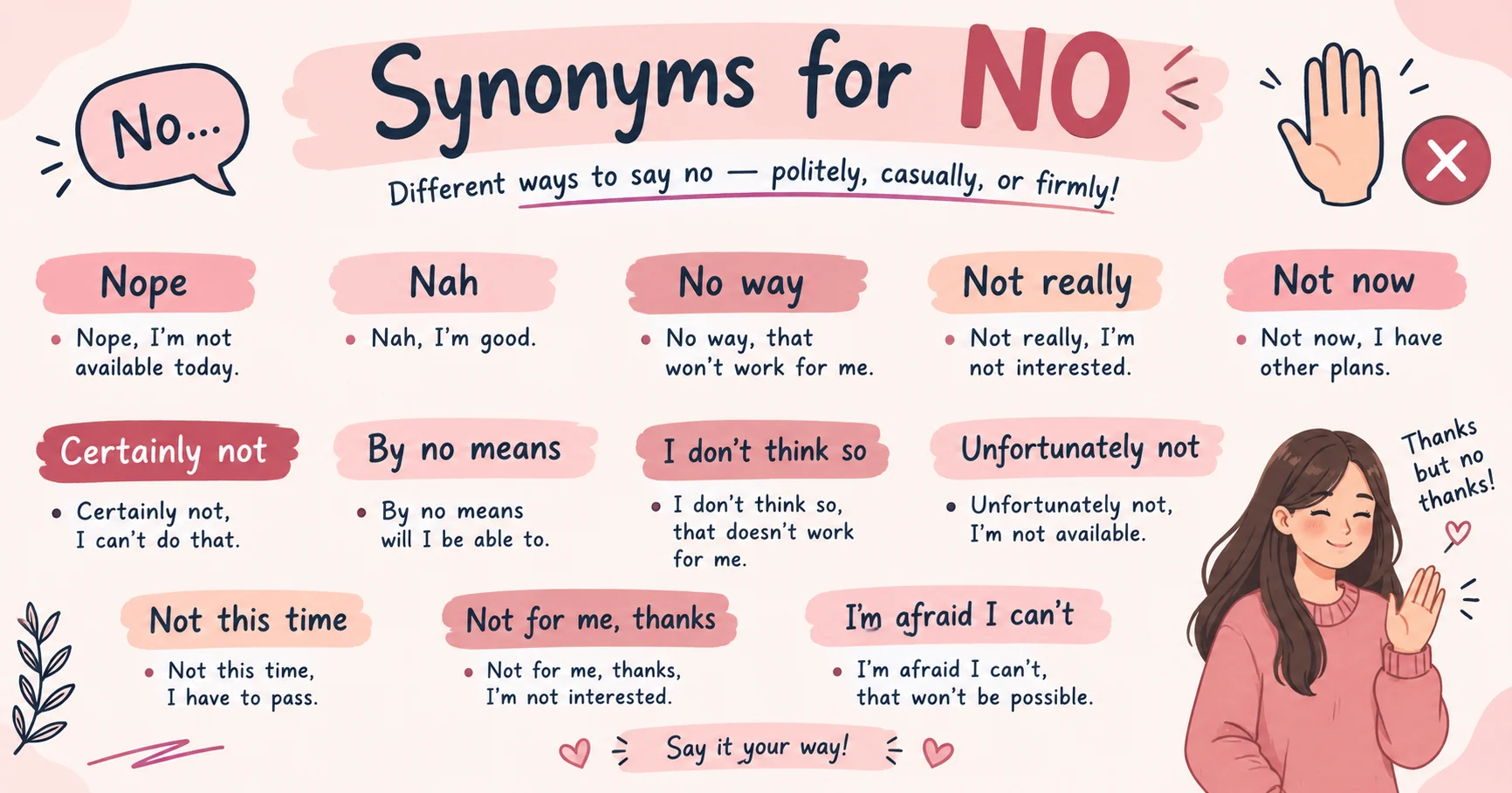
Sometimes “no” is all you need, but in other sentences, a different negative word or phrase can make your meaning clearer, more polite, or more precise. Synonyms for no can include related alternatives such as not, none, neither, never, negative, not at all, and by no means, but they do not work in the same grammatical or contextual situations.
No can give a negative answer, show that something is absent, or indicate that something is not permitted. For example, “No, I don’t agree” rejects a statement, “There is no water” shows that something is absent, and “No entry” indicates that entry is not allowed. Some alternatives also change the tone: “not really” can sound softer, while “absolutely not” or “by no means” can sound much more emphatic.
Because no has several uses, choosing the right alternative depends on your sentence, grammar, meaning, and intended tone. If you’re searching for synonyms for no for essays, schoolwork, professional writing, conversations, or everyday English, this guide explains useful alternatives, their differences, and when each one fits best.
What Are Synonyms for No?
Common synonyms for no and natural alternatives include nope, nah, nay, negative, not really, absolutely not, no way, I don’t think so, I’d rather not, I’ll pass, I must decline, refuse, reject, deny, oppose, object, veto, prohibit, ban, and disallow.
However, these words are not all interchangeable. Some are casual, some are polite, some are formal, and others are used when you reject an idea, refuse a request, or say that something is not allowed.
Nope
Meaning: “Nope” is a casual way to say “no.”
Examples:
- “Are you coming with us?” “Nope.”
- “Did you finish the movie?” “Nope, not yet.”
Nah
Meaning: “Nah” is a very informal way to say no or show that you do not want something.
Examples:
- “Want some cake?” “Nah, I’m full.”
- “Should we leave now?” “Nah, let’s wait.”
Nay
Meaning: “Nay” is an old-fashioned or formal way to say no.
Examples:
- The members voted nay on the proposal.
- His answer was a clear nay.
Negative
Meaning: “Negative” can be used as a firm or formal way to give a no answer.
Examples:
- “Can we change the date?” “Negative.”
- The officer gave a negative response.
Not Really
Meaning: “Not really” is a soft way to say no or show slight disagreement.
Examples:
- “Are you hungry?” “Not really.”
- “Do you like this design?” “Not really.”
Not at All
Meaning: “Not at all” can express a complete negative answer in certain questions.
Examples:
- “Did the noise bother you?” “Not at all.”
- “Are you upset with me?” “Not at all.”
Absolutely Not
Meaning: “Absolutely not” is a very strong and clear refusal.
Examples:
- “Can I use your laptop without asking?” “Absolutely not.”
- “Would you lie for me?” “Absolutely not.”
Certainly Not
Meaning: “Certainly not” is a firm way to say no, often with a formal tone.
Examples:
- “Would you share my private message?” “Certainly not.”
- “Is that an acceptable solution?” “Certainly not.”
Definitely Not
Meaning: “Definitely not” gives a strong and certain negative answer.
Examples:
- “Are you buying that expensive phone?” “Definitely not.”
- “Will I forget your birthday?” “Definitely not.”
By No Means
Meaning: “By no means” is a formal way to say that something is definitely not true or acceptable.
Examples:
- This task is by no means easy.
- By no means should you share that password.
No Way
Meaning: “No way” is a strong and usually informal way to refuse or show disbelief.
Examples:
- “Can I borrow your new car?” “No way.”
- “Are you really moving tomorrow?” “No way!”
Not a Chance
Meaning: “Not a chance” is a strong way to say that something will not happen.
Examples:
- “Will you change your mind?” “Not a chance.”
- There is not a chance I will miss the event.
Not Likely
Meaning: “Not likely” means something probably will not happen or be accepted.
Examples:
- “Will he join us?” “Not likely.”
- It is not likely that I will finish tonight.
I Don’t Think So
Meaning: “I don’t think so” is a soft and natural way to disagree or give a negative answer.
Examples:
- “Will the store be open?” “I don’t think so.”
- “Should we take this road?” “I don’t think so.”
I Don’t Believe So
Meaning: “I don’t believe so” is a polite way to say that you think the answer is no.
Examples:
- “Is Sarah coming today?” “I don’t believe so.”
- “Did he send the email?” “I don’t believe so.”
I’m Afraid Not
Meaning: “I’m afraid not” is a polite way to give a negative answer.
Examples:
- “Can I book the room today?” “I’m afraid not.”
- “Is there another seat available?” “I’m afraid not.”
I’m Afraid I Can’t
Meaning: “I’m afraid I can’t” is a polite way to refuse a request or invitation.
Examples:
- I’m afraid I can’t attend the meeting.
- I’m afraid I can’t help you tonight.
I Can’t
Meaning: “I can’t” means you are unable or not able to do something.
Examples:
- I can’t stay for dinner tonight.
- I can’t join the trip this weekend.
I Cannot
Meaning: “I cannot” is a more formal way to say that you are unable or unwilling to do something.
Examples:
- I cannot accept the offer.
- I cannot attend the meeting tomorrow.
I Won’t
Meaning: “I won’t” means you refuse to do something or say that you will not do it.
Examples:
- I won’t share your secret.
- I won’t change my answer.
I’d Rather Not
Meaning: “I’d rather not” is a polite and gentle way to refuse something.
Examples:
- I’d rather not discuss that topic.
- I’d rather not go out tonight.
I’ll Pass
Meaning: “I’ll pass” is a casual and polite way to say that you do not want something.
Examples:
- “Want some dessert?” “I’ll pass.”
- “Do you want to join the game?” “I’ll pass.”
No Thanks
Meaning: “No thanks” is a friendly way to refuse an offer.
Examples:
- “Would you like some coffee?” “No thanks.”
- “Do you need a ride?” “No thanks, I’m okay.”
No Thank You
Meaning: “No thank you” is a polite way to refuse something while showing good manners.
Examples:
- “Would you like another plate?” “No thank you.”
- “Can I help you with that?” “No thank you.”
Not for Me
Meaning: “Not for me” politely means that something is not suitable or appealing to you.
Examples:
- Spicy food is not for me.
- “Want to watch a horror movie?” “Not for me.”
Not Today
Meaning: “Not today” means you do not want to do something at the present time.
Examples:
- “Want to go shopping?” “Not today.”
- I’m too tired to exercise today, so not today.
Not Now
Meaning: “Not now” means you do not want something to happen at the present moment.
Examples:
- “Can we talk?” “Not now, please.”
- I can’t help you right now, so not now.
Not This Time
Meaning: “Not this time” is a soft way to refuse an offer or request for the current occasion.
Examples:
- “Will you come with us?” “Not this time.”
- I decided not to enter the contest this time.
Maybe Another Time
Meaning: “Maybe another time” is a gentle way to refuse an invitation without sounding too direct.
Examples:
- “Want to grab lunch?” “Maybe another time.”
- I can’t join tonight, but maybe another time.
I’m Not Interested
Meaning: “I’m not interested” clearly says that you do not want an offer or opportunity.
Examples:
- Thanks, but I’m not interested in the offer.
- I’m not interested in buying a new phone.
That Won’t Work for Me
Meaning: “That won’t work for me” politely says that a plan or suggestion does not suit you.
Examples:
- Friday won’t work for me.
- That meeting time won’t work for me.
That’s Not Possible
Meaning: “That’s not possible” says that something cannot happen or be done.
Examples:
- I’m sorry, but that’s not possible today.
- Changing the order now is not possible.
Synonyms for Lonely: 50 +Words for Every Shade of Loneliness
I’m Not Available
Meaning: “I’m not available” politely says that you cannot meet, help, or take part at a certain time.
Examples:
- I’m not available on Monday morning.
- Sorry, I’m not available for the meeting.
I Can’t Commit to That
Meaning: “I can’t commit to that” means you are not willing or able to promise something.
Examples:
- I can’t commit to that deadline.
- I can’t commit to working every weekend.
I Must Decline
Meaning: “I must decline” is a formal and polite way to refuse an offer or request.
Examples:
- Thank you for the invitation, but I must decline.
- I appreciate the offer, but I must decline.
I Respectfully Decline
Meaning: “I respectfully decline” is a formal way to refuse something while showing respect.
Examples:
- Thank you for the offer, but I respectfully decline.
- I respectfully decline the invitation.
Decline
Meaning: “Decline” means to politely refuse an offer, invitation, or request.
Examples:
- She decided to decline the invitation.
- I had to decline the job offer.
Refuse
Meaning: “Refuse” means to say no because you do not agree to do or accept something.
Examples:
- He refused to answer the question.
- She refused the offer politely.
Reject
Meaning: “Reject” means to not accept an idea, offer, application, or proposal.
Examples:
- The editor rejected my article.
- They rejected the new proposal.
Deny
Meaning: “Deny” means to say that something is not true or to refuse to admit something.
Examples:
- He denied the accusation.
- She denied taking the money.
Oppose
Meaning: “Oppose” means to be against an idea, plan, or action.
Examples:
- Many workers oppose the new rule.
- I oppose the plan to close the library.
Object
Meaning: “Object” means to say that you disagree with or disapprove of something.
Examples:
- I object to this change.
- She objected to the new rule.
Disapprove
Meaning: “Disapprove” means to show that you do not approve of something.
Examples:
- Her parents disapprove of the plan.
- I strongly disapprove of that behavior.
Veto
Meaning: “Veto” means to officially stop or reject a decision or proposal.
Examples:
- The board vetoed the proposal.
- The leader used a veto to stop the plan.
Forbid
Meaning: “Forbid” means to officially or firmly say that someone must not do something.
Examples:
- My parents forbid me from driving at night.
- The school forbids students from using phones during tests.
Prohibit
Meaning: “Prohibit” means to officially say that something is not allowed.
Examples:
- The rules prohibit smoking inside.
- The law prohibits this type of activity.
Ban
Meaning: “Ban” means to officially stop people from doing or using something.
Examples:
- The school banned phones during exams.
- The city banned parking on this street.
Disallow
Meaning: “Disallow” means to refuse to accept or permit something.
Examples:
- The rules disallow late entries.
- The system disallowed the payment.
Dissent
Meaning: “Dissent” means to openly disagree with an opinion or decision.
Examples:
- Two members expressed dissent during the meeting.
- She voiced her dissent about the decision.
Refusal
Meaning: “Refusal” is the act of saying no to a request, offer, or demand.
Examples:
- His refusal surprised the team.
- We received a refusal by email.
Rejection
Meaning: “Rejection” is the act of not accepting an offer, idea, application, or proposal.
Examples:
- She received a rejection from the company.
- The rejection of the proposal caused a long discussion.
Choosing the Right Alternative to “No”
Not every alternative to no can replace it in every sentence. The best choice depends on your purpose and tone.
| Situation | Natural choice |
|---|---|
| Casual conversation | Nope, nah |
| Polite refusal | No thanks, I’d rather not |
| Soft disagreement | Not really, I don’t think so |
| Strong refusal | Absolutely not, no way |
| Professional refusal | I must decline, I respectfully decline |
| Refusing an offer | Decline, reject |
| Refusing to do something | Refuse, I can’t |
| Saying something is untrue | Deny |
| Showing disagreement | Oppose, object, dissent |
| Saying something is not allowed | Forbid, prohibit, ban, disallow |
| Official rejection | Veto, reject |
This is why synonyms for no should be chosen by context rather than by replacing “no” with the first similar word you find.
Synonyms for Confidence: 50 Words for Trust, Self-Belief & Certainty
Synonyms for No in Casual English
Casual conversations often use short and natural expressions. Words and phrases such as nope, nah, not really, no way, I’ll pass, and not today can sound more natural with friends and family.
For example, instead of saying:
“No, I don’t want any.”
You might say:
“No thanks, I’m good.”
Or:
“I’ll pass.”
These expressions are friendly, but some should not be used in very formal writing.
Synonyms for No in Professional English
Professional communication usually needs a polite and clear refusal. Expressions such as I must decline, I respectfully decline, I’m afraid I can’t, and that won’t work for me can soften a negative response.
For example:
“Thank you for the offer, but I must decline.”
This sounds more professional than a short:
“No.”
The goal is not to make your answer longer than necessary. It is to choose wording that fits the situation.
Synonyms for No in Academic Writing
In essays and academic writing, it is usually better to express the exact idea instead of replacing every “no” with an unusual synonym.
Words such as reject, deny, oppose, dissent, and disapprove can be useful when their specific meanings fit the sentence.
For example:
“The researchers rejected the original explanation.”
Here, rejected is more precise than simply writing “said no to.”
Strong Ways to Say No
When you need a firm refusal, expressions such as absolutely not, certainly not, definitely not, no way, and not a chance make your answer clear.
Use these carefully because they can sound strong.
For example:
“Can I use your private account?”
“Absolutely not.”
That answer leaves little room for misunderstanding.
Polite Ways to Say No
If you want to refuse without sounding rude, try no thanks, no thank you, I’d rather not, I’m afraid not, maybe another time, or I must decline.
The best phrase depends on the relationship and situation.
A friendly refusal might be:
“No thanks, I’m okay.”
A professional refusal might be:
“Thank you for the invitation, but I must decline.”
What Is the Difference Between “No,” “Nope,” and “Nah”?
No is the standard word and works in almost every setting.
Nope is casual and friendly.
Nah is even more informal and is common in relaxed conversations.
For example:
- “No, thank you.” — neutral and polite
- “Nope.” — casual
- “Nah.” — very casual
Avoid very casual forms such as nah in formal emails, academic writing, or professional documents.
Frequently Asked Questions About Synonyms for No
What are the most common synonyms for no?
Common direct or closely related alternatives include nope, nah, nay, negative, and not really. Other phrases such as no thanks, I’d rather not, and I must decline are useful ways to express refusal.
What is a polite synonym for no?
No thanks, no thank you, I’d rather not, I’m afraid not, and I must decline are polite ways to refuse something. The best choice depends on how formal the situation is.
What is a casual synonym for no?
Nope and nah are common casual alternatives. I’ll pass and not really can also work in relaxed conversations.
What is a formal way to say no?
In formal situations, you can use I must decline, I respectfully decline, I’m afraid I can’t, or I cannot. These expressions can sound more professional than a short “no.”
What is a strong way to say no?
Absolutely not, certainly not, definitely not, no way, and not a chance can express a strong refusal. Some of these phrases are informal, so choose one that fits the situation.
What is another word for no in an essay?
There is no single replacement that works in every essay. Words such as reject, deny, oppose, disapprove, or dissent may work when their exact meanings fit the sentence.
Are all synonyms for no interchangeable?
No. This is important. Nope and nah are casual forms of “no,” while deny means to say something is not true, reject means not to accept something, and prohibit means to officially say something is not allowed. Always choose the word that matches your exact meaning.
Conclusion
Learning synonyms for no gives you more control over your English. You can sound casual with “nope,” polite with “no thanks,” gentle with “I’d rather not,” or formal with “I must decline.” The key is understanding that related words do not always have the same meaning. Practice these alternatives in emails, essays, messages, and daily conversations. With regular use, you can avoid repetition, communicate more clearly, and choose the right words for every situation.

I am Joseph Clark, a vocabulary and language content writer at SynonymLibrary.com. I create clear, practical synonym guides that help readers improve their writing, word choice, and communication skills. My goal is to make language learning simple, accurate, and useful for students, writers, professionals, and everyday learners.







