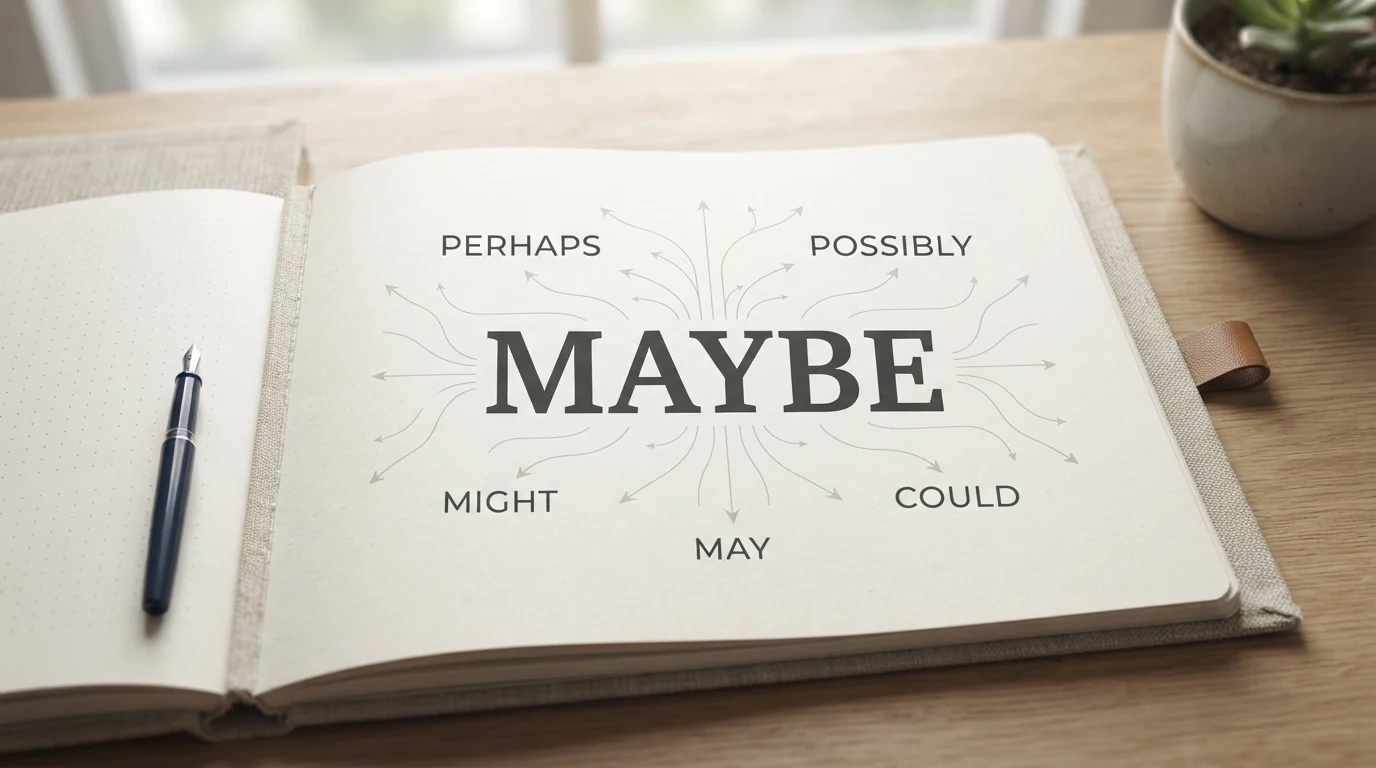
Want to replace “maybe” without changing the meaning of your sentence? Synonyms for maybe include perhaps and possibly, which are the closest alternatives, while words and phrases such as potentially, conceivably, and it may be that can work in more specific contexts. Maybe is an adverb used to show that something is possible but not certain.
For example, you might say, “Maybe I’ll join you later,” or replace it with “Perhaps I’ll join you later.” Although these alternatives express possibility, they can differ in formality, emphasis, and sentence structure. Perhaps often sounds slightly more formal, while possibly can emphasize that something is one possible outcome.
Other alternatives may change the strength or focus of the idea, so they are not always interchangeable with maybe. If you’re searching for synonyms for maybe for essays, schoolwork, professional writing, conversation, or everyday English, this guide explains useful alternatives, their differences, and when to use each one.
Perhaps
Meaning: Perhaps means something is possible but you are not certain, and it is a neutral alternative to “maybe.”
Examples:
- Perhaps we can meet after lunch.
- Perhaps she forgot about the meeting.
Possibly
Meaning: Possibly means something may happen or may be true, and it can sound a little more formal than “maybe.”
Examples:
- We could possibly finish the work today.
- Possibly, he took the wrong train.
Conceivably
Meaning: Conceivably means something is possible to imagine or believe, although it may not be likely.
Examples:
- She could conceivably arrive before noon.
- This plan could conceivably work.
Potentially
Meaning: Potentially means something could happen or become possible in a particular situation.
Examples:
- This change could potentially save money.
- The new road could potentially reduce traffic.
Plausibly
Meaning: Plausibly means something seems possible and believable.
Examples:
- He could plausibly finish the project alone.
- She plausibly explained why she was late.
Perchance
Meaning: Perchance means “perhaps” or “possibly,” but it sounds old-fashioned or literary.
Examples:
- Perchance we shall meet again.
- Perchance he knows the answer.
Mayhap
Meaning: Mayhap means “perhaps,” but it is uncommon and old-fashioned.
Examples:
- Mayhap we will find a better solution.
- Mayhap she will return tomorrow.
Could Be
Meaning: Could be means something is possible but not certain.
Examples:
- That could be the right answer.
- He could be at home now.
Might Be
Meaning: Might be means something is possible but you are not sure it is true.
Examples:
- She might be busy right now.
- That might be the reason he left.
May Be
Meaning: May be means “might be” and is used as a verb phrase to show possibility.
Examples:
- He may be at work today.
- This may be the best choice.
Could
Meaning: Could can show that something is possible.
Examples:
- We could go there tomorrow.
- She could join us later.
Might
Meaning: Might shows that something may happen, but there is no certainty.
Examples:
- I might call you tonight.
- They might arrive late.
May
Meaning: May is a modal verb that can show that something is possible.
Examples:
- She may come with us.
- It may rain this evening.
It Could Be
Meaning: It could be means a person thinks something is possible.
Examples:
- It could be a simple mistake.
- It could be the answer we need.
It Might Be
Meaning: It might be means something is possible but uncertain.
Examples:
- It might be too late now.
- It might be a good idea.
It May Be
Meaning: It may be means something is possible and has a slightly formal tone.
Examples:
- It may be the safest option.
- It may be difficult to finish today.
It Is Possible
Meaning: It is possible means something can happen or can be true.
Examples:
- It is possible that she missed the bus.
- It is possible that we will finish early.
It Is Possible That
Meaning: It is possible that introduces an uncertain idea that could be true.
Examples:
- It is possible that he forgot the date.
- It is possible that prices will rise.
It Could Happen
Meaning: It could happen means an event is possible even though it is not certain.
Examples:
- A delay could happen because of the weather.
- Anything could happen during the trip.
It Might Happen
Meaning: It might happen means an event may happen, but there is uncertainty.
Examples:
- The meeting might happen tomorrow.
- A change might happen later.
It May Happen
Meaning: It may happen means an event is possible and can sound slightly more formal.
Examples:
- The event may happen next week.
- A delay may happen during the trip.
There Is a Chance
Meaning: There is a chance means something has some possibility of happening.
Examples:
- There is a chance she will come.
- There is a chance of rain tonight.
There Is a Possibility
Meaning: There is a possibility means something may happen or may be true.
Examples:
- There is a possibility that he will agree.
- There is a possibility of another delay.
There Could Be
Meaning: There could be means something may exist or happen.
Examples:
- There could be another reason.
- There could be a problem with the file.
There Might Be
Meaning: There might be means something may exist or happen, but you are not sure.
Examples:
- There might be a mistake in the report.
- There might be another way to solve it.
There May Be
Meaning: There may be means something is possible and often sounds more formal.
Examples:
- There may be a better answer.
- There may be some changes tomorrow.
There Could Possibly Be
Meaning: There could possibly be emphasizes that something is one possible explanation or result.
Examples:
- There could possibly be another reason.
- There could possibly be a problem with the system.
There Might Possibly Be
Meaning: There might possibly be means something may exist or happen, with extra emphasis on uncertainty.
Examples:
- There might possibly be a mistake.
- There might possibly be another solution.
It Is Conceivable
Meaning: It is conceivable means something is possible to imagine or accept as a possibility.
Examples:
- It is conceivable that they will change the plan.
- It is conceivable that he forgot the meeting.
It Is Plausible
Meaning: It is plausible means something is possible and seems believable.
Examples:
- It is plausible that she missed the train.
- It is plausible that the delay caused the problem.
It Seems Possible
Meaning: It seems possible means something looks possible based on what you know.
Examples:
- It seems possible that we can finish today.
- It seems possible that he knows about it.
It Appears Possible
Meaning: It appears possible means something looks possible from the available information.
Examples:
- It appears possible that they will agree.
- It appears possible to finish before Friday.
Possibly So
Meaning: Possibly so means something may be true, but the speaker is not fully certain.
Examples:
- “Did she forget?” “Possibly so.”
- “Is that the reason?” “Possibly so.”
Could Possibly
Meaning: Could possibly shows that something is possible while keeping the result uncertain.
Examples:
- We could possibly finish by Friday.
- She could possibly help us tomorrow.
Might Possibly
Meaning: Might possibly emphasizes that something is uncertain but could happen.
Examples:
- He might possibly join us later.
- The price might possibly change next month.
May Possibly
Meaning: May possibly means something may happen and gives a cautious sense of possibility.
Examples:
- The plan may possibly change.
- She may possibly arrive later.
Probably
Meaning: Probably means something is more likely to happen than not, so it shows more certainty than “maybe.”
Examples:
- I will probably stay home tonight.
- She will probably call tomorrow.
Likely
Meaning: Likely means something has a good chance of happening or being true, so it is stronger than “maybe.”
Examples:
- He is likely to arrive soon.
- It is likely that prices will rise.
Presumably
Meaning: Presumably means something is probably true based on what you already know.
Examples:
- Presumably, they have already left.
- Presumably, she knows about the change.
Chances Are
Meaning: Chances are means something is probably true or likely to happen.
Examples:
- Chances are, he will call later.
- Chances are, they already know.
Odds Are
Meaning: Odds are means something is likely to happen or be true.
Examples:
- Odds are, we will see her there.
- Odds are, the store is already closed.
In All Likelihood
Meaning: In all likelihood means something is very likely to happen or be true.
Examples:
- In all likelihood, they will accept the offer.
- In all likelihood, she is already home.
In All Probability
Meaning: In all probability means something is very likely based on the information available.
Examples:
- In all probability, the meeting will continue.
- In all probability, he has already heard the news.
Not Unlikely
Meaning: Not unlikely means something has a reasonable chance of happening or being true.
Examples:
- It is not unlikely that she will join us.
- A delay is not unlikely during the holiday season.
Synonyms for Learned: 55+ Precise Alternatives by Meaning
Seemingly
Meaning: Seemingly means something appears to be true, although you are not completely certain.
Examples:
- Seemingly, everything went well.
- The problem is seemingly easy to fix.
Apparently
Meaning: Apparently means something seems to be true based on information you have received.
Examples:
- Apparently, the store is closed today.
- Apparently, she moved last month.
It Seems
Meaning: It seems means something appears to be true, but the speaker is not presenting it as certain.
Examples:
- It seems he is feeling better.
- It seems they changed their plans.
It Appears
Meaning: It appears means something looks or seems to be true based on what is known.
Examples:
- It appears that he is away.
- It appears we took the wrong road.
For All We Know
Meaning: For all we know means something is possible because we do not have enough information to be certain.
Examples:
- For all we know, she may already be there.
- For all we know, the plan could change tonight.
Quite Possibly
Meaning: Quite possibly means something has a strong possibility of being true or happening.
Examples:
- She is quite possibly the best person for the job.
- He could quite possibly arrive before us.
Very Possibly
Meaning: Very possibly means something is quite possible, with strong emphasis on the chance.
Examples:
- They could very possibly win the contract.
- She may very possibly need more time.
It Could Well Be
Meaning: It could well be means something is a realistic or fairly strong possibility.
Examples:
- It could well be the answer we need.
- That could well be the reason.
It May Well Be
Meaning: It may well be means something is quite possible and may be true.
Examples:
- It may well be the best option.
- That may well be why he left.
Synonyms for Manage: Words for Handling, Leading & Organizing
FAQs About Synonyms for Maybe
What is the best synonym for maybe?
Perhaps is one of the closest and most natural synonyms for maybe. Both words show that something is possible but not certain.
Is perhaps the same as maybe?
Yes, perhaps and maybe usually express the same basic idea of possibility. “Maybe” often sounds more casual, while “perhaps” can sound more neutral or slightly more formal.
What is a formal synonym for maybe?
Possibly, perhaps, conceivably, and potentially can work in more formal writing. The best choice depends on the sentence and the level of certainty you want to show.
What is a casual synonym for maybe?
Could, might, and could be are common natural choices in everyday English. Maybe itself is also very common in casual conversation.
Is probably the same as maybe?
No. Probably shows more confidence than maybe. “Maybe” means something is possible, while “probably” suggests that something is more likely to happen or be true.
What is the difference between maybe and may be?
Maybe is one word and usually works as an adverb meaning “perhaps” or “possibly.” May be is two words and works as a verb phrase.
For example:
- Maybe she is busy.
- She may be busy.
Both express possibility, but they have different grammatical structures.
Can I use these synonyms in academic writing?
Yes, but choose them based on tone and meaning. Perhaps, possibly, it is possible, and it is plausible can work well in formal writing. Avoid old-fashioned choices such as perchance and mayhap unless the style calls for them.
Conclusion
Learning synonyms for maybe helps you express possibility with greater variety and accuracy. Some choices, such as perhaps and possibly, are very close to “maybe,” while others show stronger certainty or a different tone. This makes them useful for students, bloggers, content writers, and daily English users. Practice these words in emails, essays, blog posts, and conversations. The more you use them, the easier it becomes to choose the right expression naturally.