Have you ever written the word “argue” over and over again in an essay and felt like it just was not strong enough? That happens to a lot of students and writers every single day.
Think about this. You write: “They argue about everything.” It is plain and flat. But what if you wrote: “They clash and bicker about everything”? Now it sounds real, vivid, and full of life.
The word argue means to disagree with someone and speak strongly about your different opinion. It can happen between friends, family members, coworkers, or even countries. You see it in news articles, stories, school essays, and daily conversations all the time.
Learning synonyms for argue helps you describe disagreements and debates in a much more powerful and precise way. It makes your writing more interesting and your meaning much clearer.
Let us now explore 50 great synonyms for argue that you can start using today.
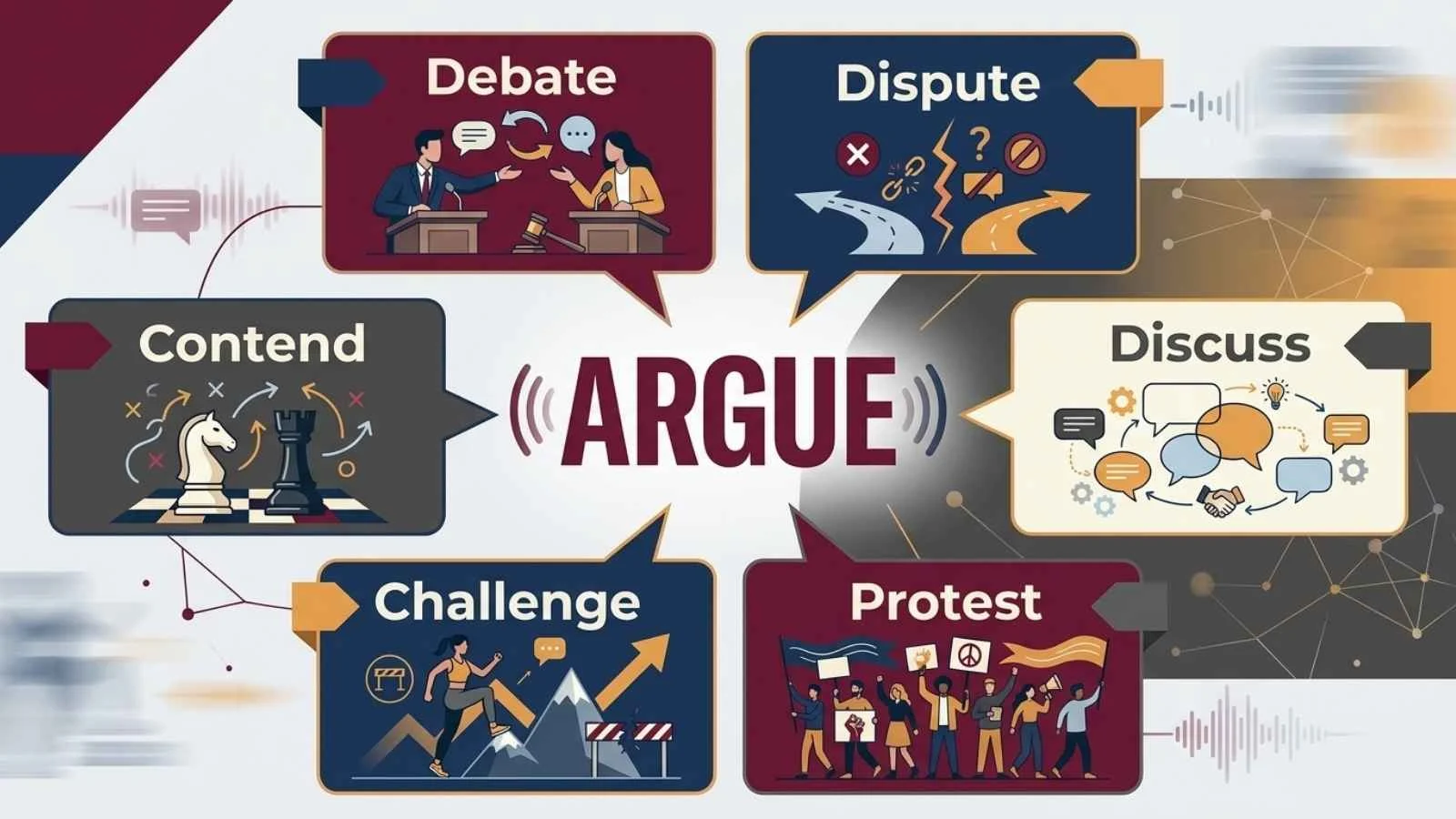
1. Debate
Meaning:
Debate means to talk about a topic where two sides share different opinions in an organized way.
Examples:
- The students were asked to debate whether homework should be banned in schools.
- Politicians often debate new laws before they are officially passed and signed.
2. Dispute
Meaning:
Dispute means to say that something is wrong or to disagree strongly with someone about it.
Examples:
- The two neighbors began to dispute who owned the fence between their gardens.
- She disputed the charges on her bill and asked the company to check it again.
3. Quarrel
Meaning:
Quarrel means to have an angry disagreement with someone over something that upset you.
Examples:
- The two brothers quarreled over who would get to use the computer first that night.
- They quarreled for an hour before finally deciding to talk calmly and work it out.
4. Bicker
Meaning:
Bicker means to argue about small and unimportant things in a repeated and annoying way.
Examples:
- The children bickered all the way to school about whose turn it was to sit by the window.
- She was tired of hearing her coworkers bicker over the same little issues every morning.
5. Clash
Meaning:
Clash means to come into a strong disagreement or conflict with someone because of different views.
Examples:
- The two managers clashed during the meeting over how the budget should be divided.
- Their strong personalities clashed from the very first day they worked together.
6. Wrangle
Meaning:
Wrangle means to argue in a long, noisy, and complicated way that is hard to resolve.
Examples:
- The lawyers wrangled over the details of the contract for several long weeks.
- The two teams wrangled about the rules of the game before they could even start playing.
7. Squabble
Meaning:
Squabble means to have a small and silly argument about something that is not very important.
Examples:
- The kids squabbled over who got the bigger slice of birthday cake at the party.
- Stop squabbling and just share the toys so everyone can have fun this afternoon.
8. Contend
Meaning:
Contend means to say firmly that something is true and stand up for your point strongly.
Examples:
- She contended that the new rule was unfair and should be changed right away.
- He contended that his team had done all the work and deserved full credit for it.
9. Disagree
Meaning:
Disagree means to have a different opinion from someone and not think the same way.
Examples:
- The two scientists disagreed about the best way to run the new experiment.
- It is okay to disagree with a friend as long as you both listen to each other.
10. Challenge
Meaning:
Challenge means to question whether something is right or true and ask for proof.
Examples:
- She challenged the teacher’s answer and politely explained why she thought differently.
- He challenged the referee’s decision and asked for the play to be reviewed again.
11. Confront
Meaning:
Confront means to face someone directly and bring up a problem or disagreement clearly.
Examples:
- She finally decided to confront her colleague about the repeated delays in the work.
- He confronted his friend calmly after finding out what had really been said about him.
12. Contest
Meaning:
Contest means to formally argue against a decision or claim and say it should be changed.
Examples:
- The losing team decided to contest the final result of the championship match.
- She plans to contest the will in court because she believes it was not written fairly.
13. Oppose
Meaning:
Oppose means to be against something and speak out firmly to stop it from happening.
Examples:
- Many people stood up to oppose the plan to build a factory near the school.
- She opposed the idea from the start and made her reasons very clear to everyone.
14. Resist
Meaning:
Resist means to push back against something and refuse to accept or go along with it.
Examples:
- He resisted every attempt to change the original plan he had worked so hard on.
- She resisted the pressure to agree and stood firmly by what she believed was right.
15. Rebut
Meaning:
Rebut means to give a strong reply to an argument and prove that the other person is wrong.
Examples:
- She rebutted every claim made against her with clear and well researched evidence.
- The lawyer rebutted the accusation in a calm but very convincing way in court.
16. Refute
Meaning:
Refute means to prove that what someone said is completely wrong using facts and proof.
Examples:
- He refuted the false story with three pieces of solid evidence that could not be ignored.
- The scientist was able to refute the old theory with new data from the latest research.
17. Object
Meaning:
Object means to say that you are against something and that you do not agree with it.
Examples:
- She objected to the new seating arrangement because it separated her from her team.
- He stood up and objected loudly when the unfair decision was announced to the group.
18. Protest
Meaning:
Protest means to speak out strongly or take action to show that you disagree with something.
Examples:
- Hundreds of people gathered to protest the new law that many felt was not fair.
- She protested the decision by sending a long and detailed letter to the board.
19. Altercate
Meaning:
Altercate means to have a noisy and heated argument with someone in a very direct way.
Examples:
- The two drivers began to altercate loudly in the middle of the busy parking lot.
- They altercated for so long that the whole office could hear them from down the hall.
20. Spar
Meaning:
Spar means to argue or exchange sharp words with someone in a lively back and forth way.
Examples:
- The two reporters sparred over the facts of the story during the live broadcast.
- She loved to spar with her debate partner to sharpen her skills before a competition.
21. Feud
Meaning:
Feud means to have a long and bitter argument or conflict that goes on for a long time.
Examples:
- The two families had feuded over the land for more than three generations already.
- She did not want to feud with her neighbor and decided to settle things peacefully.
22. Lock horns
Meaning:
Lock horns means to come into a direct and strong argument with someone who disagrees.
Examples:
- The two directors locked horns over the direction the project should take going forward.
- She expected to lock horns with the committee but was surprised when they agreed.
23. Cross swords
Meaning:
Cross swords means to argue or compete strongly with someone who holds a different view.
Examples:
- The two rivals crossed swords again during the annual general meeting this year.
- She had crossed swords with the inspector before and knew how to handle the debate.
24. Take issue
Meaning:
Take issue means to disagree with something and decide to speak up about it clearly.
Examples:
- He took issue with the way the report described the events of that difficult week.
- She took issue with the grading system and raised her concerns with the head teacher.
25. Differ
Meaning:
Differ means to have a different opinion or view from someone else on a topic.
Examples:
- The two experts differed greatly on which treatment would work best for the patient.
- They differed on almost every point but still managed to come to a fair agreement.
26. Tangle
Meaning:
Tangle means to get into a messy and complicated argument with someone.
Examples:
- He got tangled in an argument with the customer that took over thirty minutes to resolve.
- She did not want to tangle with anyone over the seating plan at the family dinner.
27. Row
Meaning:
Row means to have a loud and angry argument with someone that others can clearly see or hear.
Examples:
- The couple had a terrible row in the middle of the restaurant over a small misunderstanding.
- The two teammates rowed about the strategy right before the most important game of the season.
28. Scrap
Meaning:
Scrap means to have a quick and sharp argument or fight with someone over something.
Examples:
- The two boys scrapped over the last seat on the school bus every single morning.
- She got into a scrap with her sister over borrowing clothes without asking first.
29. Hassle
Meaning:
Hassle means to argue with or bother someone in a persistent and annoying kind of way.
Examples:
- He kept hassling his parents to extend his curfew for the weekend party coming up.
- She did not want to hassle her boss about the raise but knew she had to speak up.
30. Remonstrate
Meaning:
Remonstrate means to argue or protest against something by making your objections very clear.
Examples:
- The workers remonstrated with the manager about the sudden change to working hours.
- She remonstrated loudly when she found out her work had been given to someone else.
31. Expostulate
Meaning:
Expostulate means to express strong disagreement and give your reasons in a firm clear way.
Examples:
- He expostulated with the committee over the unfair way the results had been counted.
- She expostulated the poor conditions in the building and demanded quick action.
32. Push back
Meaning:
Push back means to respond to something with disagreement and refuse to accept it quietly.
Examples:
- The team pushed back on the new deadline because it simply was not realistic at all.
- She pushed back against the criticism and explained exactly why her approach was right.
33. Cavil
Meaning:
Cavil means to make small and unnecessary complaints or arguments about minor details.
Examples:
- He caviled about every tiny detail in the report instead of focusing on the big picture.
- She did not want to cavil but felt that the small errors in the plan needed to be addressed.
34. Nit-pick
Meaning:
Nit-pick means to argue about very small and unimportant things in an annoying way.
Examples:
- He spent the whole meeting nit-picking over wording instead of discussing the real issues.
- She asked her team to stop nit-picking and focus on finishing the presentation first.
35. Call into question
Meaning:
Call into question means to argue that something may not be right and ask people to think again.
Examples:
- The new findings called into question everything that had been believed for many years.
- She called into question the fairness of the process and asked for a full review.
36. Haggle
Meaning:
Haggle means to argue back and forth about a price or a deal until both sides agree.
Examples:
- He haggled with the seller for twenty minutes before finally agreeing on a fair price.
- She loved to haggle at the market and always walked away with a great bargain.
37. Plead
Meaning:
Plead means to argue your case strongly and ask someone to understand or agree with you.
Examples:
- He pleaded with the judge to consider all the facts before making a final decision.
- She pleaded her case to the school board and asked for a second chance at the exam.
38. Assert
Meaning:
Assert means to state your opinion or belief firmly and with great confidence and force.
Examples:
- She asserted that the decision had been made without consulting the whole team fairly.
- He asserted his right to be heard and refused to sit down until everyone had listened.
39. Maintain
Meaning:
Maintain means to keep saying something is true even when others try to say otherwise.
Examples:
- She maintained that she had followed all the rules even as others questioned her actions.
- He maintained his innocence throughout the entire length of the investigation.
40. Insist
Meaning:
Insist means to say something firmly again and again and refuse to back down from it.
Examples:
- She insisted that the work needed to be done again before it could be officially submitted.
- He insisted on having his say even when the group tried to move on to the next point.
41. Stand one’s ground
Meaning:
Stand one’s ground means to refuse to change your opinion even when others pressure you to.
Examples:
- She stood her ground during the heated discussion and never changed her position once.
- He stood his ground against much older and more experienced colleagues in the room.
42. Stick to one’s guns
Meaning:
Stick to one’s guns means to keep your opinion firmly even when people try to change your mind.
Examples:
- He stuck to his guns about the timeline even though the client pushed back hard.
- She stuck to her guns and the results later proved that she had been right all along.
43. Take a stand
Meaning:
Taking a stand means to clearly and publicly argue for what you believe is right and fair.
Examples:
- She took a stand against the unfair policy and encouraged others to speak up too.
- He took a stand for the junior employees when no one else in the room would speak.
44. Wrangle over
Meaning:
Wrangle over means to argue in a messy and drawn out way about a particular issue.
Examples:
- The two sides wrangled over the terms of the agreement for several difficult weeks.
- They spent an entire afternoon wrangling over which plan to choose for the new project.
45. Talk back
Meaning:
Talk back means to reply to someone in a rude or argumentative way when corrected.
Examples:
- The student talked back to the teacher and was asked to stay after class that day.
- She never talked back to her parents even when she strongly disagreed with their rules.
46. Kick against
Meaning:
Kick against means to argue against or resist something that has been decided or imposed.
Examples:
- The workers kicked against the new rules and refused to follow them without a discussion.
- She kicked against the idea from the start and made her opposition very clear to all.
47. Hammer out
Meaning:
Hammer out means to argue through a disagreement step by step until a solution is found.
Examples:
- The two sides worked hard to hammer out a deal that both of them could live with.
- They hammered out their differences over a long lunch and came back as a united team.
48. Bandy words
Meaning:
Bandy words means to exchange sharp and argumentative remarks back and forth with someone.
Examples:
- She did not want to bandy words with him in front of the whole team that afternoon.
- The two politicians bandied words on live television for the full length of the debate.
49. Set to
Meaning:
Set to means to suddenly start arguing or fighting with someone in a direct and lively way.
Examples:
- The two coaches set to in the tunnel after the final whistle had blown on the match.
- She did not expect them to set to so quickly over such a simple and small matter.
50. Fall out
Meaning:
Fall out means to have an argument with someone that leads to a break in your relationship.
Examples:
- The two best friends fell out over a misunderstanding and did not speak for a whole month.
- She and her business partner fell out badly over how to divide the profits that year.
Conclusion
Knowing strong synonyms for argue makes your writing more precise and powerful every time. You do not have to use the same word every time you describe a disagreement, debate, or conflict. Try using words like “clash,” “wrangle,” or “rebut” in your next essay, story, or blog post. Practice these words in daily conversations too. The more you use them, the more natural and sharp your writing will become. Keep growing your vocabulary one word at a time, and your writing will always improve.

I am Meer Hadi, a passionate language and content writer at SynonymLibrary.com. I focus on creating helpful word guides that make it easier for readers to choose the right words, understand meanings, and express their ideas more clearly. Through my work, I aim to support students, writers, and professionals in building stronger communication skills.