Have you ever read a marketing report and seen the word “demographics” used five times in one page? It starts to feel repetitive fast. You might wonder if there is a better way to say it.
Here is a simple example. A blogger writing about their audience might say “demographics” in every sentence. That gets boring. Using a synonym makes the writing feel fresh and smart.
Demographics means the facts about a group of people. Things like age, gender, income, and location are all part of demographics.
Knowing synonyms of demographics helps students write stronger papers. It helps bloggers sound more professional. It helps content writers keep readers engaged. And it helps everyday English users express their ideas clearly.
Meaning and Origin of Demographics
Meaning:
Demographics means information about groups of people. It covers facts like how old they are, where they live, and how much money they make. Researchers use this data to understand people better.
Origin:
The word comes from two Greek words. “Demos” means people. “Graphia” means writing or recording. Together, they mean writing about people. The word became common in the 1800s when governments started counting and studying their populations more carefully.
Let us explore 50 useful synonyms of demographics right now.
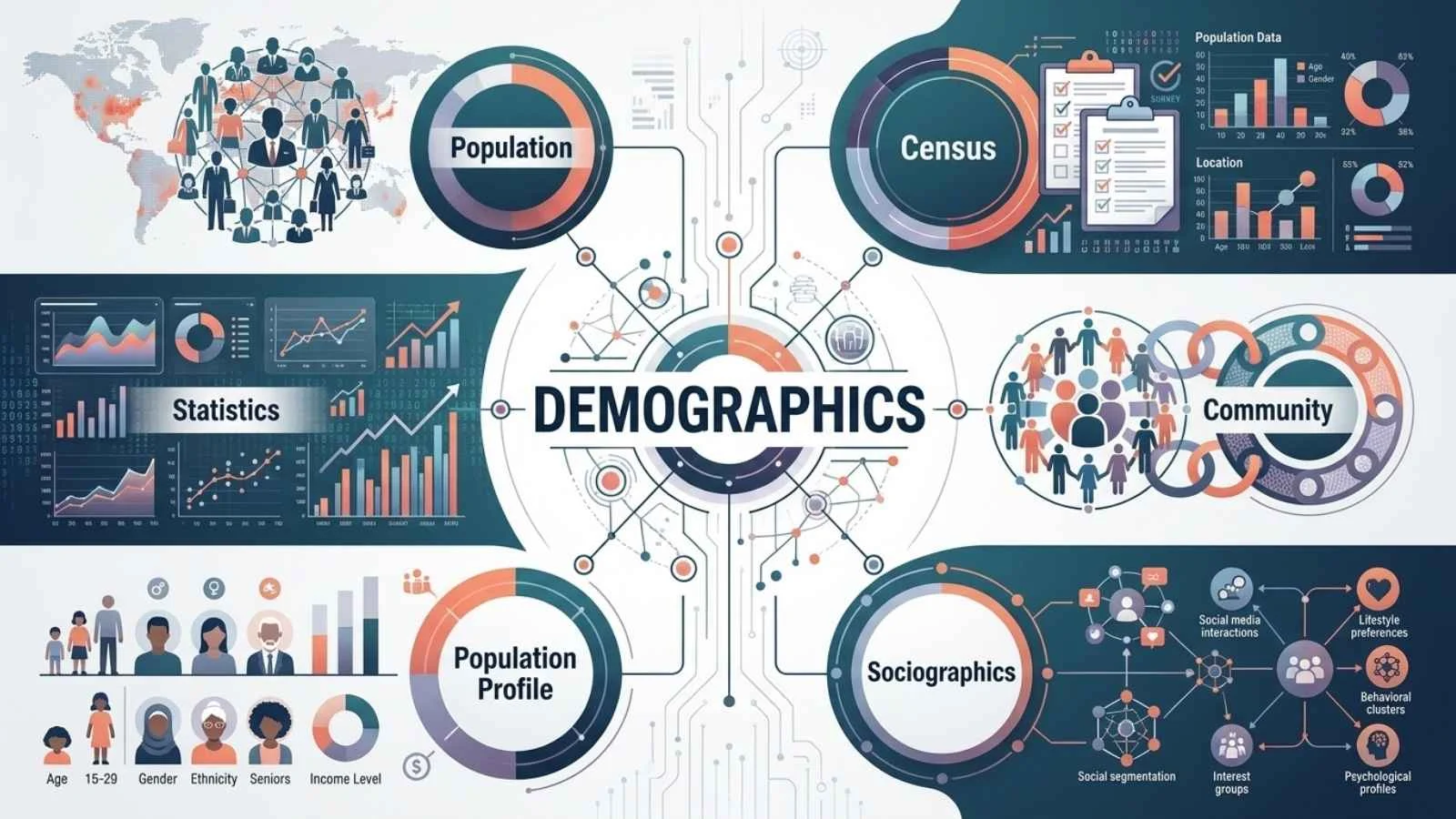
1. Population Data
Meaning:
Numbers and facts collected about a large group of people.
Usage:
Used in research reports and government studies to describe measurable facts about people.
Examples:
- The team studied population data to plan the new hospital.
- Population data showed that most residents were over the age of forty.
2. Census Information
Meaning:
Official facts collected by a government about every person in a country.
Usage:
Used in official reports and academic writing when referring to government-collected people data.
Examples:
- Census information showed that the city grew by ten percent last year.
- The school used census information to find out how many children lived nearby.
3. Sociographics
Meaning:
Data about the social habits and behaviors of a group of people.
Usage:
Used in marketing and social research to describe group behavior patterns.
Examples:
- The team used sociographics to understand what the community cared about.
- Sociographics helped them plan better events for the neighborhood.
4. Population Profile
Meaning:
A detailed picture of who lives in a certain area or group.
Usage:
Used in urban planning and marketing to describe the makeup of a community.
Examples:
- The city created a population profile before building the new park.
- Their population profile showed a large number of young families.
5. People Statistics
Meaning:
Numbers that describe facts about a group of people.
Usage:
Used in simple reports and presentations to talk about measurable human data.
Examples:
- People statistics helped the shop decide what products to stock.
- The teacher used people statistics to explain how populations change over time.
6. Human Statistics
Meaning:
Counted facts about people such as age, jobs, and education level.
Usage:
Used in academic and government writing to describe data collected about humans.
Examples:
- Human statistics showed a rise in people working from home.
- The report used human statistics to compare life in two countries.
7. Community Profile
Meaning:
A description of the people who live in a specific neighborhood or area.
Usage:
Used in local government planning and community development.
Examples:
- The charity built a community profile before starting its new program.
- Their community profile showed that many residents were seniors.
8. Social Composition
Meaning:
The mix of different kinds of people in a group or society.
Usage:
Used in sociology and policy writing to describe how a society is made up.
Examples:
- The social composition of the city changed after many people moved in.
- Researchers studied the social composition of each school district.
9. Population Breakdown
Meaning:
A clear split of a group into smaller categories like age or income.
Usage:
Used in reports and presentations to show how a population divides into parts.
Examples:
- The population breakdown showed equal numbers of men and women.
- Their presentation included a population breakdown by job type.
10. Audience Profile
Meaning:
A description of the type of people who read, watch, or buy something.
Usage:
Used in marketing and media to describe who a product or message is for.
Examples:
- The blog writer created an audience profile before writing her first post.
- Their audience profile showed most readers were between twenty and thirty-five.
11. Target Audience
Meaning:
The specific group of people a message or product is made for.
Usage:
Used heavily in marketing, advertising, and content creation.
Examples:
- Their target audience was working parents with young children.
- Knowing your target audience helps you write better emails.
12. Demographic Data
Meaning:
Facts collected about age, gender, income, and other traits of a group.
Usage:
Used in research, marketing, and business reports as a direct variation of demographics.
Examples:
- The company studied demographic data before launching the product.
- Demographic data showed that most buyers were women aged thirty to fifty.
13. Population Characteristics
Meaning:
The features or traits that describe a group of people.
Usage:
Used in academic writing and research to list the qualities of a studied group.
Examples:
- The study listed population characteristics like age and income level.
- Population characteristics helped the team understand their community better.
14. Socioeconomic Data
Meaning:
Information about both the social class and money situation of people.
Usage:
Used in economics, policy, and social research to link income with lifestyle.
Examples:
- Socioeconomic data showed that families in the north earned less money.
- The report used socioeconomic data to explain school performance gaps.
15. Market Segment
Meaning:
A smaller group within a larger market that shares common traits.
Usage:
Used in business and marketing to divide a large audience into focused groups.
Examples:
- They targeted a market segment of college students with their new app.
- Each market segment got a different version of the advertisement.
16. Population Distribution
Meaning:
How people are spread across different areas, age groups, or categories.
Usage:
Used in geography and planning to show where and how people are spread out.
Examples:
- Population distribution maps showed that most people lived near the coast.
- The teacher explained population distribution using a simple chart.
17. Ethnographic Data
Meaning:
Information about the culture, habits, and background of a group of people.
Usage:
Used in anthropology and cultural research to describe detailed observations of groups.
Examples:
- Ethnographic data helped the team understand daily life in the village.
- The researcher gathered ethnographic data by living with the community for a month.
18. Social Statistics
Meaning:
Numbers that describe how people live and interact in society.
Usage:
Used in sociology reports and government publications.
Examples:
- Social statistics showed a rise in single-person households.
- The teacher used social statistics to explain how families have changed.
19. Public Profile
Meaning:
A general description of the traits and habits of the public in a region.
Usage:
Used in public sector planning and policy writing.
Examples:
- The government released a public profile of voters before the election.
- Their public profile data helped them design better public services.
20. Demographic Indicators
Meaning:
Specific measures used to track and describe the features of a population.
Usage:
Used in research and policy to point to exact facts like birth rate or income.
Examples:
- Birth rate and school enrollment are key demographic indicators.
- The organization tracked demographic indicators every five years.
21. Population Trends
Meaning:
Changes in how a population looks or behaves over time.
Usage:
Used in reports and planning to show how communities are changing.
Examples:
- Population trends showed that more people were moving to smaller cities.
- Marketers study population trends to predict what people will want next.
22. Societal Data
Meaning:
Facts about the wider society including how people group together and behave.
Usage:
Used in academic writing and policy research to describe broad social facts.
Examples:
- Societal data revealed that screen time had increased in all age groups.
- The study used societal data to compare two different countries.
23. Cohort Data
Meaning:
Facts collected about a specific group of people born in the same time period.
Usage:
Used in research and health studies to track a group across time.
Examples:
- Cohort data showed that people born in the 1990s faced different challenges.
- The health team used cohort data to study long-term habits.
24. Population Metrics
Meaning:
Measured values used to track how a population grows or changes.
Usage:
Used in data-driven reports and business analytics.
Examples:
- Population metrics showed steady growth in the city over ten years.
- The company reviewed population metrics before choosing a new location.
25. Geographics
Meaning:
Data about where people live and how location affects their choices.
Usage:
Used in marketing and planning to describe location-based facts about groups.
Examples:
- Geographics helped the company decide which cities to open stores in.
- The team used geographics to target ads to people in colder climates.
26. Psychographics
Meaning:
Data about people’s values, interests, opinions, and lifestyles.
Usage:
Used in marketing to understand what motivates a specific group of people.
Examples:
- Psychographics showed that their customers valued eco-friendly products.
- The campaign used psychographics to connect with health-conscious buyers.
27. Behavioral Data
Meaning:
Information about how people act, shop, browse, or make decisions.
Usage:
Used in digital marketing and business research to understand customer actions.
Examples:
- Behavioral data showed that most users left the website after two minutes.
- The app collected behavioral data to improve the user experience.
28. Lifestyle Data
Meaning:
Facts about how people spend their time and what they enjoy doing.
Usage:
Used in marketing and product development to match offerings to daily habits.
Examples:
- Lifestyle data showed that young adults preferred fast food over cooking.
- The gym used lifestyle data to design classes its members would actually attend.
29. Vital Statistics
Meaning:
Key numbers about a population like birth rates, death rates, and marriage rates.
Usage:
Used in government and health sectors to track major life events in a population.
Examples:
- Vital statistics showed a drop in birth rates over the last decade.
- The doctor used vital statistics to explain health trends in the region.
30. Social Profile
Meaning:
A summary of the social traits and habits of a person or group.
Usage:
Used in research and marketing to describe how a group fits into society.
Examples:
- The agency built a social profile of their typical customer.
- A social profile helped the nonprofit find volunteers more easily.
31. Consumer Profile
Meaning:
A description of the type of person who buys a certain product or service.
Usage:
Used in business and marketing to help brands understand their buyers.
Examples:
- Their consumer profile showed buyers were mostly women in their thirties.
- Building a consumer profile helped the brand improve its advertising.
32. Resident Profile
Meaning:
A description of the people who live in a specific area or housing unit.
Usage:
Used in real estate and local government planning.
Examples:
- The city released a resident profile for each neighborhood.
- A resident profile helped the landlord understand who was renting in the building.
33. Demographic Composition
Meaning:
The mix of different groups of people within a population based on age, gender, and more.
Usage:
Used in policy writing and research to describe how a population is structured.
Examples:
- The demographic composition of the company changed a lot in five years.
- Reports showed a shift in demographic composition toward older workers.
34. Generational Data
Meaning:
Facts about people grouped by the decade or era in which they were born.
Usage:
Used in marketing and social research to study differences between generations.
Examples:
- Generational data showed that older buyers preferred printed catalogs.
- The study used generational data to compare shopping habits across age groups.
35. Human Geography Data
Meaning:
Information about how people are spread across the earth and how place shapes culture.
Usage:
Used in academic geography and development studies.
Examples:
- Human geography data showed that river areas had more dense populations.
- The class studied human geography data to learn about migration patterns.
36. Age Distribution
Meaning:
A breakdown of how many people in a group fall into each age range.
Usage:
Used in health, education, and planning to understand the age makeup of a group.
Examples:
- The age distribution of the town showed a lot of elderly residents.
- Marketers used age distribution to decide which products to promote.
37. Gender Breakdown
Meaning:
The split between male and female members in a given group or study.
Usage:
Used in equality research, marketing, and health studies.
Examples:
- The gender breakdown showed an almost equal split in the workforce.
- Their gender breakdown helped the brand design products for both audiences.
38. Income Distribution
Meaning:
How money is spread across different people or groups in a population.
Usage:
Used in economics and policy to show wealth gaps between groups.
Examples:
- Income distribution showed a wide gap between the richest and poorest areas.
- The report used income distribution to argue for better wages.
39. Education Level Data
Meaning:
Facts about how much schooling people in a group have completed.
Usage:
Used in policy and workforce research to describe the skills of a population.
Examples:
- Education level data showed more people finishing college than ever before.
- The employer used education level data to plan its hiring strategy.
40. Ethnic Composition
Meaning:
The mix of different ethnic or racial backgrounds within a group or community.
Usage:
Used in social research and policy to describe cultural diversity in populations.
Examples:
- The ethnic composition of the school had changed greatly over twenty years.
- Researchers studied the ethnic composition of the city to guide housing plans.
41. Population Segment
Meaning:
A smaller part of a larger population that shares specific traits.
Usage:
Used in marketing and research to narrow focus to a specific group.
Examples:
- They ran the ad campaign for just one population segment at first.
- The nonprofit focused on a population segment of low-income teenagers.
42. Social Class Data
Meaning:
Information about the economic and social levels people belong to in society.
Usage:
Used in sociology and policy to understand how class shapes life opportunities.
Examples:
- Social class data showed that children from poorer families had fewer options.
- The study used social class data to explain voting patterns.
43. Urbanization Data
Meaning:
Facts about how many people are moving from rural areas to cities.
Usage:
Used in planning and environmental research to track city growth.
Examples:
- Urbanization data showed that more people were moving to cities each year.
- The government used urbanization data to plan new public transport routes.
44. Migration Statistics
Meaning:
Numbers about people who move from one place to another.
Usage:
Used in policy, geography, and social research to study human movement.
Examples:
- Migration statistics showed a large movement of people toward the capital.
- The report used migration statistics to explain population changes in rural towns.
45. Occupational Data
Meaning:
Facts about what kinds of jobs people in a group or region hold.
Usage:
Used in workforce studies and economic planning.
Examples:
- Occupational data showed most residents worked in farming or retail.
- The city used occupational data to plan job training programs.
46. Household Composition
Meaning:
The makeup of people living together in a home such as family size and structure.
Usage:
Used in housing policy and marketing to describe living arrangements.
Examples:
- Household composition data showed more single-parent families than before.
- The survey collected household composition details to improve social services.
47. Demographic Variables
Meaning:
The different measurable factors used to describe a population such as age, income, and location.
Usage:
Used in research and analytics to define which aspects of a group are being measured.
Examples:
- The study controlled for key demographic variables like age and education.
- Marketers track demographic variables to find the right audience.
48. Cultural Profile
Meaning:
A summary of the cultural background, traditions, and values of a group of people.
Usage:
Used in anthropology, marketing, and content writing to describe cultural identity.
Examples:
- The brand built a cultural profile before launching in a new country.
- A cultural profile helped the teacher understand her students better.
49. Neighborhood Statistics
Meaning:
Data collected about the people and conditions in a specific local area.
Usage:
Used in real estate, planning, and local journalism.
Examples:
- Neighborhood statistics showed a drop in crime over the last three years.
- The blog used neighborhood statistics to help people choose where to live.
50. Population Variables
Meaning:
The different traits or factors that can change or differ across a population.
Usage:
Used in statistics and research to list the parts of a population being measured.
Examples:
- Population variables like age and income were tracked over ten years.
- The data team listed all population variables before starting the study.
FAQs
What is another word for demographics?
Some common alternatives are population data, audience profile, census information, and sociographics.
Can I use “target audience” instead of “demographics”?
Yes, especially in marketing. Target audience refers to the specific group a message is aimed at, which is part of demographics.
What does demographics mean in simple words?
Demographics means facts about groups of people such as their age, location, income, and gender.
Why do writers and bloggers need synonyms of demographics?
Using the same word too often makes writing dull. Synonyms help keep content fresh and professional.
Are psychographics the same as demographics?
No. Demographics covers facts like age and income. Psychographics covers values, interests, and opinions. Both are related but different.
Conclusion
Learning synonyms of demographics makes you a better writer, blogger, and communicator. Instead of repeating the same word, you can choose the right term for the right moment. This makes your emails sharper, your essays stronger, and your conversations clearer. Pick five words from this list today and try them in your next piece of writing. Small vocabulary upgrades lead to big improvements over time.

I am Meer Hadi, a passionate language and content writer at SynonymLibrary.com. I focus on creating helpful word guides that make it easier for readers to choose the right words, understand meanings, and express their ideas more clearly. Through my work, I aim to support students, writers, and professionals in building stronger communication skills.