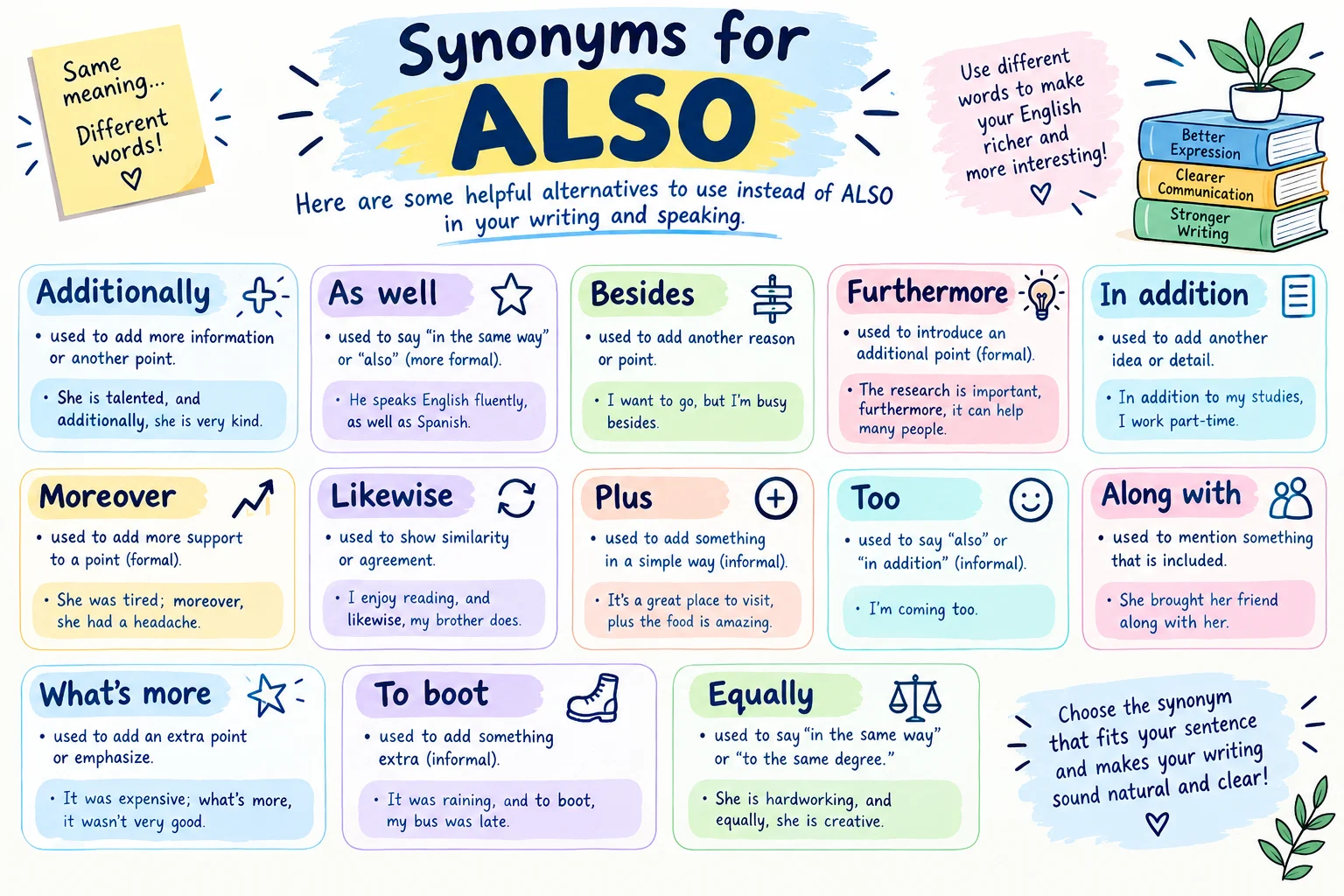
Need another way to say also without making your sentence sound awkward or overly formal? Synonyms for also include too, as well, additionally, furthermore, moreover, besides, and in addition, but these alternatives are not interchangeable in every context. Also usually adds another fact, idea, action, or point to something already mentioned.
For example, “She speaks Spanish and also speaks French” can become “She speaks Spanish and speaks French too” or “She speaks Spanish and French as well.” Too and as well are common in everyday English, while additionally and in addition are more formal.
Furthermore and moreover usually introduce another supporting point, especially in formal or academic writing. Besides can add another reason or consideration and often sounds more conversational. If you’re searching for synonyms for also for essays, schoolwork, professional writing, or everyday English, this guide explains their meanings, differences, and best uses.
What Are the Best Synonyms for Also?
The most useful alternatives to also are:
too, as well, additionally, in addition, furthermore, moreover, besides, plus, what’s more, as well as, along with, together with, likewise, similarly, equally, on top of that, not only…but also, and in addition to.
For everyday English, use too or as well. For essays and academic writing, additionally, furthermore, moreover, and in addition are useful. For similarity, use likewise or similarly.
The best synonym depends on what you are trying to say.
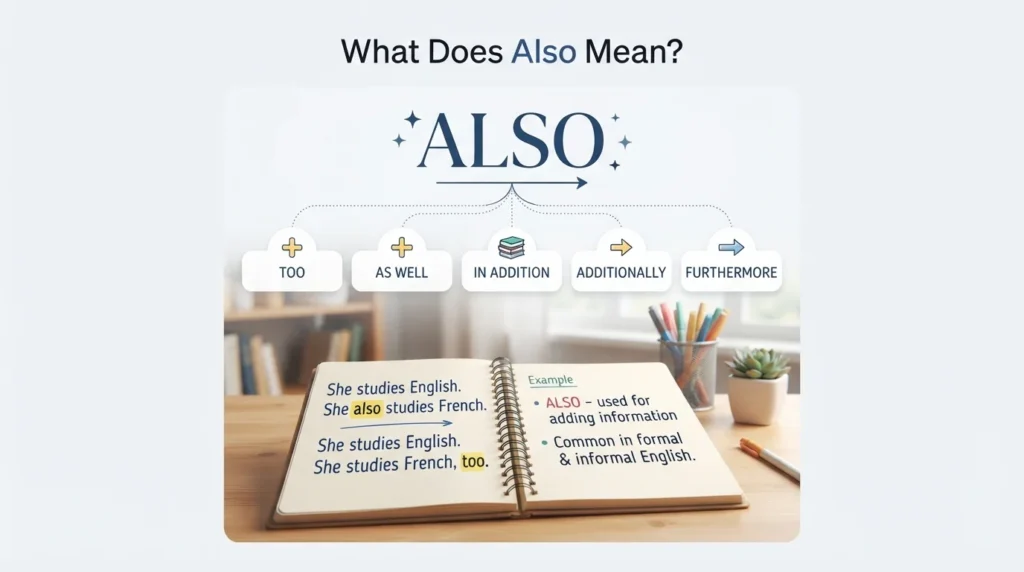
What Does “Also” Mean?
Also means “in addition,” “too,” or “as well.” It tells the reader that another person, thing, action, or idea is included.
For example:
- She also speaks French.
- He also wants to join us.
- The course is affordable and also easy to follow.
In everyday English, also is completely natural. You do not need to replace it every time you use it. However, changing the structure occasionally can prevent repetition and make longer writing flow better.
Synonyms and Alternatives for Also
Too
Meaning: Adds another person, thing, or idea.
Examples:
- I like this book too.
- She wants to come too.
Best for: Everyday English and casual writing.
As Well
Meaning: Means “also” or “too.”
Examples:
- He speaks Spanish as well.
- She wants to attend the meeting as well.
Best for: Conversation and general writing.
Additionally
Meaning: Adds another piece of information or another point.
Examples:
- The course is affordable. Additionally, it is flexible.
- The phone is fast. Additionally, its battery lasts all day.
Best for: Formal, professional, and academic writing.
In Addition
Meaning: Introduces another related fact or idea.
Examples:
- The hotel is clean. In addition, it has free Wi-Fi.
- In addition, students receive extra practice.
Best for: Essays, reports, and formal writing.
Furthermore
Meaning: Adds another point that supports or strengthens the previous idea.
Examples:
- The method is simple. Furthermore, it is inexpensive.
- The plan saves time. Furthermore, it reduces costs.
Best for: Academic and formal writing.
Moreover
Meaning: Adds a significant or strengthening point.
Examples:
- The solution is practical. Moreover, it is affordable.
- The evidence is limited. Moreover, several results disagree with it.
Best for: Formal arguments and essays.
Besides
Meaning: Adds another reason, fact, or consideration.
Examples:
- I do not want to go. Besides, it is already late.
- Besides being useful, the app is easy to use.
Best for: Everyday and general writing.
Plus
Meaning: Adds another point in a casual way.
Examples:
- The restaurant is cheap. Plus, the food is excellent.
- She is talented. Plus, she works extremely hard.
Best for: Informal writing and conversation.
What’s More
Meaning: Adds another point, often one that makes the previous statement stronger.
Examples:
- The house is beautiful. What’s more, it has a large garden.
- He finished early. What’s more, he helped his classmates.
Best for: General and persuasive writing.
What Is More
Meaning: A more formal version of “what’s more.”
Examples:
- The program is effective. What is more, it is affordable.
- She completed the project. What is more, she improved the design.
Best for: Formal writing.
As Well As
Meaning: Connects two people, things, qualities, or activities.
Examples:
- She studies English as well as French.
- He brought his laptop as well as his notes.
Best for: Connecting related items.
Along With
Meaning: Shows that something is included with something else.
Examples:
- She brought her notebook along with her textbook.
- The package includes a charger along with the device.
Together With
Meaning: Shows that people or things are included or involved together.
Examples:
- She attended the event together with her sister.
- The report, together with the supporting data, was submitted.
Likewise
Meaning: Shows that something is true in the same or a similar way.
Examples:
- Sarah enjoys reading. Likewise, her brother loves books.
- The first team worked hard. Likewise, the second team stayed focused.
Important: Likewise is about similarity, so it is not always a direct synonym for also.
Similarly
Meaning: Shows that two ideas, situations, or actions are alike.
Examples:
- The first study found positive results. Similarly, the second study reported improvement.
- Dogs need exercise. Similarly, cats benefit from regular activity.
Equally
Meaning: Shows that another point is just as important or true.
Examples:
- Good communication matters. Equally, good listening is important.
- She values honesty. Equally, she values kindness.
On Top of That
Meaning: Adds another fact or benefit, often with emphasis.
Examples:
- The car is affordable. On top of that, it is reliable.
- She finished her work. On top of that, she helped her coworkers.
Best for: Conversational writing.
Not Only That
Meaning: Adds another fact, often to create emphasis.
Examples:
- She won the competition. Not only that, she broke the record.
- He cooked dinner. Not only that, he cleaned the kitchen.
In Addition To
Meaning: Means “besides” or “as well as.”
Examples:
- In addition to English, she studies Spanish.
- In addition to his salary, he receives travel benefits.
Grammar: Usually followed by a noun, pronoun, or -ing form.
Over and Above
Meaning: Means beyond something already expected or included.
Examples:
- She worked over and above her normal duties.
- The company offered support over and above the basic service.
Alongside
Meaning: Shows that two things exist, happen, or develop together.
Examples:
- She studied history alongside literature.
- The new system was developed alongside the existing one.
Coupled With
Meaning: Shows that two things combine to produce an effect.
Examples:
- Hard work, coupled with patience, can lead to success.
- Her experience, coupled with strong communication skills, helped her succeed.
Important: This is a related expression, not a universal replacement for also.
In Conjunction With
Meaning: Means together with or in combination with.
Examples:
- The program operates in conjunction with local schools.
- The treatment was used in conjunction with regular exercise.
Best for: Formal and technical writing.
In Combination With
Meaning: Shows that two things are used or considered together.
Examples:
- The software works well in combination with other tools.
- Exercise, in combination with a balanced diet, can support general fitness.
Combined With
Meaning: Shows that one thing is joined with another.
Examples:
- Experience combined with training can improve performance.
- Fresh ingredients combined with careful cooking create a better meal.
Added to That
Meaning: Introduces another point or consideration.
Examples:
- The journey was long. Added to that, the weather was difficult.
- She had little time. Added to that, she had another assignment.
To Add to This
Meaning: Introduces another supporting point.
Examples:
- The service was fast. To add to this, the staff were friendly.
- She was experienced. To add to this, she was highly organized.
To Add to That
Meaning: Adds another point to what has just been said.
Examples:
- The book is easy to read. To add to that, it has useful examples.
- He is reliable. To add to that, he communicates clearly.
Besides That
Meaning: Adds another fact or reason.
Examples:
- The course is affordable. Besides that, it is easy to access.
- I cannot go. Besides that, I have too much work.
Beyond That
Meaning: Introduces something more than the point already mentioned.
Examples:
- The book is informative. Beyond that, it is enjoyable to read.
- The job offers good pay. Beyond that, it provides useful experience.
Not to Mention
Meaning: Adds another detail that is worth considering.
Examples:
- The trip was expensive, not to mention exhausting.
- The course is useful, not to mention affordable.
Not to Forget
Meaning: Adds something that should also be remembered.
Examples:
- The event included games and music, not to forget the food.
- The course develops writing skills, not to forget critical thinking.
To Say Nothing Of
Meaning: Adds another point, often emphasizing an additional problem, cost, or benefit.
Examples:
- The apartment is expensive, to say nothing of the maintenance costs.
- The project required time, to say nothing of the extra resources.
Another Point Is
Meaning: Introduces another idea or argument.
Examples:
- Another point is that the plan could save time.
- Another point is the effect on small businesses.
Best for: Essays and argumentative writing.
Another Factor Is
Meaning: Introduces another factor that affects an issue.
Examples:
- Cost is important. Another factor is reliability.
- Another factor is the amount of time required.
Best for: Academic and analytical writing.
A Further Point Is
Meaning: Introduces one more related point.
Examples:
- A further point is the need for better communication.
- A further point is that the results may vary.
. Further
Meaning: Can introduce additional information in formal writing.
Examples:
- Further, the study examined long-term effects.
- Further, the report identifies several areas for improvement.
Note: Further has other meanings too, so use it according to context.
And
Meaning: Simply joins two ideas, actions, or things.
Examples:
- She reads books and writes stories.
- He finished his work and helped his friend.
Sometimes and is the best replacement for also because it keeps the sentence simple.
Both … And
Meaning: Shows that two things are included or true.
Examples:
- She is both intelligent and hardworking.
- The course covers both grammar and vocabulary.
Not Only … But Also
Meaning: Emphasizes that two things are true or included.
Examples:
- She is not only talented but also hardworking.
- The course teaches not only grammar but also pronunciation.
In Tandem With
Meaning: Shows that two things work or develop together.
Examples:
- The programs operate in tandem with each other.
- Training works best in tandem with regular practice.
In Parallel With
Meaning: Shows that two activities happen or develop alongside each other.
Examples:
- The new system was developed in parallel with the existing one.
- She studied in parallel with her part-time work.
At the Same Time
Meaning: Shows that two things happen or are true during the same period.
Examples:
- She was nervous and excited at the same time.
- He worked and studied at the same time.
Important: This expresses timing, not simply addition.
What’s More, Besides
Meaning: Adds another consideration, usually in conversational writing.
Examples:
- The plan is expensive. Besides, we do not have enough time.
- She was already tired. Besides, she had another assignment.
In most cases, simply using besides is cleaner.
On Another Note
Meaning: Introduces another point or a slightly different topic.
Examples:
- The project is nearly finished. On another note, we need to discuss the budget.
- The lesson was useful. On another note, the students enjoyed the activity.
Important: This is not a direct synonym for also because it can signal a topic shift.
. In Turn
Meaning: Shows that one thing leads to or results in another.
Examples:
- She helped her classmates. In turn, they supported her.
- Better communication builds trust, which in turn improves teamwork.
Important: In turn describes sequence or consequence, not simple addition.
To Boot
Meaning: Adds something extra, usually at the end of a statement.
Examples:
- The bag was cheap and stylish to boot.
- He was kind, funny, and generous to boot.
Best for: Informal or literary writing.
Into the Bargain
Meaning: Means something extra was received in addition to the main thing.
Examples:
- She won the prize and received a scholarship into the bargain.
- The hotel was comfortable and affordable into the bargain.
Best for: Idiomatic or literary writing.
Another Word for Also in an Essay
If you are searching for an also synonym for an essay, do not automatically choose the most complicated word. Pick the transition that matches the relationship between your ideas.
| If you want to… | Try… |
|---|---|
| Add a simple fact | Additionally |
| Add another point | In addition |
| Strengthen an argument | Furthermore |
| Add an important point | Moreover |
| Show similarity | Similarly |
| Show the same idea applies | Likewise |
| Introduce another argument | Another point is |
| Introduce another factor | Another factor is |
| Keep the writing simple | Also |
Example
Weak repetition:
Exercise improves physical health. Also, it can improve sleep. Also, it can reduce stress.
Smoother:
Exercise improves physical health. Additionally, it can improve sleep. Furthermore, it may help reduce stress.
The goal is not to eliminate also. The goal is to make the paragraph flow naturally.
Another Word for Also to Start a Paragraph
When you need another word for also to start a paragraph, these are useful:
- Additionally,
- Furthermore,
- Moreover,
- In addition,
- Another point is that…
- A further consideration is that…
- Beyond that,
- Another factor is that…
For example:
Additionally, the new system gives students more opportunities to practice.
Or:
Furthermore, the findings suggest that regular practice improves retention.
Use moreover and furthermore when the new point strengthens the argument. Use additionally or in addition when you simply want to add information.
Synonyms for Also in a Sentence
For a normal sentence, too and as well are usually the easiest alternatives.
Compare:
She also likes coffee.
She likes coffee too.
She likes coffee as well.
The meaning is almost the same.
However, grammar matters.
With “also”
Also often comes before the main verb:
She also studies French.
But it usually follows the verb be:
She is also a teacher.
With “too”
Too commonly comes at the end:
She studies French too.
With “as well”
As well also commonly comes at the end:
She studies French as well.
This small difference is useful when you are trying to make your writing sound natural rather than simply swapping one word for another.
Formal Synonyms for Also
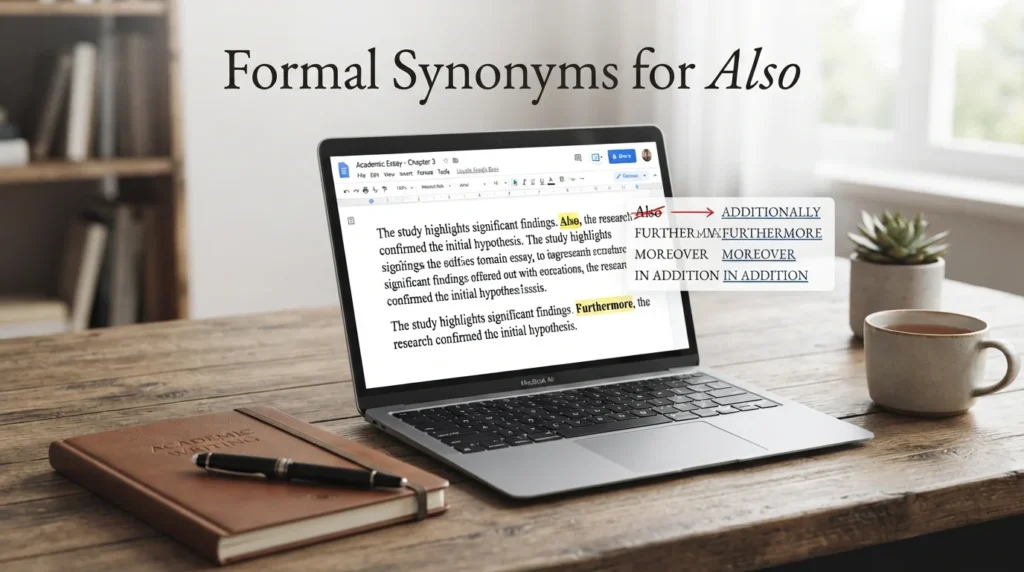
If you need a formal way to say also, consider:
additionally, furthermore, moreover, in addition, a further point is, another factor is, and in conjunction with.
But formality should not become a goal by itself.
For example:
The study also examined memory.
is perfectly appropriate academic English.
You do not have to change it to:
Furthermore, the study examined memory.
If the sentence already reads naturally, keeping also may be the better choice.
Synonyms for Also in Academic Writing
For also synonym academic writing, the most useful options are:
- Additionally — straightforward addition.
- Furthermore — additional supporting evidence.
- Moreover — additional emphasis.
- In addition — another related point.
- Similarly — comparison with another finding.
- Likewise — a similar result or situation.
- A further point is — another argument.
- Another factor is — another consideration.
Example
Instead of:
The study also found that students performed better after regular practice.
You could write:
Additionally, the study found that students performed better after regular practice.
If the next sentence presents another supporting finding:
Furthermore, the researchers observed improved long-term retention.
Notice that the alternatives are not being used randomly. Each one performs a different job.
Synonyms for Also in an Email
The best synonyms for also in an email depend on how formal the message is.
Professional email
Use:
- Additionally
- In addition
- As well as
- Furthermore when appropriate
- Also
Example:
Please send the completed form. Additionally, please attach a copy of your identification.
Friendly email
Use:
- Too
- As well
- Plus
- Also
Example:
I would love to join you too.
The important thing is to match the word to the relationship and tone of the message.
Also vs. Too
Also and too are close synonyms, but their normal positions differ.
| Word | Common position | Example |
|---|---|---|
| Also | Before the main verb | She also likes music. |
| Too | Usually at the end | She likes music too. |
Both can mean “in addition.”
Also vs. As Well
As well is another close synonym for also.
He also plays tennis.
He plays tennis as well.
The main difference is placement and style. As well often comes at the end of the sentence.
Also vs. Additionally
Also is common and flexible.
Additionally sounds more formal and is often useful at the beginning of a sentence or paragraph.
The program is affordable. Additionally, it is easy to use.
This makes additionally particularly useful when searching for a professional or academic synonym.
Also vs. Furthermore
Furthermore generally does more than simply add another fact. It often introduces another supporting point.
The proposal is affordable. Furthermore, it can be implemented quickly.
If you simply want to say that another fact is true, also or additionally may be enough.
Also vs. Moreover
Moreover is usually more emphatic and formal.
The method is affordable. Moreover, it produces consistent results.
It is especially useful in essays when the next point strengthens the argument.
Also vs. Likewise
These words are often confused.
Also means in addition.
Likewise means in the same way or similarly.
Compare:
Maria likes painting. She also likes photography.
This adds another interest.
Maria likes painting. Likewise, her sister enjoys photography.
This creates a comparison between two people.
Also vs. Similarly
Similarly is used when two ideas or situations resemble each other.
The first experiment produced positive results. Similarly, the second experiment showed improvement.
You would not normally replace also with similarly unless there is a genuine comparison.
How to Use Also Naturally
You can place also in different parts of a sentence depending on the verb.
Before the main verb
She also works on weekends.
After “be”
She is also a writer.
After an auxiliary verb
They have also completed the project.
At the beginning for emphasis
Also, remember to save your work.
Although sentence-opening also is possible, repeating it at the beginning of several paragraphs can make your writing feel mechanical. In longer writing, use a suitable transition or restructure the sentence when necessary.
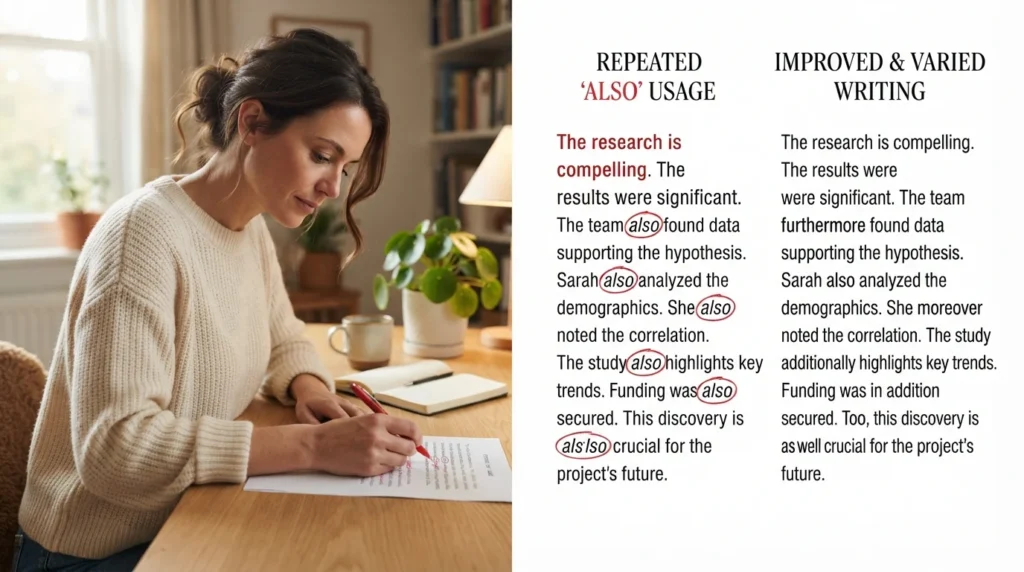
How to Avoid Repeating Also
If you notice also appearing several times in one paragraph, try these strategies:
1. Use a close alternative
She likes reading too.
2. Change the sentence structure
Instead of:
The course is affordable. It also includes practice tests.
Try:
The affordable course includes practice tests.
3. Combine ideas
Instead of:
She studies English. She also studies Spanish.
Try:
She studies both English and Spanish.
4. Use a transition
The course is affordable. Additionally, it includes practice tests.
5. Show the actual relationship
If the second idea is similar:
Similarly, the second study produced positive results.
If it strengthens the argument:
Furthermore, the findings support the original conclusion.
This creates better flow than simply replacing every also with a random synonym.
Common Mistakes When Replacing Also
Mistake 1: Using “moreover” everywhere
Moreover is formal and often emphatic. It is not the natural choice for every conversation or email.
Mistake 2: Treating “likewise” as an exact synonym
Likewise expresses similarity, not simple addition.
Mistake 3: Using “similarly” without a comparison
There should be some meaningful similarity between the ideas.
Mistake 4: Using “plus” in a formal essay
Plus is natural in conversation but can sound too casual in academic writing.
Mistake 5: Thinking every related phrase is a synonym
Expressions such as at the same time, in turn, in tandem, concurrently, and simultaneously describe timing, sequence, or cooperation. They cannot replace also in every sentence.
Mistake 6: Avoiding “also” at all costs
Also is a normal, useful English word. Strong writing is not about using the rarest synonym. It is about using the clearest expression.
Quick Guide: Which Synonym Should You Choose?
| Situation | Natural choice |
|---|---|
| Everyday conversation | Too / As well |
| Simple addition | Also / Additionally |
| Essay | Additionally / In addition |
| Strong supporting point | Furthermore |
| Important additional point | Moreover |
| Casual writing | Plus / Besides |
| Similar idea | Similarly / Likewise |
| Connecting two things | As well as / Along with |
| Adding emphasis | What’s more / On top of that |
| Two equal elements | Both…and |
| Strong paired structure | Not only…but also |
| Professional writing | Additionally / In addition |
| Academic writing | Additionally / Furthermore / Moreover |
| Also / Additionally / As well | |
| Avoiding repetition | Restructure the sentence |
Frequently Asked Questions
What words can I use instead of “also”?
You can use too, as well, additionally, in addition, furthermore, moreover, besides, plus, what’s more, and as well as, depending on the sentence.
How do I professionally say “also”?
For professional writing, additionally and in addition are usually safe choices. Furthermore and moreover work when the additional point strengthens the discussion.
What is another word for “also” in an essay?
Common choices include additionally, furthermore, moreover, in addition, and similarly when you are actually comparing ideas.
What is another word for “also” to start a paragraph?
Try Additionally, Furthermore, Moreover, In addition, Another point is, or A further consideration is.
What is another word for “also” in a paragraph?
Use additionally, in addition, furthermore, moreover, or another point is when introducing another idea. You can also restructure the paragraph instead of replacing every also.
What is another word for “also” in an email?
For a professional email, additionally, in addition, and also work well. For a casual email, too and as well are natural.
Is “too” a synonym for “also”?
Yes. In many sentences, too has essentially the same meaning as also, although it is usually placed near the end of the sentence.
Is “as well” a synonym for “also”?
Yes. As well can replace also in many sentences and commonly appears at the end.
Is “moreover” a synonym for “also”?
It can be an alternative when you are adding a point, but the meanings are not identical. Moreover is more formal and often adds emphasis.
What is the synonym of “also” in academic writing?
Useful choices include additionally, furthermore, moreover, in addition, similarly, and likewise, depending on the relationship between the ideas.
What is another word for “but also”?
A common structure is not only…but also:
The course is not only useful but also affordable.
The exact alternative depends on the sentence structure.
Final Takeaway
There is no single best synonym for also for every situation. The right choice depends on your meaning and audience.
Use too or as well when you want natural everyday English. Choose additionally or in addition when you simply need to introduce another point. Use furthermore when the new information supports your argument, and moreover when you want an additional point to carry more emphasis. Choose similarly or likewise only when you are showing a genuine similarity.
And remember: you do not have to replace also every time it appears. Sometimes the clearest sentence is simply the one that keeps it.
The goal is not to make your writing sound complicated. The goal is to make every sentence clear, natural, precise, and easy to follow.

I am Meer Hadi, a passionate language and content writer at SynonymLibrary.com. I focus on creating helpful word guides that make it easier for readers to choose the right words, understand meanings, and express their ideas more clearly. Through my work, I aim to support students, writers, and professionals in building stronger communication skills.