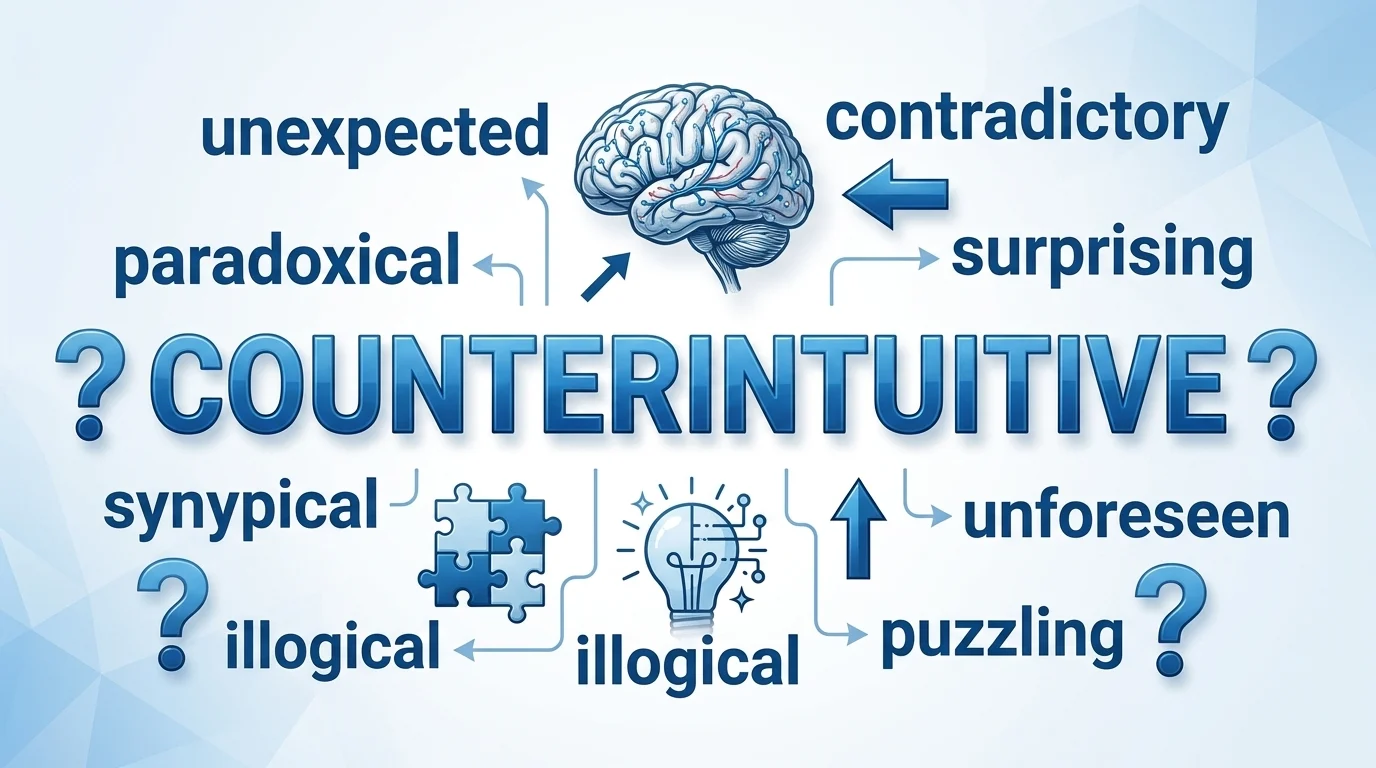
Have you ever heard something that made no sense at first but turned out to be true? Like drinking warm water to cool down. Or sleeping less to feel more awake. That feeling when something works the opposite way you expect is called counterintuitive.
The word counterintuitive means something that is the opposite of what feels natural or normal. It goes against what most people think. For example, “It is counterintuitive that eating fat can help you lose weight.”
Knowing synonyms of counterintuitive helps you:
- Students explain tricky ideas in essays without using big words.
- Bloggers keep readers interested with fresh, clear language.
- Content writers sound smart without being hard to understand.
- Daily English users express surprising ideas in simple words.
Let’s explore 50 great synonyms of counterintuitive right now.
1. Unexpected
Meaning:
- Something that surprises you because it did not happen the way you thought it would.
Examples:
- It was unexpected that the quiet student won the speech contest.
- The doctor gave him an unexpected piece of advice about rest.
2. Surprising
Meaning:
- Something that shocks or amazes you because it is not normal or usual.
Examples:
- It is surprising that drinking more water can reduce water weight.
- The surprising result confused even the scientists in the lab.
3. Paradoxical
Meaning:
- Something that seems wrong or impossible but is actually true.
Examples:
- It is paradoxical that the more you chase happiness, the less you find it.
- The paradoxical truth is that slowing down can help you finish faster.
4. Illogical
Meaning:
- Something that does not follow normal thinking or reason.
Examples:
- It seems illogical to rest more when you want to get more done.
- Her illogical fear of butterflies surprised everyone in the room.
5. Puzzling
Meaning:
- Something that is hard to understand or explain because it is so strange.
Examples:
- It is puzzling how some plants grow better when ignored.
- The puzzling outcome of the experiment baffled the whole team.
6. Strange
Meaning:
- Something that is unusual and different from what people normally see or know.
Examples:
- It is strange that laughing can actually reduce physical pain.
- The strange result made the researcher go back and check everything.
7. Baffling
Meaning:
- Something so confusing that it is very hard to make sense of.
Examples:
- It is baffling that eating less food sometimes leads to weight gain.
- The baffling behavior of the bees puzzled the scientist for years.
8. Perplexing
Meaning:
- Something that makes you feel confused and unable to find a clear answer.
Examples:
- It is perplexing that more choices can make people less happy.
- The perplexing data showed the opposite of what the team expected.
9. Unusual
Meaning:
- Something that is not common or regular in daily life.
Examples:
- It is unusual that cold showers can actually help you feel warmer.
- Her unusual approach to the problem turned out to be the right one.
10. Odd
Meaning:
- Something that feels a bit strange or out of place.
Examples:
- It is odd that exercising when tired can give you more energy.
- That odd fact about honey never spoiling surprised the whole class.
11. Unconventional
Meaning:
- Something that is different from the normal or accepted way of doing things.
Examples:
- His unconventional study method helped him pass every test.
- The unconventional treatment worked when all other options failed.
12. Illusory
Meaning:
- Something that looks real or true but is actually misleading or false.
Examples:
- The idea that more sleep always helps is sometimes illusory.
- That illusory sense of safety made people ignore the real danger.
13. Misleading
Meaning:
- Something that gives you a wrong idea or false impression.
Examples:
- The headline was misleading because the full story was very different.
- Misleading advice about dieting caused a lot of confusion online.
14. Contradictory
Meaning:
- Something that goes against another idea or fact, making both hard to believe at once.
Examples:
- The contradictory study results confused doctors and patients alike.
- It felt contradictory when he said he was happy but looked so sad.
15. Irrational
Meaning:
- Something that is not based on clear thinking or good reason.
Examples:
- It seems irrational to pay more for a product just because it costs less.
- His irrational fear of success kept him from trying new things.
16. Nonsensical
Meaning:
- Something that makes no sense at all and seems silly or absurd.
Examples:
- It sounds nonsensical that doing less work can make you more productive.
- The nonsensical rule confused everyone on the first day of school.
17. Absurd
Meaning:
- Something that is so strange or wrong that it seems almost funny.
Examples:
- It sounds absurd that being busy all day can make you feel lazier.
- That absurd result in the science class turned into an important discovery.
18. Counterproductive
Meaning:
- Something that causes the opposite result of what you wanted.
Examples:
- Studying all night without sleep is counterproductive before a big exam.
- Shouting to get silence in a room is completely counterproductive.
19. Mind-bending
Meaning:
- Something that is so surprising or complex that it is hard for the brain to accept.
Examples:
- It is mind-bending that time moves slower near a black hole.
- The mind-bending truth about memory shocked every student in class.
20. Deceptive
Meaning:
- Something that tricks you into thinking the wrong thing.
Examples:
- The calm water was deceptive and the current underneath was very strong.
- Deceptive simplicity made the math problem look easier than it was.
21. Unorthodox
Meaning:
- Something that breaks the usual rules or accepted ways of doing things.
Examples:
- Her unorthodox teaching style produced the best results in the school.
- The doctor tried an unorthodox approach that helped the patient recover.
22. Unintuitive
Meaning:
- Something that does not feel natural or easy to understand right away.
Examples:
- The new software was unintuitive and hard to figure out on day one.
- It feels unintuitive that saving less money sometimes builds better habits.
23. Confusing
Meaning:
- Something that is hard to understand and leaves you feeling lost.
Examples:
- It is confusing that sunscreen can sometimes increase sun damage if used wrong.
- The confusing instruction manual made the task harder than it needed to be.
24. Anti-intuitive
Meaning:
- Something that works against natural instinct or common sense.
Examples:
- It is anti-intuitive that the best way to learn is to make more mistakes.
- Anti-intuitive financial advice often turns out to be the most effective.
25. Thought-provoking
Meaning:
- Something that makes you stop and think in a deep or new way.
Examples:
- The thought-provoking idea that rest is productive changed how she worked.
- His thought-provoking speech made everyone rethink their daily habits.
26. Nonobvious
Meaning:
- Something that is not easy to see or understand without thinking carefully.
Examples:
- The nonobvious answer to the riddle surprised even the smartest student.
- The best business strategies are often nonobvious at first glance.
27. Against the grain
Meaning:
- Something that goes against what most people normally think or do.
Examples:
- His decision to quit a high-paying job went against the grain.
- Teaching children through play goes against the grain of old-school learning.
28. Counterlogical
Meaning:
- Something that works against normal logic and expected reasoning.
Examples:
- It seems counterlogical that practicing piano slower helps you play faster.
- Her counterlogical plan confused the team but led to great results.
29. Elusive
Meaning:
- Something that is hard to grasp, understand, or pin down.
Examples:
- The truth behind the experiment remained elusive for many years.
- Happiness can be elusive when you chase it too hard.
30. Enigmatic
Meaning:
- Something that is mysterious and hard to fully explain or understand.
Examples:
- The enigmatic results of the study took years to fully interpret.
- He gave an enigmatic smile that no one in the room could figure out.
31. Bizarre
Meaning:
- Something that is very strange and hard to believe or explain.
Examples:
- It is bizarre that plants can grow faster when you talk to them.
- The bizarre experiment produced results no one had ever seen before.
32. Inverse
Meaning:
- Something that is the opposite or reverse of what is expected.
Examples:
- There is an inverse relationship between stress and creative thinking.
- The inverse result proved that the original theory was completely wrong.
33. Contrary
Meaning:
- Something that is the opposite of a common belief or idea.
Examples:
- Contrary to popular belief, sugar does not actually cause hyperactivity in kids.
- The contrary finding in the study changed how doctors treated the illness.
34. Unconceivable
Meaning:
- Something that is so unusual it is almost impossible to imagine or believe.
Examples:
- It was once unconceivable that humans could walk on the moon.
- The unconceivable business idea turned into a billion-dollar company.
35. Remarkable
Meaning:
- Something that stands out because it is so surprising or different from the norm.
Examples:
- It is remarkable that a tiny seed can grow into a giant tree.
- The remarkable results showed that kindness improved worker productivity.
36. Twisted
Meaning:
- Something that has been turned or changed in an unexpected or strange way.
Examples:
- The twisted logic of the situation made everyone laugh and think at once.
- Life has a twisted way of teaching us what we need most.
37. Inverted
Meaning:
- Something that has been turned upside down or reversed from the normal order.
Examples:
- The inverted pyramid style in journalism puts the most important info first.
- The inverted result showed that less effort sometimes brings bigger rewards.
38. Ironic
Meaning:
- Something that turns out to be the opposite of what was expected, often in a funny or sad way.
Examples:
- It is ironic that the fire station burned down last winter.
- The ironic outcome of the plan made the whole team rethink their strategy.
39. Surprising
Meaning:
- Something that shocks or amazes you because it is not what you thought would happen.
Examples:
- It is surprising that taking breaks can improve your focus at work.
- The surprising connection between sleep and learning blew everyone’s minds.
40. Unforeseeable
Meaning:
- Something that could not have been predicted or seen coming.
Examples:
- The unforeseeable consequence of the policy shocked the entire city.
- An unforeseeable chain of events led to the company’s biggest success.
41. Astounding
Meaning:
- Something so surprising and amazing that it is hard to believe.
Examples:
- It is astounding that the human brain can store about 2.5 million gigabytes.
- The astounding truth about how bees navigate left the audience speechless.
42. Unconvincing at first
Meaning:
- Something that seems wrong or hard to believe when you first hear it.
Examples:
- The idea of eating more fat to lose weight was unconvincing at first.
- His plan sounded unconvincing at first, but the results proved everyone wrong.
43. Nonintuitive
Meaning:
- Something that is not easy to figure out through instinct or natural thinking.
Examples:
- The controls on the new device were nonintuitive and needed a tutorial.
- It is nonintuitive that avoiding eye contact can sometimes build more trust.
44. Beguiling
Meaning:
- Something that is charmingly tricky or misleading in a surprising way.
Examples:
- The beguiling simplicity of the problem hid a very complex answer.
- Her beguiling calm during the crisis actually led to the best decisions.
45. Reversed
Meaning:
- Something where the expected outcome has been completely flipped around.
Examples:
- The reversed outcome of the study changed the way doctors gave advice.
- His reversed approach to the project saved the company a lot of money.
46. Improbable
Meaning:
- Something that seems very unlikely to be true or to happen.
Examples:
- It seems improbable that a short walk can boost creativity so much.
- The improbable solution turned out to be exactly what the team needed.
47. Defying logic
Meaning:
- Something that works even though it goes completely against common sense.
Examples:
- The result was defying logic. No one expected the underdog to win so easily.
- His success in defying logic inspired many young entrepreneurs around the world.
48. Bewildering
Meaning:
- Something that confuses you so much that you do not know what to think.
Examples:
- It is bewildering how some people thrive under extreme pressure.
- The bewildering fact about déjà vu still puzzles scientists today.
49. Subversive
Meaning:
- Something that quietly challenges or overturns accepted ideas or systems.
Examples:
- The subversive study showed that traditional schooling was not always best.
- His subversive thinking led to the most creative solution in the workshop.
50. Paradox-driven
Meaning:
- Something that is built on or powered by a truth that seems impossible at first.
Examples:
- The paradox-driven idea that less screen time increases productivity went viral.
- Her paradox-driven approach to management changed the company culture forever.
Conclusion
Learning synonyms of counterintuitive makes you a sharper writer and a clearer thinker. When you can say “paradoxical,” “mind-bending,” or “against the grain,” your essays, emails, and blog posts instantly sound stronger and smarter.
Use these words in your daily conversations, school assignments, and professional writing. One new word each day is all it takes. Over time, your vocabulary will grow, your ideas will land better, and your communication will stand out from the crowd.

I am Joseph Clark, a vocabulary and language content writer at SynonymLibrary.com. I create clear, practical synonym guides that help readers improve their writing, word choice, and communication skills. My goal is to make language learning simple, accurate, and useful for students, writers, professionals, and everyday learners.