Have you ever read a history book and seen the word “war” used over and over again? It can start to feel very repetitive. Whether you are writing an essay, a story, or a blog post, using the same word again and again makes your writing feel flat and boring.
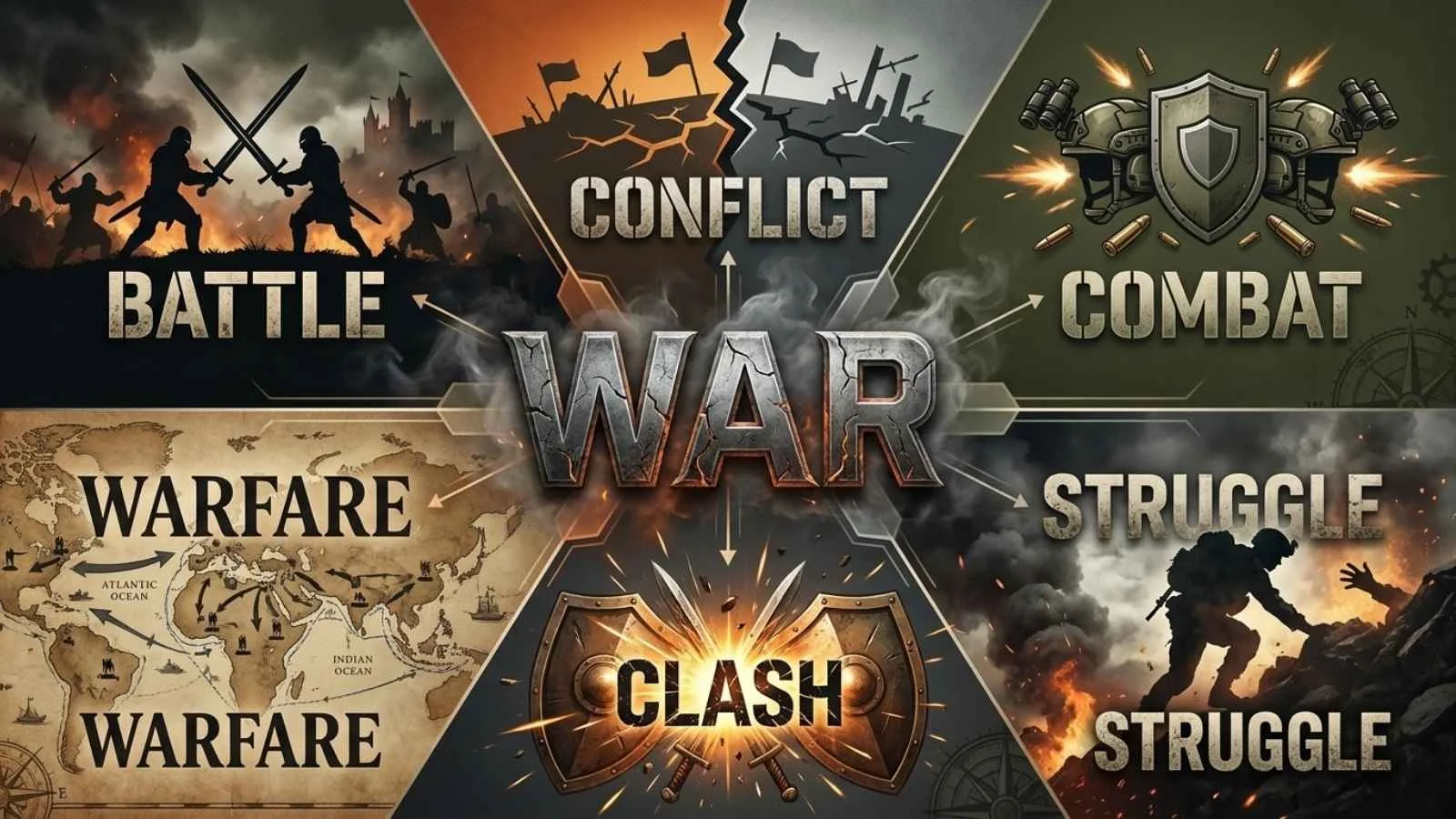
That is where synonyms for war come in.
War means a big and serious fight between two or more groups, countries, or armies. It usually lasts a long time and causes a lot of damage, loss, and pain. War can happen between countries, inside one country, or even between groups of people with different beliefs.
Knowing many synonyms for war is very helpful for students writing history essays. It helps bloggers and content writers add variety to their posts. It helps daily English users express ideas about conflict in a clearer and more interesting way.
Let us look at 50 useful synonyms for war with simple meanings and easy examples.
1. Conflict
Meaning:
Conflict means a serious fight or disagreement between two or more groups that causes a lot of harm.
Examples:
- The conflict between the two nations lasted for over a decade before peace was reached.
- Historians studied the conflict carefully to understand what caused it to start.
2. Battle
Meaning:
A battle is a single organized fight between two armies or groups during a larger war.
Examples:
- The soldiers trained for months before they were ready to fight in the first battle.
- The battle lasted three days and left both sides with heavy losses.
3. Combat
Meaning:
Combat means fighting directly against an enemy, usually in a physical and dangerous way.
Examples:
- The young soldier was sent into combat for the first time after just six months of training.
- Many veterans find it hard to talk about the things they saw during combat.
4. Warfare
Meaning:
Warfare means the methods and activities that are used when fighting a war.
Examples:
- Modern warfare uses technology and computers in ways that older soldiers never imagined.
- The book described the brutal warfare of the ancient world in very clear detail.
5. Struggle
Meaning:
A struggle is a long and hard fight to win something or to survive against a strong force.
Examples:
- The struggle for independence went on for many years before the country was finally free.
- It was a difficult struggle but the small army refused to give up.
6. Clash
Meaning:
A clash is a sudden and violent meeting between two groups that disagree or fight each other.
Examples:
- A clash broke out between the two rival groups in the center of the city.
- The clash at the border left both sides shaken and looking for answers.
7. Hostilities
Meaning:
Hostilities means acts of fighting and aggression that happen between two enemies during a war.
Examples:
- The peace agreement called for both sides to stop all hostilities immediately.
- Hostilities broke out again after weeks of calm and shattered hopes for peace.
8. Invasion
Meaning:
An invasion is when one country or army enters another place by force to take control of it.
Examples:
- The invasion began at dawn when thousands of soldiers crossed the border.
- The citizens were terrified when news of the invasion reached their small village.
9. Skirmish
Meaning:
A skirmish is a small and quick fight between two groups that is part of a bigger conflict.
Examples:
- A skirmish broke out near the river but was quickly stopped before it grew larger.
- The skirmish lasted only an hour but made clear that tensions were still very high.
10. Campaign
Meaning:
A campaign is a planned series of battles or military actions done to reach a goal in a war.
Examples:
- The general planned the campaign carefully to avoid unnecessary loss of life.
- The long military campaign finally ended with the capture of the enemy’s capital city.
11. Uprising
Meaning:
An uprising is when a group of people suddenly rise up and fight against those in power over them.
Examples:
- The uprising began after the people had endured years of unfair treatment.
- Soldiers were sent in to stop the uprising before it could spread to other cities.
12. Revolution
Meaning:
A revolution is a big and often violent change where people fight to overthrow their government or rulers.
Examples:
- The revolution changed the entire political structure of the country overnight.
- Many ordinary people joined the revolution because they wanted a better and fairer life.
13. Rebellion
Meaning:
A rebellion is when a group of people refuse to obey their leaders and fight back against them.
Examples:
- The rebellion started in a small town but quickly spread across the whole region.
- The king sent his army to crush the rebellion before it could grow any stronger.
14. Siege
Meaning:
A siege is when an army surrounds a place and cuts off supplies to force the people inside to give up.
Examples:
- The siege lasted six months before the city finally ran out of food and water.
- Families trapped inside the city suffered greatly during the long and brutal siege.
15. Operation
Meaning:
An operation is a planned and organized military action done to achieve a specific goal.
Examples:
- The rescue operation was carried out at night to avoid being seen by the enemy.
- The military operation required months of planning and total secrecy to succeed.
16. Strife
Meaning:
Strife means serious disagreement and fighting between people or groups that causes a lot of trouble.
Examples:
- Years of strife tore the country apart and left millions of people without homes.
- The region finally found peace after decades of bitter strife and suffering.
17. Aggression
Meaning:
Aggression means the act of attacking or threatening another group or country without being provoked.
Examples:
- The other nations condemned the aggression and called for an immediate ceasefire.
- Unprovoked aggression against a smaller nation is never acceptable under international law.
18. Confrontation
Meaning:
A confrontation is a direct and serious face-to-face meeting between two opposing sides that often turns violent.
Examples:
- The confrontation at the checkpoint quickly turned into a full armed fight.
- Both sides tried to avoid a confrontation but tensions made it impossible to stay calm.
19. Feud
Meaning:
A feud is a long and bitter fight between two families, groups, or countries that goes on for a very long time.
Examples:
- The feud between the two villages had lasted for over a hundred years before peace came.
- What started as a small disagreement grew into a feud that hurt both sides deeply.
20. Dispute
Meaning:
A dispute is a serious disagreement between two sides that can sometimes lead to fighting or war.
Examples:
- The border dispute between the two countries nearly turned into an all-out war.
- Years of failed negotiations turned a simple dispute into a major armed conflict.
21. Engagement
Meaning:
An engagement is a planned fight or battle between two military forces during a war.
Examples:
- The naval engagement destroyed several ships on both sides of the conflict.
- The soldiers prepared carefully before entering the most dangerous engagement of the war.
22. Crusade
Meaning:
A crusade is a long and passionate fight for a cause that someone believes in very strongly.
Examples:
- The crusade for control of the holy city lasted for many long and painful years.
- Leaders called it a crusade to convince people it was worth fighting and dying for.
23. Assault
Meaning:
An assault is a sudden and forceful attack on an enemy position or group of people.
Examples:
- The assault on the hilltop fort began before sunrise with a massive wave of soldiers.
- The assault caused great damage but the defenders refused to surrender.
24. Offensive
Meaning:
An offensive is a major and powerful military attack planned to push back or defeat the enemy.
Examples:
- The general launched a massive offensive to recapture the territory that was lost.
- The spring offensive caught the enemy completely off guard and changed the whole war.
25. Bloodshed
Meaning:
Bloodshed means the killing and wounding of people that happens during violent fighting or war.
Examples:
- Both leaders agreed to talk peace to prevent further needless bloodshed.
- Years of bloodshed left the country broken and desperate for lasting peace.
26. Turmoil
Meaning:
Turmoil means a state of great confusion, disorder, and violence that makes life very unsafe.
Examples:
- The country was thrown into turmoil after the sudden collapse of its government.
- Families fled the city to escape the turmoil that had taken over every neighborhood.
27. Violence
Meaning:
Violence means using physical force to hurt, damage, or destroy someone or something.
Examples:
- The violence in the region forced millions of people to leave their homes.
- World leaders gathered to discuss how to stop the ongoing violence once and for all.
28. Carnage
Meaning:
Carnage means the killing of a very large number of people, leaving terrible destruction behind.
Examples:
- The battlefield was a scene of carnage that shocked even the most experienced soldiers.
- Reporters on the ground described the carnage in ways that disturbed the whole world.
29. Devastation
Meaning:
Devastation means terrible and widespread destruction that leaves little or nothing standing.
Examples:
- The devastation left by the war took the country decades to recover from.
- Aerial photos showed the full devastation of the city after weeks of heavy bombing.
30. Occupation
Meaning:
Occupation means when one country moves into and takes control of another country by force.
Examples:
- Life under occupation was very hard for the people who could not leave.
- The occupation lasted for five years before the liberating forces finally arrived.
31. Raid
Meaning:
A raid is a quick and surprise attack on a place to cause damage or capture something.
Examples:
- The midnight raid on the enemy camp destroyed their supplies and weapons.
- The soldiers carried out a daring raid deep inside enemy territory and returned safely.
32. Resistance
Meaning:
Resistance means fighting back against an enemy or an occupying force that is trying to control you.
Examples:
- The resistance fighters refused to give up even after years of being hunted.
- Their quiet but powerful resistance inspired people all over the world to stand up.
33. Crisis
Meaning:
A crisis is a very dangerous and urgent situation that requires immediate action to prevent disaster.
Examples:
- The international crisis brought the world closer to war than it had been in years.
- Leaders rushed to find a solution as the crisis threatened to drag more nations in.
34. Tension
Meaning:
Tension means a feeling of fear and unease between two groups that might explode into fighting.
Examples:
- Rising tension along the border made both governments call their armies to alert.
- Years of tension between the two sides finally boiled over into open warfare.
35. Standoff
Meaning:
A standoff is a situation where two sides face each other with weapons and neither one backs down.
Examples:
- The armed standoff lasted for hours before negotiators managed to calm both sides.
- A tense standoff on the border kept the whole world watching and waiting nervously.
36. Bombardment
Meaning:
Bombardment means a heavy and continuous attack using bombs, missiles, or cannon fire.
Examples:
- The bombardment of the city lasted for three days without stopping.
- Residents had no choice but to hide underground during the relentless bombardment.
37. Insurrection
Meaning:
An insurrection is a violent attempt by a group of people to take power from their government.
Examples:
- The insurrection was quickly put down but left deep scars on the whole nation.
- Dozens of people were arrested for their role in planning the insurrection.
38. Mutiny
Meaning:
A mutiny is when soldiers or sailors refuse to obey their commanders and rise up against them.
Examples:
- The crew staged a mutiny after weeks of no food and no clear orders from the captain.
- The mutiny shocked the army and led to major changes in how soldiers were treated.
39. Antagonism
Meaning:
Antagonism means strong and open hostility between two groups who are against each other.
Examples:
- The deep antagonism between the two armies made any peace deal nearly impossible.
- Decades of antagonism finally gave way to a surprising and historic peace agreement.
40. Conquest
Meaning:
Conquest means taking over a place or people by force after defeating them in battle.
Examples:
- The conquest of the island took two years of hard fighting on land and at sea.
- History is full of stories of conquest and the suffering it caused to defeated peoples.
41. Attrition
Meaning:
Attrition means a long and exhausting kind of war where both sides slowly wear each other down.
Examples:
- The war of attrition dragged on for years with neither side gaining much ground.
- Soldiers on both sides were exhausted by the relentless war of attrition.
42. Overthrow
Meaning:
An overthrow means removing a leader or government by force, often through violence and fighting.
Examples:
- The overthrow of the dictator was celebrated in the streets by thousands of citizens.
- The attempted overthrow of the government was stopped before it could fully begin.
43. Counterattack
Meaning:
A counterattack is when a group fights back against an enemy who has just attacked them first.
Examples:
- The general ordered a swift counterattack to retake the positions lost that morning.
- The powerful counterattack pushed the enemy forces back across the river.
44. Guerrilla warfare
Meaning:
Guerrilla warfare means fighting using surprise attacks and hiding, rather than big open battles.
Examples:
- The rebels used guerrilla warfare to fight an army ten times their size.
- Guerrilla warfare made the conflict difficult to end because the fighters blended in everywhere.
45. Onslaught
Meaning:
An onslaught is a very powerful and overwhelming attack that hits hard and fast.
Examples:
- The onslaught of enemy forces overwhelmed the small garrison defending the town.
- Nothing could have fully prepared the defenders for the terrifying onslaught that came.
46. Annihilation
Meaning:
Annihilation means the complete and total destruction of an enemy or a place during a war.
Examples:
- The general vowed annihilation of the enemy’s forces before the year was out.
- The small battalion fought bravely to avoid total annihilation by the much larger army.
47. Incursion
Meaning:
An incursion is a sudden and brief invasion into enemy territory to cause damage or gather information.
Examples:
- The brief military incursion was over in hours but caused serious international tension.
- The incursion into the neighboring territory was seen as a direct act of aggression.
48. Subjugation
Meaning:
Subjugation means forcing a group of people to completely submit and live under someone else’s control.
Examples:
- Centuries of subjugation had not broken the spirit of the people or their culture.
- The subjugation of the region was brutal and left a wound that lasted for generations.
49. Havoc
Meaning:
Havoc means widespread destruction and chaos caused by fighting, bombing, or violent conflict.
Examples:
- The bombing campaign wreaked havoc on the city’s roads, bridges, and power supply.
- War wreaks havoc not just on buildings but on the lives of ordinary people everywhere.
50. Catastrophe
Meaning:
Catastrophe means a sudden and terrible event that causes massive suffering and destruction.
Examples:
- The war was a catastrophe that erased decades of hard-won progress in the region.
- International aid poured in after the catastrophe left millions without food or shelter.
Final Thoughts
Learning synonyms for war makes your writing stronger, richer, and more precise. Instead of repeating the same word over and over, you can pick the exact word that fits what you are trying to say. Students can use these words in history and social studies essays. Bloggers can use them to write more powerful and engaging content. Daily English users can use them to discuss world events with greater clarity.
Pick five words from this list and practice using them today. Write one in a sentence. Try one in your next school essay. Use one when talking about the news. The more you use these words, the more naturally they will come to you.
Good writing starts with the right words. Choose them with care.

I am Joseph Clark, a vocabulary and language content writer at SynonymLibrary.com. I create clear, practical synonym guides that help readers improve their writing, word choice, and communication skills. My goal is to make language learning simple, accurate, and useful for students, writers, professionals, and everyday learners.